Eten Besieged638 CE
In 638, followers of Domnall Brec of Dál Riata were defeated at the uncertain site of Glenn Muiresan, followed by a siege of Eten, probably Edinburgh. The episode reflected political instability after the 637 battle of Mag Roth and Ireland’s connections with western Scotland. Domnall mac Áedo remained a powerful but not undisputed king of Tara. Annals also record deaths of abbots including Crónán of Clonmacnoise and Mochua of Balla, highlighting churches’ growing economic and political importance. Ireland remained a rural, cattle-centred society sustained by farming, labour, waterways and ecclesiastical networks.
Dateline
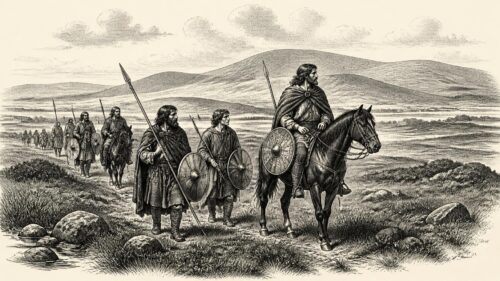
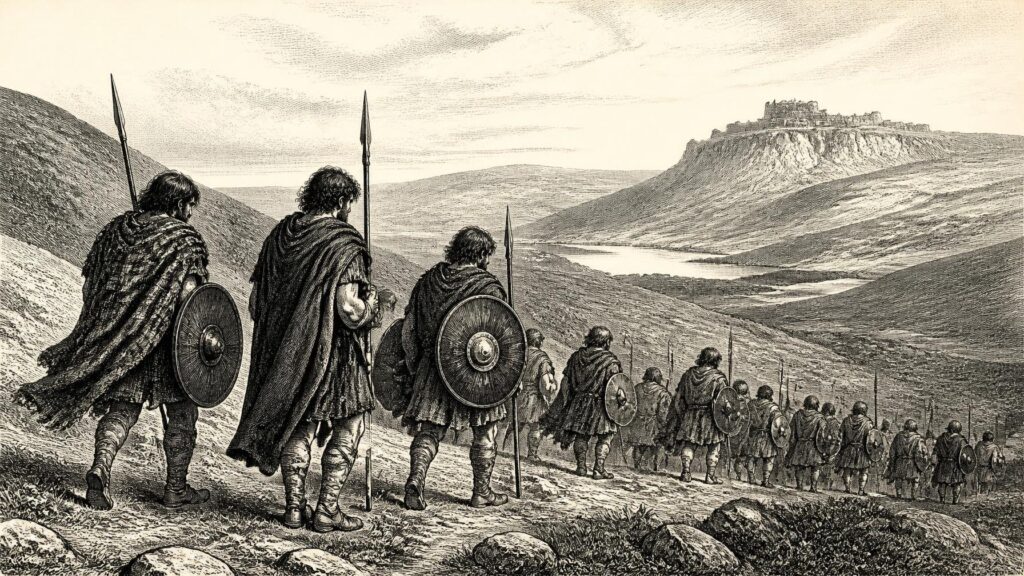
In 638 CE, the clearest event linked to Irish history was not fought on the island of Ireland itself, but in the Irish Sea world to which north-east Ireland belonged. Chronicon Scotorum records a battle at Glenn Muiresan in which the followers of Domnall Brec were put to flight, followed by the besieging of Eten. Domnall Brec was king of the Cenél nGabráin, the leading kindred of Dál Riata: a Gaelic sea-kingdom whose territories and connections extended between Argyll and the coast of Antrim. The annal therefore preserves a hard, if brief, sign that the political shocks of the late 630s reached across the narrow seas. Yet its brevity is itself a warning. It does not identify Glenn Muiresan securely, name the victors, state who conducted the siege, or tell its outcome. Ireland’s history in this year must be told with that uncertainty in view.
A Battle Beyond the Channel
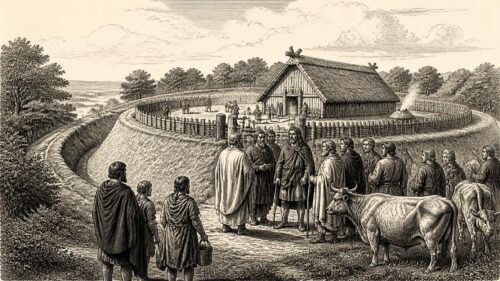
The place called Eten is generally understood to be Din Eidyn, the Brittonic stronghold at modern Edinburgh. That identification makes the 638 notice part of the contest for power in southern Scotland and northern Britain, where Britons, Northumbrian Angles, Picts and Gaelic rulers all had interests. Glenn Muiresan is much less certain: attempts to place it precisely have not won general agreement. The sensible conclusion is narrower than many reconstructions. A force associated with Domnall Brec suffered a reverse somewhere in northern Britain, and a siege involving Eten occurred in the same campaign or sequence of events.
Domnall Brec’s connection with Ireland was substantial rather than incidental. Dál Riata was divided by water, not defined by it. Its rulers drew authority from a Gaelic political sphere embracing the north-east of Ireland and western Scotland; ships, warriors, ecclesiastics and aristocratic families could move through that world more readily than armies could cross many inland frontiers. An event involving Domnall Brec in Lothian was therefore relevant to Ulster and to the wider balance of Irish dynastic politics, even though no Irish battlefield is named for 638.
The entry also follows closely after the battle of Mag Roth, conventionally dated to 637, at which Domnall mac Áedo of the Cenél Conaill and the sons of Áed Sláine defeated Congal Cáech of Ulaid and his allies. A separate battle at Sailtír, recorded on the same day, was won by Conall Cáel against Cenél nÉogain forces. The annalistic record connects Domnall Brec with the defeated side in this wider crisis. It would be too strong to say that the setback at Glenn Muiresan was simply a direct consequence of Mag Roth: the sources do not demonstrate that. But 638 plainly found Domnall Brec operating after an alliance system in the north had been gravely damaged.
After Mag Roth
For Ireland, the political setting was one of hard-won but incomplete dominance. Domnall mac Áedo, king of Tara, remained the foremost Uí Néill ruler after Mag Roth. His authority rested not on a modern state or a permanent bureaucracy, but on personal kingship, military following, kinship, hostage-taking, tribute and negotiated relationships with subordinate or rival rulers. The victory of 637 had removed Congal Cáech, but it did not make Ireland a unified kingdom. Provincial kings and regional dynasties retained their own resources, ambitions and sacred affiliations.
The year 638 should consequently not be imagined as a period of island-wide peace administered from Tara. It was a moment in which the victory of one coalition narrowed the options available to its rivals. In Ulaid, the death of Congal had left a serious political vacancy. Across the North Channel, Domnall Brec’s defeat at Glenn Muiresan exposed the vulnerability of a ruler whose position depended on maritime reach as well as local support. Domnall mac Áedo’s own kingship was strong, but it was strongest where allies accepted it or where his military force could be brought to bear. The annals’ concentration on battles and royal deaths reflects this political reality.
A notice traditionally associated with 638 also records the death of Dúinsech, wife of Domnall mac Áedo. Her background is unknown, and the sources do not permit a larger story about her marriage or influence. Still, the bare record matters. Dynastic households were political institutions: marriages could bind kindreds, children secured succession, and royal women could hold estates, retainers and religious connections. Her death is a reminder that the personnel of kingship included more than the men who commanded armies.
Churches in a Maritime Landscape
Two further notices attached to 638 in Chronicon Scotorum are the deaths of Crónán moccu Laegde, abbot of Clonmacnoise, and Do-Chua or Mochua of Balla. Their precise chronology must be handled carefully. Parallel Irish annals can place the same deaths under differently numbered years, because their chronological systems and later copying traditions do not always align. Nevertheless, the notices belong securely to this immediate late-630s horizon, and they show what an annal regarded as worth preserving beside battle: the passing of heads of important ecclesiastical communities.
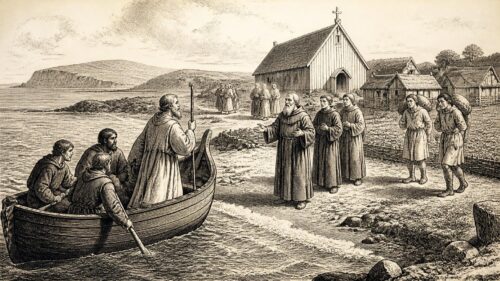
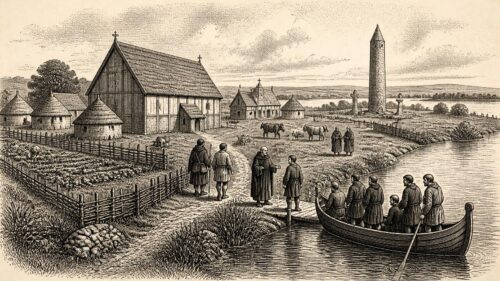
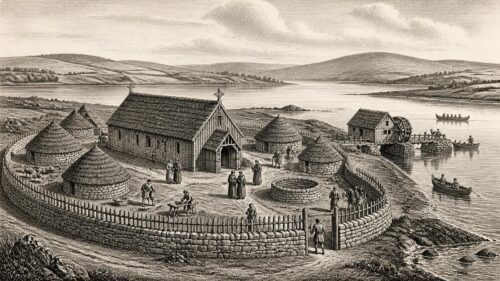
Clonmacnoise, on the Shannon, occupied an exceptionally useful position in the midlands. It was a religious community, a centre of learning and commemoration, and a place connected to travel along Ireland’s great river system. Balla, in what is now County Mayo, represented another kind of ecclesiastical influence: a western foundation embedded in local kinship and landscape. Their leaders were not merely private holy men. An abbot could supervise land, food renders, dependants, guests and clerics; he could also speak for a church whose saintly patronage carried social and political weight.
The same caution applies to famous notices for Crídán of Noendrum, Áed Dub of Kildare and Do-Láise of Leighlin. The Annals of Ulster preserves them under a heading calibrated as AD 638, while modern chronological work and biographical reference works commonly place Áed Dub’s death in 639. They should not be presented as firmly dated deaths in 638. They do, however, illuminate the institutional world active during this year. Noendrum, on Mahee Island in Strangford Lough, was a monastic site tied to seaborne routes in the very region affected by northern politics. Leighlin lay on an important Leinster route corridor. Kildare, meanwhile, was among the island’s most ambitious churches.
Kildare’s Royal Bishop
Áed Dub is especially revealing. A member of the Uí Dúnlainge ruling dynasty of north Leinster, he was both abbot and bishop of Kildare and was remembered as a royal bishop associated with all Leinster. Whether or not his death belongs to 638 rather than 639, he was a major figure in the Kildare of this moment. His career demonstrates that ecclesiastical and dynastic power were not separate spheres. Elite families supplied church leaders; churches, in turn, offered their patrons prestige, literate expertise, sanctuary, prayers and claims to authority over people and land.
Within a generation, Cogitosus’s Life of St Brigit would present Kildare in highly ambitious language: a great community of monks, priests and nuns, a sanctuary for fugitives, a destination for pilgrims, and a church claiming an island-wide reach. This is not a documentary description written in 638, and its rhetorical claims cannot simply be treated as a census. Even so, it is valuable evidence for the direction of Kildare’s institutional self-image in the decades surrounding Áed Dub’s career. The literary culture that made such claims possible was already being sustained by communities with trained Latin readers, scribes and clerics.
Work, Food and Settlement
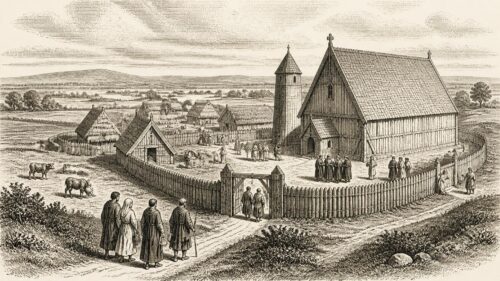
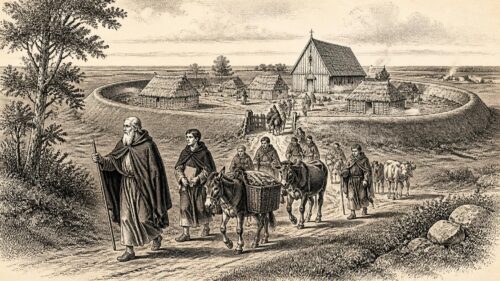
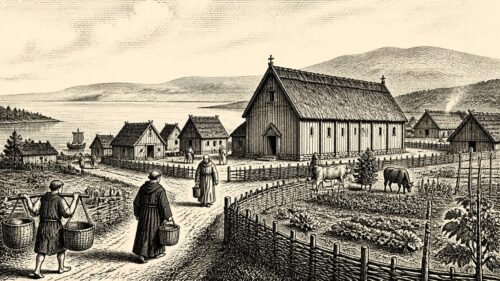
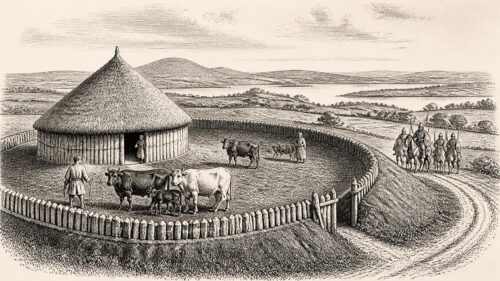
There is no securely dated Irish famine, epidemic, major fire or weather event assigned to 638 in the principal annalistic record. It would therefore be irresponsible to invent a dramatic environmental crisis for the year. Everyday life continued in an overwhelmingly rural landscape of dispersed farmsteads, enclosed settlements, fields, pasture, woods, wetlands and waterways. Archaeology and early Irish legal material indicate a mixed economy in which cattle were central to wealth and status, alongside sheep, pigs and cultivation of cereals. Dairy processing, grain grinding, spinning, weaving, woodworking, herding and seasonal repair work shaped most lives far more consistently than royal warfare did.
Monasteries were woven into this economy rather than set apart from it. Their communities required food, fuel, labour, buildings, livestock and transport. They received gifts and renders, cultivated or controlled land, fed guests and maintained churches and workshops. River crossings, coastal waters and overland tracks mattered because they carried people, animals, news and goods between royal residences, farms and ecclesiastical sites. The conflict associated with Domnall Brec thus belonged to a wider connected world, but that world was sustained day by day by farming households and local labour.
What the Year Can Bear
638 CE is not a year for a fabricated Irish set-piece. Its strongest evidence is a terse record of fighting and siege beyond the Channel involving the following of a Dál Riata king, against the immediate backdrop of the upheaval at Mag Roth. Around that event stand the deaths of church leaders recorded in one annalistic tradition, the continuing rule of Domnall mac Áedo at Tara, and the growing weight of institutions such as Clonmacnoise, Balla, Noendrum, Leighlin and Kildare. Together they show an Ireland whose politics extended across the sea, whose rulers still depended on shifting personal alliances, and whose churches were becoming durable centres of authority, memory and learning.

Primary Sources
- Chronicon Scotorum, Part 58: Annals CS634–CS638
- The Annals of Ulster, Part 209: Year U639
- The Annals of Ulster
- The Annals of Tigernach
- Annals of the Four Masters, Part 47: Annals M636–M645
- Chronological Synchronisation of the Irish Annals, AD 488–722
- Domnall
- Áed Dub
- Cogitosus
- Domnall mac Áeda: (d. 642), high-king of Ireland
- Ministry, Mission and Myth: The Legacy of the Early Church in Scotland
- Nendrum Ecclesiastical Site
- County Carlow Urban Archaeology Survey 1990
- Agriculture, Settlement and Society in Early Medieval Ireland
- Early Medieval Archaeology Project: Chapter 7, Early Medieval Agriculture and Economy
- The Archaeology of Livestock and Cereal Production in Early Medieval Ireland, AD 400–1100
- Early Medieval Dwellings and Settlements in Ireland, AD 400–1100, Volume 1
- Early Medieval Ireland, AD 400–1100: The Evidence from Archaeological Excavations
- Early Medieval Ireland: Investigating Social, Economic and Settlement Change, AD 400–1100
- Forts and Fields: A Study of ‘Monastic Towns’ in Seventh and Eighth-Century Ireland
- Reassessing the Irish ‘Monastic Town’
- Romanitas and Realpolitik in Cogitosus’ Description of the Church of St Brigit, Kildare
- Two Lives of Saint Brigid
- Exploring the Irish Annals