Irish Chronicle626 CE
The surviving annals preserve a small but usable dossier for Ireland in 626 CE. Their securely dated notices record battles, deaths, and a religious vision, while related entries in other annal traditions help confirm the placement of several items. The evidence is uneven: some notices are explicitly tied to AD 626, others are cross-referenced from neighboring years or later compilations. This account keeps the year distinct from wider context, avoids filling gaps with conjecture, and compares only what the texts themselves state about that year.
Dateline
Yearly Frame
The clearest evidence for 626 CE comes from the annal entries that explicitly mark the year in their own sequence. The Annals of Ulster place several notices under AD 626, including a battle at Ard Corann, a battle at Carn Feradaig in Cliu, and a vision seen by Fursa. The same textual frame also identifies the death of Fiachna son of Demán within that year, so the surviving record is not empty, only brief and selective. [3]
The year is also legible through adjacent annal traditions, though not every entry stands in the same place in every compilation. The Annals of Tigernach and the Annals of Inisfallen both attach later cross-references to notices that belong in the same chronological cluster, and the Four Masters provide an independent regnal frame for the same period. Taken together, these witnesses show a compact annual dossier rather than a single isolated notice. [1] [4] [5]
Ard Corann
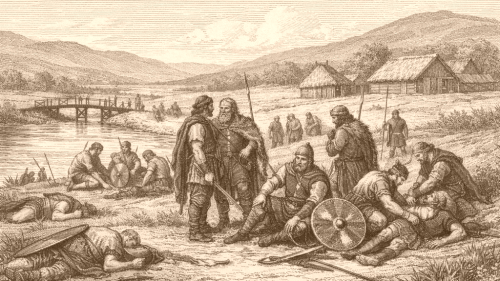
Under AD 626, the Annals of Ulster report the battle of Ard Corann, where Fiachna son of Demán fell and the Dál Riata were victors. The same event appears in the Annals of Tigernach in a parallel entry, which likewise records Fiachna son of Demán as the fallen man and names the victors. This is one of the firmest securely dated notices for the year because two annalistic witnesses align on the event and its general outcome. [3] [2]
The wording differs slightly between the traditions, but the observable overlap is clear. Ulster places the battle in AD 626 and names the slain man; Tigernach records the same combat under its own year sequence with matching names and result. No extra detail about cause, troop movements, or wider strategy appears in these excerpts, so the safest conclusion is simply that a battle was entered for this year and attached to the same casualty in both texts. [3] [2]
Carn Feradaig
A second securely dated notice for 626 CE is the battle of Carn Feradaig in Cliu. The Annals of Ulster say that Failbe the Red of Feimen was victor, Guaire of Aidne fled, Conall son of Maeldub fled, and the king of Uí Maine fell. The Four Masters preserve a closely similar record, though they date it differently in their own sequence, showing that the event was widely remembered even where the year labels do not coincide exactly. [3] [4]
This notice is notable for its concentration on named participants and outcomes. The Annals of Ulster list flight and death in a single battle entry, while the Four Masters likewise name Failbe Flann as victor and Guaire Aidhne as routed, with additional deaths among the Connachta. What cannot be extracted from these passages is any fuller narrative of the engagement; the annals preserve result, not explanation, and the year’s evidence should be kept at that level. [3] [4]
Religious Notes
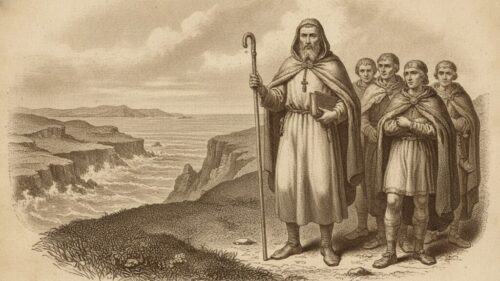
The year also contains a religious notice rather than a military one. Under AD 626, the Annals of Ulster record the vision seen by Fursa. The entry is brief and does not elaborate on content, setting, or consequences. Its importance here lies in its placement within the year’s sequence, demonstrating that the annalists did not limit 626 to battles and deaths alone. [3]
Because the entry is so compact, the safest reading is restrained. It confirms that a vision associated with Fursa belongs in the year’s notice-list, but it does not by itself supply a chronology of revelation or later reception. The neighboring annal context elsewhere in the same tradition also records ecclesiastical deaths and foundations, yet those wider notices belong to surrounding years, not to the year under review unless explicitly dated there. [3] [1] [4]
Deaths Recorded
The death of Fiachna son of Demán is the most prominent personal death attached to 626 in the Annals of Ulster, because it is tied directly to the battle of Ard Corann. Tigernach’s parallel notice likewise includes his death in connection with that battle. The Four Masters preserve other nearby deaths in related years, but the year 626 itself is not a place for adding unmarked casualties from surrounding entries. [3] [2] [4]
In the same annalistic neighborhood, other deaths are listed under adjacent years: Rónán son of Tuathal, Mongán son of Fiachna, and Maedóc of Ferns appear in the sequence around 625, while later notices move into 627 and beyond. That pattern matters because it shows how tightly the year 626 record is bounded in the surviving texts. The evidence for 626 is not broad, but it is precise where it exists. [3]
Cross Texts
The strongest comparison for 626 comes from the way different annals align, even when their internal year numbers differ. The Annals of Ulster identify 626 as the year of Ard Corann, Carn Feradaig, and Fursa’s vision. Tigernach places the same Ard Corann notice in its own sequence, and Inisfallen later links a Carn Feradaig entry to AU 627. These references show overlap in content while also revealing that annalistic dating is not always identical across books. [3] [2] [5]
The result is a cautious but coherent picture. The year’s record is built from a small set of repeated notices, especially battles and one religious vision, and the repeated names help confirm that these are not arbitrary entries. At the same time, the sources do not allow more than a modest reconstruction. They record occurrence, not a connected narrative of politics or society, and that restraint is part of the historical evidence itself. [3] [2] [5]
Regional Setting
The names attached to 626 point to several regions without allowing a full map of the year. Ard Corann, Carn Feradaig in Cliu, and the identities of the slain and victorious figures suggest that the record spans more than one locality and more than one dynastic grouping. Yet the annals only present these places through battle notices, so the year’s geographic evidence remains fragmentary and strictly event-based. [3] [2] [4]
The same limitation applies to people. Fiachna son of Demán, Failbe of Feimen, Guaire of Aidne, Conall son of Maeldub, and the king of Uí Maine appear as named actors, but the annals do not explain their relationships in these passages. What survives for 626 is therefore a list of names linked to outcomes. That is enough for secure chronology and comparison, but not enough for fuller reconstruction without stepping beyond the texts. [3] [2] [4]
Historical Bound
For 626 CE, the evidence supports a narrow but solid account: two battles and a vision are securely dated in the Annals of Ulster, one of the battles is paralleled in Tigernach, and Inisfallen preserves a related cross-reference that helps situate the Carn Feradaig notice within the wider annalistic tradition. The surviving record is therefore real, but limited, and it must not be expanded into an invented annual narrative. [3] [2] [5]
That restraint is the proper ending point. The annals let the year be seen through repeated notices of conflict, a death, and a vision, but they do not invite broader claims that the passages themselves do not state. For Ireland in 626 CE, the evidence is best read as a carefully bounded set of yearly entries, not as a complete chronicle of all that happened across the island. [3] [2] [5]
Source References
Hover over a number to see the source. Select it to open the source.