Máedóc of Ferns
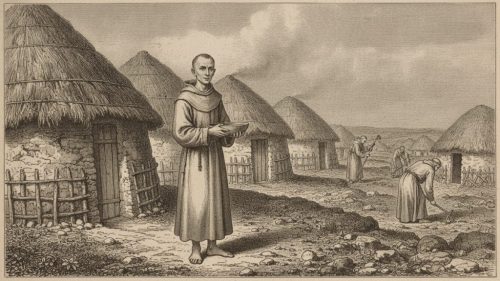
Saint Máedóc of Ferns is known through the Life of Maedoc of Ferns, a text that preserves a sequence of stories about his birth, early miracles, and foundation at Ferns. The surviving account presents him as a figure of Connaught by origin and of Ferns by association, with a life marked from the beginning by signs of divine favour. What remains is a traditional saint’s narrative, set out in episodes that explain how his holiness was understood in the sources. The life says that a rich nobleman in Connaught named Sétna, son of Erc, had a wife named Eithne of the race of Amalgaid son of Fiachra, son of Eochaid Muigmedon.
Dateline
Saint Máedóc of Ferns is known through the Life of Maedoc of Ferns, a text that preserves a sequence of stories about his birth, early miracles, and foundation at Ferns. The surviving account presents him as a figure of Connaught by origin and of Ferns by association, with a life marked from the beginning by signs of divine favour. What remains is a traditional saint’s narrative, set out in episodes that explain how his holiness was understood in the sources.
Birth Signs
The life says that a rich nobleman in Connaught named Sétna, son of Erc, had a wife named Eithne of the race of Amalgaid son of Fiachra, son of Eochaid Muigmedon. They had no heir, neither son nor daughter, and they entreated God earnestly and devoutly that they might have a son worthy to take their place after them. In this behalf they gave frequent alms with fastings and abstinences, and the saints and righteous men joined in their prayers that they might obtain their request from the one God. The account places the beginning of Máedóc’s story in this setting of prayer and expectation.
After this, Eithne saw a vision as it were a star falling down from heaven into her mouth, and Sétna himself saw the same vision, a star falling from heaven into his wife’s mouth. When they told the vision to men of prudence and penetration, those men explained that a star had guided the kings to Christ in Bethlehem, and that by the same sign a noble and worshipful son would be born of them, filled with the grace and favour of the Holy Spirit. In the same night, the holy and mighty one was conceived in his mother’s womb, and the text says that he was called son of the star for that reason.
When Eithne was pregnant and travelling in her chariot, a cunning druid met her on the road. He heard the thunder and noise of the chariot and said it was like a king’s chariot or one under the favour of the Holy Spirit. When he looked, he saw that there was no one in it but Eithne. Then he declared that she would bear a beautiful and mighty son full of the grace and exceeding favour of the Holy Spirit. The narrative then says that the boy was born in Inis Brechmaighe in Magh Slecht, to speak precisely. It also says that in the place where he was born there was for a long time no want of light by day or night.
Early Wonders
The life records several wonders from Máedóc’s early years. The first miracle after his birth was that the stone on which he was carried to his baptism became a means by which folk would be ferried backwards and forwards as in any ferry-boat. Another miracle concerns the webstress’s slay that Eithne held at the child’s birth. Made of hard dry hazel-wood, it later produced leaves and goodly flowers. The text says that this hazel still stands as a fresh unaging tree in Inis Brechmaighe in token of the miracle. It also reports the learned men of the district saying that earth from this hazel, if placed between prisoners and their chains with nine Masses said over it, would cause them to escape at once.
The same early section includes a poem made to commemorate these marvels. In that poem the stone on which Aedóc was baptized is described as moving like a ferry-boat, Magh Slecht is said to have been all in one blaze of light by day and night, and the hazel staff is said to have become covered with fair fresh leaves. The poem repeats the account of the tree’s continuing freshness and of the virtue attributed to its earth. These are the miracles preserved in the text as part of Máedóc’s memory.
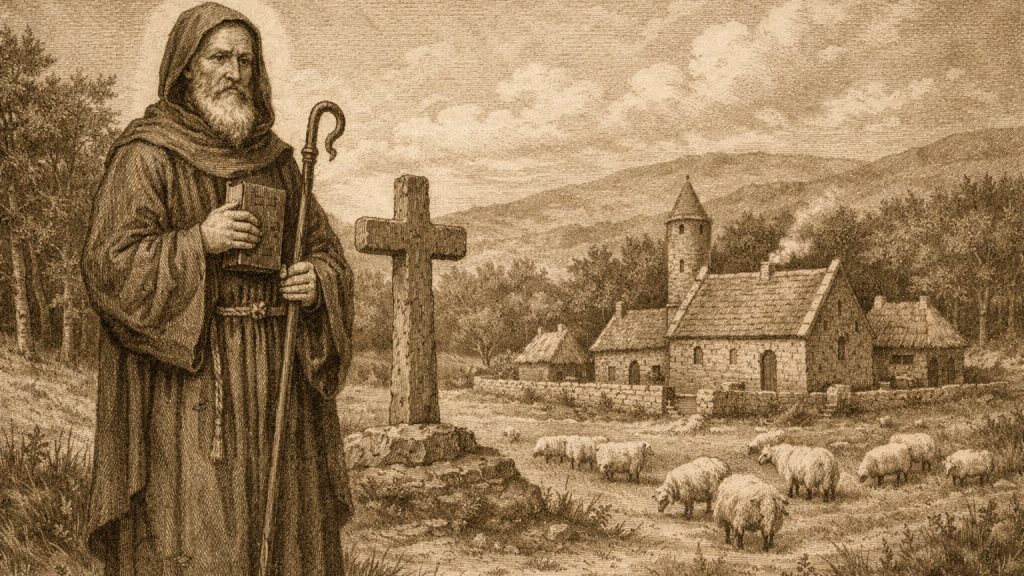
Other episodes continue the same pattern. The shepherds of the king’s fort saw eight wolves coming towards the flock of Máedóc, and the wolves did obeisance before him. He then granted a sheep to each wolf, and they carried them off. When the shepherds complained, the story moved on to another sign: eight sheep in colour and fashion like the others were sent, and joined the flock, so that it was not known whence they came. In another scene, Máedóc was praying in the recesses of a wood when he saw a stag pursued by hounds. The stag stopped by him, and he threw the corner of his plaid over its horns so that the hounds could not find trace or sight of it. The stag then returned safely to the wood.
Ferns Foundation
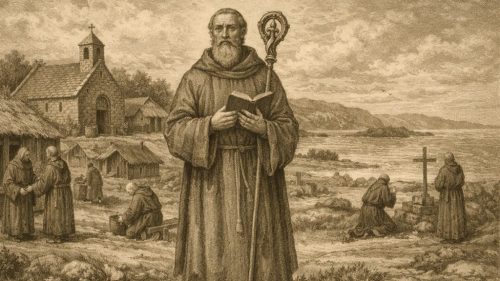
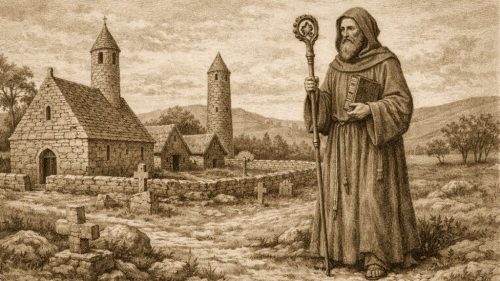
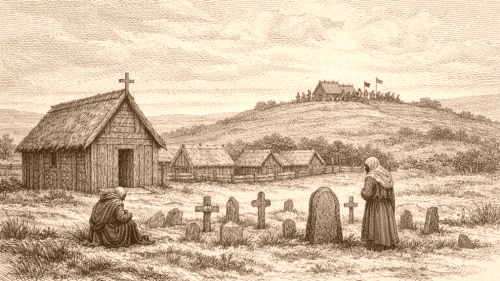
The life also links Máedóc to Ferns through a foundation narrative. One day he and another disciple named Lasrianus were praying at the foot of two trees, and they loved each other very dearly. They asked whether it was God’s will that they should part or remain together to the end. Then one of the trees fell to the south and the other to the north. By the fall of the trees they understood that they must part. Máedóc then fared south and built a noble monastery at Ferns, while Lasrianus fared north and built a monastery in Devenish.
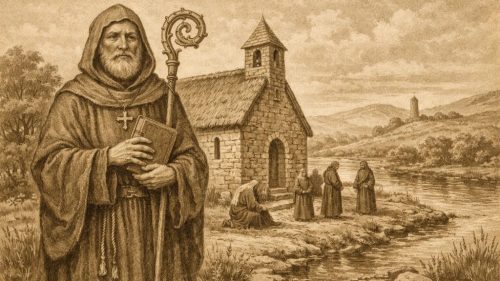
Another episode places Máedóc on Slieve Beagh when night overtook him. He prayed God to direct him on the right road, and then saw two angels who took him on their hands and carried him to the royal fort. He erected a noble cross on the spot to make known the miracle. The text then continues with a scene by Lough Erne, where a woman came to meet him wringing her hands bitterly because her son and two other children had been drowned there. The episode is preserved in the same narrative sequence as part of the saint’s remembered life.
What the evidence shows is clear enough. Máedóc is presented as a saint born in Connaught, marked by visions and light from the beginning, associated with wonders involving stone, tree, wolves, stag, angels, and cross, and remembered as the founder of a monastery at Ferns. The surviving life does not offer a modern biography in the usual sense; instead, it preserves the traditional sequence of signs by which his sanctity was understood.
Source References
Hover over a number to see the source. Select it to open the source.