Editorial — How Public Life Takes Shape
In today’s issue we follow the ways people organised, exercised authority and kept a record of what happened. The early annals take us from Tailtiu and Ard Corann to notices of church leaders and even an earthquake in Pontus. The writers do not always agree on where an event belongs, and their differences show how the record reached us. We then turn to the campaign for Catholic emancipation and to the lives of O’Donovan Rossa, Michael Davitt and others whose work brought them into public life. Their stories give the question of how communities organise a more familiar human setting.
The path leads through Belfast’s local government, Justin McCarthy’s work in the press and John Redmond’s efforts to reunite his party. The lives of Michael Collins and Kevin O’Higgins take us into the revolutionary years and the early Free State. Cearbhall Ó Dálaigh and Mary McAleese offer two routes to the presidency, while Simon Harris’s early advocacy brings the issue back to the work of a local group. What links these stories is the way people build, inherit and change institutions. Follow the links within the editorial to read the individual articles and see where their accounts agree or differ.
Dateline
How Public Life Takes Shape
Welcome to the Emerald Archives Gazette. Today we follow the ways Irish history moves from one set of hands to another. The annals keep battles, church notices and changes of ruler in brief entries that later writers arranged differently. Our recent articles take us into campaigns, newspapers, parliament and public office, where people tried to change the institutions they inherited. The connecting thread is the work of making public life possible and remembering what happened within it. We begin with the early records, where a name or a place sometimes has to carry nearly everything we know about an event.
At Tailtiu, the Annals of Ulster leave open the possibility that a battle belonged in an entry that also records an eclipse, a death and the storming of Dún Lethglaise. The words “Or here” are easy to pass over. They tell us that the person arranging the record had to make a choice about where the battle fitted. The Annals of Tigernach likewise remember a solar disturbance and the storming of Downpatrick, while the Four Masters preserve a different group of notices. The article lets us see how the same period was assembled into slightly different stories by different hands.
The eclipse is an interesting companion to the uncertain battle. A darkening of the sun would have been striking to people who experienced it, while a writer had only the words that survived. A battle could be remembered through a place name or a familiar leader, but those details did not always settle where a notice belonged in the chronology. Reading the entries together teaches us to pay attention to different sorts of evidence. The eclipse, the storming and the death notice each have their own place in the record, even where their appearance together does not explain their relationship.
The Seghais article gives us another group of notices that refuses to settle around a single event. The Annals of Ulster remember a victory at Inne Mór and an earthquake in Pontus, while the Annals of Tigernach record fighting at Sleamain. The Four Masters give a battle notice using a different form of the name Inne Mór. It is worth taking these entries slowly rather than expecting them to read like columns in a newspaper. Each book has made its own selection, and those selections are part of the history we are trying to understand when we compare them today.
A report of an earthquake far away can be startling in a book we open to read about Ireland. Its presence reminds us that keeping a chronicle meant doing more than watching events. Information from another region could be considered relevant enough to be copied beside a dispute over power at home. We cannot assume that everyone living here knew about the earthquake, or knew it in the form in which it reached the annals. What we can see is the reach of the record. An Irish chronicle had room for both nearby fighting and an event across the world.
In the related Inne Mór entry, Muirchertach Mac Erca is named as victor. The Ulster chronicle keeps that notice beside a storming, an earthquake and a memorial for Mac Cuilinn of Lusk. The article also draws attention to differences in the date headings available for comparison. For someone reading the story outside a scholarly edition, it is enough to recognise that records can have several layers. There is what the entry says, where a writer placed it and how later editions mark the year. The differences become less bewildering once those are treated as separate questions rather than one question.
The notices grouped with Mo Chóe of Naendruim give another reason to read the entries through more than one tradition. A place remembered for church life and a place remembered for fighting can belong to the same stretch of a chronicle without belonging to the same story. That can be frustrating if the aim is to make a continuous account from one year to the next. It is one of the pleasures of the material. A name can lead from a local church to the wider record and prompt us to look at the kinds of events remembered alongside it.
The other Inne Mór article makes the variety of the records even more obvious. Bishop Ibar appears under different dates and with different forms of his name. Nearby are stories concerning a gospel, relics and the battle of Cenn Ailbe. These notices deserve to be considered separately before anyone treats their position on the page as a account of what happened. The references to the gospel and relics are important for what they tell us about what a compiler considered worth recording. They show that the history being preserved was also a history of religious belief, books and sacred objects.
The uncertainty surrounding Ibar’s death is a reminder that careful record keeping does not always lead to agreement. Different dates may survive because people with different information wrote them down and later copyists kept more than one version. The reader does not have to decide among those versions simply to learn from the article. It is useful to ask which details the notices share and which details belong to a particular tradition. An old record can be quite precise about a day and month while leaving us uncertain whether someone else remembered the event under the same date at all.
At Cenn Ailbe, Cairpre son of Niall is described as winning over the Laigin in the Annals of Ulster. Other entries in the collection of articles give us Sleamain in Meath and Druim Lochmaighe, with different wording about who prevailed. The names can be hard to keep straight at first. Reading them as a group, then returning to each notice, gives us a better chance of seeing where the records agree. It also makes the importance of place apparent. These names are often the clearest markers we have for episodes that the annalists recorded in only a line or two.
A single victory notice does not tell us who planned the fighting, how many people were involved or what happened to everyone who lived near the place. Yet it does give us a point from which to read the larger sequence. The same groups and rulers recur, while the name of the battle and the year attached to it may vary. Those patterns help make sense of the early articles without requiring us to fill their gaps. This issue returns to the difference between recognising a pattern and claiming more than the records can support about how it came about.
Druim Loghmag is remembered in the Annals of Tigernach as a victory for the Leinstermen over the Uí Néill. The same part of the chronicle carries a notice about Pope Simacus, while the Four Masters in their corresponding year record fighting at Freamhain. Two readers consulting different books could therefore come away with different descriptions of the same year, and each could be reading attentively. The article puts the notices beside one another so we can see that problem clearly. That is a valuable habit whenever a familiar event finds its way into more than one record about the past.
The contrast between a battle notice and a reference to a pope does something else for this issue. It gives a glimpse of what counted as public history to a compiler whose interests crossed kinds of authority. Matters of religion and matters of local rule could both belong in one chronological record. Later in the Gazette, we will see other sorts of authority meeting in the lives of campaigners, parliamentarians and judges. The settings are far apart, but the variety of subjects in the annals makes a starting point for thinking about what people chose to keep in public memory.
The Segais article records a victory attributed to Muirchertach Mac Erca and the death of Duach, king of Connacht. The Ulster heading is expressed in a way that leaves its year uncertain. That detail matters because modern readers are often sent to the annals by a date, expecting the year itself to be one of the most settled things about the event. Here the account offers a clear name and outcome, while the chronology needs qualification. Looking at the article gives us a simple example of how one part of the same record can be firmer than another part appears.
The Tigernach notice for this period includes a battle at Inde Mór and a reference to Bishop Iubar. Those entries add more people and settings to a sequence already complicated by similar names and variant dates. It is natural to want every notice to fit neatly beside the next. One advantage of keeping the entries separate is that it leaves room for the surviving differences. We can follow the fortunes of a named ruler through several references without treating each battle as another name for the same encounter. The distinctions make the story slower to read but easier to trust.
At Manu, the Annals of Ulster give a victory to Aedán. In the same group of notices, Cerpan is remembered as a bishop connected with Temair, and an alternative entry draws attention to the death of Bishop Ibar. The Four Masters preserve other deaths for comparison. Reading this article after the pieces on Inne Mór and Segais makes clear how often a chronicle assembles material of different kinds. The book was used to keep memories of warfare and church life in view. The job of a modern account is to make that variety legible while keeping the separate claims clear.
Cerpan’s association with Temair offers a local detail worth lingering over. Place names matter because they tell us where a community remembered a person or event. That connection can be easier to grasp than the relationship between several versions of the same year. It gives readers a way to enter an unfamiliar record through somewhere they can investigate on a map or through another article. In the Manu piece, Temair is part of the church notice, while the battle and the uncertainty about Ibar belong to other lines. Keeping those distinctions in mind makes the collection of entries more readable.
The notice of Muircheartach’s accession is direct by comparison. The Four Masters name him and record the beginning of his reign. Other chronicles arrange related material around the preceding year and make different choices about which events to include. This article is helpful because it identifies the claim the evidence can support and shows where that claim comes from. It brings a ruler into better focus without attempting to tell us more about his authority than a brief accession statement can show. The difference between an explicit notice and a conclusion inferred from entries is worth remembering throughout the issue.
The clear statement of a reign makes us consider how history can be organised around office. A chronicle may mark the beginning of rule as a turning point when it has little to say about what the new ruler did in the months that followed. A biography usually has a different balance, with room for earlier experiences and the choices that brought someone into public life. We see both forms in today’s Gazette. One helps us locate changes in authority in time. The other can take us into the circumstances in which someone learned to exercise power or challenge it.
At Fremainn, the sources give us forms of the names of the place and the people involved that are recognisably related without being identical. Chronicon Scotorum remembers a victory over Fiachaidh son of Niall by Foilge Berraidhe. The annal of Tigernach has a similar notice under a different reference, using its spelling. It is useful to see those versions together before turning the event into a timeline entry. The details that recur give us a basis for comparison. The differences are clues to how the story survived and to the choices a writer has to make when describing it now.
The related notice of Druim Lochmaige shows why comparison needs patience. Two battle entries may sit together in a set of extracts and concern people of the same period without being interchangeable. A sound account keeps the names, places and outcomes visible and looks for a connection only when the evidence supports it. That principle applies beyond the annals. In the later articles we will meet several people involved in movements for political change, yet their aims and methods cannot be assumed to match. The historical work begins by slowing down enough to recognise such distinctions even within familiar stories.
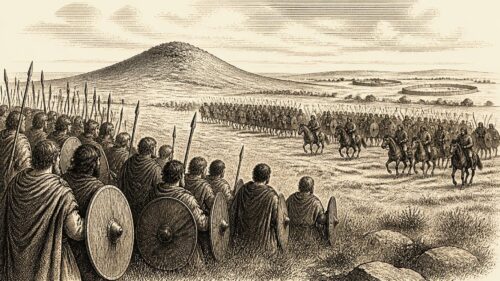
The article that reads Ard Corann across the Annals of Ulster and the Annals of Inisfallen is useful for seeing how far the two books agree. Each preserves a battle notice using a related place name. Their chronological presentation differs, because one excerpt gives an explicit year heading and the other does not. The disagreement makes little difference to our ability to see why the event deserves attention. It does matter when a reader asks for a single date. The article shows how a shared event can be clear while part of the information needed for a timeline remains unsettled.
The shortness of both Ard Corann notices deserves a moment of attention. They preserve the existence of a battle without giving an account of what led up to it. Much of what we might like to know about the people on either side sits outside the surviving lines. That gap is a feature of the material, and recognising it is part of reading well. A publication can give readers the fullest account of the words that survive, then let the silence around them stand. There is value in knowing where a story comes from, even when that story is brief.
The article pairing Ard Corann with Fremainn in Meath adds the death of Lugaid to the comparison. The Ulster text records the battle and the death under one heading, while a separate reference in the same book complicates the chronology. The Tigernach notice brings Fremainn into the picture. It would be easy to turn the placement of these events into an explanation of one by another. The safer reading keeps the entries separate until a connection is supported. That approach gives the reader clearer points of reference and avoids putting more weight on a short phrase than it can bear.
Lugaid’s death is a reminder that the end of a reign can be preserved in a notice that offers little explanation of the change that followed. A date may be important to the compiler because it marks a place in the order of kings. It can be important to the modern reader for a different reason, helping to place a story among other events. Those two purposes can coexist without being identical. Looking at the surrounding entries gives an impression of what the chroniclers thought worth remembering and of the gaps we inherit when we try to follow the sequence.
Our Ard Corrann article brings the variations into view once more. The Ulster record places the battle with the death of Lugaid, while Tigernach and Chronicon Scotorum arrange the material differently. The different spellings and references can be demanding, but a reader who has followed the pieces will recognise much of the pattern. One book can preserve a detail another puts elsewhere, and both can help us understand how the event was remembered. This is a fitting place to leave the annals for today, with the story of the battle visible and the limits of our knowledge kept in view.
Different kinds of record take us into different kinds of public life. We have read about rulers, bishops and places whose names were kept by chroniclers. The later articles bring us into families, workplaces, political parties, cabinets and courts. They give us more evidence for what people said and did, and more reason to distinguish the choices they faced. Having many surviving records does not make the historian’s work automatic. It gives us more ways to see how people entered public life, found others to work with, and made decisions whose meaning could change over the course of their careers.
Daniel O’Connell and the campaign for Catholic emancipation bring the question of political organisation into view. The sources describe him pressing a cause through public mobilisation, and one account draws attention to his decision to stand for County Clare. The account gives readers a way to see the work of a campaign through a particular choice rather than simply through its outcome. An election might open an opportunity to press a cause, provided people could be gathered around it. That is one way to understand why the story of emancipation belongs in an issue about the making of public life.
The emphasis on mobilisation is worth carrying into the other biographies. Organising voters, speaking in public and keeping a cause before people are different activities from winning a battle or holding an office. The article on emancipation makes these activities visible as part of a historical outcome we may already know. It also allows readers to consider the accounts of O’Connell’s leadership as accounts written by people with their own understanding of the campaign. A source can help us see what a leader did and what later writers believed mattered about that work, which are related questions with different answers.
Jeremiah O’Donovan Rossa takes us to Rosscarbery and to memories of the Great Famine, which he later revisited in his writing. The article follows him into the Phoenix National and Literary Society and identifies his place among Fenian leaders. His recollections give readers a route into the story that begins with what someone remembered of the place where he grew up. That is useful alongside public records of organisations and campaigns. A memoir cannot answer every question about a period, but it can help us see how a person later understood the experiences that became part of his public life.
The name of the Phoenix National and Literary Society helps make a connection with the other lives in today’s issue. Literature and public activity could sit together in the name of an organisation, as they did in the careers of writers we meet later. A society gave people a way to work together and to build connections beyond what any individual could manage alone. In Rossa’s case the article lets us see a route from local experience into political organisation. We can recognise the role of his writing in preserving that account without assuming it gives the whole of it.
Michael Davitt’s childhood begins in circumstances that put land, work and opportunity close together. The child of evicted tenant farmers from Mayo, he worked in a Lancashire mill while young and lost an arm in a workplace accident. He returned to formal education afterwards. These events give readers a sense of the world he entered before following him into imprisonment and political activity. His life is often remembered through the public movements to which he contributed. The article lets us begin with a family, a workplace and a school, all of which help make that later political story more tangible.
The period Davitt spent in prison adds a further change of setting to the story. A biography can follow someone through years that a short account of a campaign might pass over quickly. That matters in this case because the man who returned to political life had lived through situations different from those of an elected representative or a newspaper editor. Reading him beside O’Connell and Rossa makes the range of nineteenth century activism easier to see. The conditions that drew people into causes were varied, and the means open to them did not look the same in every generation.
Joseph Biggar entered his father’s Belfast business as a provision merchant before becoming active in local politics. He led the firm and later served as a town councillor, with a role in the city’s Water Commission. Those details give his biography a local setting. Water provision is a practical matter that concerns people in a growing town, and work on it is a form of public responsibility readers can understand. The article follows Biggar towards Home Rule, but the earlier experience deserves attention. It gives us a person already accustomed to institutions and decisions that affected people beyond his household.
Biggar’s business and municipal roles make a useful companion to the stories of Davitt and Rossa. They show how different experiences could bring people into politics. A merchant involved with Belfast’s water supply had dealt with questions many people encountered in everyday life, even as the campaigns he later joined reached beyond the city. The biography is a reminder to look for those earlier responsibilities when trying to understand a national political figure. They can give readers a sense of what a person had learned to do before appearing in the records through which we most often meet them today.
Justin McCarthy began as a journalist in Cork and worked in Liverpool and London. Reporting on parliament and editing the Morning Star gave him a professional life closely connected to public argument. The same article introduces him as a historian, novelist and politician. That combination is worth noting after the account of Rossa’s society. Writing and publishing provided ways of explaining events to people who could not attend a meeting or follow a debate in person. McCarthy’s career takes us through several towns and several kinds of writing, giving a fuller picture of the work behind a familiar political name.
The press changes what is available to the historian. A chronicler might preserve an event in one line, whereas a journalist following parliament can describe a debate as part of an unfolding story. Both writers have choices to make about what to include, and both influence what later readers can see. McCarthy’s life makes that work easier to picture through the particular jobs he held. The article invites us to follow a career that joined writing with public life and to think about the ways a newspaper could make political events intelligible to people beyond the room where they happened.
John Redmond’s career takes us from his education to elected office and through a period of division in the Irish Parliamentary Party. He led its Parnellite wing before becoming leader of the reunited party. That sequence is useful because it brings the work of keeping an organisation together into focus. Public life includes periods when people who share some objectives disagree about whom to follow or how to act. The biography follows one person across that divide. By the time we meet him leading the reunited party, we have a sense of why putting people back together mattered to it.
The article on Redmond can be read alongside those on Biggar and McCarthy. Between them we see a merchant with local responsibilities, a journalist familiar with parliamentary proceedings and a leader working through a split in an established party. Their biographies make the institutions of the period more accessible by showing the people who worked in them. Each person had a career and experience before he came to be known for a role. For a reader trying to understand Home Rule politics, that is a way in. Parties and campaigns consisted of people whose lives drew on many different settings.
Michael Collins’s early years take us from Woodfield near Clonakilty to an exam for a clerkship and work in London. He held positions at the Post Office Savings Bank and with financial firms before the later events for which he is widely remembered. Those details give the biography a starting point in ordinary work. We can follow a young person moving for employment and learning his way around institutions before seeing where his political involvement took him. The article records his membership of the Irish Republican Brotherhood, connecting his early working life to one of the movements encountered elsewhere today.
Collins’s path makes a useful transition from the biographies of parliamentarians to the articles concerned with the emerging state. The experience of working in offices and financial institutions belonged to the same life as his involvement in a revolutionary movement. That does not mean every skill can be traced to a particular early job, but it does give the reader a more substantial beginning than a list of public milestones. His biography is one of several today that become more revealing when we spend time on how somebody made a living before reaching the roles through which they are remembered.
Kevin O’Higgins appears in the records as Deputy President and Minister for Justice in the early Irish Free State. The details of office give the article a different setting from the pieces on public campaigns. We are looking at people trying to run institutions that had to act in the name of a new government. The Irish Revolution Project records O’Higgins among his cabinet colleagues, while the foreign policy documents give another way into his public life. Reading those materials side by side helps us see why the choices of a minister can be studied through several kinds of record.
The roles held by O’Higgins help bring order to the journey through this issue. We have read about taking up a cause, building an organisation and gaining elected office. The work of government brings its own questions about how public authority is exercised and how it is recorded. Cabinet lists can tell us who held a post, while speeches and documents show some of the matters occupying that person at the time. The article is worth reading for the opportunity to see those records together and to consider the responsibilities that came with placing a name beside a ministerial title.
Cearbhall Ó Dálaigh’s biography begins with scholarship and study of Celtic subjects, then moves through journalism, the law and public office. He worked as Irish language editor of the Irish Press before holding positions for which he is more often remembered. Those details give a reader something concrete to follow through a career that can otherwise look like a list of titles. A person working with language and texts later took on the responsibilities of a barrister, judge and president. The biography brings those fields into the same account without losing the distinct work he did in each of them.
Ó Dálaigh’s legal career puts another kind of service in view after the piece on O’Higgins. A minister and a lawyer can occupy important places in public affairs while working through different institutions and responsibilities. The article follows Ó Dálaigh through the Bar and his periods as Attorney General. Those appointments are useful markers, especially when read within the larger story of the person’s education and interests. They give us a sense of how someone came to hold public authority and how that part of a life can be understood through specific changes in role rather than through reputation alone.
Mary McAleese brings us to the presidency through a childhood in Belfast and a career whose presidential theme was Building Bridges. She was the first President to come from Northern Ireland and had grown up during the period that became known as the Troubles. Those details give the theme a setting that readers can understand without reducing a long presidency to a single phrase. A role shared with previous holders can take on a distinct character through the person who occupies it. The article uses her life and time in office to help readers see what she brought with her.
The two terms McAleese served draw attention to the way a presidency can be remembered through a sustained public idea. Building Bridges gives readers a point of entry into the work described by her biography. Set beside Ó Dálaigh’s legal and linguistic interests, it offers another example of the different experiences that can precede the same office. That comparison belongs to the theme of inheritance. People take up institutions that existed before them, and their careers give us ways of understanding how the office was understood, used and presented while they were the person carrying its responsibilities in public life.
The Simon Harris article brings the issue into a recent period through a local support group. Before his later roles, he helped establish the Wicklow Triple A Alliance to support families affected by autism and to seek better provision. That early activity offers a point from which to read the rest of the biography. Like the accounts of local government and public campaigning earlier in the issue, it begins with people joining together around a concern they could describe in everyday terms. The practical work of offering support and making a case for change deserves attention in its own right.
Reading that profile alongside O’Connell’s campaign or Biggar’s local politics can bring out a connection without treating their circumstances as alike. Public work begins with a particular local need or a question of how people are treated. Organising around it can lead into institutions whose purposes and responsibilities reach beyond the starting concern. The article closes this part of the issue by returning us to local experience, after pieces about cabinet and presidential office. It reminds us that public life is visible in the work of a group as well as in the career of someone who serves in government.
Thank you for reading today’s Gazette. We have moved from the chronicles of battles and church communities to campaigns, newspapers and the institutions of modern Ireland. Each article tells its own story, but taken together they show how public life depends on people doing work that others can continue and record. The links throughout this editorial will take you to the individual articles and the evidence that guided them. If one detail has stayed with you, follow it back to the longer account. A small fact, understood in its proper setting, can make a much larger history clearer to us.