Claims Approved
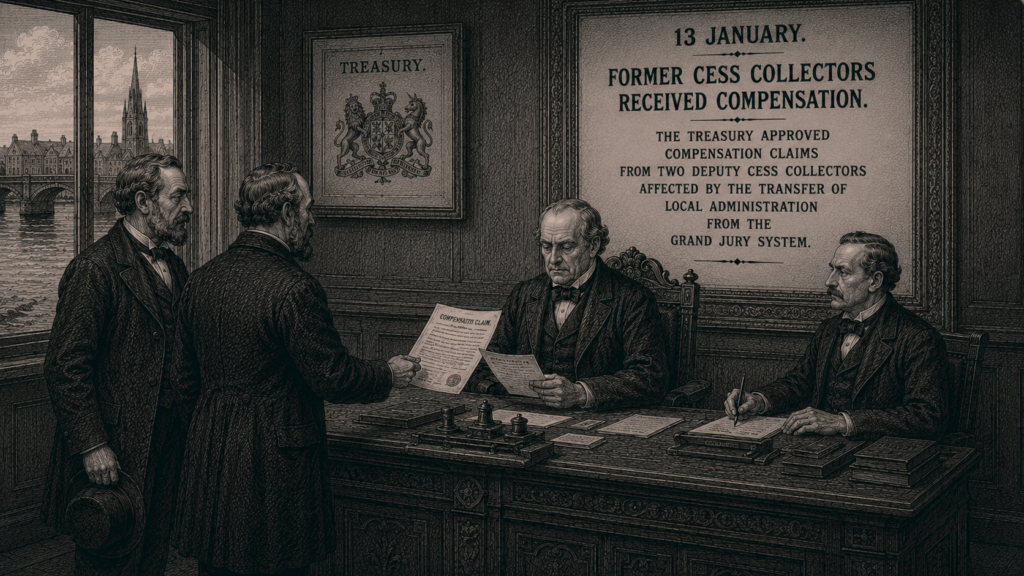
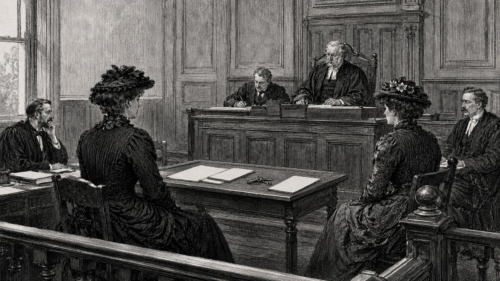
The Treasury approved compensation claims submitted by two former deputy cess collectors whose employment had been affected by the transfer of local administration from the Grand Jury system. The decision, reported on 13 January 1900, reached Limerick County Council by telegram. Councillors had previously concluded that they possessed no legal authority under the Local Government (Ireland) Act of 1898 to compensate deputies who had not been formally appointed by the Grand Jury. The successful applicants therefore carried their cases beyond the Council, asking the Treasury to recognise the financial loss created when the older machinery of county taxation was replaced.
County cess was the local tax formerly raised to finance roads, bridges, courthouses and other services administered through the Grand Jury. Official collectors were responsible for gathering the assessment, but much of the practical work could be undertaken by deputies operating beneath them. The democratic county councils established under the 1898 legislation inherited many Grand Jury responsibilities and introduced new arrangements for collecting rates. Officers whose recognised posts disappeared or whose income was reduced could seek compensation, yet the position of deputies was less secure when their appointments had not been formally recorded by the outgoing authority.
Limerick County Council’s refusal appears to have rested upon this distinction rather than upon a denial that the men had performed useful work. The Council believed that the statutory compensation provisions applied to legally constituted officers whose positions had been abolished or diminished by administrative reform. The deputy collectors argued that the practical reality of their employment should carry weight even when formal appointment procedures had been incomplete. Their appeal exposed a weakness in the transition: public duties had often been performed through arrangements understood locally, but the new system demanded documentary proof before responsibility for compensation could be assigned.
The Treasury telegram confirmed that two claims would be allowed and encouraged expectations that other pending applications might receive similar treatment. No compensation amounts were stated in the surviving report, and the affected officers were not named. The ruling nevertheless mattered to former employees throughout County Limerick who had lost fees or positions when elected councils replaced the Grand Jury administration. It also relieved the County Council of having to stretch its interpretation of the Act beyond what members believed lawful, while acknowledging that central government could address hardship arising from gaps in the legislation’s treatment of subordinate officials.
The case illustrated the human cost of a reform generally celebrated for transferring local power from appointed landowners to elected representatives. New councils assumed responsibility for taxation, roads and public services, but the change also disrupted established livelihoods within the old administrative structure. Compensation disputes required officials to distinguish between recognised office, customary employment and informal delegation. By accepting the two Limerick claims, the Treasury recognised that administrative modernisation could produce genuine pecuniary loss even where legal status remained uncertain. The decision offered limited protection to displaced workers while leaving the broader question of similar deputy appointments to be resolved claim by claim.
- Irish Times, “Deputy Cess Collectors and Compensation,” 13 January 1900, p. 9.
- Local Government (Ireland) Act 1898, 61 & 62 Vict., c. 37, section 120 and Seventh Schedule, provisions governing compensation for existing officers suffering direct pecuniary loss.
- John J. Clancy, A Handbook of Local Government in Ireland, Dublin: Sealy, Bryers and Walker, 1899, commentary on the Local Government (Ireland) Act and compensation arrangements for transferred or displaced officers.
- Limerick Grand Jury Presentments Collection, P37, Limerick Archives, printed presentments and cess records relating to Grand Jury taxation and county expenditure, 1807–1900.
- Limerick County Council minute books, 1899–1900, Limerick Archives, records concerning the administrative transfer from the Grand Jury system and claims arising from displaced county officers.