Divided Welcome
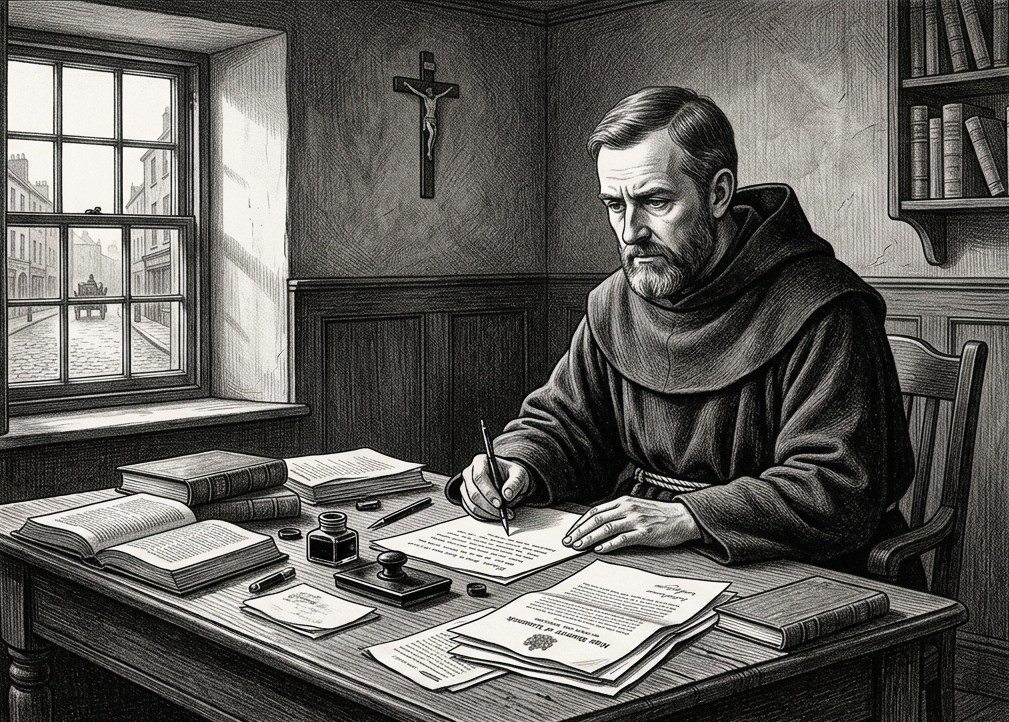
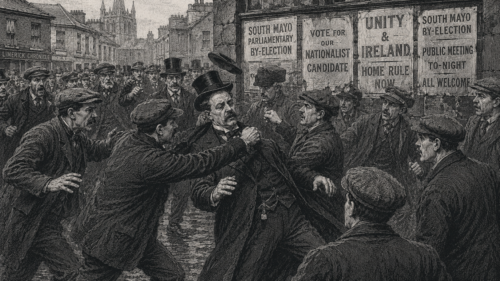
Queen Victoria’s final visit to Ireland in April 1900 became a matter of immediate political argument in Limerick before the royal party entered Dublin. Patrick Fidelis Kavanagh, a Franciscan friar and president of the Limerick Young Ireland Society, received a circular from the county’s High Sheriff inviting him to a meeting intended to organise an address of welcome. Kavanagh declined and sent a lengthy reply attacking both British rule and the South African War. His refusal provides direct evidence that the proposed civic greeting was not a simple expression of shared enthusiasm, but an occasion on which Limerick’s competing loyalties were sharply exposed.
Victoria landed at Kingstown on 4 April and began the nine-mile journey to the Vice-Regal Lodge in Phoenix Park in an open carriage. The route passed through decorated streets and beneath a temporary triumphal arch at Leeson Street, while soldiers, police, civic officials and large crowds formed the public setting for the procession. Shamrocks appeared prominently in the Queen’s dress and in the ceremonies surrounding her arrival, giving the royal spectacle an intentionally Irish character. To supporters of the visit, such gestures represented recognition of Ireland within the monarchy; to critics, they could not erase the constitutional grievances and coercive legislation associated with Victoria’s long reign.
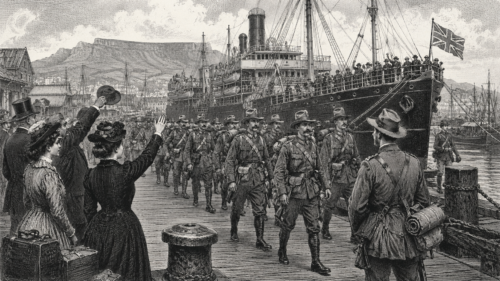
The timing made the visit especially contentious. Britain was fighting the South African War, and Irish regiments were serving in the imperial forces while nationalist sympathy for the Boer republics was widespread. Kavanagh argued that the royal journey was connected with efforts to encourage Irish enlistment, a charge frequently made by advanced nationalists. The visit’s defenders could point instead to the Queen’s acknowledgement of Irish soldiers and to the ceremonial attention given to the country. These rival interpretations turned apparently harmless decorations, addresses and cheering crowds into political signs, read either as evidence of loyalty or as an attempt to strengthen imperial authority during an unpopular conflict.
In Limerick, the surviving correspondence reveals opposition but does not establish that Kavanagh spoke for the whole city or county. The High Sheriff’s attempt to gather supporters for an address demonstrates that an organised loyal response also existed, even though the available account does not identify everyone involved or record the meeting’s outcome. Reports of the Dublin ceremonies nevertheless carried the dispute beyond the capital, allowing readers to compare the official pageantry with nationalist objections. The same shamrocks, uniforms and civic formalities could therefore produce very different meanings in households, clubs and political circles already divided over Home Rule, the monarchy and Ireland’s place within the United Kingdom.
The visit lasted through much of April and became one of the final great public ceremonies of Victoria’s reign. Its importance lay not merely in the sight of an elderly monarch travelling through Dublin, but in the arguments the occasion brought into public view. Royal organisers presented Ireland as welcomed and recognised within the empire, while opponents insisted that ceremony could not substitute for political self-government or justify war abroad. Limerick’s proposed address and Kavanagh’s refusal captured that contradiction with unusual clarity. The episode showed how a royal visit could celebrate Irish symbols while deepening disagreement over who possessed the right to define Irish loyalty, identity and national interest.
- Queen Victoria, Journal, 4 April 1900, Royal Archives, Windsor Castle.
- British Pathé, Queen Victoria in Dublin 1900, silent newsreel, 4 April 1900, Irish Film Institute Archive Player, duration 1 minute 48 seconds.
- The Advocate (Melbourne), 19 May 1900, p. 1, letter from Patrick Fidelis Kavanagh to the High Sheriff of Limerick concerning the proposed address of welcome.
- Michael J. F. McCarthy, Five Years in Ireland, 1895–1900 (London: Simpkin, Marshall, Hamilton, Kent & Co.; Dublin: Hodges, Figgis & Co., 1901), chapter XXXII, “Narrative of Queen Victoria’s Visit to Ireland in 1900.”
- Colin Fowler, “‘Firebrand Friar’—Patrick Fidelis Kavanagh OSF (1838–1918),” Journal of the Australian Catholic Historical Society 41 (2020): 6–18.
- Senia Pašeta, “Nationalist Responses to Two Royal Visits to Ireland, 1900 and 1903,” Irish Historical Studies 31, no. 124 (November 1999): 488–504.
- Donal P. McCracken, Forgotten Protest: Ireland and the Anglo-Boer War (Belfast: Ulster Historical Foundation, 2003).