14 July 2026
Elm Hill
Elm Hill, County Limerick, was built around 1790 for the Studdert family as an elegant Georgian country residence. The six-bay, two-storey house stood over a raised basement and contained spacious reception rooms, nine bedrooms, servants’ quarters, kitchens, cellars and service rooms. Following the Great Famine, it was offered for sale and described as being in excellent repair. The property remained substantial for generations but gradually fell vacant and deteriorated. A 2008 architectural survey praised its limestone doorcase, carved timber entrance, slate-hung elevations, fireplaces and decorative plasterwork. Its recognised importance led to designation as a protected structure under Irish planning legislation.
View Image14 July 2026
Glenduff Castle
This reconstructed view presents Glenduff Castle in County Limerick as it may have appeared before its destruction in 1922. The imposing residence combines the fortified character of an earlier seventeenth-century tower house with the Gothic Revival additions created for the Ievers family around 1840. Tall crenellated towers, pointed windows, battlements and a formal central entrance give the building a commanding presence. Set within carefully maintained lawns and mature woodland, the castle reflects the scale and confidence of a nineteenth-century Irish country estate. The image offers a plausible visual impression rather than a definitive record of its original appearance or grandeur.
View Image15 July 2026
Edwardian Limerick
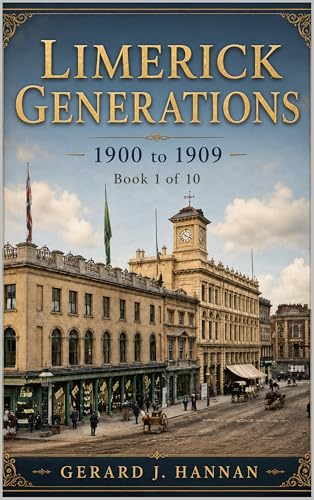
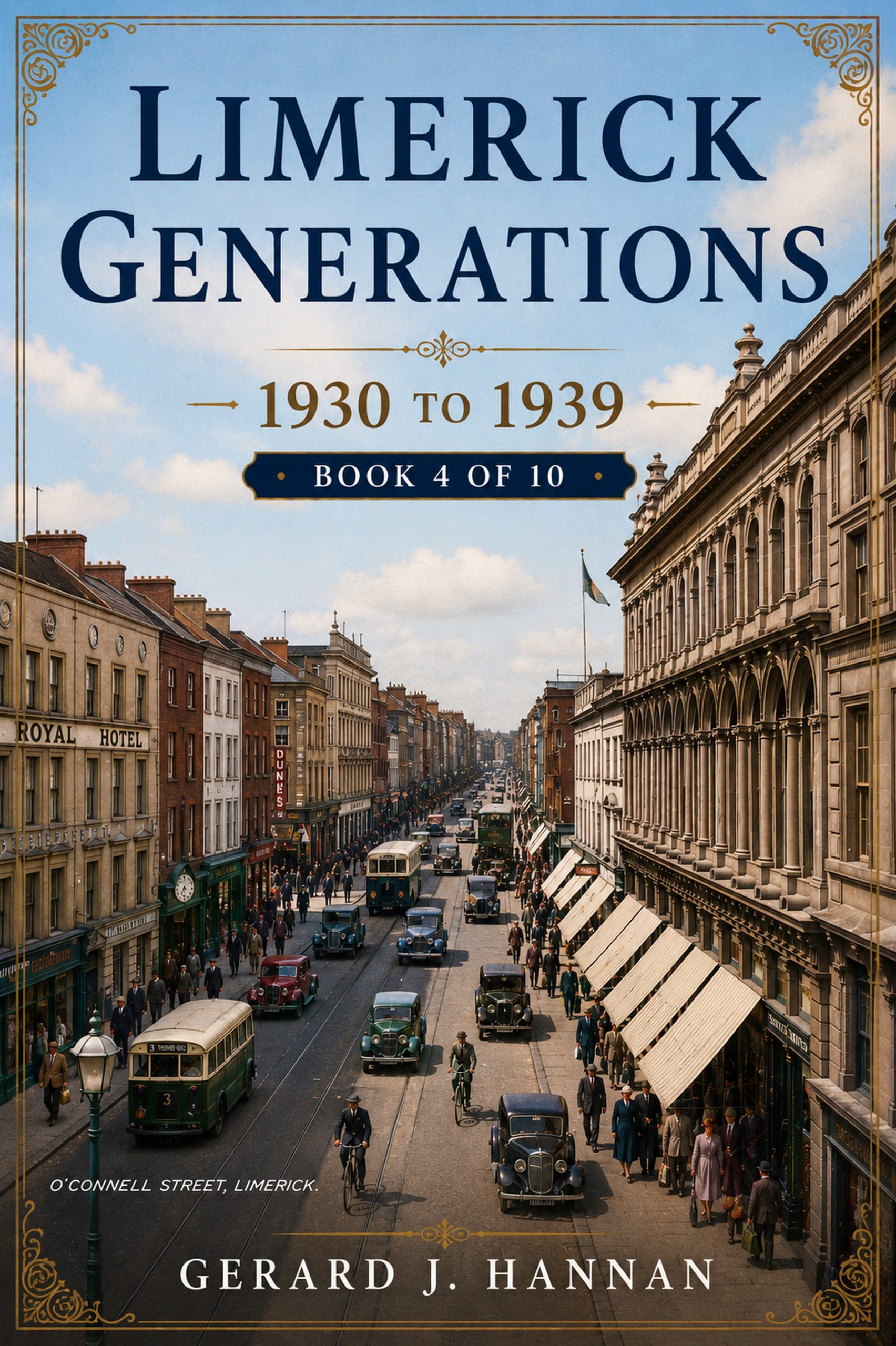
At the beginning of the twentieth century, George Street stood at the centre of commercial life in Limerick. Today known as O’Connell Street, it was bordered by impressive Georgian buildings housing hotels, shops, offices and established local businesses. Horse-drawn carts, private carriages and crowds of pedestrians moved constantly along the busy thoroughfare, while traders brought additional noise and colour to the scene. Landmarks included the Royal Hotel, MacMahon’s Temperance Hotel and firms such as O’Mahony & Company. The street’s elegant architecture and lively commerce made it one of Edwardian Limerick’s most important and recognisable urban spaces for residents and visitors.
View Image16 July 2026
Blossom Gate
Blossom Gate is the last surviving medieval gateway of Kilmallock, County Limerick, once one of Ireland’s most strongly fortified towns. Originally one of five entrances through the defensive walls, it alone remains; St John’s, Water, Ivy and Friary gates have disappeared. Standing on Emmet Street, the three-storey stone tower spans the roadway above a pointed arched vault, marking where the town walls formerly joined it. The name may derive from “Blae Gate” or from the Irish word blá, meaning flower or blossom, combined with the French porte, meaning gate. Today, it is a prominent reminder of Kilmallock’s medieval importance and…
View Image15 July 2026
Says Croker
Built in 1774 for John Croker, Ballynagarde House near Ballyneety was once among County Limerick’s grand Georgian residences. The five-bay mansion stood over a raised basement, with a central breakfront, cut limestone detailing, extensive outbuildings, walled gardens and classical statues. Raised on the site of an earlier stronghold, it remained the Croker family seat for generations. Financial mismanagement during the late nineteenth century began its decline, and the estate was divided by the Land Commission in the 1930s. Now ruined, the house survives in local folklore through tales of “Doubt It Hall” and a mysterious visitor allegedly possessing cloven hooves.
View Image10 July 2026
Baker Place
At Baker Place in early twentieth-century Limerick, Saint Saviour’s Dominican Church stands at the centre of a broad cobbled streetscape, its Gothic stone façade, rose window, pointed arches, and carved doorways giving the scene a strong ecclesiastical presence. To the right, Tait’s Clock rises above the roadway as a civic landmark, balanced by red-brick industrial buildings and smoking chimneys behind it. Period pedestrians, a horse-drawn cart, street lamps, and a small wooden kiosk add everyday activity. The view captures a city shaped by faith, industry, commerce, public memory, and the architectural confidence of Edwardian urban life in Limerick’s historic core.
View Image16 July 2026
Castlegarde Castle
Castlegarde Castle, near Cappamore in County Limerick, is regarded as Ireland’s oldest continuously inhabited castle. Established by the O’Brien family around 1190, its five-storey medieval tower rises from a limestone outcrop, strengthening its defensive position. Original features include an internal well and a murder hole above the entrance passage. In 1820, Waller O’Grady commissioned architects James and George Pain to add a castellated Gothic extension, harmonised with the ancient keep. A carved head of Brian Boru overlooks the entrance, while three unusual stone figures representing Bacchus, Pallas Athene and Aphrodite survive within the gatehouse. Today, it remains a private residence.
View Image10 July 2026
Limerick 1920s
A hazy bird’s-eye view of Limerick in the 1920s stretches across rooftops, chimneys, lanes, and terraces fading into mist. Smoke rises from houses and workshops, softening the city skyline and giving the scene a wintery industrial atmosphere. A tall church spire dominates the distance, standing above packed streets and modest dwellings, while long rows of buildings suggest dense urban life along the Shannon. The elevated perspective captures Limerick as a working city of faith, labour, and close-knit neighbourhoods. Though blurred by age and weather, the photograph preserves a rare panoramic impression of everyday Limerick between war, industry, and memory.
View Image16 July 2026
Horse Brake
By 1900, Limerick’s great long-distance stagecoach era had largely disappeared, replaced by the expanding railway network. Horse-drawn vehicles nevertheless remained essential throughout the city and surrounding countryside. Large brakes and passenger wagons carried groups on local journeys, outings and transfers, while hackney cars, jaunting cars, drays and private carriages crowded the streets. Horses also transported goods from the docks, breweries, distilleries and railway station. This reconstructed scene captures a group of formally dressed men aboard a substantial horse-drawn vehicle, reflecting a transitional age when steam powered intercity travel, but horses still firmly supported Limerick’s everyday commercial, urban and social life.
View Image16 July 2026
Nua Ruins
The old church near Holycross, County Limerick, was recorded as a ruin by 1642. In 1679, Rachael Bourchier, Countess of Bath, restored the building, just one year before her death. Thereafter it became known as the New Church, or Teampall Nua in Irish, and served local Church of Ireland parishioners. A belfry was added during the restoration, giving the structure a distinctive profile. Although the church later fell out of use and returned to ruin, its surviving walls, arched openings and graveyard remain important reminders of seventeenth-century religious life and the long history of worship at this historic site today.
View Image