12 July 2026
Cottages Adare
In July 1981, a row of traditional thatched cottages lends Adare its distinctive old-world character. Whitewashed walls, steep straw roofs and small windows line the roadside, reflecting a style once common throughout rural Ireland. The cottages appear carefully maintained, their simple façades softened by flowers, hedges and mature trees. Passing traffic and summer light place the scene firmly in everyday village life rather than a staged historical setting. The image preserves a familiar view of Adare at a time when its architectural heritage was becoming central to the village’s identity and appeal for visitors to County Limerick and beyond worldwide.
View Image13 July 2026
George Street
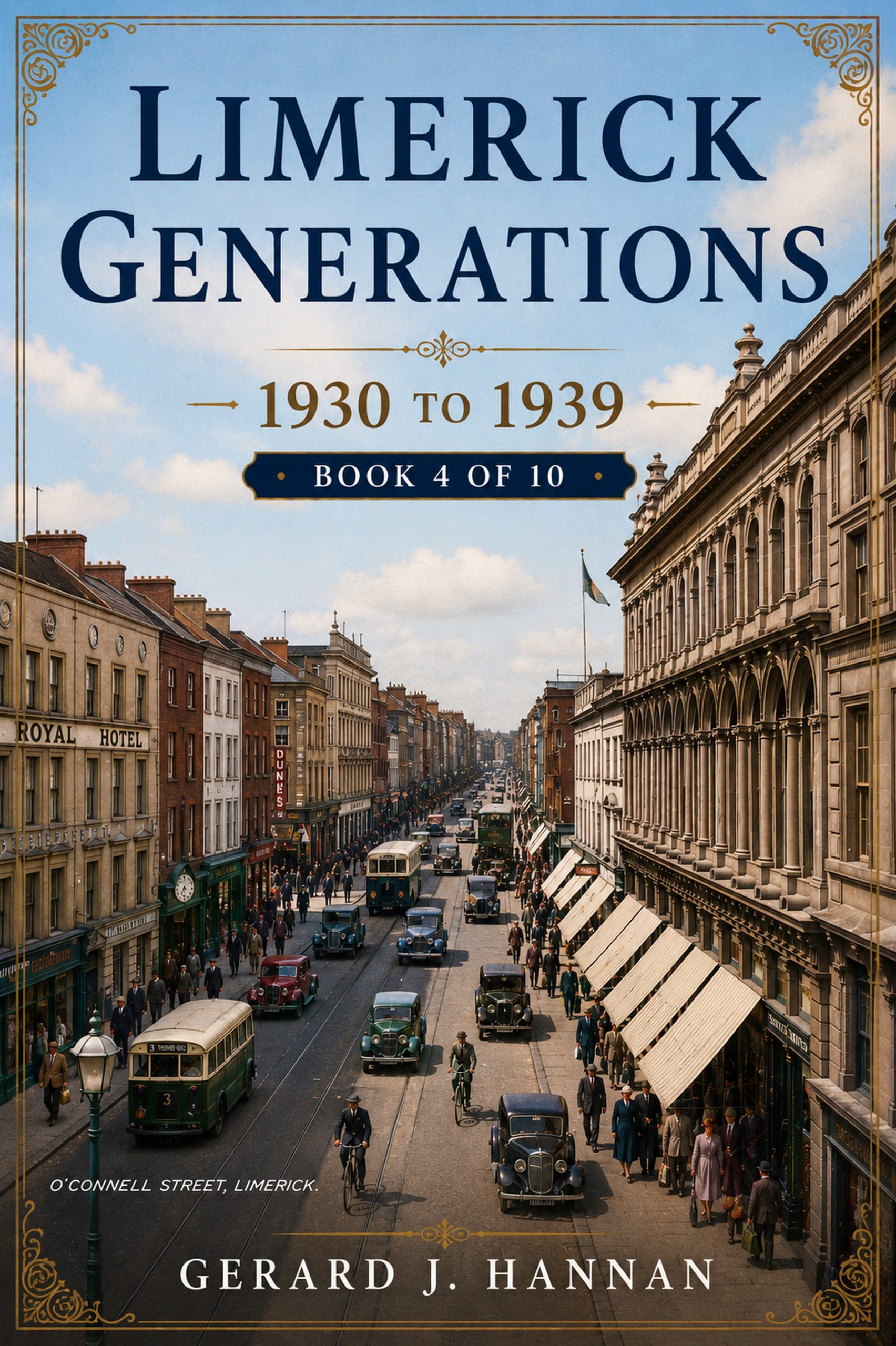
George Street, now O’Connell Street, formed the bustling commercial and social heart of Limerick around 1900. Elegant Georgian and Victorian façades lined the thoroughfare, their ornate shopfronts illuminated by gaslight and filled with goods for local shoppers. Horse-drawn carriages, jaunting cars and merchant carts crowded the roadway, while pedestrians in heavy coats and hats moved between businesses and hotels. The grand Cruises Royal Hotel stood among the street’s most prominent landmarks, welcoming merchants, travellers and visitors. This scene reflects the energy of late-Victorian Limerick before motor traffic transformed the city’s principal shopping street and historic urban centre during a changing…
View Image14 July 2026
Shannon 1850s
By the mid-nineteenth century, Limerick remained one of Ireland's most strategically significant river cities, its fortunes long tied to the Shannon as a route for trade, defence, and settlement. The medieval walls and towers still visible in this period recalled centuries of contested history, from Norman fortification to the sieges of the seventeenth century that shaped the city's identity. Alphonse Dousseau's romanticised depiction reflects a wider mid-Victorian fascination among European artists with Ireland's older townscapes, capturing Limerick at a moment when its historic core coexisted with the pressures of modernisation, emigration, and post-Famine recovery reshaping much of the country during…
View Image9 July 2026
Johns Castle
King John’s Castle stands beside the River Shannon at Curragower Falls, with broken water, river rocks and the castle’s stone frontage visible across the scene. The round towers, curtain walls and riverside defences remain central, while the burned Castle Barracks appears roofless and blackened within the enclosure. Thomond Bridge is visible to the left, with nearby trees, older buildings and a church tower rising beyond the castle walls. The river surface shows ripples, reflections and shallow movement below the fortifications. The image presents the castle after damage, set within the wider early twentieth century Limerick urban riverside landscape after 1922.
View Image31 July 2026
Ryans Garage
This early photograph captures Dan Ryan’s Garage at Punch’s Cross, Limerick, during the 1940s. The premises stood at an important junction serving motorists, cyclists and local residents as traffic through the area steadily increased. Its pumps, workshop and roadside position reflect the growing importance of motor transport in mid-twentieth-century Limerick. The image also preserves the appearance of Punch’s Cross before later development transformed the surrounding streetscape. Beyond its commercial role, the garage became a familiar local landmark and meeting point. Today, the photograph offers a valuable glimpse of everyday business, transport and community life in wartime and post-war Limerick city.
View Image16 July 2026
Thomond Gate
Thomond Gate Distillery stood beside the River Shannon from 1809 until 1919, forming an important part of Limerick’s industrial and distilling heritage. During the nineteenth century, the complex operated three copper pot stills and produced traditional Irish whiskey under several owners, including Stein Brown & Co. and Archibald Walker’s Limerick Distillery. These reconstructed scenes imagine the surrounding streets, workers, carts, buildings and towering chimneys during the distillery’s active years. Although production eventually ceased, the Thomond Gate name has been revived through an independent Limerick whiskey brand dedicated to preserving the memory and traditions of the original enterprise for future generations.
View Image9 July 2026
Marys Church
St Mary’s Church stands on Athlunkard Street in Limerick, occupying a site associated with Catholic worship since the eighteenth century. The present church opened in 1932, replacing an earlier chapel where Mass was first celebrated on December 10, 1749. Designed by Ashlin and Coleman of Dublin, the building reflects the scale and ambition of parish church architecture in early twentieth-century Limerick. Its tower, façade, railings and street setting mark an important local landmark, while the surviving holy water font from the former chapel links the modern church with the long religious history of St Mary’s parish community today.
View Image16 July 2026
Mountshannon House
Mountshannon House, near Castleconnell in County Limerick, was one of Ireland’s grandest eighteenth-century mansions. Built around 1750, it later gained a monumental Ionic portico during an 1813 remodelling by architect Lewis Wyatt. Tradition claimed the house contained 365 windows, while its vast entrance hall could accommodate a horse-drawn carriage. Surrounded by a 900-acre demesne between the River Shannon and Mulkear River, its celebrated gardens were designed by John Sutherland. Home to the powerful FitzGibbon family, including John “Black Jack” FitzGibbon, 1st Earl of Clare, the mansion became a renowned centre of political influence, hospitality, wealth, political power, and aristocratic life.
View Image16 July 2026
Horse Brake
By 1900, Limerick’s great long-distance stagecoach era had largely disappeared, replaced by the expanding railway network. Horse-drawn vehicles nevertheless remained essential throughout the city and surrounding countryside. Large brakes and passenger wagons carried groups on local journeys, outings and transfers, while hackney cars, jaunting cars, drays and private carriages crowded the streets. Horses also transported goods from the docks, breweries, distilleries and railway station. This reconstructed scene captures a group of formally dressed men aboard a substantial horse-drawn vehicle, reflecting a transitional age when steam powered intercity travel, but horses still firmly supported Limerick’s everyday commercial, urban and social life.
View Image16 July 2026
Monasteranenagh Abbey
Founded in 1148 by Toirdelbhach mac Diarmaida Ua Briain, Monasteranenagh Abbey became one of County Limerick’s most important Cistercian foundations. This reconstruction imagines the monastery during its earliest years, with newly completed stone buildings, steep roofs, narrow lancet windows, timber doors, and monks moving quietly through the surrounding grounds. The austere architecture reflects the Cistercian ideals of simplicity, discipline, prayer, and communal labour. Supported by the O’Brien dynasty, the abbey later expanded under Domnall Mór Ua Briain. Though centuries of conflict and collapse reduced it to ruins, its surviving walls remain a powerful monument to medieval Irish faith and craftsmanship.
View Image