14 July 2026
Grange House
This reconstructed scene evokes the life of a prosperous Georgian country estate around the turn of the nineteenth century. The imposing house, formal gardens and gravel approach reflect the architectural taste and social order of the period. Elegantly dressed visitors, household servants, gardeners and horse-drawn carriages suggest activity surrounding such residences, where family life, hospitality and estate management met. Although idealised, the image offers a vivid historical impression of how the property may once have appeared when newly built, occupied and maintained, before decline altered its character and left only fragments of its former grandeur for future generations to study.
View Image16 July 2026
George Street
Before becoming Cannocks, the premises at 134 George Street, now O’Connell Street, housed a successful drapery business dating from around 1814. By the mid-nineteenth century, the shop was operated by Cumine and Mitchell and was regarded as a high-class retail establishment. In 1850, Scottish businessmen George Cannock and John Arnott purchased the property, establishing Cannocks and Company, which developed into one of Limerick’s best-known department stores. The business remained a prominent feature of the city’s commercial life for generations. In 1980, the store was sold to Penneys, which continues to occupy the historic site today on O’Connell Street in Limerick.
View Image10 July 2026
Baker Place
At Baker Place in early twentieth-century Limerick, Saint Saviour’s Dominican Church stands at the centre of a broad cobbled streetscape, its Gothic stone façade, rose window, pointed arches, and carved doorways giving the scene a strong ecclesiastical presence. To the right, Tait’s Clock rises above the roadway as a civic landmark, balanced by red-brick industrial buildings and smoking chimneys behind it. Period pedestrians, a horse-drawn cart, street lamps, and a small wooden kiosk add everyday activity. The view captures a city shaped by faith, industry, commerce, public memory, and the architectural confidence of Edwardian urban life in Limerick’s historic core.
View Image16 July 2026
Monasteranenagh Abbey
Founded in 1148 by Toirdelbhach mac Diarmaida Ua Briain, Monasteranenagh Abbey became one of County Limerick’s most important Cistercian foundations. This reconstruction imagines the monastery during its earliest years, with newly completed stone buildings, steep roofs, narrow lancet windows, timber doors, and monks moving quietly through the surrounding grounds. The austere architecture reflects the Cistercian ideals of simplicity, discipline, prayer, and communal labour. Supported by the O’Brien dynasty, the abbey later expanded under Domnall Mór Ua Briain. Though centuries of conflict and collapse reduced it to ruins, its surviving walls remain a powerful monument to medieval Irish faith and craftsmanship.
View Image14 July 2026
Shannon Bridge
Shannon Bridge, opened on 30 May 1988, remains widely known in Limerick as the “New Bridge”, despite now being several decades old. This four-lane concrete girder crossing connects the Dock Road and Mallow Street area with the North Circular Road and Clancy Strand, providing an important inner-city relief route across the River Shannon. Soon after opening, it acquired another memorable nickname, the “Whistling Bridge”. Strong winds travelling up the Shannon Estuary passed through gaps in the original railings, producing a loud, eerie shrill sound. The problem was later reduced by fitting mesh grilles over the railings along the exposed crossing.
View Image16 July 2026
Mary Street
Dutch Billy houses were once a distinctive feature of Limerick’s Englishtown and Irishtown districts. Characterised by narrow brick façades, steeply pitched gables and tall windows, the style developed in Irish towns during the late seventeenth and early eighteenth centuries. Many examples survived along Mary Street into the early twentieth century, preserving the appearance of Limerick’s merchant quarters. Their name is traditionally associated with King William III, although the term was applied broadly to gabled urban houses of the period. By around 1900, these buildings stood as reminders of the city’s commercial growth, architectural character and changing streetscape across previous centuries.
View Image9 July 2026
Treaty Stone
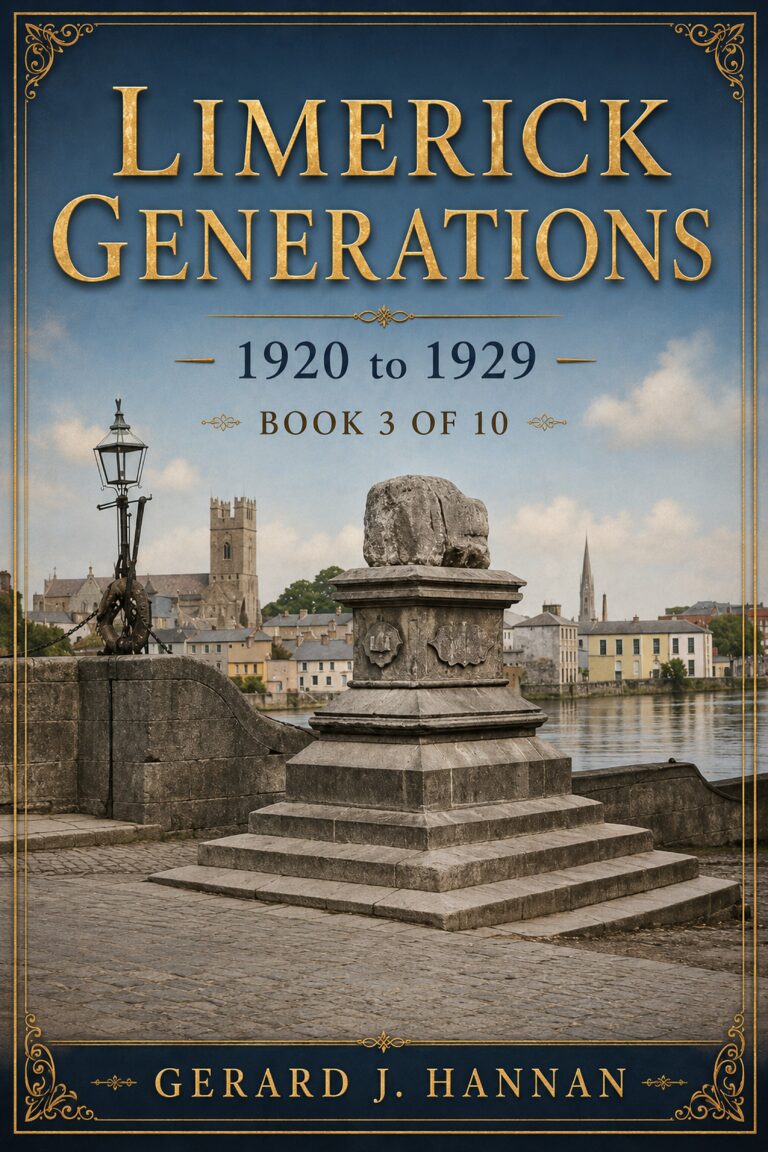
AI-assisted archival reconstruction showing the Treaty Stone on Thomond Bridge, Limerick, with the riverside castle buildings and historic bridge approach in the background. The scene presents the monument, cobbled roadway, bridge parapet, pedestrians, and horse-drawn traffic in a restored early twentieth-century setting, preserving the atmosphere of the original historical source image.
View Image16 July 2026
Thomond Gate
Thomond Gate Distillery stood beside the River Shannon from 1809 until 1919, forming an important part of Limerick’s industrial and distilling heritage. During the nineteenth century, the complex operated three copper pot stills and produced traditional Irish whiskey under several owners, including Stein Brown & Co. and Archibald Walker’s Limerick Distillery. These reconstructed scenes imagine the surrounding streets, workers, carts, buildings and towering chimneys during the distillery’s active years. Although production eventually ceased, the Thomond Gate name has been revived through an independent Limerick whiskey brand dedicated to preserving the memory and traditions of the original enterprise for future generations.
View Image10 July 2026
Boat Club
Limerick Boat Club, established in 1870, is one of the city’s oldest and most distinctive rowing institutions. Situated on the western side of Wellesley Pier beside Sarsfield Bridge, the club occupies a handsome Victorian red-brick clubhouse overlooking the River Shannon. As the second oldest rowing club in Limerick, it has played an important role in the city’s sporting and social life for generations. The club is particularly associated with recreational rowing, welcoming members who enjoy the river for exercise, companionship and leisure. Its historic setting and continuing community presence make it a familiar landmark on Limerick’s waterfront within the city.
View Image10 July 2026
Marys Cathedral
AI-assisted archival reconstruction showing St Mary’s Cathedral, Limerick, viewed from the surrounding garden grounds. The image presents the cathedral tower, Gothic windows, mature trees, planted walks, benches, and landscaped foreground in a restored historical setting, preserving the atmosphere of the original source photograph while removing modern watermarking and visual damage.
View Image