16 July 2026
Thomond Gate
Thomond Gate Distillery stood beside the River Shannon from 1809 until 1919, forming an important part of Limerick’s industrial and distilling heritage. During the nineteenth century, the complex operated three copper pot stills and produced traditional Irish whiskey under several owners, including Stein Brown & Co. and Archibald Walker’s Limerick Distillery. These reconstructed scenes imagine the surrounding streets, workers, carts, buildings and towering chimneys during the distillery’s active years. Although production eventually ceased, the Thomond Gate name has been revived through an independent Limerick whiskey brand dedicated to preserving the memory and traditions of the original enterprise for future generations.
View Image16 July 2026
Shortest Street
Quinlan Street is one of the shortest principal streets in Limerick City, measuring approximately eighty-five feet at its centre. Located within the historic Georgian Quarter, it forms an important connection between the Crescent, at the southern end of O’Connell Street, and O’Connell Avenue. Developed between the 1820s and 1840s, the street is lined with distinctive multi-storey red-brick Georgian townhouses built over basements. Its unusual layout means that one side is longer than the other. The street was named after Thomas Quinlan, the builder responsible for the original houses at numbers 1 and 2, preserving his contribution to Limerick’s urban development.
View Image16 July 2026
Mary Street
Dutch Billy houses were once a distinctive feature of Limerick’s Englishtown and Irishtown districts. Characterised by narrow brick façades, steeply pitched gables and tall windows, the style developed in Irish towns during the late seventeenth and early eighteenth centuries. Many examples survived along Mary Street into the early twentieth century, preserving the appearance of Limerick’s merchant quarters. Their name is traditionally associated with King William III, although the term was applied broadly to gabled urban houses of the period. By around 1900, these buildings stood as reminders of the city’s commercial growth, architectural character and changing streetscape across previous centuries.
View Image10 July 2026
Marys Cathedral
AI-assisted archival reconstruction showing St Mary’s Cathedral, Limerick, viewed from the surrounding garden grounds. The image presents the cathedral tower, Gothic windows, mature trees, planted walks, benches, and landscaped foreground in a restored historical setting, preserving the atmosphere of the original source photograph while removing modern watermarking and visual damage.
View Image16 July 2026
Shortest Street
Quinlan Street is one of the shortest principal streets in Limerick City, measuring approximately eighty-five feet at its centre. Located within the historic Georgian Quarter, it forms an important connection between the Crescent, at the southern end of O’Connell Street, and O’Connell Avenue. Developed between the 1820s and 1840s, the street is lined with distinctive multi-storey red-brick Georgian townhouses built over basements. Its unusual layout means that one side is longer than the other. The street was named after Thomas Quinlan, the builder responsible for the original houses at numbers 1 and 2, preserving his contribution to Limerick’s urban development.
View Image10 July 2026
Boat Club
Athlunkard Boat Club was founded in 1898, taking its name from its home beside O’Dwyer Bridge at the end of Athlunkard Street. By the 1930s, the club was already firmly woven into Limerick’s rowing tradition, with a proud record on the water. Its greatest distinction came through the Senior Eight Championship, which Athlunkard won twice, in 1913 and 1923. That achievement made it the only Limerick club to secure the title on two occasions. Its riverside presence and competitive success gave Athlunkard Boat Club a lasting place in the sporting history of the city and the wider Shannon rowing community.
View Image16 July 2026
Mathew Bridge
Mathew Bridge, completed between 1844 and 1846, forms an important crossing over the Abbey River in Limerick City. Designed by William Henshaw Owen, the triple-span ashlar limestone structure features segmental arches, rounded breakwaters and a broad flat roadway. It linked Rutland Street and Bank Place with Bridge Street and Merchant’s Quay, connecting the Georgian commercial quarter of Newtown Pery with medieval Englishtown. The bridge replaced the inadequate New Bridge of 1762 and accommodated the city’s growing Victorian traffic. Named for Father Theobald Mathew, the celebrated temperance reformer, it remains a notable example of nineteenth-century Irish civic engineering and urban development.
View Image14 July 2026
Glenduff Castle
This reconstructed view presents Glenduff Castle in County Limerick as it may have appeared before its destruction in 1922. The imposing residence combines the fortified character of an earlier seventeenth-century tower house with the Gothic Revival additions created for the Ievers family around 1840. Tall crenellated towers, pointed windows, battlements and a formal central entrance give the building a commanding presence. Set within carefully maintained lawns and mature woodland, the castle reflects the scale and confidence of a nineteenth-century Irish country estate. The image offers a plausible visual impression rather than a definitive record of its original appearance or grandeur.
View Image10 July 2026
Pery Square
Around 1900, Pery Square presented one of Limerick’s most elegant urban settings, facing the newly opened People’s Park and framed by distinctive Georgian terraces. The celebrated Tontine Buildings, built between 1835 and 1838 as a speculative venture, gave the square a story as unusual as its architecture. Their shares, tied to named lives in the so-called Life and Death Lottery, were still gaining value as horse-drawn traffic, pedestrians, gas lamps, and civic buildings animated the street. The tontine was finally won in 1913 by Sophia Vanderkiste, closing a remarkable chapter in Limerick’s local social and architectural history.
View Image15 July 2026
Edwardian Limerick
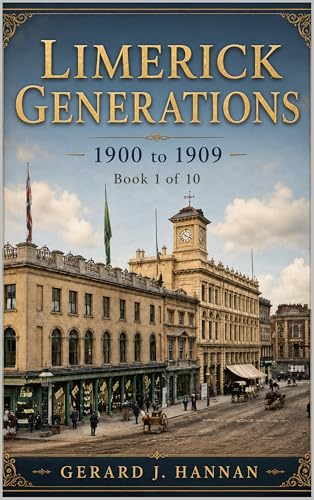
At the beginning of the twentieth century, George Street stood at the centre of commercial life in Limerick. Today known as O’Connell Street, it was bordered by impressive Georgian buildings housing hotels, shops, offices and established local businesses. Horse-drawn carts, private carriages and crowds of pedestrians moved constantly along the busy thoroughfare, while traders brought additional noise and colour to the scene. Landmarks included the Royal Hotel, MacMahon’s Temperance Hotel and firms such as O’Mahony & Company. The street’s elegant architecture and lively commerce made it one of Edwardian Limerick’s most important and recognisable urban spaces for residents and visitors.
View Image