14 July 2026
Shannon Bridge
Shannon Bridge, opened on 30 May 1988, remains widely known in Limerick as the “New Bridge”, despite now being several decades old. This four-lane concrete girder crossing connects the Dock Road and Mallow Street area with the North Circular Road and Clancy Strand, providing an important inner-city relief route across the River Shannon. Soon after opening, it acquired another memorable nickname, the “Whistling Bridge”. Strong winds travelling up the Shannon Estuary passed through gaps in the original railings, producing a loud, eerie shrill sound. The problem was later reduced by fitting mesh grilles over the railings along the exposed crossing.
View Image13 July 2026
George Street
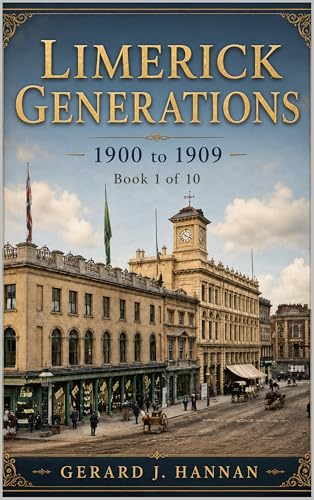
George Street, now O’Connell Street, formed the bustling commercial and social heart of Limerick around 1900. Elegant Georgian and Victorian façades lined the thoroughfare, their ornate shopfronts illuminated by gaslight and filled with goods for local shoppers. Horse-drawn carriages, jaunting cars and merchant carts crowded the roadway, while pedestrians in heavy coats and hats moved between businesses and hotels. The grand Cruises Royal Hotel stood among the street’s most prominent landmarks, welcoming merchants, travellers and visitors. This scene reflects the energy of late-Victorian Limerick before motor traffic transformed the city’s principal shopping street and historic urban centre during a changing…
View Image16 July 2026
Horse Brake
By 1900, Limerick’s great long-distance stagecoach era had largely disappeared, replaced by the expanding railway network. Horse-drawn vehicles nevertheless remained essential throughout the city and surrounding countryside. Large brakes and passenger wagons carried groups on local journeys, outings and transfers, while hackney cars, jaunting cars, drays and private carriages crowded the streets. Horses also transported goods from the docks, breweries, distilleries and railway station. This reconstructed scene captures a group of formally dressed men aboard a substantial horse-drawn vehicle, reflecting a transitional age when steam powered intercity travel, but horses still firmly supported Limerick’s everyday commercial, urban and social life.
View Image16 July 2026
Mary Street
Dutch Billy houses were once a distinctive feature of Limerick’s Englishtown and Irishtown districts. Characterised by narrow brick façades, steeply pitched gables and tall windows, the style developed in Irish towns during the late seventeenth and early eighteenth centuries. Many examples survived along Mary Street into the early twentieth century, preserving the appearance of Limerick’s merchant quarters. Their name is traditionally associated with King William III, although the term was applied broadly to gabled urban houses of the period. By around 1900, these buildings stood as reminders of the city’s commercial growth, architectural character and changing streetscape across previous centuries.
View Image10 July 2026
Barricades Limerick
At Thomond Bridge in Limerick in 1923, a soldier stands guard beside a rough barricade near the Treaty Stone, a symbolic landmark now overshadowed by civil conflict. The scene evokes the tense aftermath of the Treaty split, when Anti-Treaty IRA forces and pro-Treaty National Army troops fought for control of the city. Sandbags, timber, stone, and street debris suggest hurried urban fortification, while the soldier’s watchful posture conveys danger and uncertainty. The bridge becomes both military checkpoint and historic threshold, linking Limerick’s medieval memory with the bitter street warfare that marked the Irish Civil War in the city that summer.
View Image16 July 2026
Nua Ruins
The old church near Holycross, County Limerick, was recorded as a ruin by 1642. In 1679, Rachael Bourchier, Countess of Bath, restored the building, just one year before her death. Thereafter it became known as the New Church, or Teampall Nua in Irish, and served local Church of Ireland parishioners. A belfry was added during the restoration, giving the structure a distinctive profile. Although the church later fell out of use and returned to ruin, its surviving walls, arched openings and graveyard remain important reminders of seventeenth-century religious life and the long history of worship at this historic site today.
View Image15 July 2026
Edwardian Limerick
At the beginning of the twentieth century, George Street stood at the centre of commercial life in Limerick. Today known as O’Connell Street, it was lined with impressive Georgian buildings containing hotels, shops, offices and established local businesses. Horse drawn carts, private carriages, traders and crowds of pedestrians moved constantly along the busy thoroughfare. Prominent landmarks included the Royal Hotel, MacMahon’s Temperance Hotel and firms such as O’Mahony & Company. Its elegant architecture, lively street activity and concentration of commerce made George Street one of Edwardian Limerick’s most important, prosperous and recognisable urban spaces for residents, workers, shoppers and visitors.
View Image10 July 2026
Pery Square
Around 1900, Pery Square presented one of Limerick’s most elegant urban settings, facing the newly opened People’s Park and framed by distinctive Georgian terraces. The celebrated Tontine Buildings, built between 1835 and 1838 as a speculative venture, gave the square a story as unusual as its architecture. Their shares, tied to named lives in the so-called Life and Death Lottery, were still gaining value as horse-drawn traffic, pedestrians, gas lamps, and civic buildings animated the street. The tontine was finally won in 1913 by Sophia Vanderkiste, closing a remarkable chapter in Limerick’s local social and architectural history.
View Image11 July 2026
Thomond Bridge
This 1881 reconstructed image is based on an engraving and depicts Thomond Bridge and King John’s Castle overlooking the River Shannon in Limerick, County Limerick. The original was published in Élisée Reclus’s geographical work The Earth and Its Inhabitants, the image presents one of the city’s most recognisable historic views. The medieval castle dominates the riverbank, while the bridge connects the city across the Shannon. Boats, buildings, and figures add detail to the busy riverside setting. The engraving reflects both the architectural importance of the castle and the strategic role of the crossing, preserving a valuable nineteenth-century representation of Limerick’s…
View Image16 July 2026
Mathew Bridge
Mathew Bridge, completed between 1844 and 1846, forms an important crossing over the Abbey River in Limerick City. Designed by William Henshaw Owen, the triple-span ashlar limestone structure features segmental arches, rounded breakwaters and a broad flat roadway. It linked Rutland Street and Bank Place with Bridge Street and Merchant’s Quay, connecting the Georgian commercial quarter of Newtown Pery with medieval Englishtown. The bridge replaced the inadequate New Bridge of 1762 and accommodated the city’s growing Victorian traffic. Named for Father Theobald Mathew, the celebrated temperance reformer, it remains a notable example of nineteenth-century Irish civic engineering and urban development.
View Image