-
Battalion Arrives
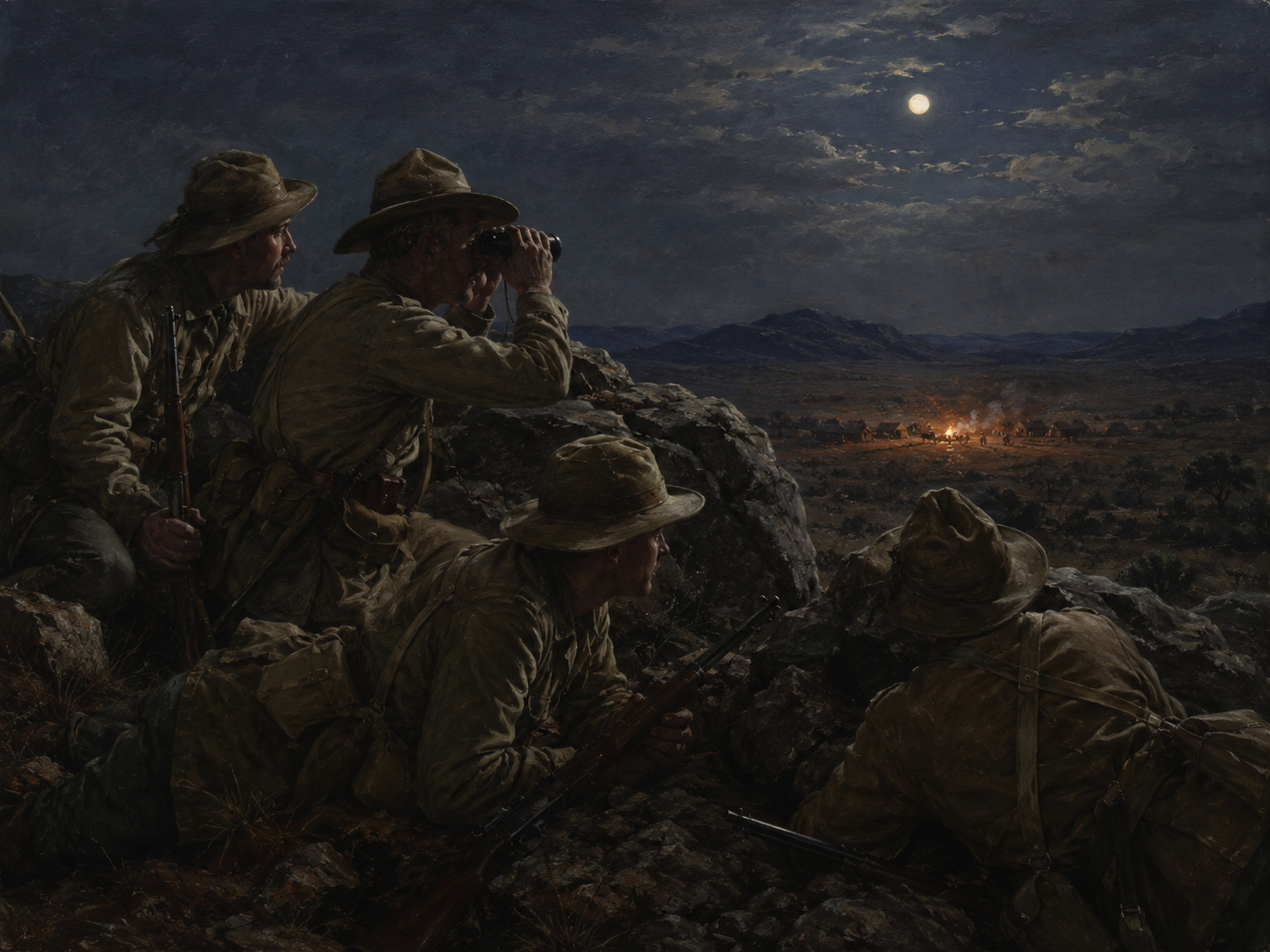
Read Article: Battalion ArrivesThe 1st Battalion of the Royal Irish Regiment reached the Cape aboard the troopship Gascon on 7 January, completing a voyage that had begun on 14 December. Its arrival formed part of Britain’s accelerating military reinforcement of South Africa after the serious reverses suffered during the opening months of the war. The soldiers disembarked into an unfamiliar summer climate after spending more than three weeks at sea, carrying rifles, uniforms, personal kit and the expectations of a campaign whose duration remained uncertain. Their landing transformed the battalion from a home-based regiment into an active component of Britain’s expanding field army.
The Royal Irish Regiment maintained its depot at Clonmel and recruited principally from Tipperary, Kilkenny, Waterford and Wexford. Its officers and men therefore carried strong connections with towns, farms and working families throughout the south-east of Ireland. News of the battalion’s safe arrival would have been followed closely by relatives awaiting letters and newspaper reports. The passage aboard the Gascon represented only the beginning of a much more demanding journey. Before confronting Boer forces, the soldiers required equipment checks, fresh supplies, transport arrangements and orders directing them from the Cape towards the inland operational districts.
The battalion was assigned to the 12th Brigade alongside the 2nd Bedfordshire, 2nd Worcestershire and 2nd Wiltshire regiments. Major-General Ralph Clements commanded the brigade, which was initially associated with the newly organised 6th Division. British commanders were attempting to recover from defeats that had exposed weaknesses in tactics, reconnaissance and mobility. The arrival of trained infantry offered badly needed strength, but the conditions of the campaign differed sharply from conventional European warfare. Boer commandos travelled rapidly across open country, used the landscape effectively and could direct accurate rifle fire from concealed positions before withdrawing beyond immediate pursuit.
For the Irish soldiers, arrival brought relief from the confinement of the voyage but introduced harsher uncertainties. Long marches, intense heat, cold nights, limited water and irregular supplies would become familiar features of service. Disease presented dangers alongside enemy fire, while horses, wagons and railway lines determined how quickly troops and provisions could move. Many men had joined the army for regular pay and security rather than any deep attachment to imperial policy. Their service nevertheless placed them inside a war that divided Irish opinion, with some nationalists openly sympathising with the Boer republics while Irish regiments continued to fight for Britain.
The battalion would soon take a prominent part in operations around Colesberg and later serve during the advance into the Orange Free State. Its arrival aboard the Gascon therefore marked the opening of a difficult campaign rather than a ceremonial landing. Behind the military record stood hundreds of individual lives, each linked to families waiting in Ireland for uncertain news. Letters might take weeks to arrive, casualty reports could be incomplete, and newspaper accounts rarely conveyed the ordinary strain of service. On 7 January, however, the immediate fact was simple: the battalion had reached South Africa safely and was preparing to enter the war.
- W. H. Ferrar, The Campaigns and History of the Royal Irish Regiment, Volume II, chapter “In South Africa: Colesberg and Bethlehem,” recording that the 1st Battalion sailed aboard the Gascon on 14 December 1899 and reached the Cape on 7 January 1900.
- War Office, The Monthly Army List, January 1900, entries for the Royal Irish Regiment, its officers, battalions and regimental depot.
- War Office, South African War medal rolls for the Royal Irish Regiment, The National Archives, series WO 100.
- Military Archives of Ireland, Information Document on the Irish Regiments of the British Army, Royal Irish Regiment entry identifying Clonmel as its depot and Tipperary, Kilkenny, Waterford and Wexford as its principal recruiting counties.
- Australian War Memorial, photographic records of the 1st Royal Irish Regiment serving in South Africa during 1900, including the battalion at Slingersfontein and soldiers preparing ammunition for outpost duty.
-
Scholar Remembered
Read Article: Scholar RememberedThe Reverend Robert King, clergyman, teacher and respected historian of the Irish church, died on 4 January after several years of declining health. Born in Cork in 1815, he had spent more than four decades in County Antrim, where he served as headmaster of the diocesan school at Ballymena. His death ended a long career combining parish work, education, historical research and Irish-language scholarship. King was buried at Broughshane, a village closely associated with the final period of his life, while former pupils, clergy and readers were left to assess the unusual range of his intellectual labour.
King received his education at Trinity College Dublin, where he distinguished himself in mathematics, Hebrew and divinity. Elected a scholar in 1835, he graduated with high honours three years later and entered the ministry of the Church of Ireland. His clerical appointments brought him through several counties before he settled in Ballymena in 1858. There he assumed responsibility for the diocesan school of Armagh and Connor, an institution intended to provide a classical and religious education. King remained its headmaster until his death, even as enrolment declined and plans developed for the school’s eventual reorganisation.
His reputation extended far beyond the classroom. King devoted much of his life to the history of Christianity in Ireland, producing studies that examined early churches, ecclesiastical authority, religious institutions and the development of Irish Christianity. His best-known work, A Primer of the History of the Holy Catholic Church in Ireland, appeared in three volumes between 1849 and 1855. Although written from a Protestant perspective, the study drew upon manuscripts, earlier histories and ecclesiastical records at a time when Irish church history was becoming an increasingly serious field of scholarship.
King also possessed a sustained interest in the Irish language. He prepared educational and devotional works in Irish, produced a grammar and participated in the revision of an Irish version of the Book of Common Prayer. His engagement with the language was significant during a century when Irish was declining rapidly in many districts and was often neglected by Protestant institutions. King believed that clergy working among Irish-speaking communities required some knowledge of the language. His scholarship therefore connected religious history, linguistic study and practical ministry, even though many of his conclusions reflected the theological controversies of his time.
The school King directed had only a small number of pupils by the end of his life, and an official reorganisation was already anticipated. After his death, the institution developed into what became Ballymena Academy, giving his educational career a lasting connection with one of the town’s principal schools. He left a widow, Harriette, and a large family, including sons who entered professional and clerical life. His books, notes and surviving papers preserved decades of work on Irish religious history, while his burial at Broughshane marked the close of a life shaped by scholarship, ministry and teaching.
- Linde Lunney, “King, Robert,” Dictionary of Irish Biography, Royal Irish Academy, biographical entry for Robert King (1815–1900).
- Calendar of Wills and Administrations, District Registry of Belfast, 1900, probate entry for the Reverend Robert King of Ballymena, County Antrim, who died on 4 January 1900.
- Robert King, A Primer of the History of the Holy Catholic Church in Ireland, three volumes, Dublin, 1849–1855.
- Church of Ireland Representative Church Body Library, manuscripts and papers of the Reverend Robert King, including notes on Irish church history and correspondence concerning his scholarly and educational work.
- George Dames Burtchaell and Thomas Ulick Sadleir, editors, Alumni Dublinenses: A Register of the Students, Graduates, Professors and Provosts of Trinity College Dublin, Dublin, 1935, entry for Robert King.
-
Recruitment Intensifies
Read Article: Recruitment IntensifiesA fresh sequence of enlistments was entered for the Royal Irish Regiment as recruiting activity increased during the South African War. The new names reflected the widening demand for soldiers after the British Army suffered heavy reverses during the closing weeks of 1899. Recruiting offices were encouraging suitable men to enter regular service, while reservists were being recalled and additional forces prepared for overseas deployment. For many Irish families, the war was no longer a remote imperial struggle reported from distant battlefields. It had begun to influence employment decisions, household income and the movements of young men across towns and rural districts.
The Royal Irish Regiment drew much of its manpower from Tipperary, Waterford, Kilkenny and Wexford, with its regimental depot established at Victoria Barracks in Clonmel. Its location placed the regiment within easy reach of men travelling through Munster in search of military employment. Recruits did not always enter the regiment most closely associated with their home county, as vacancies, recruiting arrangements and personal connections could determine where they were accepted. The enlistments recorded on 2 January therefore formed part of a broader military system that moved men between local recruiting offices, regional depots, training establishments and battalions preparing for active service abroad.
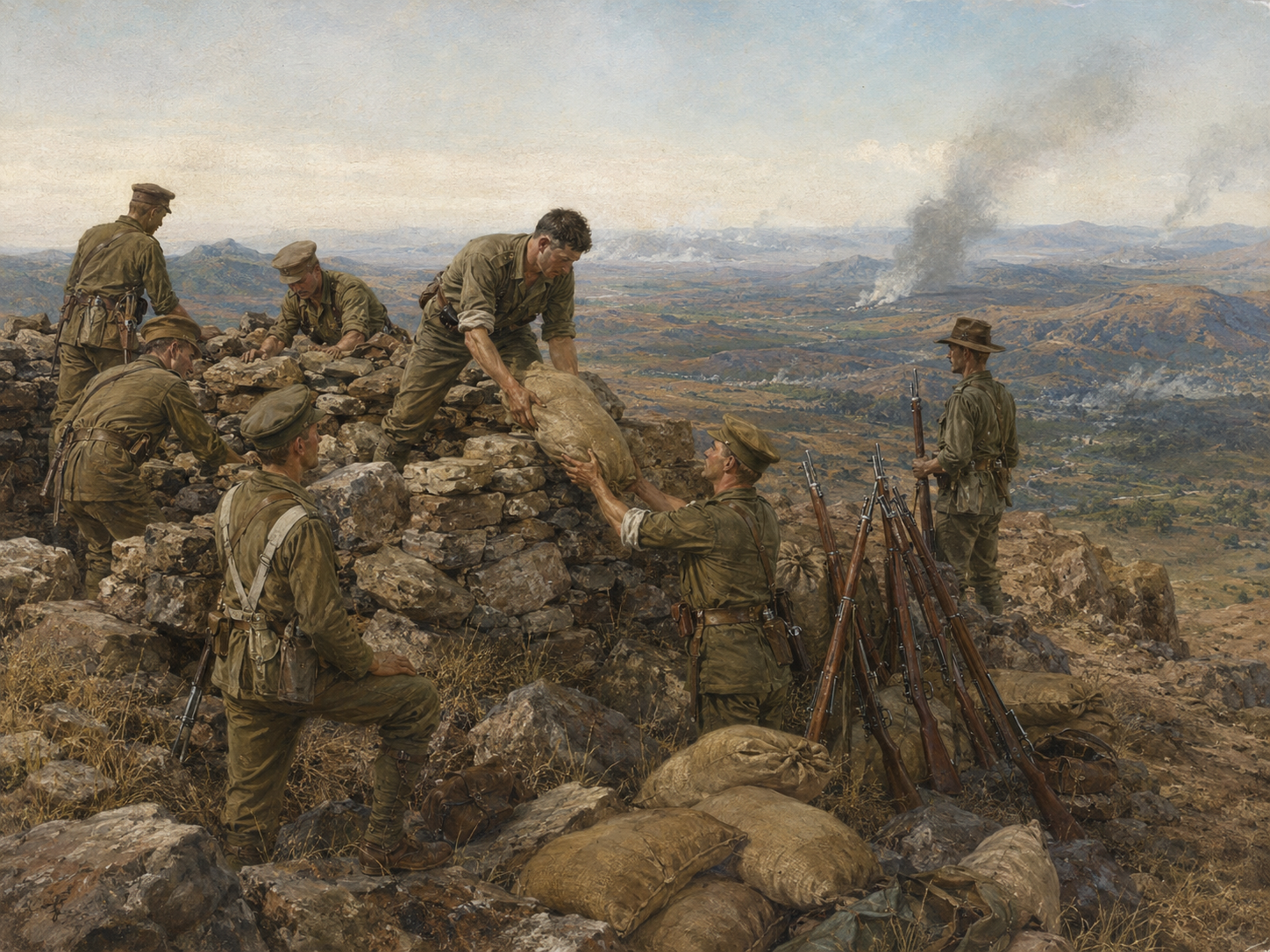
Recruitment had acquired greater urgency following the British defeats of December 1899, a period widely remembered as Black Week. Boer forces had demonstrated unexpected strength, mobility and marksmanship, while British commanders faced the difficulties of reinforcing armies operating across vast distances. The 1st Battalion of the Royal Irish Regiment had already sailed for South Africa and was approaching the Cape when the latest enlistments were entered. New soldiers could not be transformed immediately into experienced infantrymen, but each attestation strengthened the reserve from which the regiment could replace casualties, maintain home duties and prepare future drafts for overseas service.
For working men, enlistment could represent both danger and opportunity. Army service offered regular pay, food, clothing and accommodation at a time when secure civilian employment was difficult to obtain. The decision to enlist was rarely individual in its consequences. Parents could lose a son’s contribution to the household, wives might depend upon military allowances, and younger relatives could find themselves carrying additional responsibilities. Letters and newspaper reports linked Irish homes to military camps and battlefields thousands of miles away. Recruitment was therefore shaped not only by patriotism or imperial enthusiasm, but also by poverty, uncertainty, family tradition and the practical search for a dependable livelihood.
The new entries also revealed the complicated relationship between Ireland and the British Army. Nationalist opposition to the South African campaign existed alongside a long tradition of Irish military service. Men could criticise British policy while relatives wore British uniforms, and communities could oppose the war while supporting soldiers’ families. Such contradictions were especially visible in Munster, where military barracks, recruiting routes and generations of army employment formed part of everyday life. The enlistments recorded on 2 January were modest administrative entries, yet behind each name stood a personal decision capable of altering a household and carrying an Irish recruit into the expanding conflict.
- British Army service and attestation records, Royal Irish Regiment enlistments dated 2 January 1900, War Office personnel series.
- War Office, The Monthly Army List, January 1900, entries for the Royal Irish Regiment and its Clonmel depot.
- War Office, South African War medal rolls and battalion records for the Royal Irish Regiment, The National Archives, series WO 100.
- Royal Irish Regiment campaign records concerning the 1st Battalion’s departure for South Africa in December 1899 and arrival at the Cape in January 1900.
- Contemporary Irish and British newspaper reports from December 1899 and January 1900 concerning recruiting, mobilisation, reservists and military reverses in South Africa.
-
Grazing Dominance
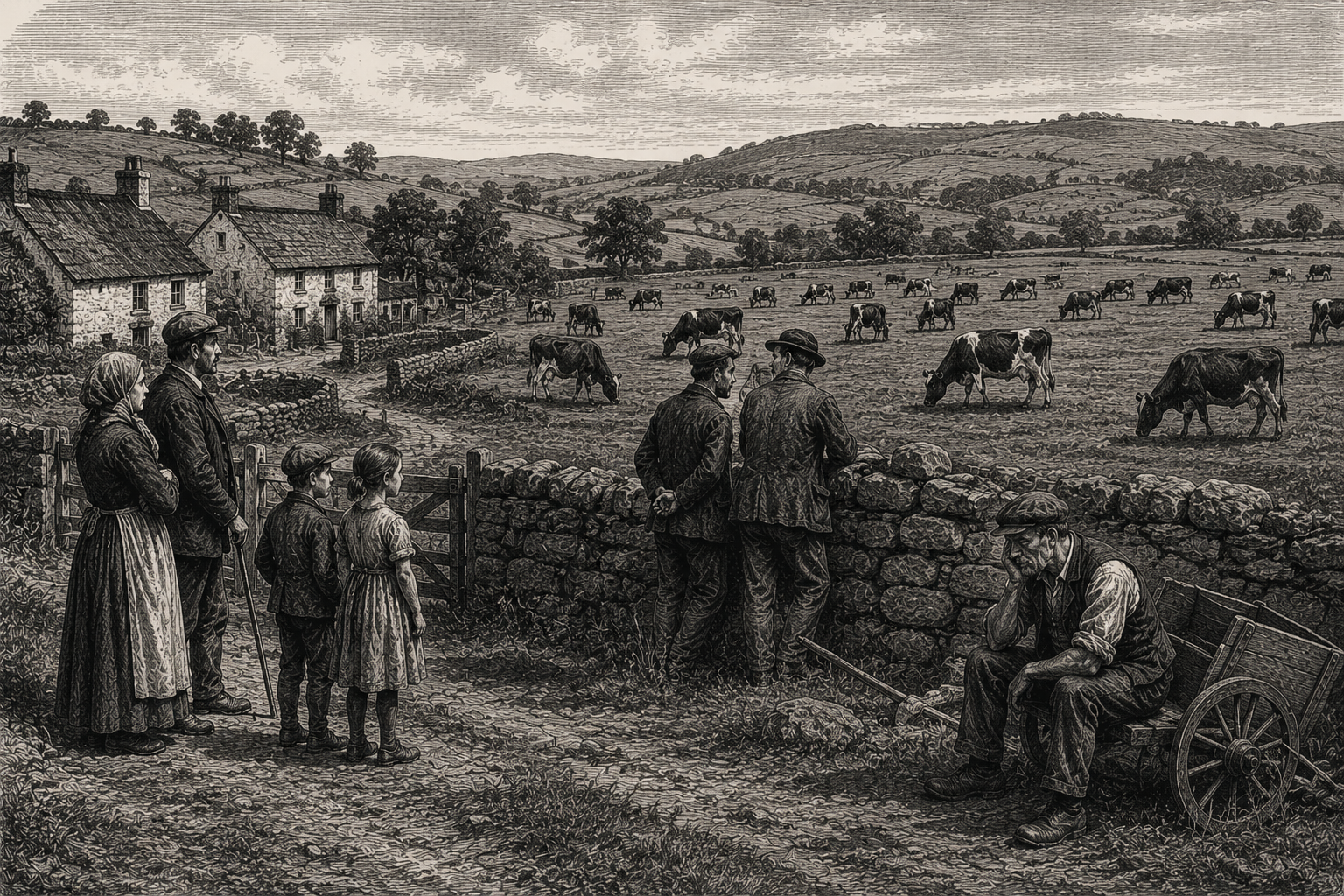
Read Article: Grazing DominanceCattle grazing remains more profitable than tillage in many Irish districts, encouraging landowners and substantial occupiers to devote extensive farms to livestock rather than labour-intensive cultivation. The difference is keenly felt in County Limerick, where broad grasslands can support valuable cattle while requiring comparatively few permanent workers. Families dependent upon agricultural wages find fewer opportunities wherever ploughing, sowing, weeding and harvesting give way to grazing. Supporters of the existing system point to dependable livestock markets and lower operating costs, but critics argue that profitable land is failing to sustain the number of people it once employed.
Tillage requires labour throughout much of the agricultural year. Fields must be prepared, planted, maintained and harvested, creating work for ploughmen, labourers, carters, women and seasonal hands. Grazing demands fewer workers once fences, water and pasture are properly maintained. A large cattle farm may therefore produce a satisfactory return for its occupier while providing little employment to neighbouring households. The contrast has strengthened complaints that agricultural profitability is being measured without sufficient attention to the number of families supported by the land or the condition of labourers left dependent upon irregular hiring.
The expansion of grazing is also connected with changes in markets and farming practice. Irish cattle can be raised upon grass and sold for finishing or slaughter in Britain, offering producers access to a large commercial market. Tillage farmers face uncertain weather, fluctuating grain prices and competition from imported produce. Many occupiers consequently regard livestock as the safer investment. Yet land campaigners maintain that private calculations have created a wider public injury, particularly where extensive grass farms stand near cramped holdings whose occupants require additional acreage to achieve even modest security.
Rural unemployment contributes directly to migration and population decline. Labourers unable to obtain sufficient work may travel to other counties or cross the Irish Sea for seasonal employment. Younger men and women frequently conclude that permanent emigration offers greater security than remaining in districts where agricultural work continues to contract. Their departure weakens local trade, reduces school attendance and leaves ageing relatives responsible for farms and households. County Limerick’s market towns may still benefit from cattle fairs and livestock commerce, but prosperity measured through sales does not necessarily reach cottages in which employment has disappeared.
The conflict between grazing and tillage has therefore become part of the broader Irish land question. Campaigners seek the division of large grass farms and the enlargement of smallholdings, arguing that land should support families as well as cattle. Graziers answer that they are using their farms according to market conditions and cannot be expected to maintain uneconomic cultivation merely to provide employment. The dispute places commercial freedom against social necessity. In Limerick, its consequences are visible wherever fertile pasture produces valuable livestock while labouring families confront unemployment, seasonal absence and the continuing loss of population from the countryside.
- Department of Agriculture and Technical Instruction for Ireland, Agricultural Statistics of Ireland with Detailed Report for the Year 1900, Dublin: His Majesty’s Stationery Office, 1901. Consult the county tables concerning tillage acreage, pasture, livestock and agricultural production. Exact table and page should be confirmed before formal citation.
- Census of Ireland, 1901, County of Limerick Tables, Dublin: His Majesty’s Stationery Office. Consult the returns concerning population change, agricultural occupations and rural districts. Exact volume, table and page should be confirmed before formal citation.
- Irish Agricultural Organisation Society, Annual Report for 1900, Dublin: Irish Agricultural Organisation Society. Consult the reports concerning livestock farming, rural employment, agricultural organisation and population loss. Exact page and section should be confirmed before formal citation.
- House of Commons Debates, 1900, debates concerning Irish agriculture, grazing farms, congested districts and rural depopulation. The precise debate, date, volume, column and speaker must be identified before formal citation.
- Limerick Chronicle, 1900, reports concerning cattle fairs, grazing farms, agricultural employment, tillage and rural conditions in County Limerick. Exact issue, page and column should be confirmed before formal citation.
-
Creamery Rivalry
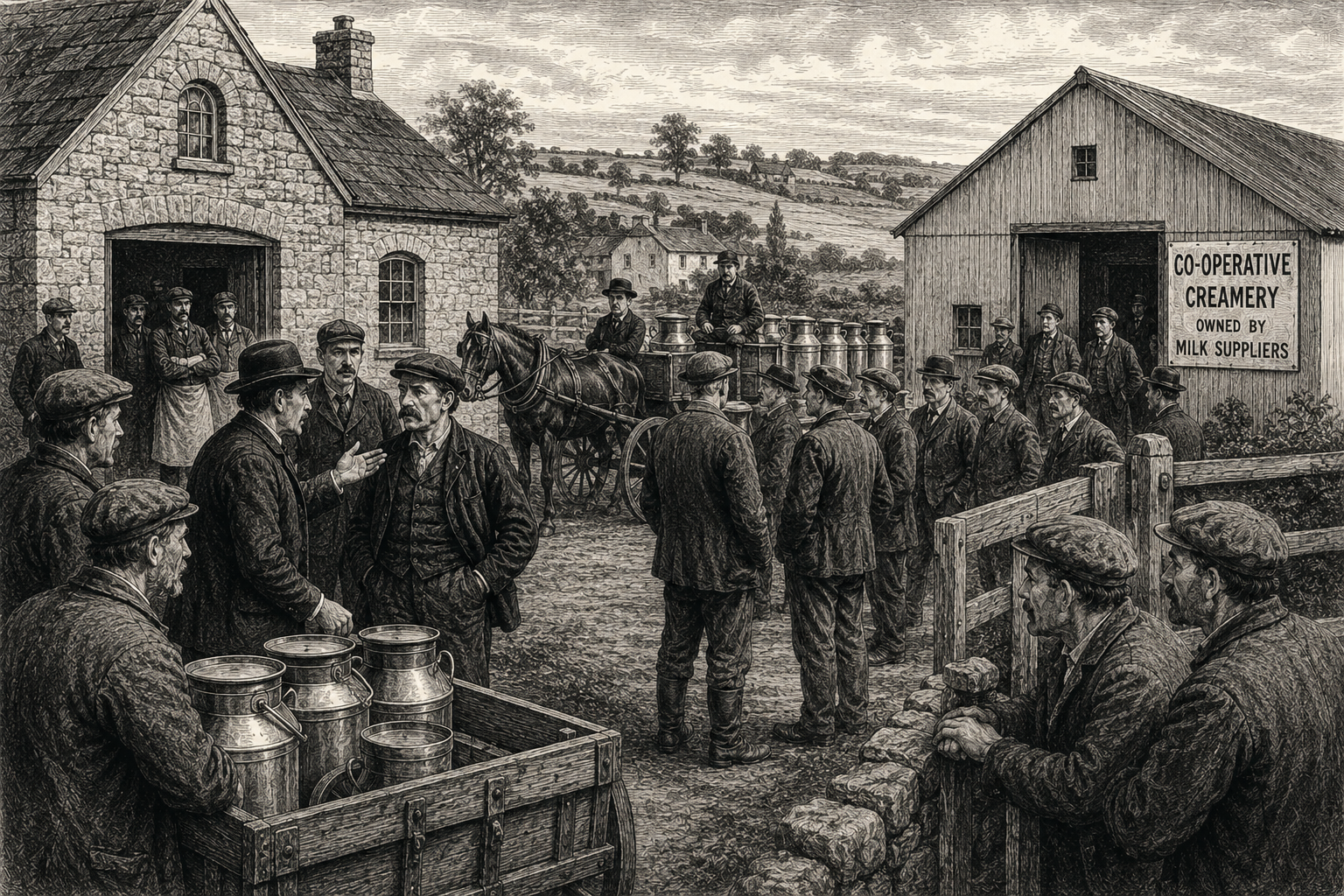
Read Article: Creamery RivalryLocal disputes are arising between co-operative creameries owned by milk suppliers and privately operated concerns seeking to retain control of established dairying districts. The rivalry is especially significant in County Limerick, where cattle, milk and butter provide income for farmers, labourers, carriers and merchants. Co-operative organisers argue that producers should collectively own the machinery through which their milk is processed and marketed. Private proprietors answer that independently managed businesses can offer efficient service without requiring farmers to invest capital, accept committee authority or assume responsibility for commercial losses.
Competition centres upon the daily supply of milk. No creamery can operate successfully without obtaining sufficient quantities from neighbouring farms, and rival establishments may offer different prices, collection arrangements or credit terms to attract suppliers. A private proprietor may raise payments when a co-operative society opens nearby, while co-operators warn that such inducements may disappear once their organisation has been weakened. Farmers must decide whether immediate returns outweigh the longer-term advantages claimed for collective ownership. Their decisions can divide families and neighbours whose milk travels along the same roads but reaches competing churns.
The Irish Agricultural Organisation Society assists communities wishing to establish farmer-owned creameries, providing advice on rules, shareholding, accounts and management. Its supporters regard each new society as an attempt to return commercial power to those producing the milk. Private firms and established butter interests may regard that intervention as an organised attack upon legitimate enterprise. County Limerick has already played an important part in the development of co-operative dairying, although individual establishments have not always remained under co-operative ownership. The movement’s progress has therefore involved reversals, conversions and continued competition rather than an uninterrupted advance.
Disputes may extend beyond prices into access to machinery, transport routes, skilled managers and markets for finished butter. A creamery losing suppliers can quickly become uneconomic, while farmers who have purchased shares may fear that desertion by neighbours will leave them responsible for debt. Private businesses also possess capital and trading connections that newly formed societies may lack. Co-operative committees must demonstrate that democratic control can coexist with discipline, technical competence and prompt payment. Poor accounts or inferior butter can damage the movement as seriously as external opposition, giving private competitors evidence that collective ownership is impractical.
For rural Limerick, these struggles concern more than rivalry between neighbouring buildings. They determine who controls the value created from milk, who bears commercial risk and how much authority farmers exercise over the sale of their produce. A successful co-operative may retain profits locally and teach members to manage shared business affairs. A successful private concern may offer dependable employment and purchasing without requiring collective investment. The continuing disputes reveal a countryside testing two competing forms of enterprise, with milk suppliers deciding whether their future lies principally with proprietor-led commerce or with organisations owned and governed by farmers themselves.
- Irish Agricultural Organisation Society, Annual Report for 1900, Dublin: Irish Agricultural Organisation Society. Consult the creamery statistics, affiliated-society lists and organisers’ reports. Exact page and table should be confirmed before formal citation.
- Irish Homestead, 1900, contemporary reports and editorial commentary concerning co-operative creameries, private competition, milk supplies and butter marketing. Exact issue, page and column should be confirmed before formal citation.
- Horace Plunkett, Ireland in the New Century, London: John Murray, 1904. Consult the chapters concerning agricultural co-operation, creamery organisation and resistance from established commercial interests.
- Department of Agriculture and Technical Instruction for Ireland, Agricultural Statistics of Ireland with Detailed Report for the Year 1900, Dublin: His Majesty’s Stationery Office, 1901. Exact livestock, dairying and butter-production tables should be confirmed before formal citation.
- Limerick Chronicle, 1900, reports concerning creamery ownership, milk prices, butter markets and agricultural organisation in County Limerick. Exact issue, page and column should be confirmed before formal citation.
-
Creamery Contest
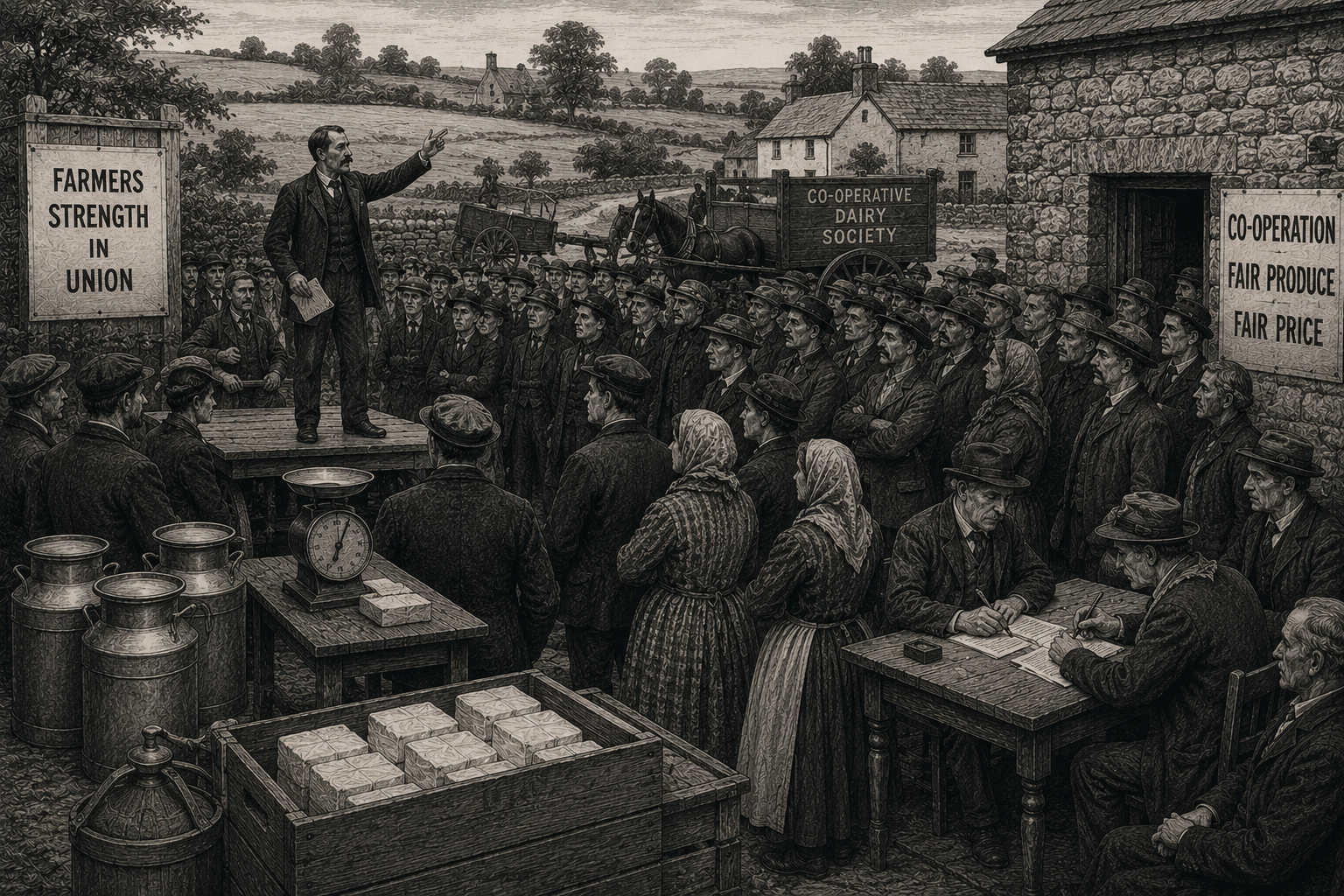
Read Article: Creamery ContestAgricultural co-operation is challenging the private commercial control long exercised over Irish butter production and marketing. Farmer-owned creameries allow milk suppliers to combine their resources, process milk by machinery and sell butter through organisations answerable to their members. The movement carries particular importance in County Limerick, where dairying supports farmers, labourers, carriers, merchants and rural households. Supporters argue that producers should receive a greater share of the value created from their milk instead of remaining dependent upon private creamery proprietors, butter buyers and commercial intermediaries whose interests may not coincide with those of farming communities.
Under the co-operative system, local farmers purchase shares, elect a committee and undertake to supply milk to a central creamery. Mechanical separation and organised churning can produce butter of more consistent quality than scattered household production, while collective marketing may strengthen the farmers’ position when negotiating prices. Surpluses remain within the society rather than passing entirely to an outside owner. Success nevertheless demands competent management, accurate accounts and loyalty from suppliers. A society can be weakened when members divide their milk between competing establishments or accept temporary inducements offered by private firms seeking to preserve control of a district.
The Irish Agricultural Organisation Society, founded in 1894, has encouraged the formation of creameries and other farmer-owned enterprises under the influence of Horace Plunkett and his fellow organisers. Travelling representatives convene meetings, explain the principles of shared ownership and assist communities in drawing up rules. Limerick has become closely connected with this work through early societies formed in its dairying districts. Co-operation is presented not merely as a new method of manufacturing butter but as a means by which farmers may learn collective business management, scrutinise expenditure and exercise greater authority over the route their produce takes to market.
Private proprietors and established butter interests have not surrendered their position without resistance. Rival creameries may compete aggressively for milk, raise payments in districts where a co-operative society appears and reduce them when that threat has passed. Merchants accustomed to controlling purchase and resale may regard farmer-owned marketing as an intrusion into legitimate commerce. Co-operators answer that individual suppliers possess little bargaining power when dealing separately with larger concerns. The dispute therefore concerns not only machinery or butter quality but the ownership of rural enterprise, the distribution of profits and the authority to determine how agricultural produce is sold.
For County Limerick, the outcome may shape the economic life of entire communities. A successful co-operative creamery can create employment, encourage improved cattle breeding, support transport services and provide a regular gathering place for farmers. It can also retain locally a portion of the income formerly absorbed by private intermediaries. Failure, however, may leave members burdened by debt and restore control to commercial competitors. Agricultural co-operation has consequently become both a practical business experiment and a challenge to inherited trading relationships, asking whether those who supply the milk can also own the machinery, supervise production and share the proceeds of the butter market.
- Irish Agricultural Organisation Society, Annual Report for 1900, Dublin: Irish Agricultural Organisation Society. Consult the creamery statistics, affiliated-society lists and reports of organising activity. Exact page and table should be confirmed before formal citation.
- Irish Homestead, 1900, contemporary reports and editorial commentary concerning co-operative creameries, private competition, butter production and agricultural organisation. Exact issue, page and column should be confirmed before formal citation.
- Horace Plunkett, Ireland in the New Century, London: John Murray, 1904. Consult the chapters describing the origins, commercial purpose and difficulties of agricultural co-operation.
- Department of Agriculture and Technical Instruction for Ireland, Agricultural Statistics of Ireland with Detailed Report for the Year 1900, Dublin: His Majesty’s Stationery Office, 1901. Exact dairy, livestock and butter-production tables should be confirmed before formal citation.
- Limerick Chronicle, 1900, reports concerning creameries, butter markets, milk prices and agricultural organisation in County Limerick. Exact issue, page and column should be confirmed before formal citation.
-
Creamery Expansion
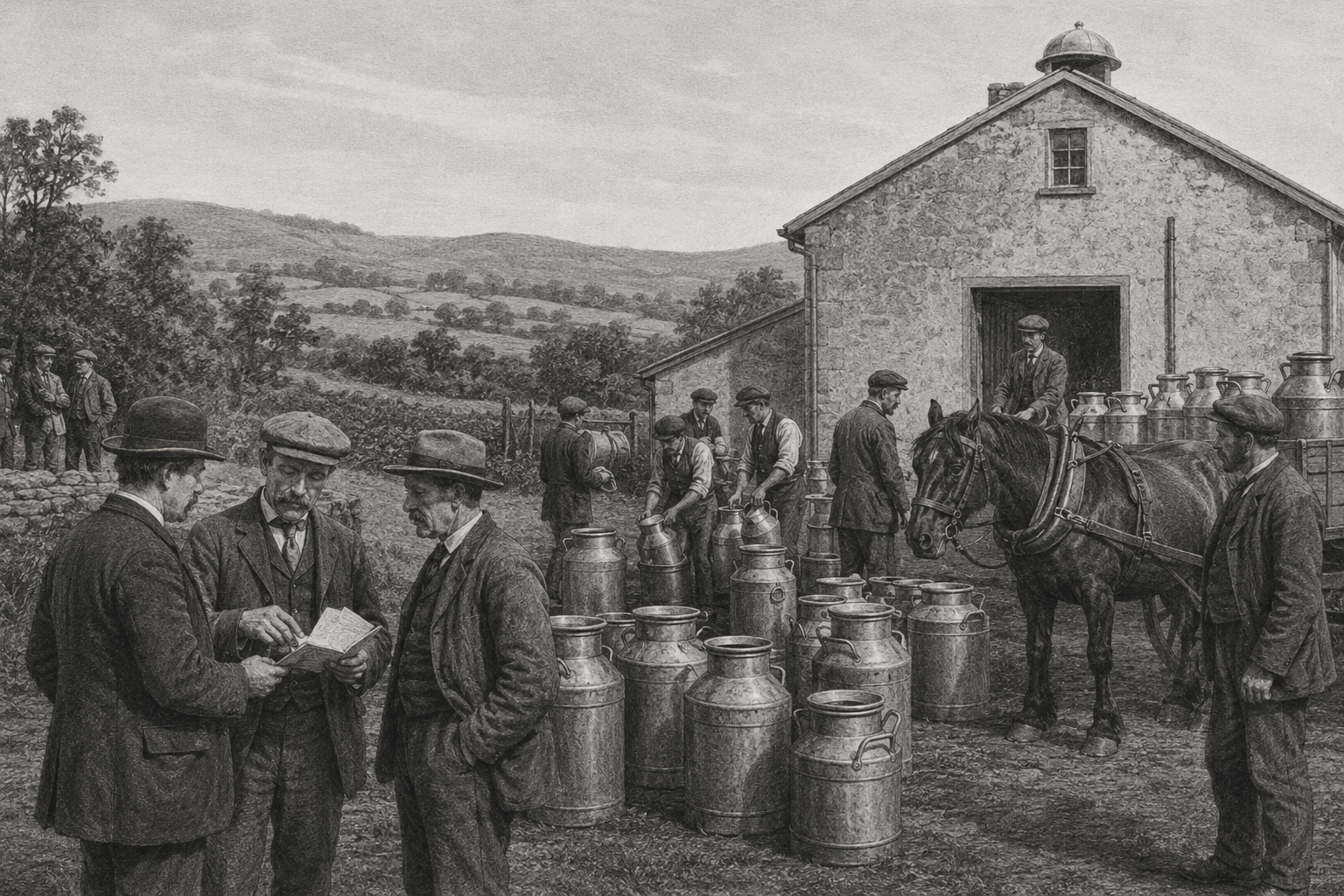
Read Article: Creamery ExpansionCo-operative creameries continue to spread across rural Ireland under the influence of Horace Plunkett and the Irish Agricultural Organisation Society. The movement encourages farmers to combine their milk, capital and labour so that butter can be produced by modern machinery, graded to a consistent standard and sold through an organisation owned by the suppliers themselves. County Limerick, with its strong dairying tradition and growing network of creameries, occupies an important place in this agricultural transformation. Supporters argue that co-operation allows small farmers to overcome disadvantages that none could manage alone.
A co-operative creamery is established when local farmers purchase shares and agree to supply milk to a central facility. Mechanical separators remove cream more efficiently than many household methods, while trained managers supervise production, cleanliness, accounts and marketing. After operating expenses are met, the value created by the business belongs to its members rather than an outside proprietor. The system requires trust, regular milk supplies and careful administration. A poorly managed society can fail, but a successful creamery may secure better prices, improve butter quality and provide a dependable commercial centre for the surrounding countryside.
Plunkett has promoted agricultural co-operation since the late 1880s, arguing that rural prosperity requires better farming, sound business practice and stronger community organisation. The Irish Agricultural Organisation Society, founded in 1894, sends organisers into the countryside to explain co-operative principles, assist farmers in drafting rules and advise newly formed societies. Its annual reports record the expansion of affiliated creameries, agricultural societies, credit associations and other rural enterprises. The organisation’s purpose is not to operate every creamery directly but to help farmers establish and govern businesses capable of serving their own districts.
The movement faces determined commercial opposition. Privately owned creameries and butter merchants fear the loss of milk supplies and local influence, while the British Co-operative Wholesale Society has also established Irish creameries to serve its own extensive market. Rival businesses may compete for suppliers by adjusting prices or opening facilities near existing societies. Co-operative organisers warn that temporary inducements can weaken farmer-owned ventures before outside buyers regain control. Political and religious disagreements may also divide communities, although Plunkett insists that practical economic interests should unite farmers regardless of party or denomination.
In Limerick, the spread of co-operative dairying may influence far more than butter production. Creameries create employment, encourage improved cattle breeding, increase demand for transport and bring farmers into regular commercial contact. Meetings and shared accounts also teach members how to conduct collective business, elect committees and scrutinise management. The wider significance lies in transferring economic power towards local producers, although success depends upon loyalty, competent administration and access to markets. The co-operative creamery is becoming both an agricultural institution and a rural meeting place, offering farming families a means of strengthening their position through organised self-help.
- Irish Agricultural Organisation Society, Annual Report for 1900, Dublin: Irish Agricultural Organisation Society. Consult the lists and statistical tables concerning affiliated co-operative creameries, membership and trading activity. Exact page and table should be confirmed before formal citation.
- Horace Plunkett, Ireland in the New Century, London: John Murray, 1904. Consult the chapter concerning agricultural co-operation and the work of the Irish Agricultural Organisation Society.
- Irish Homestead, 1900, reports and commentary concerning co-operative creameries, dairy farming and agricultural organisation. Exact issue, page and column should be confirmed before formal citation.
- Department of Agriculture and Technical Instruction for Ireland, Agricultural Statistics of Ireland with Detailed Report for the Year 1900, Dublin: His Majesty’s Stationery Office, 1901. Exact dairy and livestock tables should be confirmed before formal citation.
- Limerick Chronicle, 1900, reports concerning creameries, butter markets, milk suppliers and co-operative organisation in County Limerick. Exact issue, page and column should be confirmed before formal citation.
-
Farming Progress
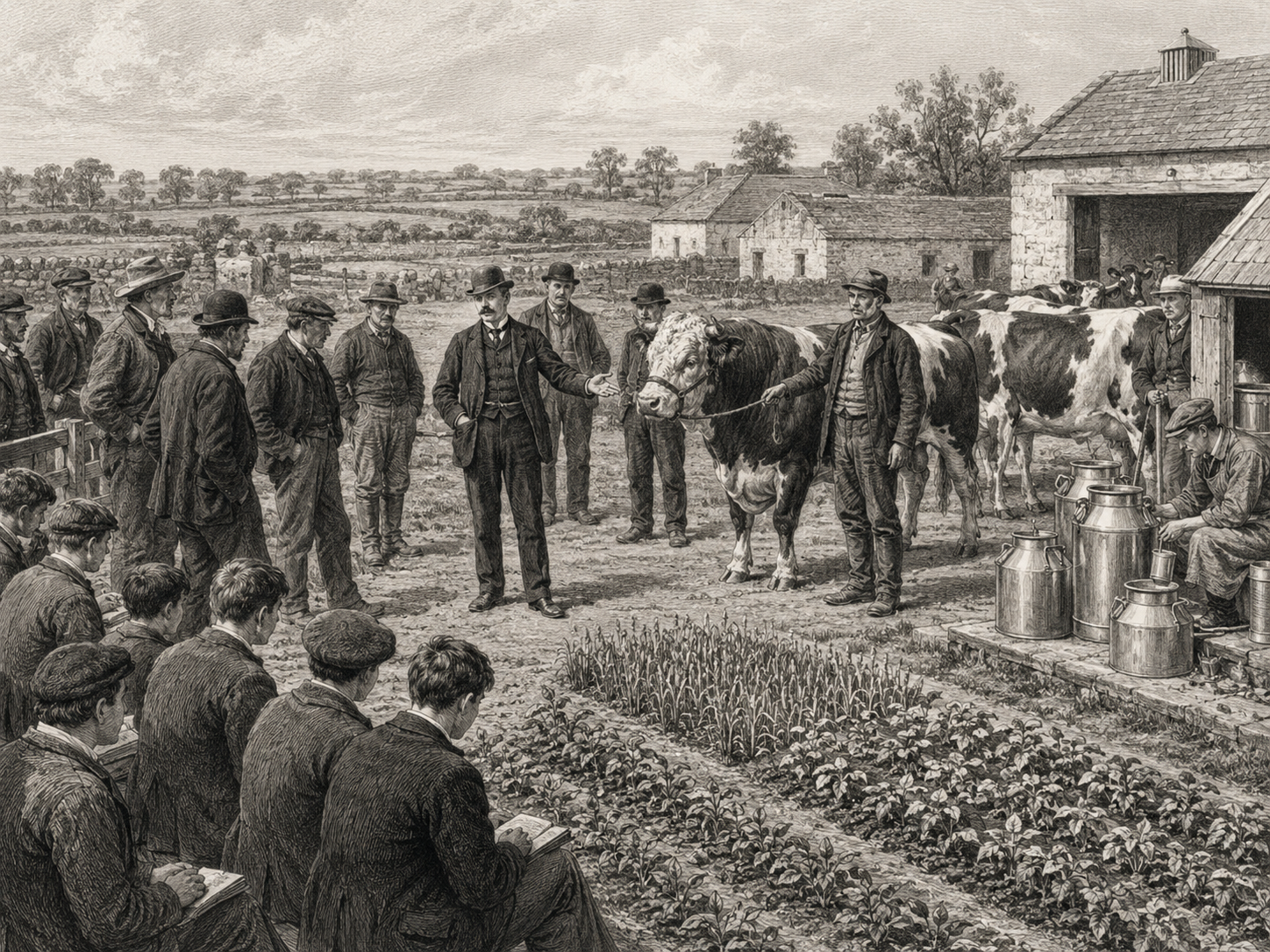
Read Article: Farming ProgressThe Department of Agriculture and Technical Instruction is promoting improved farming methods, livestock breeding, dairying and practical education as part of its new programme for Irish rural development. Established under the Agriculture and Technical Instruction Act of 1899, the Department has begun bringing agricultural advice, scientific knowledge and technical training under one central authority. Farmers in County Limerick are watching closely, particularly in districts where cattle raising, milk production and butter making sustain local households, creameries, merchants and labourers. The initiative promises a more organised relationship between government, local committees, agricultural societies and the people working directly upon the land.
Improved methods are expected to reach farms through instructors, demonstrations, experiments and publications explaining crop cultivation, animal care and the efficient use of land. Traditional experience remains valuable, but the Department argues that tested scientific methods can help farmers recognise disease, improve soil, select seed and obtain better results from limited holdings. County committees may adapt schemes to local conditions, allowing instruction to reflect the importance of dairying and livestock in Munster. The practical value of the programme will depend upon whether advice reaches small farmers as readily as prosperous landowners and whether recommended improvements can be afforded by households possessing little spare capital.
Livestock breeding forms another important branch of the Department’s work. Better bulls, improved herd management and closer attention to animal health may increase the quality and value of Irish cattle. Stronger breeding practices could benefit County Limerick farmers selling animals at fairs or supplying milk to local creameries. The Department’s responsibilities also extend towards controlling animal disease and supervising regulations affecting livestock. Farmers have often suffered severe losses when illness spreads through a herd, making veterinary knowledge and early detection economically important. Scientific breeding, however, must be introduced carefully so that useful local breeds are strengthened rather than displaced without regard for regional conditions.
Dairying has become increasingly important to agricultural improvement. Cooperative creameries are demonstrating that organised production, machinery and careful handling can raise butter quality and improve access to larger markets. By the end of 1900, Ireland possessed 193 central creameries and seventy-seven auxiliaries, while cooperative dairy societies had attracted more than 26,000 members. The new Department is assuming responsibility for technical instruction that had previously been undertaken by voluntary agricultural organisations. In Limerick, where milk, butter and cattle already occupy a major place in rural commerce, improved dairy education may affect household income, creamery employment and the reputation of local produce.
Technical education is intended to connect rural schooling with useful employment rather than confine instruction to abstract subjects. Classes in dairying, poultry keeping, horticulture, machinery and domestic economy may help young people develop skills suited to farms, creameries and local industries. The Department’s success will be measured by whether instruction produces visible improvements in output, income and living conditions. For Limerick families, better farming cannot be separated from secure work, affordable housing and the possibility of remaining at home. Agricultural education offers no immediate cure for poverty, but it may give farmers and labourers practical tools with which to confront it.
- Agriculture and Technical Instruction (Ireland) Act, 1899, 62 & 63 Vict., c. 50. The Act established the Department, Council of Agriculture, Agricultural Board and Board of Technical Instruction.
- Department of Agriculture and Technical Instruction for Ireland, Journal, Volume I, Dublin: His Majesty’s Stationery Office, 1900–1901. Exact issue, article and page should be confirmed before formal citation.
- Department of Agriculture and Technical Instruction for Ireland, Agricultural Statistics of Ireland with Detailed Report for the Year 1900, Dublin: His Majesty’s Stationery Office, 1901. Exact section, table and page should be confirmed before formal citation.
- Horace Plunkett, Ireland in the New Century, London: John Murray, 1904. Consult the chapters discussing agricultural cooperation, technical instruction and the Department’s early work.
- Report from the Recess Committee on the Establishment of a Department of Agriculture and Industries for Ireland, Dublin, 1896. Exact edition and page should be confirmed before formal citation.
-
Farming Department
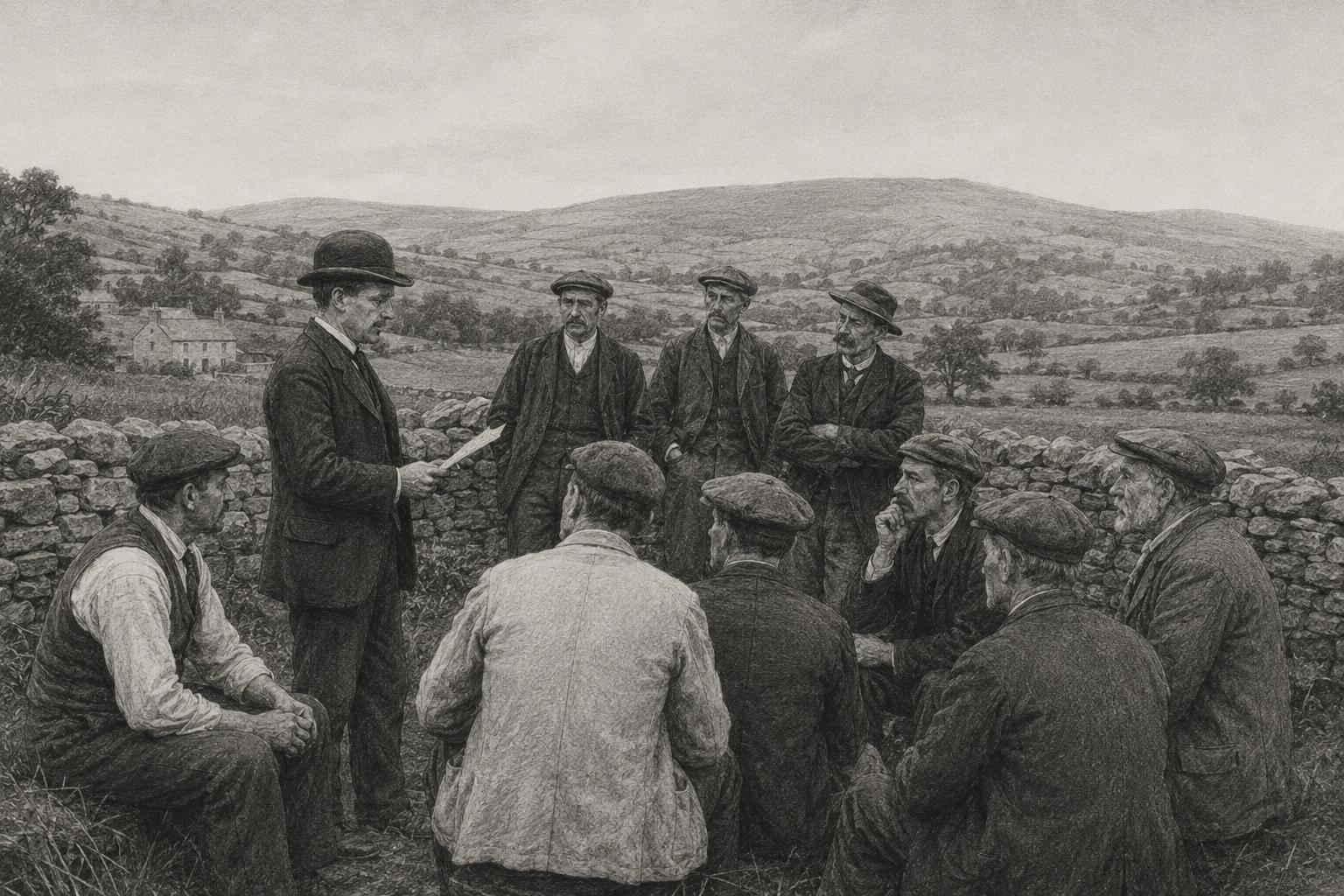
Read Article: Farming DepartmentThe newly established Department of Agriculture and Technical Instruction for Ireland has begun assuming responsibility for agricultural development, scientific instruction and several services previously divided among different public bodies. Created by legislation passed in 1899, the Department is intended to bring greater organisation to farming, fisheries, rural industries and technical education. Its emergence is being closely watched in County Limerick, where farmers, labourers, teachers and local representatives hope that practical instruction and improved scientific knowledge will strengthen agricultural production and create opportunities beyond traditional methods inherited within families.
The new authority has inherited responsibility for collecting agricultural statistics, supervising measures against destructive insects and regulating fertilisers and feeding stuffs. It will also assume functions connected with fisheries and important agricultural institutions, including the Munster Institute. These powers give the Department an unusually broad influence over rural development. Rather than dealing solely with crops and livestock, it is expected to encourage technical knowledge, local industries and better methods of production. Supporters believe that Irish farming can become more efficient when practical experience is reinforced by scientific testing, organised instruction and reliable information about markets and agricultural conditions.
County and local committees are expected to play an important role in shaping programmes suited to their districts. In Limerick, where dairying, cattle raising, tillage and agricultural labour remain central to economic life, instruction may include improved breeding, butter production, poultry keeping, horticulture and the treatment of plant or animal disease. Travelling instructors and demonstration schemes could bring new methods directly to farmers who cannot attend distant colleges. Technical classes may also benefit young people seeking employment in trades or rural industries, although much will depend upon funding, local participation and the availability of qualified teachers.
The Department’s creation reflects years of concern that Ireland lacked a coordinated system for developing its agricultural and industrial resources. Reformers associated with the Recess Committee studied systems operating abroad and argued that education must be connected directly with the realities of Irish economic life. Horace Plunkett, appointed vice-president of the new Department, has long promoted agricultural cooperation and practical self-help. His involvement has encouraged hopes that creameries, farming organisations and educational bodies will work together, although political opponents remain suspicious of any institution administered under British authority.
For ordinary Limerick families, the Department will be judged by visible results rather than administrative promise. Farmers require healthier livestock, dependable seed and better access to technical advice. Labourers need secure employment, improved housing and opportunities to acquire useful skills. Young men and women need instruction capable of opening livelihoods at home rather than preparing them only for emigration. The Department now possesses powers extending across agriculture, fisheries, statistics and technical education. Whether those powers can improve incomes and daily conditions throughout rural Ireland will become clearer as its programmes move from legislation into farms, classrooms, creameries and local communities.
- Agriculture and Technical Instruction (Ireland) Act, 1899, 62 & 63 Vict., c. 50, granted Royal Assent on 9 August 1899. The Act established the Department and transferred to it functions concerning agriculture, statistics, fisheries, technical instruction and agricultural institutions.
- Department of Agriculture and Technical Instruction for Ireland, Agricultural Statistics of Ireland with Detailed Report for the Year 1900, Dublin: His Majesty’s Stationery Office, 1901. Exact table and page should be confirmed before formal citation.
- Department of Agriculture and Technical Instruction for Ireland, Journal, Volume I, Dublin: His Majesty’s Stationery Office, 1900–1901. Exact issue, article and page should be confirmed before formal citation.
- Report from the Recess Committee on the Establishment of a Department of Agriculture and Industries for Ireland, Dublin, 1896. Exact edition and page should be confirmed before formal citation.
- Limerick Chronicle, 1900, reports concerning agricultural instruction, local technical-education schemes, farming organisations and the new Department’s activities. Exact issue, page and column should be confirmed before formal citation.
-
Labourers Organise
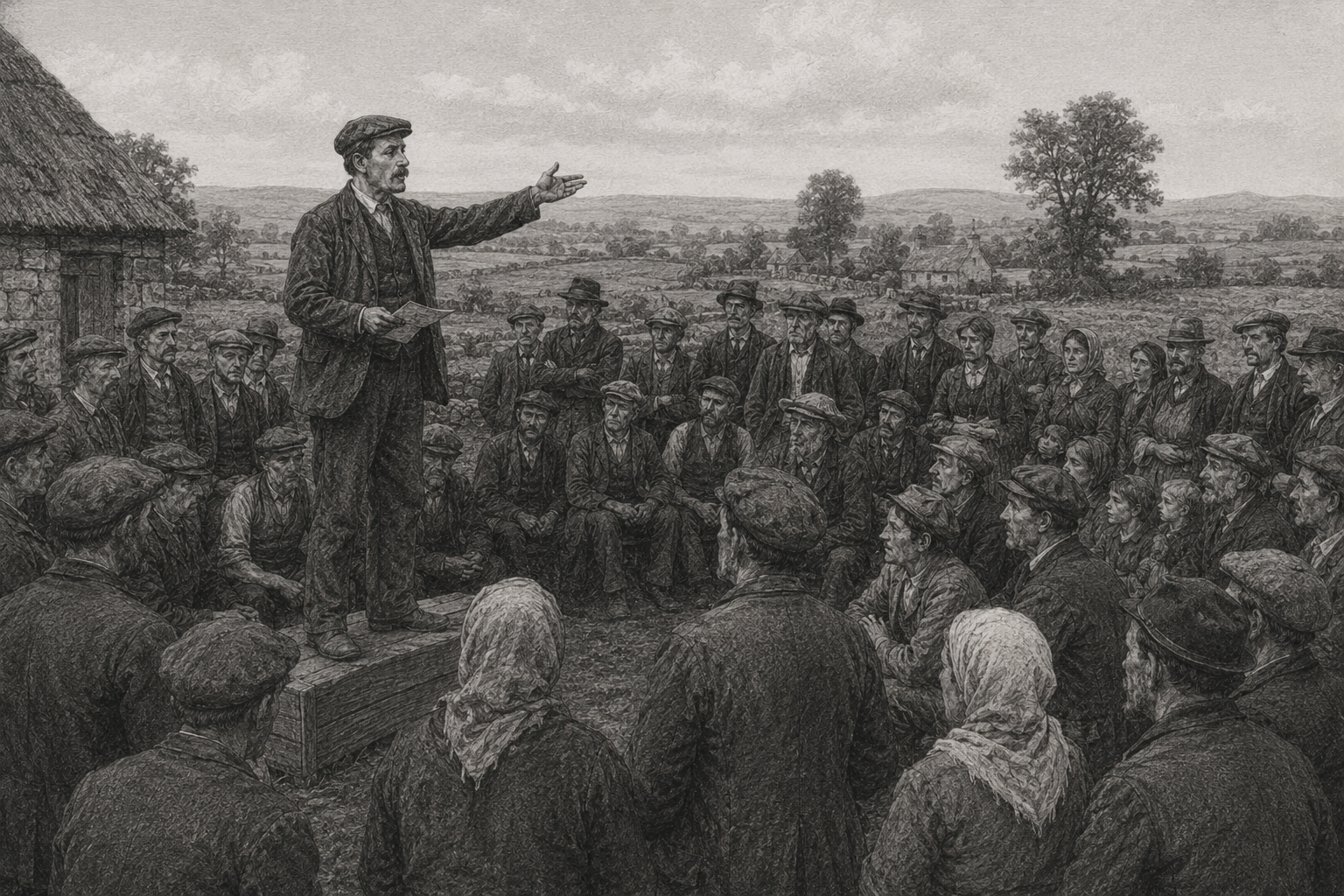
Read Article: Labourers OrganiseAgricultural labourers throughout County Limerick and the wider Munster countryside continue to campaign for better cottages, fairer wages and access to small plots of land. Their position remains distinct from that of tenant farmers seeking ownership of the farms they occupy. Labourers frequently possess neither secure employment nor property, depending instead upon seasonal hiring, daily wages and accommodation controlled by farmers or landlords. Public meetings increasingly insist that any settlement of the Irish land question must include the men and women whose labour sustains agriculture but who remain among the countryside’s poorest inhabitants.
Housing is one of the campaign’s most urgent concerns. The Labourers Acts introduced since 1883 permit local authorities to build cottages with small allotments, yet provision remains uneven and applications may be delayed by disputes over sites, costs and local opposition. Many families continue living in damp, overcrowded or poorly maintained dwellings attached to employment. Losing work may therefore mean losing a home as well as wages. Reformers demand cottages offered at affordable rents, with enough ground for potatoes, vegetables and perhaps a pig or poultry, giving labouring households a modest measure of independence.
Wages remain uncertain and vary according to district, season, skill and the demand for workers. Employment may be plentiful during planting and harvest but scarce during winter, forcing households to depend upon credit, temporary road work or migration. Labourers argue that wages have not kept pace with the cost of food, clothing, fuel and rent. Their bargaining position is weakened when many men compete for limited work or when an employer controls both employment and accommodation. Organisation through land-and-labour associations and public demonstrations offers workers a collective means of pressing their grievances before elected councils and parliamentary representatives.
The establishment of county and rural district councils under the Local Government Act of 1898 has created new opportunities for agitation. Labourers can now direct petitions and electoral pressure towards representatives responsible for cottage schemes, roads and other local works. In County Limerick, the question is becoming a test of whether the new councils will serve landless workers as readily as farmers, merchants and property owners. Labour representatives insist that suitable cottage sites should not be rejected merely because neighbouring landowners object, while councillors must balance urgent need against borrowing costs and administrative delay.
Access to land remains inseparable from housing and wages. Even a small allotment can provide food, reduce dependence upon shop credit and allow a family to survive periods of unemployment. Campaigners therefore seek not great farms but secure cottages, gardens and sufficient ground to supplement earned income. Their demands reveal an unresolved division within rural reform: tenant purchase may transform farmers into owners while leaving labourers without property or security. Unless their claims receive equal attention, those who cultivate Ireland’s fields may remain excluded from the benefits promised by land reform and representative local government.
- Labourers (Ireland) Act, 1883, 46 & 47 Vict., c. 60. This legislation empowered sanitary authorities to develop schemes providing cottages and allotments for agricultural labourers.
- Labourers (Ireland) Act, 1885, 48 & 49 Vict., c. 77. This measure amended the earlier legislation governing rural labourers’ housing and land provision.
- Local Government (Ireland) Act, 1898, 61 & 62 Vict., c. 37. The Act established elected county and rural district councils with important responsibilities for local administration and labourers’ cottage schemes.
- Census of Ireland, 1901, County of Limerick tables concerning housing, occupations, agricultural labour and rural population. Exact volume, table and page should be confirmed before formal citation.
- Limerick Chronicle, 1900, reports concerning labourers’ cottages, agricultural wages, rural district councils and land-and-labour meetings in County Limerick. Exact issue, page and column should be confirmed before formal citation.