Battalion Arrives(c.1890s)
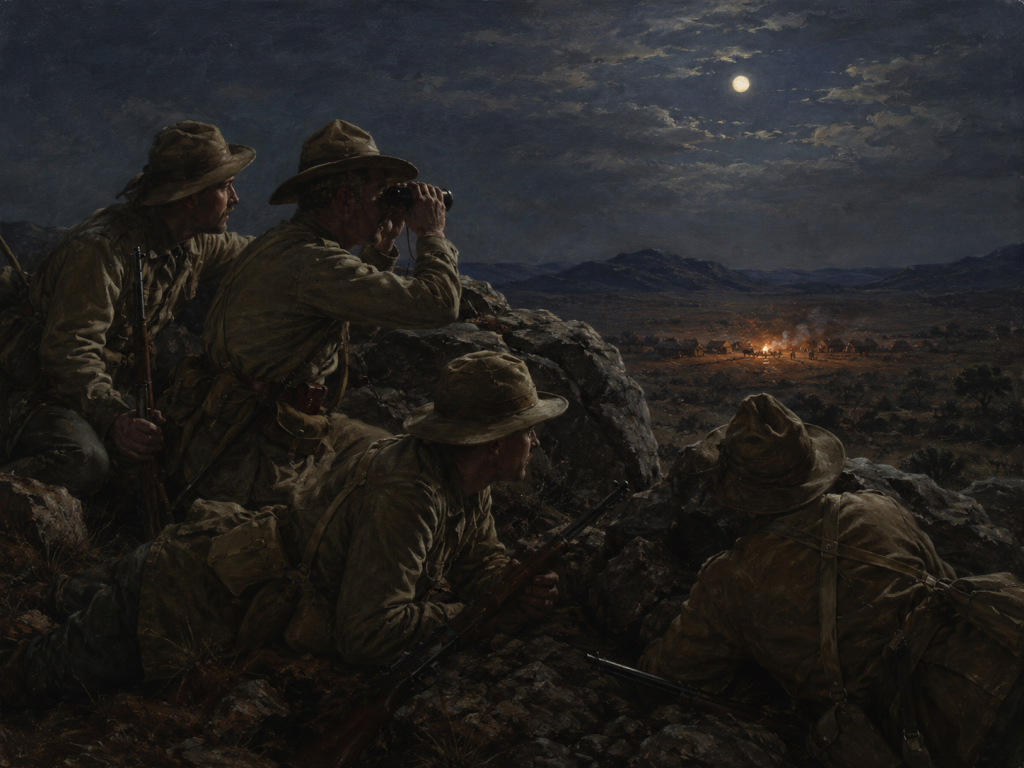
The 1st Battalion of the Royal Irish Regiment reached the Cape aboard the troopship Gascon on 7 January, completing a voyage that had begun on 14 December. Its arrival formed part of Britain’s accelerating military reinforcement of South Africa after the serious reverses suffered during the opening months of the war. The soldiers disembarked into an unfamiliar summer climate after spending more than three weeks at sea, carrying rifles, uniforms, personal kit and the expectations of a campaign whose duration remained uncertain. Their landing transformed the battalion from a home-based regiment into an active component of Britain’s expanding field army.
The Royal Irish Regiment maintained its depot at Clonmel and recruited principally from Tipperary, Kilkenny, Waterford and Wexford. Its officers and men therefore carried strong connections with towns, farms and working families throughout the south-east of Ireland. News of the battalion’s safe arrival would have been followed closely by relatives awaiting letters and newspaper reports. The passage aboard the Gascon represented only the beginning of a much more demanding journey. Before confronting Boer forces, the soldiers required equipment checks, fresh supplies, transport arrangements and orders directing them from the Cape towards the inland operational districts.
The battalion was assigned to the 12th Brigade alongside the 2nd Bedfordshire, 2nd Worcestershire and 2nd Wiltshire regiments. Major-General Ralph Clements commanded the brigade, which was initially associated with the newly organised 6th Division. British commanders were attempting to recover from defeats that had exposed weaknesses in tactics, reconnaissance and mobility. The arrival of trained infantry offered badly needed strength, but the conditions of the campaign differed sharply from conventional European warfare. Boer commandos travelled rapidly across open country, used the landscape effectively and could direct accurate rifle fire from concealed positions before withdrawing beyond immediate pursuit.
For the Irish soldiers, arrival brought relief from the confinement of the voyage but introduced harsher uncertainties. Long marches, intense heat, cold nights, limited water and irregular supplies would become familiar features of service. Disease presented dangers alongside enemy fire, while horses, wagons and railway lines determined how quickly troops and provisions could move. Many men had joined the army for regular pay and security rather than any deep attachment to imperial policy. Their service nevertheless placed them inside a war that divided Irish opinion, with some nationalists openly sympathising with the Boer republics while Irish regiments continued to fight for Britain.
The battalion would soon take a prominent part in operations around Colesberg and later serve during the advance into the Orange Free State. Its arrival aboard the Gascon therefore marked the opening of a difficult campaign rather than a ceremonial landing. Behind the military record stood hundreds of individual lives, each linked to families waiting in Ireland for uncertain news. Letters might take weeks to arrive, casualty reports could be incomplete, and newspaper accounts rarely conveyed the ordinary strain of service. On 7 January, however, the immediate fact was simple: the battalion had reached South Africa safely and was preparing to enter the war.
- W. H. Ferrar, The Campaigns and History of the Royal Irish Regiment, Volume II, chapter “In South Africa: Colesberg and Bethlehem,” recording that the 1st Battalion sailed aboard the Gascon on 14 December 1899 and reached the Cape on 7 January 1900.
- War Office, The Monthly Army List, January 1900, entries for the Royal Irish Regiment, its officers, battalions and regimental depot.
- War Office, South African War medal rolls for the Royal Irish Regiment, The National Archives, series WO 100.
- Military Archives of Ireland, Information Document on the Irish Regiments of the British Army, Royal Irish Regiment entry identifying Clonmel as its depot and Tipperary, Kilkenny, Waterford and Wexford as its principal recruiting counties.
- Australian War Memorial, photographic records of the 1st Royal Irish Regiment serving in South Africa during 1900, including the battalion at Slingersfontein and soldiers preparing ammunition for outpost duty.