Mountshannon House in Splendour
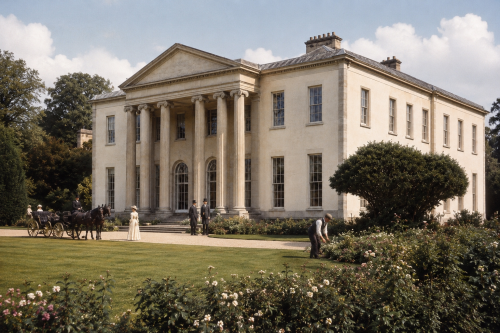
Mountshannon House, near Castleconnell in County Limerick, was one of Ireland’s grandest eighteenth-century mansions. Built around 1750, it later gained a monumental Ionic portico during an 1813 remodelling by architect Lewis Wyatt. Tradition claimed the house contained 365 windows, while its vast entrance hall could accommodate a horse-drawn carriage. Surrounded by a 900-acre demesne between the River Shannon and Mulkear River, its celebrated gardens were designed by John Sutherland. Home to the powerful FitzGibbon family, including John “Black Jack” FitzGibbon, 1st Earl of Clare, the mansion became a renowned centre of political influence, hospitality, wealth, political power, and aristocratic life.
Pery Square
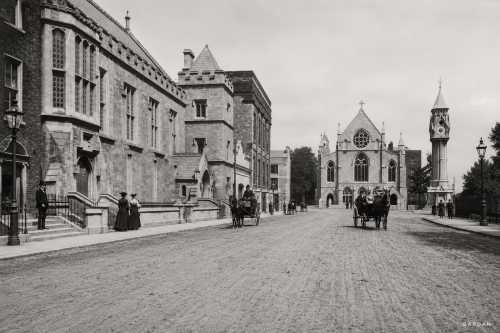
Around 1900, Pery Square presented one of Limerick’s most elegant urban settings, facing the newly opened People’s Park and framed by distinctive Georgian terraces. The celebrated Tontine Buildings, built between 1835 and 1838 as a speculative venture, gave the square a story as unusual as its architecture. Their shares, tied to named lives in the so-called Life and Death Lottery, were still gaining value as horse-drawn traffic, pedestrians, gas lamps, and civic buildings animated the street. The tontine was finally won in 1913 by Sophia Vanderkiste, closing a remarkable chapter in Limerick’s local social and architectural history.
Cheering Crowds
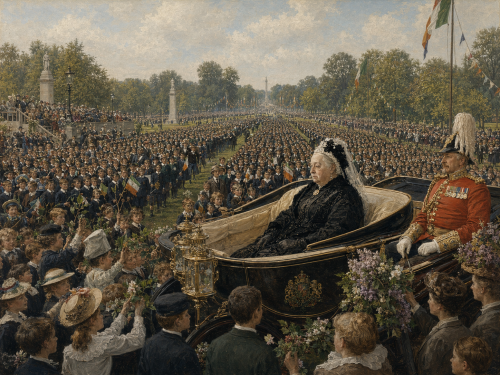
Large crowds have lined the route of Queen Victoria’s procession from Kingstown towards Dublin, creating one of the most striking public spectacles witnessed during her final visit to Ireland. The royal carriage passed through heavily decorated streets while spectators filled pavements, windows and temporary viewing places. Reports reaching Limerick describe sustained cheering as the procession moved towards the capital and the Viceregal Lodge in Phoenix Park. The gathering revealed more than official organisation alone. Public curiosity drew thousands outdoors, while loyalist residents and supporters of the Union treated the Queen’s arrival as an opportunity to demonstrate attachment to the Crown and British Empire.
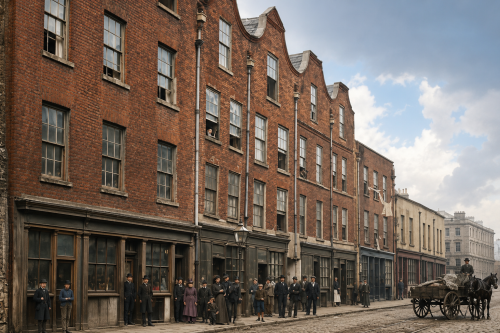
Dutch Billy Houses, Mary Street
Dutch Billy houses were once a distinctive feature of Limerick’s Englishtown and Irishtown districts. Characterised by narrow brick façades, steeply pitched gables and tall windows, the style developed in Irish towns during the late seventeenth and early eighteenth centuries. Many examples survived along Mary Street into the early twentieth century, preserving the appearance of Limerick’s merchant quarters. Their name is traditionally associated with King William III, although the term was applied broadly to gabled urban houses of the period. By around 1900, these buildings stood as reminders of the city’s commercial growth, architectural character and changing streetscape across previous centuries.
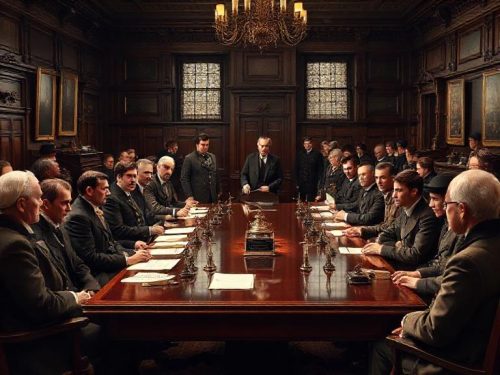
League Endorsed
The United Irish League’s campaign for nationalist unity received an important endorsement from parliamentary representatives gathered at Dublin’s Mansion House on 17 January. By appearing together and advancing negotiations for reunion, members of the rival nationalist factions acknowledged the popular demand that had grown around the League since its establishment by William O’Brien in 1898. The organisation had begun chiefly as a campaign for land reform and the enlargement of uneconomic holdings, but its branches increasingly called upon politicians to end the quarrels created by the fall of Charles Stewart Parnell and restore a united parliamentary movement.

O’Connell Street, 1937
This 1937 view of O’Connell Street, historically known as George’s Street, captures Limerick’s principal commercial thoroughfare during a period of urban transition. Georgian façades, prominent shopfronts and the landmark clock tower frame a busy scene of pedestrians, cyclists, motorcars and public transport. Heavy coats and formal dress reflect everyday life before the Second World War, while traditional businesses line both sides of the street. Several buildings and upper storeys shown here were later altered or demolished during redevelopment. Despite extensive modernisation and pedestrianisation, O’Connell Street remains central to Limerick’s commercial, architectural and social identity within the changing modern city today.

The Treaty Stone
The Treaty Stone stands on Clancy’s Strand, facing King John’s Castle across the River Shannon. Tradition holds that the Treaty of Limerick was signed upon this limestone block on 3 October 1691, ending the Williamite War in Ireland. Once used as a horse-mounting stone near Thomond Bridge, it was raised onto an ornate pedestal in 1865 by Mayor John Rickard Tinslay. The monument commemorates both surrender and betrayal, since promised protections for Catholics were later broken. Its military terms enabled thousands of Irish soldiers to leave for France and serve in Europe in the celebrated Flight of the Wild Geese.
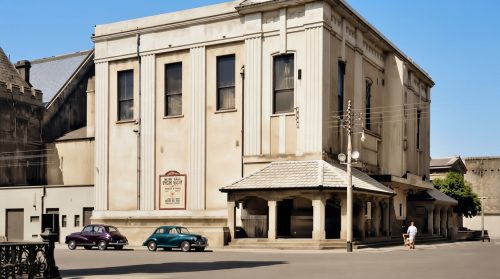
The Lyric Cinema
The Lyric Cinema on Glentworth Street was one of Limerick’s best-loved picture houses, serving generations from the silent-film era until 1976. Occupying a prominent corner site near Baker Place, Mallow Street and Pery Square, it contained stalls, a balcony, gallery and spacious auditorium. During cinema’s golden age, the Lyric became especially popular for inexpensive children’s matinees and its lively local atmosphere. Its staff joined the city’s theatrical workers’ strike in 1953. The cinema closed on 28 August 1976 after screening Operation Daybreak. Demolished in 1981, the Lyric remains fondly remembered as an important part of Limerick’s social and cultural history.
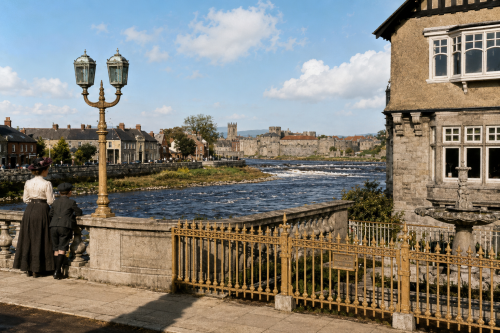
Shannon Rowing Club
Shannon Rowing Club is Limerick City’s oldest sporting institution. Founded in 1866 by entrepreneur and mayor Sir Peter Tait, the club has long been identified by its royal blue and white colours. Its historic headquarters on Wellesley Pier beside Sarsfield Bridge opened in 1905. Designed by William Clifford Smith, the listed Edwardian Arts and Crafts building remains one of the city’s most distinctive sporting landmarks. The clubhouse supports dry training through gym equipment, static bicycles and rowing machines, while also providing space for snooker and chess. It continues to represent Limerick’s rowing tradition and community spirit.