Terminus Tragedy

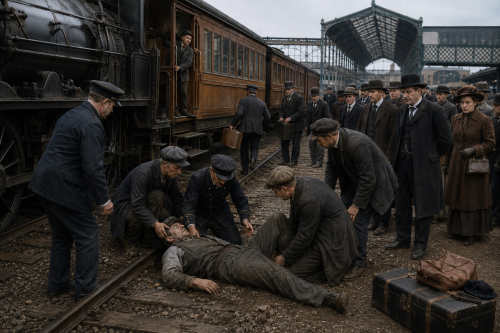
A serious accident at Limerick railway terminus left labourer James Davoren requiring the amputation of his right leg. The Irish Times reported on 2 January 1900 that Davoren had gone to the station to see his brother, described as a solicitor, depart by train for Fermoy. During the farewell, he fell from the platform onto the permanent way and was caught beneath the passing train. Railway staff and bystanders found him lying on the rails after the carriages had cleared. He was removed without delay to Barrington’s Hospital, where surgeons determined that the injured limb could not be saved.
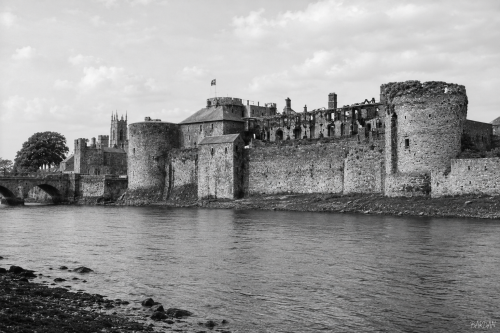
King John’s Castle (1922)

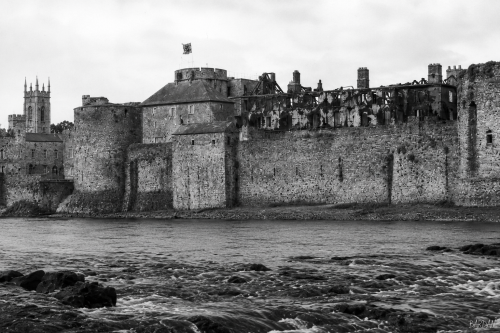
King John’s Castle stands beside the River Shannon at Curragower Falls, with broken water, river rocks and the castle’s stone frontage visible across the scene. The round towers, curtain walls and riverside defences remain central, while the burned Castle Barracks appears roofless and blackened within the enclosure. Thomond Bridge is visible to the left, with nearby trees, older buildings and a church tower rising beyond the castle walls. The river surface shows ripples, reflections and shallow movement below the fortifications. The image presents the castle after damage, set within the wider early twentieth century Limerick urban riverside landscape after 1922.

O’Connell Street, 1937

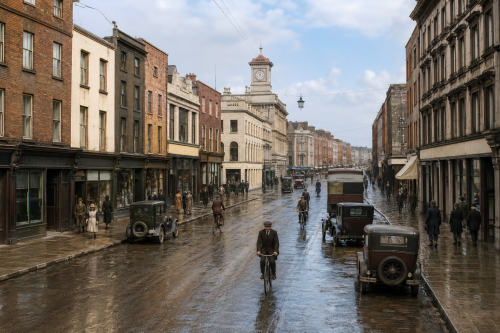
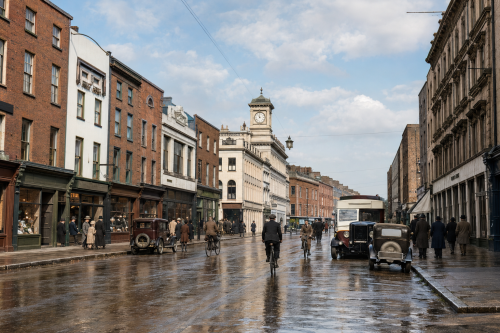
This 1937 view of O’Connell Street, historically known as George’s Street, captures Limerick’s principal commercial thoroughfare during a period of urban transition. Georgian façades, prominent shopfronts and the landmark clock tower frame a busy scene of pedestrians, cyclists, motorcars and public transport. Heavy coats and formal dress reflect everyday life before the Second World War, while traditional businesses line both sides of the street. Several buildings and upper storeys shown here were later altered or demolished during redevelopment. Despite extensive modernisation and pedestrianisation, O’Connell Street remains central to Limerick’s commercial, architectural and social identity within the changing modern city today.

King John’s Castle (1922)

King John’s Castle stands beside the River Shannon at Curragower Falls, with broken water, river rocks and the castle’s stone frontage visible across the scene. The round towers, curtain walls and riverside defences remain central, while the burned Castle Barracks appears roofless and blackened within the enclosure. Thomond Bridge is visible to the left, with nearby trees, older buildings and a church tower rising beyond the castle walls. The river surface shows ripples, reflections and shallow movement below the fortifications. The image presents the castle after damage, set within the wider early twentieth century Limerick urban riverside landscape after 1922.

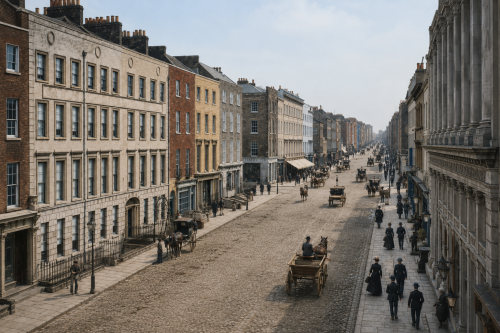
A Busy Day On George Street

George Street, now O’Connell Street, formed the bustling commercial and social heart of Limerick around 1900. Elegant Georgian and Victorian façades lined the thoroughfare, their ornate shopfronts illuminated by gaslight and filled with goods for local shoppers. Horse-drawn carriages, jaunting cars and merchant carts crowded the roadway, while pedestrians in heavy coats and hats moved between businesses and hotels. The grand Cruises Royal Hotel stood among the street’s most prominent landmarks, welcoming merchants, travellers and visitors. This scene reflects the energy of late-Victorian Limerick before motor traffic transformed the city’s principal shopping street and historic urban centre during a changing era.

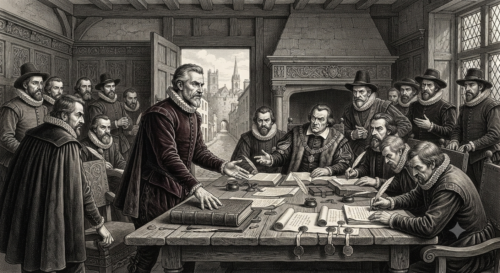
Civic Defiance

Edmond Sexten inherited his family’s extensive Limerick property around 1594 and became one of the most powerful, persistent and controversial figures in the city’s early seventeenth-century government. A grandson and namesake of the Tudor mayor who had acquired the former lands of St Francis’s and St Mary’s religious houses, Sexten served as an alderman, held the mayoralty several times and repeatedly occupied the office of high sheriff. His municipal service did not produce harmony with Limerick Corporation. Instead, much of his adult life was consumed by arguments over whether his inherited lands stood inside or beyond the authority of the city’s mayor and council.

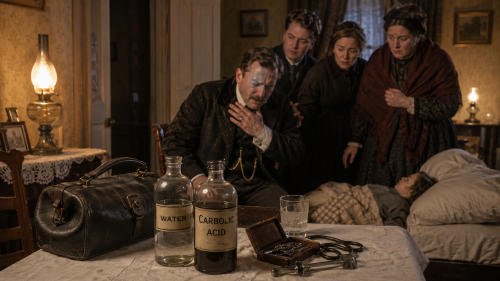
Fatal Confusion

Cappamore and the surrounding district lost a medical practitioner in early February 1900 when Dr Charles Philip Tennant died after accidentally swallowing carbolic acid during an evening visit to a family at Rath. Tennant served patients across the Cappamore and Murroe area, where a country doctor might travel considerable distances to reach sick people in their homes. The surviving reports describe no deliberate act and no dispute over the cause. An ordinary medical call ended in tragedy because two liquids carried to the house were confused, turning a customary gesture of hospitality into a fatal emergency.

Estates Reorganised

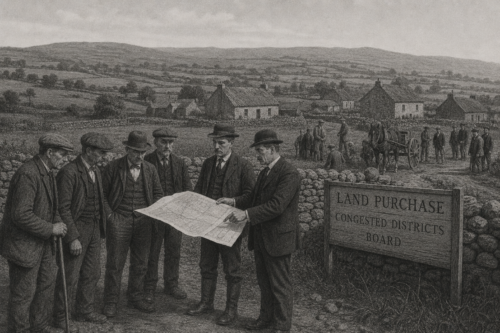
The Congested Districts Board is continuing its efforts to purchase and reorganise estates in the poorest districts of western Ireland. Created in 1891 to relieve chronic rural poverty, the Board has increasingly turned towards land purchase as a means of enlarging uneconomic farms, combining scattered plots and moving selected families from overcrowded districts onto more productive ground. Its work is concentrated principally in Connacht and the western counties, where generations of subdivision have left many households dependent upon holdings too small or infertile to provide a secure living.

O’Connell Street, 1937

This 1937 view of O’Connell Street, historically known as George’s Street, captures Limerick’s principal commercial thoroughfare during a period of urban transition. Georgian façades, prominent shopfronts and the landmark clock tower frame a busy scene of pedestrians, cyclists, motorcars and public transport. Heavy coats and formal dress reflect everyday life before the Second World War, while traditional businesses line both sides of the street. Several buildings and upper storeys shown here were later altered or demolished during redevelopment. Despite extensive modernisation and pedestrianisation, O’Connell Street remains central to Limerick’s commercial, architectural and social identity within the changing modern city today.

New Nationalism

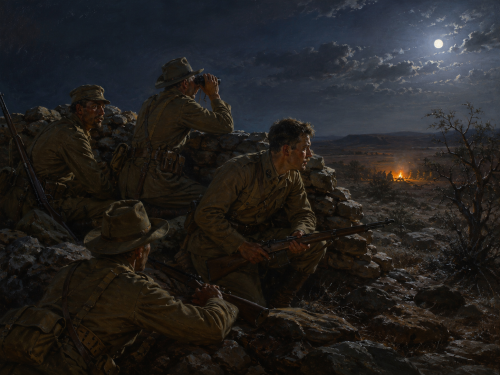
Pro-Boer feeling is giving renewed confidence to younger Irish nationalists who have grown dissatisfied with the pursuit of Home Rule solely through the British Parliament. In Limerick, admiration for the resistance of the Transvaal and Orange Free State has entered political meetings, newspaper discussions and conversations among cultural revivalists. Many continue to support the reunited Irish Parliamentary Party, yet others ask whether speeches and negotiated concessions can secure genuine national freedom. To these younger activists, the Boer struggle appears to show that a small nation must cultivate its own institutions, resources and determination rather than depend upon imperial goodwill.

Now Sharing: Articles (154) | Images (196) | Total Items Archived (350)
Our Mission: 100,000 Items | Total Percentage Achieved (0.35%)