League Endorsed(c.1900s)
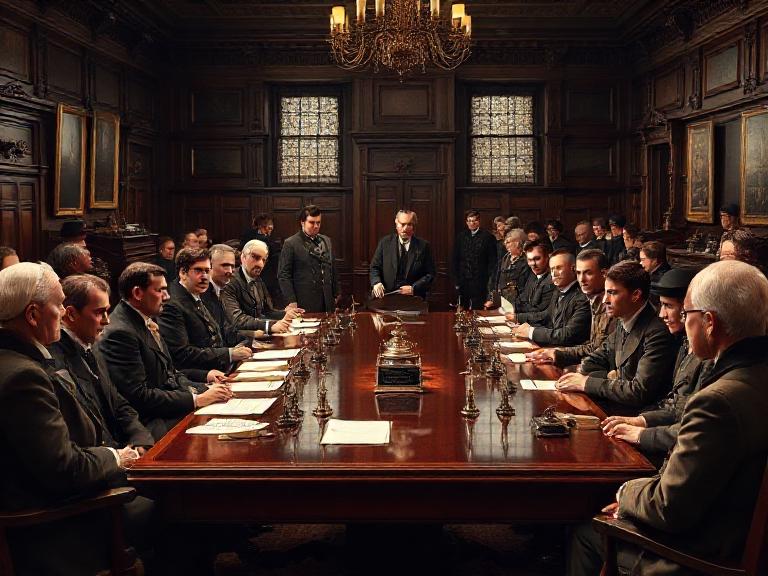
The United Irish League’s campaign for nationalist unity received an important endorsement from parliamentary representatives gathered at Dublin’s Mansion House on 17 January. By appearing together and advancing negotiations for reunion, members of the rival nationalist factions acknowledged the popular demand that had grown around the League since its establishment by William O’Brien in 1898. The organisation had begun chiefly as a campaign for land reform and the enlargement of uneconomic holdings, but its branches increasingly called upon politicians to end the quarrels created by the fall of Charles Stewart Parnell and restore a united parliamentary movement.
The endorsement demonstrated how greatly the balance of influence within constitutional nationalism had changed. During the 1890s, the rival parliamentary groups had maintained separate leaderships, organisations and loyalties while claiming to represent the same national electorate. The United Irish League developed outside those exhausted divisions and gathered support among tenant farmers, rural organisers and local political activists. Its rapid growth gave it an authority that established politicians could no longer dismiss. Representatives attending the Mansion House conference understood that reunion was required not merely to improve their position at Westminster, but to retain the confidence of supporters organising independently throughout Ireland.
William O’Brien had presented political unity as necessary for pursuing the land question with sufficient strength. The League opposed the concentration of extensive grazing lands in relatively few hands and demanded measures that would allow small farmers and congested communities to obtain viable holdings. These economic grievances gave the campaign for unity a practical foundation. Local members were not being asked simply to forget past political quarrels; they were being promised that a reunited movement could exert greater pressure for land purchase, redistribution and national self-government. The Mansion House proceedings indicated that parliamentary representatives were prepared to recognise that argument.
Support for the League did not mean that every politician accepted O’Brien’s methods, programme or growing personal influence. John Redmond, John Dillon, Timothy Healy and their respective followers retained different views about leadership, discipline and the future organisation of the nationalist movement. Some feared that the League might challenge sitting members or allow local activists to control parliamentary selection. Nevertheless, the public endorsement of its appeal for unity strengthened the League’s claim to speak for a broad body of nationalist opinion. The organisation had succeeded in making continued factional conflict appear increasingly indefensible before voters tired of political weakness and personal recrimination.
The development helped prepare the reunion of the Irish Parliamentary Party under John Redmond later in January. It also anticipated the League’s emergence as the principal grassroots organisation supporting the reunited party. The relationship would not remain free from disagreement, but the events of 17 January showed that popular organisation could shape decisions made by parliamentary leaders. The United Irish League had turned land agitation into a broader demand for national political discipline. Its endorsement at the Mansion House represented a significant victory for activists who believed that constitutional nationalism could recover its influence only by reconnecting parliamentary action with organised opinion across Ireland.
- Freeman’s Journal, 18 January 1900, report of the Mansion House conference and negotiations among the nationalist parliamentary factions.
- Philip Bull, “The United Irish League and the Reunion of the Irish Parliamentary Party, 1898–1900,” Irish Historical Studies, volume 26, number 101, May 1988, pages 51–78.
- John Redmond Papers, National Library of Ireland, correspondence and political papers concerning nationalist reunion and the United Irish League.
- United Irish League, Constitution and Rules Adopted by the Irish National Convention, 19–20 June 1900, Dublin, Swan & Company, 1900.
- F. S. L. Lyons, The Irish Parliamentary Party, 1890–1910, London, 1951, discussion of the League’s expansion and its influence upon parliamentary reunion.