Clare’s Second Verdict1829 CE
In 1829, Catholic Emancipation transformed Irish constitutional politics after Daniel O’Connell’s 1828 Clare election and the Catholic Association’s mass mobilisation forced Wellington’s government to act. The Roman Catholic Relief Act, assented to on 13 April, enabled Catholics taking a new oath to enter Parliament and many public offices, though it preserved the Protestant state settlement and excluded them from certain positions. Simultaneously, the Irish election law raised the county freehold qualification from forty shillings to £10, disfranchising many poor Catholic voters. O’Connell’s pre-Act election required a Clare by-election, which he won unopposed. Protestant opposition persisted; Gerald Griffin’s novel reflected society.
Dateline
In 1829 Ireland’s most consequential event was not a battle, a rebellion or a change of government in Dublin Castle, but a constitutional concession won through mass political organisation. On 13 April the Roman Catholic Relief Act received royal assent. It removed central civil disabilities which had long excluded Roman Catholics from parliamentary office and much public life within the United Kingdom. For the Catholic majority in Ireland, the measure was a landmark. Yet its passage came tied to a severe contraction of the Irish county electorate. The year therefore joined emancipation to disfranchisement: an advance in eligibility for office, purchased in part by reducing the voting power of many of the small freeholders who had helped make the advance unavoidable.
A Crisis Made Constitutional
The immediate background belonged to the years before 1829, but it determined the shape of this one. Daniel O’Connell, a Kerry-born barrister and leader of the Catholic Association, had been elected for County Clare in July 1828. As a Catholic, he could not take the existing oath required of a member of parliament. His election nonetheless demonstrated that a Catholic candidate could defeat the nominee of major Protestant property and government influence through open, legal electoral mobilisation. The result placed the ministry of the Duke of Wellington and the home secretary, Robert Peel, under pressure to find a settlement which they had previously resisted.
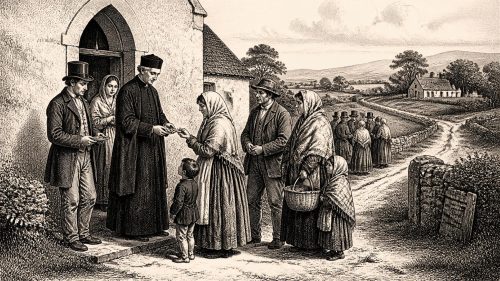
That pressure was not simply the work of one celebrated lawyer. The Catholic Association had created a national political infrastructure. Its organisers used parish connections, meetings, petitions, newspapers and the small popular subscriptions known as Catholic Rent to link lawyers and merchants in towns with priests, tenant farmers and labouring households in the countryside. This did not erase differences of class or locality, but it gave large numbers of Catholics a means of acting collectively in public politics. On 12 February 1829, meeting at the Rotunda in Dublin, the Association voted to dissolve itself, judging emancipation effectively secured; its methods, personnel and local networks, however, had already altered Irish political life.
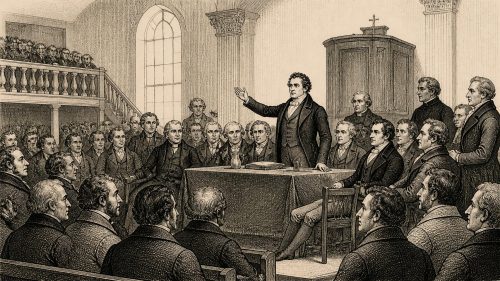
On 5 February the King’s Speech directed parliament’s attention to the condition of Ireland and the removal of civil disabilities affecting Roman Catholics. Peel introduced the linked relief and Irish election-qualification measures in early March. The combination mattered. Ministers presented relief as a necessary answer to the danger of exclusion and disorder, while presenting a remodelling of the franchise as a safeguard for Protestant property and the established political order. Parliamentary speeches laid bare the competing assumptions: supporters argued that continued exclusion was untenable; opponents feared that Catholic political participation would overturn the Protestant constitution in church and state.
Relief, With Limits
The Roman Catholic Relief Act was substantial. Catholics who took the new oath could sit and vote in parliament and hold many civil and military offices from which they had been barred. In Ireland, where the overwhelming majority of the population was Catholic but political authority remained disproportionately Protestant, this was an important change in principle as well as law. It made possible Catholic representation at Westminster and opened careers in public office to a larger section of the Catholic professional and landed classes. The Act was the largest legal advance won by Irish Catholics during the nineteenth century.
It was not, however, religious equality in a modern sense. The monarchy and the Protestant succession remained untouched. Important offices, including the lord chancellorship and the Irish lord lieutenancy, remained unavailable to Catholics; Catholic clergy could not sit in the Commons. Other provisions reflected the continuing suspicion with which the state viewed Catholic institutions and ecclesiastical authority. The legislation removed a major structure of exclusion, but it deliberately preserved a Protestant state settlement. Emancipation was thus a decisive breach in the old system rather than its complete demolition.
For many Catholic families, the law’s practical importance was also symbolic and communal. Political disability had implied that their religion marked them as lesser subjects. The new Act publicly acknowledged Catholic gentlemen, lawyers, landowners and office-holders as participants in the constitution. Parish priests, who had often encouraged disciplined electoral participation, had helped make this possible. Yet ordinary rural Catholics had reason to read the accompanying franchise law with far less satisfaction.
The Cost to Freeholders
Passed alongside relief, the Parliamentary Elections (Ireland) Act raised the minimum county freehold qualification from forty shillings to £10. The change fell especially heavily on the forty-shilling freeholders: small holders whose votes had been mobilised in Clare and in earlier contests in Waterford, Louth and elsewhere. Their franchise had never made them economically independent. Many held derivative interests created within landlord-tenant arrangements and were vulnerable to pressure from proprietors. But the electoral campaigns of the 1820s had shown that, with clerical support and Association organisation, they could sometimes vote against their landlords’ wishes.
Ministers portrayed the change as a means of producing a more independent and respectable electorate, free from both landlord and priestly influence. In practice it removed the county vote from a large body of poor Catholic men whose conduct at the polls had proved politically formidable. The linked Acts therefore expressed the central contradiction of 1829. Catholics gained access to parliament, but many of the people whose votes had forced the issue lost their own route into electoral politics. The property qualification also made land value, tenancy arrangements and registration procedures still more important in everyday rural calculations.
O’Connell Still Outside
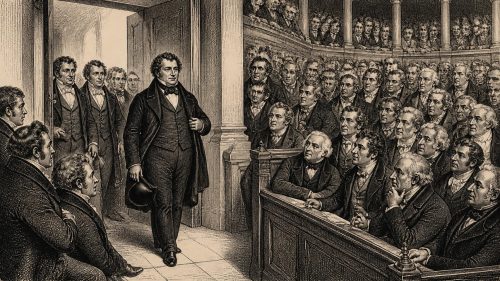
Emancipation did not immediately place O’Connell in the Commons. On 15 May he appeared at Westminster to claim his Clare seat, but his election had taken place before the new law. The Speaker ruled that he must take the former oaths, including the oath of supremacy, which O’Connell could not conscientiously take. He accepted the oaths of allegiance and abjuration but refused that oath. The crowded chamber then became the setting for a pointed constitutional anomaly: parliament had changed the law for Catholics, yet its most famous Catholic victor remained excluded because his election pre-dated the change.
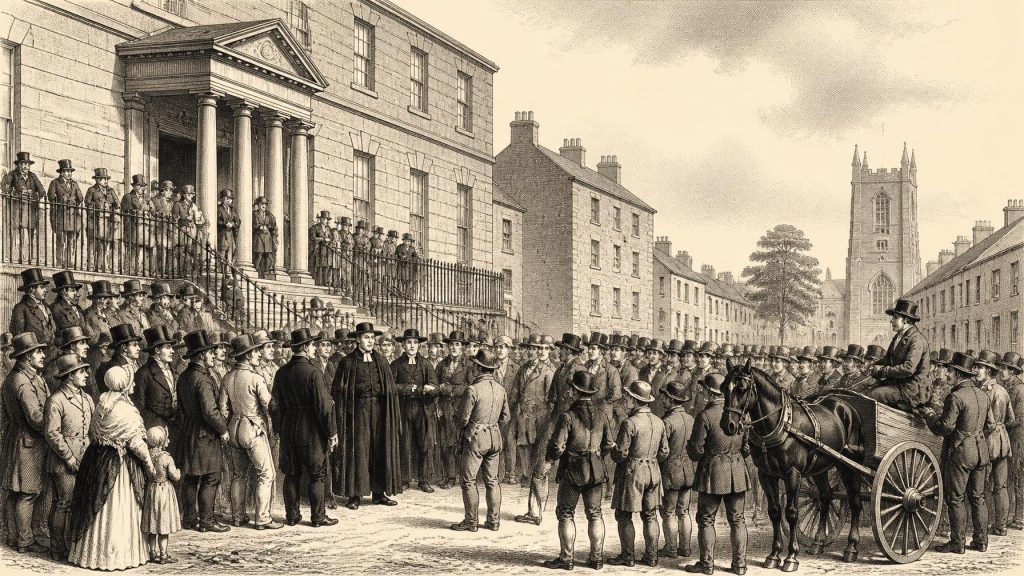
A new writ was issued for Clare. During the months leading to the election, Dublin Castle received reports from officials, magistrates, police officers and military commanders who feared disturbance in County Clare and Ennis. Such reports should not be read as neutral descriptions of popular politics: they were produced by authorities alert to threats to order. They nevertheless show the intensity surrounding the contest and the degree to which a parliamentary by-election had become a national test. When the poll came in July, O’Connell was returned unopposed. He would not actually take his seat until 4 February 1830, a distinction essential to keeping the chronology of 1829 clear.
Protestant Anxiety and Public Argument
Emancipation did not dissolve Protestant political opposition. Brunswick constitutional clubs and Orange-connected voices defended the established Church and the existing constitution, particularly in southern towns and counties with influential Protestant commercial and landed interests. In Cork, Gerard Callaghan was returned for the city in 1829 amid deeply sectarian politics, while the local Brunswick organisation worked to preserve Protestant influence. The weekly Star of Brunswick, founded late in 1828 as a more extreme Orange mouthpiece, continued publication until December 1829. These organisations and papers reveal that the year’s settlement was disputed in streets, clubs, corporations and print as well as at Westminster.
The most important conflict of 1829 was nevertheless constitutional rather than insurrectionary. O’Connell’s campaign had made electoral organisation, petitioning, public meetings and legal argument appear capable of compelling change without a rising. That achievement mattered in a country repeatedly governed through exceptional security measures. It also raised expectations which the April legislation could not wholly satisfy. The established Church of Ireland remained supported by tithes; local government and landholding remained unequal; and the Union still located Ireland’s legislature at Westminster. Those were continuing conditions, not problems solved in 1829.
A Literary Year
Irish cultural life did not stand apart from these social realities. Gerald Griffin’s novel The Collegians, published in 1829, achieved wide success. Though set in the late eighteenth century and built around an earlier Limerick murder, it portrayed a layered provincial society of gentry, middlemen, magistrates, shopkeepers and peasants. Its popularity showed the growing reach of Irish regional material in English-language literature. Griffin was also deeply concerned by the condition of the Irish poor, a concern which gave his fiction a social sharpness beyond melodrama.
By year’s end, Ireland had not become politically equal, socially peaceful or economically secure. But the balance of public life had changed. Catholic emancipation had converted O’Connell from an excluded agitator into a prospective parliamentarian and made the Catholic majority impossible to ignore within the constitutional system. The disfranchisement of the forty-shilling freeholders, however, ensured that the victory carried a grievance within it. Clare’s second verdict captured both truths: the nation had forced an opening, but the terms of that opening remained controlled by property, empire and a Protestant state.
Primary Sources
- Roman Catholic Relief Act 1829
- Catholic emancipation
- Measure for the Removal of the Roman Catholic Disabilities, 5 March 1829
- Roman Catholic Relief Bill—and Irish Election Qualification Bill, 10 March 1829
- Roman Catholic Relief Bill, 17 March 1829
- Roman Catholic Relief Bill, House of Lords, 31 March 1829
- Roman Catholic Relief Bill, House of Lords, 10 April 1829
- Mr. O’Connell—Clare Election, 15 May 1829
- Mr. O’Connell—New Writ for Clare, 21 May 1829
- Religious Oaths and Parliamentary Membership
- File of papers relating to the election of Daniel O’Connell as MP for Clare in Ennis, between May and July 1829
- Content of the Registered Papers 1818–1833
- O’Connell, Daniel
- Griffin, Gerald
- Bernard, Francis
- Sheehan, Thomas
- Callaghan, Gerard
- The Correspondence of Daniel O’Connell, Volume IV, 1829–1832
- Catholic Emancipation: Delving Deeper
- Key Documents from the Campaign for Emancipation
- The Achievement of Emancipation
- Emergency Legislation and Agrarian Disorder in Ireland, 1821–41
- Catholic Association
- Extract from Daniel O’Connell’s Address to the Electors of Clare, 28 May 1829