
Hyaena Hall’s Mammoth Sands31573 BCE
Around 31,573 BCE, Ireland lay within the climatically unstable Late Pleistocene, but no evidence permits events to be dated to a single year. Derryvree, County Fermanagh, preserves an ice-free interval of treeless, wet tundra between glacial advances, while Crag Cave records changing conditions during interstadials. Castlepook Cave, County Cork, yielded mammoth, reindeer, giant deer, hyaena and cold-adapted fauna, demonstrating links with wider north-west Europe, though mixed cave deposits complicate interpretation. A marked reindeer bone may indicate human activity, but no Palaeolithic settlement is known. Later ice expansion erased or buried evidence, leaving dynamic ecological history rather than recoverable human narrative.
Dateline
The numbered year 31,573 BCE cannot be treated as a date at which an Irish event can be placed. No written calendar existed, and neither archaeology nor environmental science can resolve a single year so deep in the past. In radiocarbon convention it falls roughly 33,500 years before AD 1950, within the Late Pleistocene and Marine Isotope Stage 3 (MIS 3), but that conversion is only a guide. Dates from this period have sizeable uncertainties and must be calibrated; the relevant Irish deposits span intervals of centuries or millennia, rather than a day, season or named year.
What can responsibly be said is that this point belongs to the unstable latter part of the last Ice Age, before the Last Glacial Maximum. Ireland was not yet the familiar island of farms, woods and coasts. Its geography, sea level, ice margins, rivers and habitats were profoundly different, and the physical traces of the period are sparse, discontinuous and often disturbed by later glaciation. The strongest evidence comes not from settlements but from cave deposits, buried wetland sediments, pollen, plant remains, insects, animal bones and cave calcite. Together they reveal an Irish landscape capable, at different times in this broad interval, of supporting cold-adapted animals. They do not furnish a continuous narrative of human life.
A Date Without a Chronicle
Modern chronological labels are useful only if their limits are kept in view. The Derryvree freshwater deposit near Maguiresbridge, County Fermanagh, produced a radiocarbon determination of 30,500 +1,170/−1,030 radiocarbon years BP. When calibrated, published assessments place the deposit broadly between about 36,900 and 31,700 years ago. That wide span overlaps the general era of 31,573 BCE, but does not prove that its plants and animals belonged to that exact calendar year. It is evidence for an ice-free episode in north-central Ireland during MIS 3, not a precise annual diary.
The climate did not simply progress from mild to cold in one steady descent. Greenland ice cores show that the last glacial period was punctuated by abrupt stadial and interstadial shifts. Ireland lay on the Atlantic fringe of this rapidly changing North Atlantic world. In south-west Ireland, uranium-thorium dating of broken and reworked calcite formations in Crag Cave records episodes when liquid water could circulate and cave calcite could grow; these episodes correspond broadly with Greenland interstadials. Such evidence supports the interpretation that conditions in Ireland varied markedly within MIS 3. It cannot tell us that every region experienced the same weather at the same moment.
Derryvree’s Treeless Wetland
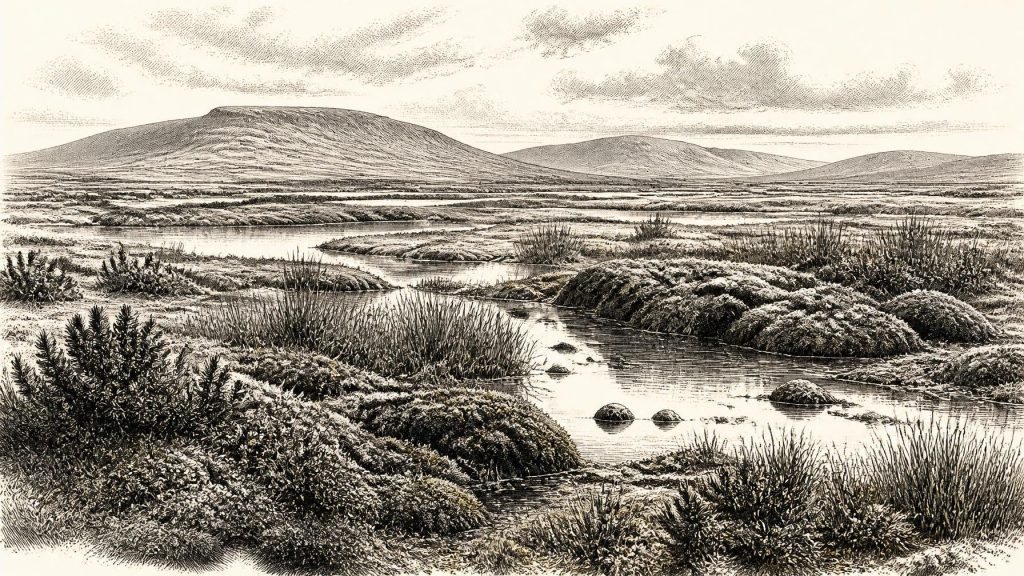
At Derryvree, road works cut through a drumlin and exposed silts and fine sands sealed between two thick sheets of till. The intervening freshwater layer contained pollen, plant macrofossils, mosses and insects. Its assemblage was interpreted as open, treeless tundra or muskeg: a wet, cold landscape of sedges and grasses, low shrubs such as juniper, herbs, mossy ground and shallow pools rich in organic matter. The record includes plants associated with freshwater and wet ground, rather than evidence for a closed forest.
This is an important corrective to an image of Ireland as either wholly ice-covered or wholly hospitable. The deposit indicates that, during the interval represented at Derryvree, there was exposed ground and freshwater habitat. Yet it was a severe environment. Comparisons with other Irish cold-stage insect assemblages suggest short productive summers, long cold winters and sparse shelter. Wind, frost action, seasonal thaw and waterlogged soils would have shaped movement across the land. The lower and upper tills show, with unusual clarity, that this landscape existed between glacial advances: it was neither timeless nor secure.
Regional change matters. The Derryvree sequence is in Fermanagh and cannot simply be projected over every Irish valley, limestone upland or coastal plain. Even so, it is among the best direct environmental archives for this portion of the Ice Age. It demonstrates that parts of Ireland could be ice-free before the major expansion of the last British–Irish Ice Sheet. Subsequent ice advance would rework older land surfaces and remove many potential archaeological sites, one reason why the material record for people is so extraordinarily thin.
Animals in the Cork Caves
County Cork provides the other principal window. Castlepook Cave, near Doneraile, was excavated mainly in the early twentieth century and yielded a very large collection of animal remains. Its galleries acquired evocative excavators’ names, including Hyaena Hall and Elephant Hall. The assemblage contains bones of woolly mammoth, reindeer, giant deer, brown bear, wolf, spotted hyaena, hare and lemmings. These animals were not necessarily contemporaries: the cave accumulated material over a long period, and old excavations often recorded context imperfectly. Later dating has also shown that some earlier radiocarbon determinations required substantial revision.
Nonetheless, the fauna establishes something significant. Ireland was connected to a wider north-west European ecological world before the Last Glacial Maximum, with large grazers and browsers, predators and small cold-adapted mammals moving through suitable habitats. A recently reported sedimentary ancient-DNA study from Castlepook identifies multiple animal taxa and indicates genetic links between some Irish and continental European populations. It is promising evidence for faunal connectivity, although it is currently a preprint rather than a peer-reviewed final publication and should be treated accordingly.
Cave bones must not be read as a census of a living herd outside the entrance. Carnivores could drag carcass parts underground; bones might be gnawed, scattered, washed through passages or mixed with deposits of a different age. Hyaenas especially make caves difficult but valuable archives, because a den can concentrate material taken from the surrounding landscape. Mammoth or reindeer remains therefore demonstrate that those animals occurred in the wider region during the dated interval, while the pattern of deposition may describe carnivore behaviour as much as animal abundance.
The Human Question
There is no securely excavated habitation floor, hearth, house, burial, tool assemblage or enduring settlement in Ireland that can be assigned to around 31,573 BCE. Consequently, there is no responsible basis for describing an Irish polity, warfare, diplomacy, kin group, language, religion, art tradition or system of learning at this date. Nor can an economy or trade network be reconstructed as an Irish social institution. Farming, metalworking, monuments and permanent villages all belong to vastly later chapters of the island’s past.
One object makes the question less simple. A reindeer femur from Castlepook has been reported as bearing deep marks interpreted by zooarchaeologist Ruth Carden as cuts or chopping made with a sharp stone tool during carcass processing. The bone has been publicised as dating to about 33,000 years ago, close in broad terms to the era considered here. If that interpretation is sustained, it would indicate a fleeting Upper Palaeolithic human presence: perhaps people processing an animal, not a settled population or an established community. It would not establish who they were, how many arrived, whether they hunted the reindeer, or how long they remained.
Caution is particularly necessary because Castlepook’s deposits were excavated long ago, are chronologically mixed in places, and have been repeatedly reassessed. A date on an animal bone dates the animal’s death, not automatically the marking episode; a single marked bone cannot bear the weight of a national settlement history. The National Museum of Ireland’s general collections guidance still states that no clear evidence has emerged for human presence in Ireland during the Palaeolithic, reflecting the high evidential threshold required for such a claim. The Castlepook femur should therefore be presented as a potentially transformative but limited signal, not as proof of a populated Ice-Age Ireland.
Before the Great Advance
In the long view, 31,573 BCE lies before the climatic nadir conventionally called the Last Glacial Maximum, generally dated to roughly 26,500–19,000 years ago. Ice sheets later expanded across much of Ireland, profoundly reshaping the terrain and likely destroying or burying many older surfaces. The contrast between Derryvree’s freshwater tundra, Crag Cave’s intermittent calcite growth and Castlepook’s varied fauna captures the central historical fact of this distant period: Ireland was environmentally dynamic, not empty of life, but its human story remains almost beyond the reach of certainty.
The appropriate history of this year is therefore one of evidence and restraint. There were wetlands beneath what would later become a drumlin in Fermanagh, and animal communities moving through favourable parts of the Irish landscape. There may have been rare human visitors, whose presence survives, if at all, in one contested-looking mark on reindeer bone rather than in a recognisable settlement. The silence is not proof that no person ever came. It is a measure of how little an Ice-Age landscape, later overridden by ice and sea-level change, has allowed to survive.
Primary Sources
- A Middle Midlandian Freshwater Series at Derryvree, Maguiresbridge, County Fermanagh, Northern Ireland
- The Irish Quaternary Fauna Project
- Irish Pleistocene biostratigraphy
- A reconsideration of the radiocarbon dating of the Marine Isotope Stage 3 fauna from southern Ireland
- Episodic speleothem deposition tracks the terrestrial impact of millennial-scale last glacial climate variability in SW Ireland
- Pattern, style and timing of British–Irish Ice Sheet advance and retreat over the last 45,000 years: evidence from NW Scotland and the adjacent continental shelf
- Maximum extent and dynamic behaviour of the last British–Irish Ice Sheet west of Ireland
- The Last Glacial Maximum
- Greenland Ice-Core Chronology 2005 (GICC05) for various Greenland ice cores
- A stratigraphic framework for abrupt climatic changes during the Last Glacial period based on three synchronized Greenland ice-core records
- Prehistoric Details: Mell Flint Flake
- First Evidence of a Late Upper Palaeolithic Human Presence in Ireland
- First evidence of a Late Upper Palaeolithic human presence in Ireland
- Figure 6: The subdivision of the Quaternary Period in Ireland
- On the Cave of Castlepook, Near Doneraile, Co. Cork
- Proceedings of the Royal Irish Academy: Castlepook Cave report
- Heritage Artefacts of County Cork 2021
- Archaeology Research Excavation Grant 2022: Final Report
- 2022:564 – Castlepook Cave, Castlepook South, Cork
- Sedimentary ancient DNA reveals Late Pleistocene faunal connectivity between Ireland and Eurasia