BIRM-166 and Hyaena Hall31334 BCE
31,334 BCE is a label for a dated Late Pleistocene interval, not a recorded Irish year. BIRM-166, an organic freshwater deposit beneath tills at Derryvree, Fermanagh, indicates a cold, treeless tundra-like wetland during MIS 3, although it cannot define conditions island-wide or precisely date events. Ireland’s ice extent, coastlines and accessibility changed and remain uncertain. Castlepook Cave, Cork, preserves a cold-stage fauna, including mammoth, reindeer and spotted hyaena, accumulated over periods. A marked reindeer femur may indicate human butchery around 31,000 BCE, but proves neither hunting nor settlement. The evidence instead shows an connected, changing landscape potentially visited by people.
Dateline
The label 31,334 BCE is a modern chronological convenience, not a year that anybody in Ireland could have named, recorded or remembered. There was no writing, calendar, state or historical chronicle on the island. Nor can archaeology isolate a particular hunt, storm, season or generation to that single year. In terms used by Quaternary scientists, it falls about 33,283 years before AD 1950, within the Late Pleistocene and broadly within Marine Isotope Stage 3 (MIS 3), a climatically unstable portion of the last Ice Age. The responsible history of this point is therefore a history of evidence: sediments beneath glacial deposits, animal bones from caves, and carefully qualified reconstructions of ice, land and sea.
A Date Within Deep Time
Modern calendar precision is unavailable. Radiocarbon laboratories report ages in radiocarbon years before present; those results must be calibrated because atmospheric carbon-14 concentrations have varied over time. Calibration produces probability ranges, not a date for an event. The key Fermanagh deposit discussed below, for example, produced the conventional radiocarbon measurement BIRM-166, 30,500 years BP with an uncertainty of roughly 1,100 years. One published calibrated summary places it at about 35.9 ± 1.1 thousand calendar years BP. It is thus valuable evidence for the wider middle-to-late Ice Age environment of Ireland, but it cannot serve as a diary entry for 31,334 BCE.
The island’s geography was also very different from today’s. Sea level was much lower globally because great volumes of water were held in northern ice sheets, while the shape of coasts and shallow seas was altered by local crustal movements, changing ice loads and sedimentation. It would be unsafe to draw a simple land bridge across the Irish Sea for this exact moment. Accessibility between Ireland, Britain and the wider north-west European landmass changed through time and remains a subject of reconstruction. What is secure is that Ireland’s fauna was not permanently isolated: cold-stage animals reached the island during parts of the Pleistocene.
Ice, Open Ground and Uncertainty
At this time Ireland was approaching, rather than necessarily experiencing everywhere, the later maximum expansion of the last British–Irish Ice Sheet. That maximum was substantially later, with major ice-sheet growth and differing regional maxima concentrated broadly between about 30,000 and 22,000 years BP, depending on sector and reconstruction. The evidence before 31,000 BP is sparse and ice margins cannot be plotted with confidence for every part of Ireland. Modern ice-sheet reconstructions rightly show uncertainty bands rather than definite lines. They should be read as tested models built from landforms, marine cores and dates, not as maps drawn by contemporary observers.
That uncertainty matters for 31,334 BCE. It is not sound to say that all Ireland lay beneath one continuous sheet of ice, nor to picture the whole island as ice-free grassland. Conditions varied by region, altitude and time. Glaciers and ice caps could grow in favourable uplands while other areas supported cold, exposed terrain, rivers, pools, wetlands and animal populations. Repeated advances later eroded, displaced and buried older ground surfaces. This is one reason why surviving evidence for an Irish human presence of this antiquity is so exceptionally thin: camps on open ground were unlikely to survive the physical remodelling of the landscape.
The Derryvree Freshwater Record
The clearest environmental archive relevant to the broader period was exposed in 1969 at Derryvree townland, near Maguiresbridge in County Fermanagh. Roadworks cut through a drumlin, revealing fine sands, silts and organic deposits between two substantial tills: unsorted debris deposited directly by glacial ice. The sequence establishes a basic order of events. Ice had crossed the locality; a subsequent non-glacial interval permitted freshwater sediment and organic matter to accumulate; later ice deposited the overlying till and sealed the record within the drumlin.
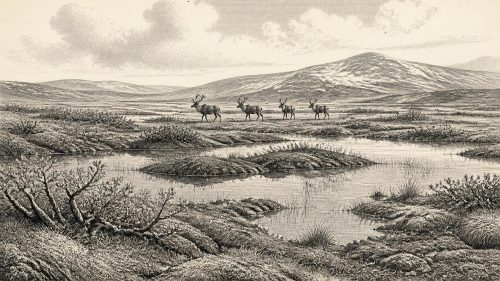
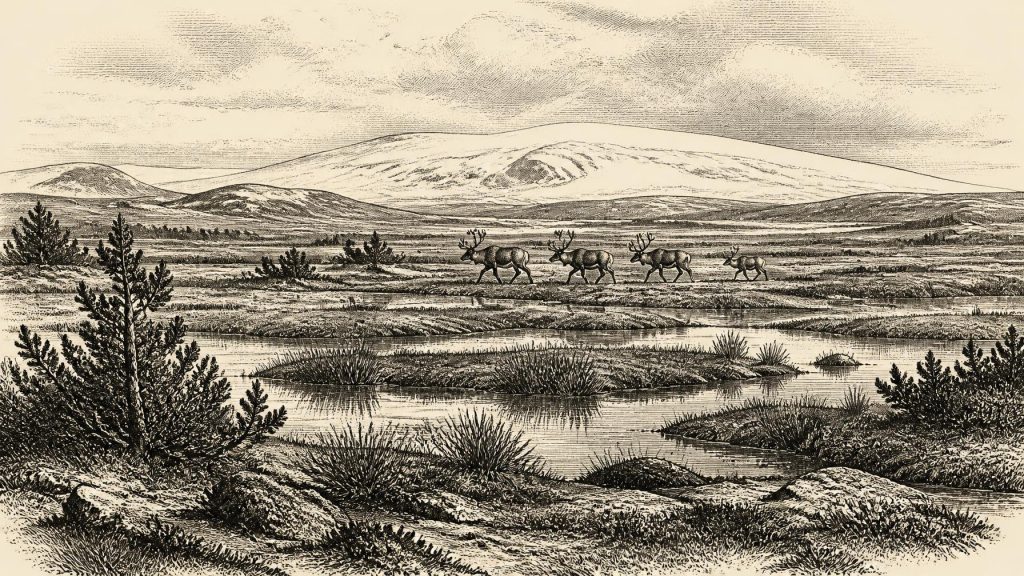
The plants, mosses, pollen and insects preserved in the intervening layers indicate a treeless, cold environment. Grasses, sedges, juniper and herbs, together with wet-ground mosses and aquatic plants, point to open tundra or tundra-like terrain rather than forest. Investigators compared the wetland to muskeg: waterlogged ground with abundant plant material, mossy surfaces and pools. This is direct evidence for a particular Fermanagh setting during the lifespan of the deposit. It is not proof that every Irish valley looked the same, or that the precise conditions preserved in one layer existed on the nominal date of 31,334 BCE.
Nevertheless, Derryvree makes everyday ecological realities visible. Seasonal freezing and thawing would have affected soil, water movement and vegetation. Productive patches around pools and streams may have contrasted with drier, wind-exposed ground. Plant cover could be low yet diverse, and summer growth brief but important to grazing animals and the predators that followed them. Such a landscape was not empty wilderness in the biological sense; it was a severe, mobile ecosystem shaped by water, frost and changing ice margins.
Castlepook’s Animal World
For southern Ireland, Castlepook Cave near Doneraile in north County Cork is the essential site. Also called Mammoth Cave, its narrow galleries and chambers yielded more than two thousand bones during excavations between 1904 and 1918. The National Museum of Ireland and the Geological Survey of Ireland identify it as Ireland’s richest archive of vertebrate remains from the period before the Last Glacial Maximum. Its well-known chamber names, including Hyaena Hall and Elephant Hall, recall the striking animals recovered there.
The assemblage includes woolly mammoth, giant deer, reindeer, brown bear, wolf, Arctic fox, mountain hare, collared and Norwegian lemmings, and spotted hyaena. These remains demonstrate that, at different points in the last cold stage, Ireland was part of a wider north-west European world inhabited by large herbivores, smaller cold-adapted mammals and formidable scavengers or predators. Hyaena teeth, gnawed bones and the character of some accumulations suggest that caves could be used or visited by carnivores as well as by animals that died or were washed into them.
A cave fauna is not a census of one year. Castlepook was excavated before modern standards of stratigraphic recording, and its deposits include bones accumulated, reworked and contaminated over long periods. Later accelerator radiocarbon work has shown that several earlier determinations from southern Irish caves were thousands of radiocarbon years too young, strengthening the case for a substantial MIS 3 fauna but also requiring caution over older neat narratives. The presence of mammoth, reindeer and hyaena in the archive does not mean that every listed species stood together outside the cave in 31,334 BCE.
The Reindeer Femur Question
One Castlepook object gives this broad interval special importance for Irish prehistory: a reindeer femur bearing a deep linear modification interpreted by zooarchaeologist Ruth Carden as a cut or chopping mark made by a sharp stone tool while the bone was fresh. County Cork heritage material has presented the find as evidence that hunters may have processed reindeer in Ireland around 31,000 BCE. If that interpretation is sustained, it would be an extraordinarily early trace of human activity on the island, placing an Upper Palaeolithic visit far before the securely documented Mesolithic settlement of the post-glacial millennia.
Its implications must remain narrow. A date obtained from the bone concerns the death of the animal, not automatically the instant at which a mark was made. Identifying a human cut is a separate specialist judgement from measuring radiocarbon. The old collection does not provide a securely associated hearth, stone-tool assemblage, dwelling floor, burial, or intact occupation surface. Natural breakage, carnivore damage, sediment movement and the methods of early excavation all complicate interpretation. The femur may indicate butchery by people; it does not demonstrate that people hunted the reindeer, lived permanently nearby, or formed a continuous Irish population.
No Polity, But Possible Passage
Nothing supports claims about political affairs, diplomacy, territorial boundaries, named peoples, languages or warfare in Ireland at this depth of time. There is likewise no identifiable religion, monument, art tradition, school of learning, trade network or settlement pattern. These are not omissions caused by a lack of imagination: they are limits imposed by the evidence. Even if a small human party did reach Castlepook’s landscape, a single modified bone could not reveal its social organisation, beliefs, origin, route or duration of stay.
The most restrained interpretation is also the most meaningful. Ireland around this nominal year belonged to a changing Ice Age zone in which cold-water wetlands existed in at least some areas, large mammals and carnivores moved through southern landscapes at different times, and ice was growing towards its later maximum. If the Castlepook incision proves human-made, it records a brief act of carcass processing by highly mobile people equipped with a sharp stone edge. It does not yet record an Irish community. BIRM-166 beneath a Fermanagh drumlin and the bones of Hyaena Hall together offer something more fundamental than a conventional annual chronicle: rare surviving evidence that an apparently remote Ireland was ecologically connected, environmentally changeable and potentially visited by people long before enduring settlement can be shown.
Primary Sources
- A Middle Midlandian Freshwater Series at Derryvree, Maguiresbridge, County Fermanagh, Northern Ireland
- Irish Pleistocene Biostratigraphy
- The Irish Quaternary Fauna Project
- A Reconsideration of the Radiocarbon Dating of the Marine Isotope Stage 3 Fauna from Southern Ireland
- Castlepook Cave
- Spotted Hyena Skull
- Growth and Retreat of the Last British–Irish Ice Sheet, 31,000 to 15,000 Years Ago: The BRITICE-CHRONO Reconstruction
- Growth and Retreat of the Last British–Irish Ice Sheet, 31,000 to 15,000 Years Ago: The BRITICE-CHRONO Reconstruction
- Exploring Controls of the Early and Stepped Deglaciation of the British–Irish Ice Sheet
- Maximum Extent and Dynamic Behaviour of the Last British–Irish Ice Sheet West of Ireland
- New Data for the Last Glacial Maximum in Great Britain and Ireland
- Late Pleistocene Chronostratigraphy and Ice Sheet Limits, Southern Ireland
- Pattern and Timing of Retreat of the Last British-Irish Ice Sheet
- Spatio-Temporal Dynamics of Speleothem Growth and Glaciation in the British Isles
- Figure 6.— The Subdivision of the Quaternary Period in Ireland
- Outreach and Education Resources
- Soils of County Waterford
- Ireland: Submerged Prehistoric Sites and Landscapes
- Pleistocene Vertebrates in the British Isles
- Proceedings
- Heritage Artefacts of County Cork
- Ancient Hybridization and an Irish Origin for the Modern Polar Bear Matriline