Hyaena Hall’s Mammoth Bones31057 BCE
31,057 BCE is not a precisely recoverable Irish year but falls within the unstable Late Pleistocene MIS 3. Derryvree, County Fermanagh, preserves freshwater sediments between glacial tills, indicating locally ice-free, treeless tundra wetlands during a broad period encompassing this date. Castlepook Cave, County Cork, contains a disturbed but significant pre-Last Glacial Maximum fauna, including mammoth, reindeer, giant deer and spotted hyaena. A cut-marked reindeer femur may indicate brief human butchery around 31,000 BCE, yet no settlement is proven. Evidence supports a cold, changing landscape intermittently used by mammals and perhaps people, not political, social or chronological narratives at this scale.

Dateline
“31,057 BCE” is a modern chronological label, not a year for which Ireland preserves an event, a ruler or a contemporary calendar. It is approximately 33,006 years before the conventional radiocarbon reference point of AD 1950, but that arithmetic must not be mistaken for archaeological precision. No available Irish evidence can securely distinguish one year, season or generation at this depth of time. The responsible frame is the later part of Marine Isotope Stage 3 (MIS 3), a climatically unstable interval of the Late Pleistocene, before the Last Glacial Maximum.
For Ireland around this notional date, environmental history is the principal history. Buried sediments, animal bones, pollen, mosses, insects, cave deposits and glacial landforms reveal fragments of an ice-age landscape. They do not yield a political narrative. There are no identifiable communities, leaders, states, wars, treaties, trading institutions, monuments, burials, houses or written traditions that can be placed in 31,057 BCE. The most useful evidence instead comes from two very different archives: an inter-till wetland deposit at Derryvree near Maguiresbridge, County Fermanagh, and the rich but complicated cave-bone assemblage at Castlepook, near Doneraile in County Cork.
A Year Inside a Long Range
The closest chronological anchor is Derryvree. Road works in 1969 cut through a drumlin and exposed freshwater silts, fine sands and organic material lying between two substantial tills: unsorted sediment left by glacier ice. The sequence establishes an important order of events. An earlier ice advance deposited the lower till; at a later time, when that locality was ice-free, standing or slow-moving freshwater accumulated sediment and organic remains; a further glacial advance then covered the deposit with upper till.
Organic material from the freshwater series gave the conventional radiocarbon determination BIRM-166, 30,500 with an uncertainty of +1,170/−1,030 radiocarbon years BP. Radiocarbon years are not calendar years. Because atmospheric carbon-14 has varied substantially, especially at this antiquity, measurements must be calibrated and produce broad probability ranges rather than an exact historic date. A commonly cited calibrated span for the Derryvree deposit is roughly 36,900–31,700 cal BP, or about 34,950–29,750 BCE. Thus 31,057 BCE falls within a wide environmental horizon potentially illuminated by Derryvree, not at a point that can be isolated within its sediments.
This qualification matters. It would be wrong to write that a particular animal drank at the Derryvree pool, that a group hunted there, or that a glacier advanced in this specific numbered year. What the deposit responsibly shows is that Ireland included at least some ice-free, cold, freshwater landscapes during this broad part of MIS 3. Later ice profoundly altered the island, and the survival of such evidence is exceptional rather than comprehensive.
Derryvree’s Open Wetland
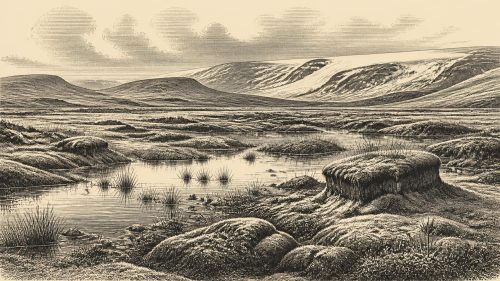
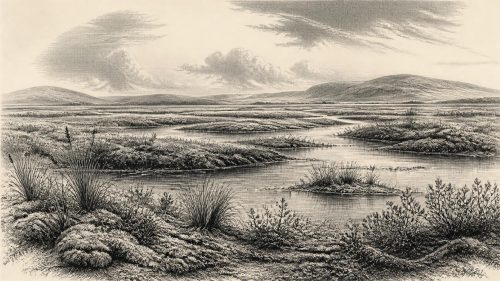
The plant and insect evidence from Derryvree points to a treeless, periglacial environment rather than the familiar wooded Ireland of the recent past. Pollen was poorly preserved, but herbaceous taxa dominate the record; macrofossils include numerous mosses. Sedges, grasses, dwarf shrubs and cold-tolerant herbs are more appropriate images than forest. Investigators interpreted the setting as open tundra or muskeg: wet, moss-rich ground with shallow pools and waterlogged patches amid sparse dry-land vegetation.
Such a place was not necessarily lifeless or uniformly snowbound. Seasonal water, plant litter and sheltered hollows could support insects and provide forage for grazing mammals. Yet it was a difficult landscape, shaped by frozen ground, short growing seasons and severe winters. The distinction between a wet hollow and an exposed ridge would have mattered greatly. Local conditions could vary within a few kilometres according to drainage, snow cover, elevation, wind exposure and the proximity of ice.
The Derryvree sequence also prevents a simple picture of a steadily worsening Ice Age. MIS 3 contained sharp climatic fluctuations. Ireland’s glaciers and ice caps expanded, retreated or changed their margins on timescales that are long in human terms but brief in geological ones. By the Last Glacial Maximum, later than the period represented here, the British–Irish Ice Sheet reached a far greater extent. At about 31,057 BCE, however, the evidence does not support treating all Ireland as continuously buried beneath a single unchanging ice cover. It instead records a changing mosaic of glacial, periglacial and ice-free terrain.
Castlepook’s Animal Archive
Almost 300 kilometres to the south-west, Castlepook Cave preserves Ireland’s most important assemblage of vertebrate remains from before the Last Glacial Maximum. Its chambers acquired evocative names during earlier exploration, including Hyaena Hall and Elephant Hall. More than 2,000 bones have been recovered, although much of the material derives from nineteenth- and early twentieth-century investigations whose excavation methods and stratigraphic records do not meet modern standards. Water movement, carnivore activity and earlier digging have further complicated the deposits.
The cave nevertheless demonstrates that a striking range of large and cold-adapted mammals reached Ireland during the wider middle-to-late Ice Age. Its fauna includes woolly mammoth, reindeer, giant deer, brown bear and spotted hyaena; Arctic fox, wolf, mountain hare and lemmings occur among other Irish late-Pleistocene records and cave deposits. The cave should not be read as a single momentary animal census. Individual bones span long periods, and re-dating has shown that some older radiocarbon assays on Irish cave material were substantially too young. The secure conclusion is regional and chronological: animal communities capable of inhabiting cold, open country were present in Ireland during MIS 3, including phases before the maximum expansion of the last ice sheet.
Spotted hyaena is especially instructive. A cave rich in bones need not have been a human camp or even a place where the animals died naturally. Hyaenas can transport carcass parts, gnaw bone and use sheltered spaces as dens. Carnivore agency, floodwater and collapsing sediment can all combine remains of different animals and ages. That taphonomic warning is central to any account of diet, hunting or settlement. Cave bones provide powerful evidence for fauna, but their original associations must be tested, not assumed.
The Human Question
A reindeer femur from Castlepook has made this interval important for the prehistory of Ireland. It bears a deep linear mark interpreted by the palaeozoologist Ruth Carden as damage made by a sharp stone tool while the bone was fresh, and it has been presented as dating to about 31,000 BCE. If that interpretation and its chronological association are sustained, the object would indicate that people handled and butchered a reindeer in Ireland far earlier than the previously well-established record of post-glacial settlement.
It is, however, evidence for a possible action, not evidence for a resident population. No securely associated hearth, stone-tool assemblage, occupation floor, dwelling, burial, repeated butchered-bone concentration or food store has yet demonstrated an Upper Palaeolithic settlement at Castlepook. Nor can one marked bone identify a language, kin group, migration route, population size or length of stay. Recent excavation has sought intact deposits and better dating, precisely because the old collections and disturbed cave sediments cannot answer every question. The careful formulation is therefore that a brief visit by mobile hunter-gatherers is possible and potentially supported by the bone, but is not yet demonstrated as a settled Irish presence.
If people did reach the island in this broad period, their economy would have been foraging, not farming. They would have depended on locally available animals, plants and materials, moved through a demanding seasonal environment and carried knowledge rather than written records. Yet these are general inferences from Upper Palaeolithic lifeways elsewhere in north-west Europe, not directly documented Irish facts. There is no evidence from Ireland around this date for cultivated crops, livestock, pottery, metal, permanent villages, formal trade networks or social ranks visible through graves and monuments.
No Polities, No Institutions
Political affairs, diplomacy and organised conflict cannot responsibly be reconstructed for Ireland in 31,057 BCE. There were no states or named territories, and no weapons deposits, fortifications or written accounts by which to distinguish warfare from hunting or scavenging. The same limits apply to religion, culture and learning. Ireland has no securely dated cave art, ritual monument, formal cemetery or symbolic assemblage from this precise horizon. Silence in the record does not prove that people, if present, lacked beliefs, stories, teaching or ceremonial practices; it means that the surviving Irish evidence cannot identify them.
Nor can trade be mapped. Materials may have travelled with animals, people, ice or water, but no dated Irish artefact assemblage of this age establishes exchange between communities. The meaningful regional change lies in ecology and geography: repeatedly changing climates altered vegetation, animal ranges, coastlines and routes across the wider Irish Sea world. Ireland was not the familiar temperate island of later millennia. It was a cold, open, environmentally unstable place in which wetlands could form between glacial episodes and mammoths, reindeer and hyaenas belonged to the wider landscape.
What This Date Can Mean
The historical value of 31,057 BCE is therefore not an anniversary of a known Irish occurrence. It is a disciplined point within a much longer interval. Derryvree offers a rare view of an ice-free freshwater tundra landscape trapped between glacier deposits. Castlepook supplies a remarkable, if taphonomically complex, archive of the animals that entered Ireland before the Last Glacial Maximum. The marked reindeer femur poses a serious question about very early human activity, but does not yet permit a conventional story of settlement.
For this deep past, evidence and interpretation must remain distinct. The evidence is sediments, fossils, radiocarbon results and altered bone. The interpretation is a cold, patchy, changing Irish landscape, intermittently available to mammals and perhaps occasionally to people. Modern calendar-year precision is unavailable. What survives is not a chronicle of one year, but a narrow and precious window onto Ireland before renewed ice transformed the country again.
Primary Sources
- A Middle Midlandian Freshwater Series at Derryvree, Maguiresbridge, County Fermanagh, Northern Ireland
- Palaeoecology
- The Subdivision of the Quaternary Period in Ireland
- Castlepook Cave: Cork County Geological Site Report
- The Irish Quaternary Fauna Project
- A Reconsideration of the Radiocarbon Dating of the Marine Isotope Stage 3 Fauna from Southern Ireland
- 2022:564 – Castlepook Cave, Castlepook South, Cork
- Heritage Artefacts of County Cork
- Archaeology Research Excavation Grant 2022: Castlepook Cave Final Report
- The IntCal20 Northern Hemisphere Radiocarbon Age Calibration Curve (0–55 cal kBP)
- Pattern and Timing of Retreat of the Last British-Irish Ice Sheet
- Extent and Deglacial Chronology of the Last British–Irish Ice Sheet: Implications of Exposure Dating Using Cosmogenic Isotopes
- Extent and Timing of the Last Glacial Maximum in Britain and Ireland: A Review
- Dimensions and Chronology of the Last Ice Sheet in Western Ireland
- Oscillating Retreat of the Last British-Irish Ice Sheet on the Continental Shelf Offshore Galway Bay, Western Ireland
- Early Deglaciation of the British-Irish Ice Sheet on the Atlantic Shelf Northwest of Ireland Driven by Glacioisostatic Depression and High Relative Sea Level
- Dynamic Cycles, Ice Streams and Their Impact on the Extent, Chronology and Deglaciation of the British-Irish Ice Sheet
- New Insights on the Fauna of Ireland’s Younger Dryas and Early Holocene from Alice & Gwendoline Cave
- The Mesolithic in Ireland: When Was It?
- Ireland’s Palaeolithic Archaeology – Fleeting Footprints in a Frozen Land