
Year by Year
Explore Year by Year articles from the most modern historical year back to the oldest.
3,305 Articles Archived

Shallow Wetland
Archived: 6 October 2026
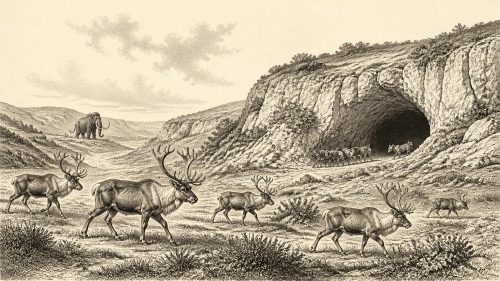
Thirty thousand one hundred and seventy-four BCE is a calendar label within Marine Isotope Stage 3, not a datable event. Derryvree, County Fermanagh, preserves freshwater sediments between glacial tills, showing a locally ice-free, cold, treeless wetland during a broadly dated interval. Plant, insect and pollen remains indicate sedges, grasses, mosses, herbs and shallow pools, rather than forest or settlement. Castlepook Cave, County Cork, holds long-accumulated remains of mammoth, giant deer, reindeer, bears and hyaenas, demonstrating varied fauna but not a contemporary community. No secure evidence confirms human occupation. These fragmentary deposits document changing habitats before Last Glacial Maximum ice growth.
Disturbed Deposits
Archived: 6 October 2026
Around 30,175 BCE, Ireland lay within the unstable later Pleistocene, before maximum expansion of the last British–Irish Ice Sheet. Precise dating is impossible, and evidence survives chiefly in disturbed cave deposits. Castlepook Cave, County Cork, preserves remains of mammoth, reindeer, giant deer, hyaena, bear and other cold-adapted animals, accumulated across millennia rather than in one episode. Open tundra-like habitats and lower sea levels shaped a landscape. A marked reindeer femur may indicate Upper Palaeolithic butchery, but lacks secure context and cannot prove settlement. No wider reconstruction is justified. Castlepook instead records intermittent animal life and a possible fleeting human encounter.

Kerry Stalagmite
Archived: 6 October 2026
Around 32,125 cal BP, rather than a precisely knowable 30,176 BCE, Ireland experienced unstable late MIS 3 conditions. Crag Cave stalagmites ceased growing, indicating colder, drier or frozen local ground. As the British-Irish Ice Sheet expanded, Ireland remained regionally varied, with lower seas and shifting routes rather than uniform ice cover or a permanent land bridge. Open habitats supported reindeer, mammoth, giant deer, hare, lemmings, wolves and hyaenas, evidenced especially at Castlepook Cave. A possibly stone-cut reindeer bone may indicate brief Upper Palaeolithic carcass processing, but proves neither settlement nor continuous occupation. Environmental archives document climate, fauna, hydrology and ice.

Open Tundra
Archived: 6 October 2026
Around 30,177 BCE, Ireland lay in the later Marine Isotope Stage 3, a cold, largely treeless landscape approaching the Last Glacial Maximum. Cave deposits at Castlepook in north Cork preserve evidence of reindeer, mammoth, giant deer and predators, demonstrating habitable open country despite climatic instability. Scientific dates provide ranges, not exact calendar years, and disturbed deposits require caution. A marked reindeer femur may record stone-tool butchery about 33,000 years ago, suggesting possible human visits. No settlement, tools, hearths or society are securely known. Advancing ice later erased much evidence, making Castlepook a vital but incomplete archive of Ice Age Ireland.

Cave Species
Archived: 6 October 2026
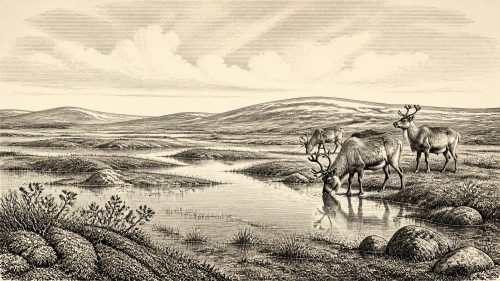
Labelled 30,178 BCE only approximately, this period belongs to later Marine Isotope Stage 3, before the Last Glacial Maximum, when Ireland experienced unstable cold climates and advancing ice. Castlepook Cave in County Cork preserves evidence of varied fauna, including reindeer, bears, deer, hyaenas, lemmings and mammoth, indicating open, changing habitats. Derryvree deposits suggest sedgy, tundra-like wetlands. Lower sea levels altered coastlines, but migration routes remain uncertain. A possibly cut-marked reindeer bone raises, without proving, early human visitation. No secure settlements or artefacts establish occupation. Subsequent ice expansion reshaped terrain and destroyed evidence, leaving fragmented records of a dynamic ecological frontier.
Intertill Mud
Archived: 6 October 2026
Around 30,179 BCE, Ireland was in the unstable cold climate of Marine Isotope Stage 3, not a datable historical year. Derryvree, County Fermanagh, preserves freshwater silts between glacial tills, indicating ice-free tundra wetland conditions before later ice advance. Castlepook Cave, County Cork, contains a long, mixed record of mammoths, giant deer, reindeer, carnivores and other Ice Age fauna. Its deposits demonstrate changing habitats, though not a single contemporary animal community. A possibly cut-marked reindeer bone may indicate human activity, but no settlement evidence exists. Ireland’s surviving record is environmental: dynamic landscapes repeatedly reshaped by ice, water, climate and animal migration.

Waterford Cervids
Archived: 6 October 2026
Around 30,180 BCE, Ireland was a changing Pleistocene margin rather than a definable historical society. Dynamic ice sheets, periglacial conditions, low sea levels and unstable routes shaped an exposed, seasonally harsh landscape. Derryvree, County Fermanagh, preserves a locally ice-free wetland episode, whose plants and insects indicate treeless tundra, shallow water and sparse vegetation. Cave finds show that reindeer, red deer, mammoth, bears, wolves, hyaenas and smaller cold-adapted animals reached Ireland during favourable intervals; a Waterford red-deer date overlaps this horizon. A possibly cut-marked Castlepook reindeer bone suggests, but cannot prove, human visits. No evidence supports settlements, farming, institutions or occupation.
Tundra Respite
Archived: 6 October 2026
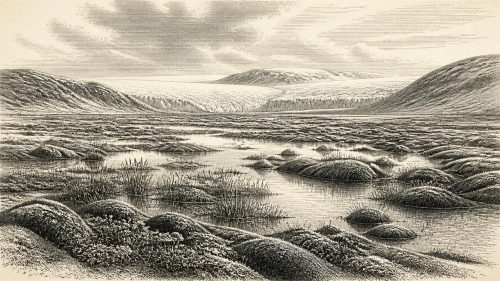
Thirty thousand years BCE is a modern approximation, not a date capable of identifying a specific Irish event. At Derryvree, County Fermanagh, sediments between two glacial tills record an ice-free interlude around 33,500 calibrated years BP, when shallow freshwater, tundra plants and periglacial conditions existed before renewed ice advance. Irish cave fauna, notably Castlepook’s, shows cold-adapted mammals, including reindeer, mammoth and giant deer, occupied landscapes during Marine Isotope Stage 3. A possibly tool-marked reindeer bone may indicate human activity, but proves neither settlement nor occupation. No evidence supports communities, farming or institutions; Ireland’s fragmentary deep past is geological and palaeoecological.

Arctic Willows
Archived: 6 October 2026
About 30,182 BCE, Ireland lay within the unstable, cold Late Pleistocene. At Derryvree near Maguiresbridge, County Fermanagh, freshwater sediments between till layers document an ice-free interval, broadly dated to 34,950–29,750 BCE. Fossils reveal treeless periglacial wetlands of grasses, sedges, dwarf willow, aquatic plants and insects. Conditions varied regionally as ice expanded, sea levels fell, and coastlines shifted. Castlepook Cave preserves cold-stage fauna, including mammoth, reindeer and hyaena. A possibly tool-marked reindeer bone may indicate brief human presence, but no secure settlement evidence exists. Glaciation destroyed much evidence, leaving a fragmented record of dynamic environments, mobile animals and uncertain human activity.

Freshwater Ponds
Archived: 6 October 2026
At 30,183 BCE, Ireland has no recoverable annual history or confirmed human settlement. Derryvree, near Maguiresbridge, provides evidence from freshwater sediments between glacial tills, dated broadly to 36,900–31,700 calibrated years BP. These reveal a locally ice-free, treeless wetland of pools, sedges, mosses, grasses and cold-adapted plants, subject to severe seasonal conditions before renewed glaciation. Ice extent elsewhere remained variable and uncertain. Castlepook Cave’s mixed fauna demonstrates intermittent availability to mammoth, reindeer and predators, while a possibly cut-marked reindeer bone suggests unproven brief human activity. No evidence supports resident communities, political life or reconstructed society; ecological remains form the principal archive.
Some records do not yet have a verified historical year and are awaiting chronological placement.