
Year by Year
Explore Year by Year articles from the most modern historical year back to the oldest.
3,305 Articles Archived
Unconfirmed Processing
Archived: 30 September 2026
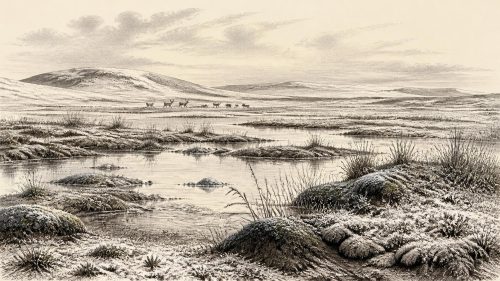
30,454 BCE is a modern chronological label within a broad Late Pleistocene range, not a recorded Irish year. Derryvree, County Fermanagh, preserves freshwater silts between tills, showing a locally ice-free interval with cold, wet, open vegetation and periglacial conditions. Castlepook Cave, County Cork, contains a long, disturbed faunal archive including mammoth, reindeer, giant deer, bears and hyaenas, rather than a single contemporaneous assemblage. A cut-marked reindeer femur may indicate brief human carcass processing around this period, but cannot prove settlement. Ireland experienced regionally changing ice, uncertain coasts and habitats, with no evidence for polities, farming, permanent villages or sustained occupation.
Short Summers
Archived: 30 September 2026
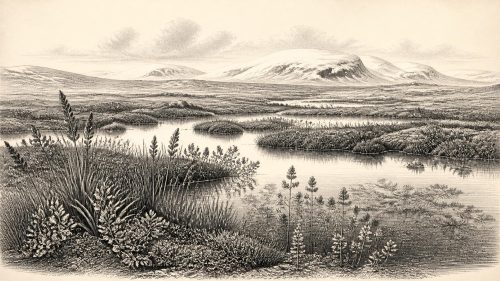
Around 30,455 BCE, Ireland lay within a cold, unstable Pleistocene landscape, although the date represents a broad calibrated range rather than a specific year. At Derryvree, County Fermanagh, freshwater silts between glacial tills preserve bogbean, water-milfoil, mosses, sedges and Arctic-alpine vegetation, indicating shallow wetlands amid open tundra during an ice-free interval. Insects support severe periglacial conditions with short productive summers. Cave finds elsewhere show Ice Age fauna, including reindeer and mammoth, but cannot be directly linked to Derryvree. A possibly cut-marked reindeer bone suggests early human activity, yet permanent occupation remains unproven. Renewed ice later completely buried this temporary ecosystem.

Palaeolithic Butchery
Archived: 30 September 2026
Around 30,456 BCE, Ireland cannot be described through exact events or populations, but through uncertain environmental evidence. Organic silts at Derryvree, County Fermanagh, dated broadly to Marine Isotope Stage 3, record a cold, treeless freshwater landscape of mosses, sedges and tundra plants between glacial advances. Castlepook Cave, County Cork, yielded reindeer, giant deer, mammoth and hyaena remains, demonstrating Ice Age fauna before the Last Glacial Maximum. A cut-marked reindeer femur may indicate Upper Palaeolithic butchery and a brief human visit, not permanent settlement. Later ice expansion reshaped and destroyed evidence, leaving fragmentary records of habitats, animal movements and possible visits.
Arctic Alpine
Archived: 30 September 2026
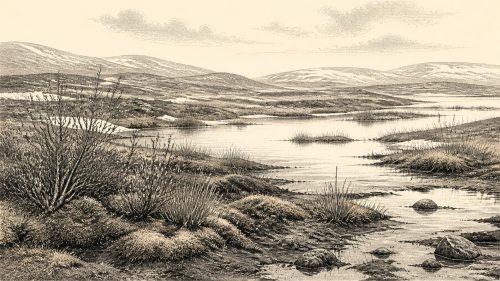
Although 30,457 BCE cannot be dated precisely, Derryvree near Maguiresbridge records an ice-free interval during Marine Isotope Stage 3. Freshwater sediments between glacial tills preserve evidence of a treeless, periglacial wetland supporting sedges, mosses, herbs, shrubs, insects and arctic-alpine plants before renewed ice advance. Ireland was environmentally varied, not uniformly ice-covered, while lower sea levels altered surrounding geography without proving migration routes. Castlepook Cave fauna demonstrates episodic cold-country habitats for mammoths, reindeer, predators and other animals. A possibly cut-marked reindeer femur may indicate human carcass processing, but cannot establish hunting, settlement or permanent population. The evidence reveals an Ice-Age landscape.
Femoral Incision
Archived: 30 September 2026
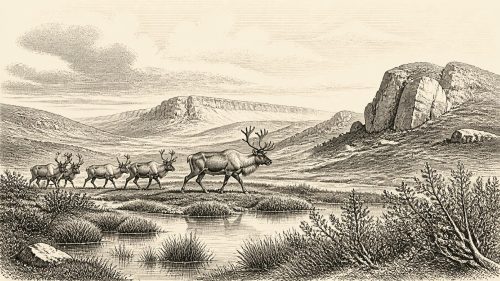
At the notional date of 30,458 BCE, Ireland lay within the climatically unstable Marine Isotope Stage 3, not a precisely datable annual setting. Dynamic ice, low sea levels and changing coasts produced varied local environments. Buried wetland deposits in Fermanagh demonstrate intervals of freshwater pools and cold, open vegetation between glacial advances. Castlepook Cave in County Cork preserves fauna including reindeer, mammoth, giant deer and predators, indicating viable grazing landscapes, although deposits are complex. A cut-marked reindeer femur may record Upper Palaeolithic butchery, yet cannot prove settlement or continuity. Later worsening climate and ice substantially obscured this already fragmentary record.

Castlepook Menagerie
Archived: 30 September 2026
30,459 BCE is not a recoverable Irish historical year but a point within Late Pleistocene Marine Isotope Stage 3. Castlepook Cave in County Cork preserves re-dated animal bones showing that southern Ireland hosted changing cold-climate faunas before the Last Glacial Maximum, including reindeer, mammoth, giant deer, Arctic fox, brown bear and spotted hyaena. Open grasslands, tundra, wetlands and sheltered productive areas supported mobile mammals, while low sea levels enabled intermittent dispersal. A possible cut mark on a reindeer femur suggests fleeting human activity, not settlement. Later ice destroyed much evidence; Castlepook remains a rare archive requiring investigation and cautious interpretation.

Stratigraphic Uncertainty
Archived: 30 September 2026
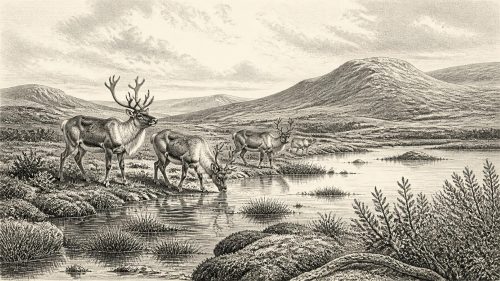
At 30,460 BCE, Ireland cannot be reconstructed year by year, but evidence indicates intermittent ice-free environments during Marine Isotope Stage 3. Derryvree, County Fermanagh, preserves freshwater deposits between glacial tills, showing cold, treeless wetland with tundra plants, insects and shallow water before renewed ice advance. Castlepook Cave, County Cork, contains mixed Late Pleistocene animal remains, including mammoth and reindeer, accumulated over long periods and poorly stratified. A cut-marked reindeer femur may indicate Upper Palaeolithic butchery, but cannot demonstrate settlement or continuity. No political, social or economic history is recoverable. The period remains fragmentary environmental prehistory, awaiting improved dating and excavation.
Questioned Cutmarks
Archived: 30 September 2026
30,461 BCE is a modern label, not a recoverable Irish historical year. Evidence places Ireland within a fluctuating later Ice Age landscape, where glaciers repeatedly advanced and retreated. At Derryvree, County Fermanagh, freshwater sediments between tills reveal cold, open wetland habitats with sedges, mosses, bogbean and adapted plants. Castlepook Cave, County Cork, preserves remains of mammoth, reindeer, horse, giant deer and carnivores, demonstrating ecological links with north-west Europe. A possibly cut-marked reindeer bone may indicate brief human presence, but remains unconfirmed. No evidence supports permanent settlement, institutions or culture; surviving records instead document precarious habitats, mobile fauna and ice expansion.

Freshwater Insects
Archived: 30 September 2026
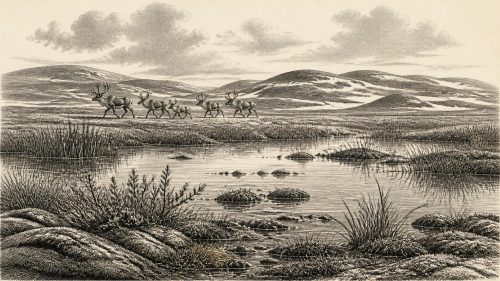
Around 30,462 BCE, Ireland’s evidence is geological rather than historical. Organic silts at Derryvree, County Fermanagh, dated approximately 30,500 radiocarbon years BP, preserve a cold, ice-free freshwater environment beneath later glacial tills. Mosses, sedges, herbs, dwarf willow and insects indicate treeless, waterlogged tundra with short growing seasons and severe winters. As the British–Irish Ice Sheet expanded, conditions varied greatly across the island. Castlepook Cave, County Cork, yielded mammoth, reindeer and hyaena remains; a possibly cut-marked reindeer bone suggests fleeting human activity. However, no contemporary settlements, tools, human remains or cultural record confirms occupation. Later ice and rising seas obscured evidence.
Eurasian Connections
Archived: 30 September 2026
30,463 BCE is a modern label rather than a recoverable Irish date, within the climatically unstable later Marine Isotope Stage 3. Growing ice sheets, lower seas and changing coastlines shaped a variable landscape before the Last Glacial Maximum. Derryvree, County Fermanagh, preserves freshwater sediments between tills, indicating locally sheltered, treeless tundra wetland with cold-adapted plants and insects. Castlepook Cave, County Cork, records mammoths, reindeer, hyaenas and fauna connected to wider Eurasia, though not as a single contemporary community. A possibly cut-marked reindeer bone suggests unconfirmed human activity. No evidence establishes settlement, society or events; traces reveal environmental change and uncertainty.
Some records do not yet have a verified historical year and are awaiting chronological placement.