The Castlepook Femoral Incision30458 BCE
At the notional date of 30,458 BCE, Ireland lay within the climatically unstable Marine Isotope Stage 3, not a precisely datable annual setting. Dynamic ice, low sea levels and changing coasts produced varied local environments. Buried wetland deposits in Fermanagh demonstrate intervals of freshwater pools and cold, open vegetation between glacial advances. Castlepook Cave in County Cork preserves fauna including reindeer, mammoth, giant deer and predators, indicating viable grazing landscapes, although deposits are complex. A cut-marked reindeer femur may record Upper Palaeolithic butchery, yet cannot prove settlement or continuity. Later worsening climate and ice substantially obscured this already fragmentary record.
Dateline
Modern calendar-year precision is not available for Ireland in 30,458 BCE. No person then used a BCE calendar, and no surviving Irish deposit can be assigned responsibly to that particular twelve-month span. The label is best treated as a point within a much broader late Pleistocene horizon: roughly 32,400 calibrated years before present, depending on the chronological convention used. This was Marine Isotope Stage 3, a long cold phase of the last glacial cycle marked not by a single unbroken freeze but by abrupt climatic oscillations. The evidence for Ireland is thin, local and often disturbed by later ice. It can illuminate landscapes, animals and a tantalising question of human activity; it cannot provide a conventional annual history.
A Date in a Changing Climate
On Greenland ice-core chronologies, this approximate point falls close to the beginning of Greenland Interstadial 5.2, a relatively milder episode dated broadly to about 32,500–32,000 years before AD 2000. That correlation is useful for setting an environmental context, not for claiming that Irish weather changed on an identifiable day or even in an identifiable year. Ice-core events describe a large North Atlantic climatic signal. Ireland, on its western edge, experienced that signal through local terrain, sea conditions, shifting ice margins and seasonal variation.
The important picture is one of instability. Colder stadial phases supported expanding ice and sparse vegetation; interstadials could bring partial warming, wetter ground and richer plant cover. Recent synthesis of the British–Irish Ice Sheet stresses that the ice mass was dynamic during Marine Isotope Stage 3, with advance and retreat phases before the much better documented Last Glacial Maximum. At about 30,458 BCE, it is therefore unsafe to depict all Ireland as either permanently ice-covered or securely temperate. Different districts could have had very different conditions, and later glaciers erased, rearranged or buried much of the earlier record.
Sea level was far below that of today, exposing extensive continental shelves around north-west Europe. Yet lowered seas alone do not prove an easy overland route to Ireland at this date. The shape of coasts, channels, ice fronts and habitable ground changed repeatedly. Any movement by animals or people must be considered against that uncertain geography rather than imagined as a simple crossing of a modern map.
Wet Ground Beneath Later Ice
Northern Ireland preserves one of the most suggestive environmental archives. At Derryvree and Maguiresbridge in County Fermanagh, road and quarry sections have revealed organic silts trapped between two tills: glacial sediments laid down by separate ice advances. These buried layers include mosses, sedges, dwarf willow, aquatic plants and other remains that indicate freshwater pools, wet margins and treeless or lightly wooded cold-country vegetation. They show that at intervals between ice incursions, parts of the Irish landscape supported functioning wetlands rather than a featureless expanse of ice.
The deposits are powerful evidence, but their limits matter. Their chronology has been debated and correlation with individual Greenland interstadials is an interpretation built from stratigraphy, radiocarbon evidence, pollen and plant macrofossils. They are not a diary of 30,458 BCE. Nor do they demonstrate what conditions were like simultaneously in Cork, Connacht, Ulster and the eastern lowlands. What they responsibly establish is ecological possibility: shallow fresh water, saturated ground and a patchwork of plants able to endure short summers, severe winters and periglacial disturbance.
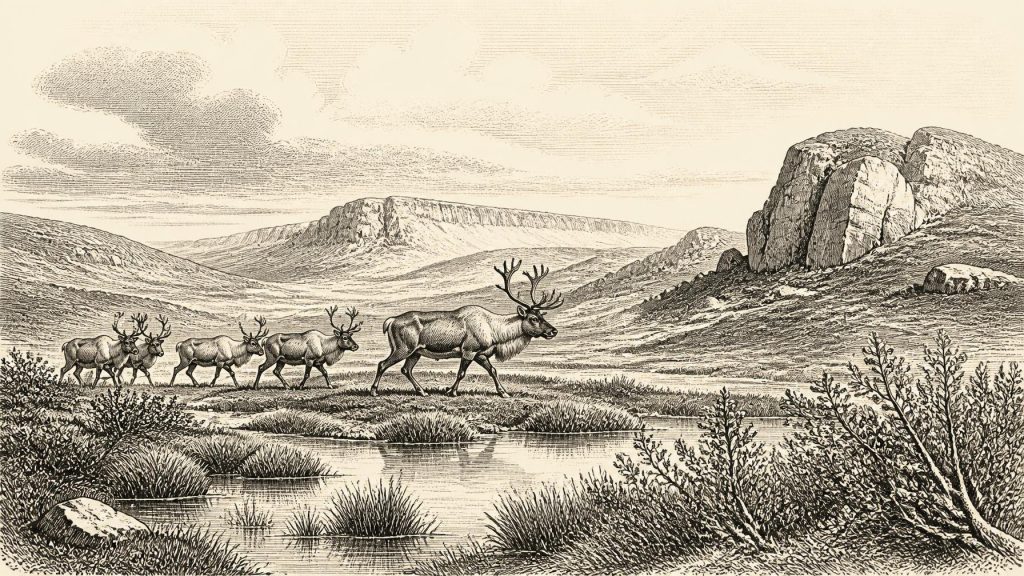
Such country would have looked unlike later, forested Ireland. Open herb-rich ground, dwarf shrubs, sedge communities and mossy hollows offered forage to grazing mammals, while exposed mineral soils and seasonal frost restricted taller vegetation. In sheltered places, streams, pools and lake margins could concentrate both plant growth and animals. The terrain was not empty wilderness in an ecological sense; it was a demanding but productive mosaic.
Castlepook’s Animal Archive
The richest direct evidence for southern Ireland comes from Castlepook Cave, also called Mammoth Cave, near Doneraile in north County Cork. Antiquarian excavations there recovered a large and complicated assemblage of bones. Modern study, including improved radiocarbon pretreatment and redating, has shown that some of its fauna belongs to Marine Isotope Stage 3 and is substantially older than earlier results had suggested. The cave is consequently central to the story of Ireland before the Last Glacial Maximum.
The wider Castlepook record includes reindeer, woolly mammoth, giant deer, brown bear, wolf, fox, Arctic fox, mountain hare, lemmings and spotted hyaena. Not every species need have lived together at one moment, and the cave was not a neutral sample of the wider countryside. Carnivores could drag prey or scavenged parts into fissures; animals could die near the cave; water could move bones; and early excavation disturbed context. Nevertheless, the range establishes that Irish landscapes during parts of this broad period could support large herbivores and the predators or scavengers associated with them.
Reindeer are especially informative. They suggest open, cold-adapted grazing country, though they do not turn Cork into a uniform Arctic plain. Mammoth and giant deer point to a larger herbivore community than modern Ireland can sustain, while hyaena is a reminder that bone deposits may record carnivore behaviour as much as natural death or hunting. The redated Castlepook evidence has also led researchers to suggest that giant deer and spotted hyaena may have disappeared locally well before the Last Glacial Maximum, around 40,000 calibrated years ago. Thus the fauna near this article’s notional date must be discussed as a changing sequence, not a fixed cast of animals.
The Cut Mark and Its Limits
Castlepook also raises the most consequential human question. A reindeer femur from the cave collection has been reported as bearing a deep incision consistent with cutting by a sharp stone tool during butchery. County Cork heritage material places the bone broadly around 31,000 BC, while public discussion commonly describes it as approximately 33,000 years old. Either expression is necessarily broad in calendar terms. It makes the specimen relevant to the early thirties of millennia BCE, rather than proof of activity in 30,458 BCE itself.
If the mark is correctly identified and belongs to the bone’s original Pleistocene context, it is evidence that one or more people handled a reindeer carcass in Ireland during the Upper Palaeolithic. That would push the island’s possible human story far earlier than the well-established post-glacial record. But the object does not prove a permanent settlement, a village, a seasonally occupied camp, a successful hunt or a continuous population. No securely associated house floor, hearth, stone-tool assemblage, human skeleton or repeated occupation horizon has yet supplied that wider context.
The responsible conclusion is therefore deliberately narrow. Ireland may have been visited by Upper Palaeolithic hunters who processed game, perhaps during an episode when climate, animal movements and geography made entry possible. It is equally important to say what cannot be recovered: their language, names, kinship system, ritual beliefs, clothing, travel route, duration of stay and relation to communities elsewhere in Europe. A single marked bone is a remarkable clue, not a lost chapter of written history.
No Polities, No Proven Trade
Terms such as politics, diplomacy and warfare do not fit the evidence. There are no known rulers, territories, alliances, defended settlements or graves from Ireland at this date. Nor is there evidence for farming, herding, metalworking, pottery, monument building, literacy or a trade network operating within Ireland. If people were present, their economy would have depended on foraging, hunting and the opportunistic use of animal and plant resources, as was normal for Upper Palaeolithic societies elsewhere. That is a comparative inference, however, not an excavated Irish household economy.
Likewise, art, religion and learning cannot be assigned to Ireland merely because Upper Palaeolithic communities on the European mainland made images, ornaments and sophisticated stone technologies. Ireland has not produced securely dated material of those kinds for this horizon. The intellectual achievement visible here lies in modern reconstruction: reading minute plant remains, bone chemistry, stratified sediments and radiocarbon measurements while resisting the temptation to make them say more than they can.
Approaching the Ice Maximum
The broad world represented by Castlepook and the Fermanagh organic beds did not endure unchanged. As the climate worsened towards the Last Glacial Maximum, expanding ice and deteriorating habitats transformed Ireland. Later ice sheets destroyed or concealed many possible traces of animals and people, helping to explain why the record is so fragmentary. The next securely documented human occupations belong much later, after major glacial retreat, and should not be presented as the direct descendants of an unproven population at Castlepook.
For 30,458 BCE, then, Ireland is best understood as a fluctuating cold-stage landscape at the edge of the North Atlantic world: open ground and wetlands at some times and places, large mammals moving through viable habitats, and a cave in north Cork preserving an unresolved but potentially profound sign of human carcass processing. The era has no recoverable political narrative. Its history lies instead in environmental survival, movement and disappearance, recorded in silts and bones beneath the legacy of ice.
Primary Sources
- A Reconsideration of the Radiocarbon Dating of the Marine Isotope Stage 3 Fauna from Southern Ireland
- The Irish Quaternary Fauna Project
- Heritage Artefacts of County Cork
- South Fermanagh, Northern Ireland: Irish Quaternary Association Field Guide 16
- Quaternary Site Descriptions
- Outreach and Education Resources
- Field Guides
- Growth and Retreat of the Last British–Irish Ice Sheet, 31,000 to 15,000 Years Ago: The BRITICE-CHRONO Reconstruction
- Pattern and Timing of Retreat of the Last British-Irish Ice Sheet
- Maximum Extent and Dynamic Behaviour of the Last British–Irish Ice Sheet West of Ireland
- The Timing and Magnitude of the British–Irish Ice Sheet Between Marine Isotope Stages 5d and 2: Implications for Glacio-Isostatic Adjustment, High Relative Sea Levels and ‘Giant Erratic’ Emplacement
- Consistently Dated Atlantic Sediment Cores Over the Last 40 Thousand Years
- Stable Stadial and Interstadial States of the Last Glacial’s Climate Identified in a Combined Stable Water Isotope and Dust Record from Greenland
- Independent Tephrochronological Evidence for Rapid and Synchronous Oceanic and Atmospheric Temperature Rises Over the Greenland Stadial-Interstadial Transitions Between ca. 32 and 40 ka b2k
- The WAIS Divide Deep Ice Core WD2014 Chronology – Part 1: Methane Synchronization (68–31 ka BP) and the Gas Age-Ice Age Difference
- New Insights on the Fauna of Ireland’s Younger Dryas and Early Holocene from Alice & Gwendoline Cave
- First Evidence of a Late Upper Palaeolithic Human Presence in Ireland
- The Mesolithic in Ireland: When Was It?
- Investigating Seasonal Mobility in Irish Giant Deer Megaloceros giganteus (Blumenbach, 1799) Through Strontium Isotope (87Sr/86Sr) Analysis
- Archaeology Research Excavation Grant 2022: Castlepook Cave, County Cork
- Studies on the Early Settlement of Scotland and Ireland
- Irish Quaternary Association Publications