Castlepook’s Changing Menagerie30459 BCE
30,459 BCE is not a recoverable Irish historical year but a point within Late Pleistocene Marine Isotope Stage 3. Castlepook Cave in County Cork preserves re-dated animal bones showing that southern Ireland hosted changing cold-climate faunas before the Last Glacial Maximum, including reindeer, mammoth, giant deer, Arctic fox, brown bear and spotted hyaena. Open grasslands, tundra, wetlands and sheltered productive areas supported mobile mammals, while low sea levels enabled intermittent dispersal. A possible cut mark on a reindeer femur suggests fleeting human activity, not settlement. Later ice destroyed much evidence; Castlepook remains a rare archive requiring investigation and cautious interpretation.
Dateline
“30,459 BCE” is a modern chronological label, not a recoverable year in Ireland’s prehistoric record. No Irish calendar, written account or annually layered archaeological sequence allows events to be assigned to this particular year. In conventional archaeological terms, it falls about 32,400 calendar years before AD 1950, during the Late Pleistocene and Marine Isotope Stage 3. The responsible way to approach it is through broad calibrated ranges, cave deposits, animal remains and regional climate records. These illuminate an Ice Age Ireland of changing habitats and mobile mammals; they do not disclose a dated episode, a ruler, a tribe or a settled community.
A Time of Ranges, Not Annals
Even the apparently exact conversion needs care. Radiocarbon ages are expressed in years “before present”, conventionally AD 1950, but they are not calendar years. Atmospheric carbon-14 varied through time, especially during the last glacial period, so laboratory measurements must be calibrated against internationally maintained curves. At great antiquity the resulting calendar estimates commonly cover wide intervals. A bone’s date records the death of the animal, moreover, not necessarily the date when it entered a cave, was disturbed by water, or—where human modification is suspected—was cut.
For this reason, Ireland around the notional date belongs within a longer archaeological frame rather than a single-year narrative. The relevant period precedes the Last Glacial Maximum, when the British–Irish Ice Sheet reached its greatest known extent, broadly between about 26,500 and 19,000 calibrated years ago. At 32,400 years ago, the island had not yet entered that fullest ice-sheet phase. Yet it was already part of a severe and unstable glacial world in which cold stadials alternated with comparatively milder interstadials. Greenland ice cores provide the clearest large-scale record of these abrupt North Atlantic shifts, but Irish evidence is too sparse and often too imprecisely dated to match a particular Irish bone deposit confidently to one named Greenland event.
The Cork Cave Record
The most important Irish evidence for this broad era comes from Castlepook Cave, also known as Mammoth Cave, near Doneraile in north County Cork. Its limestone passages were explored principally between 1904 and 1913, producing an exceptionally rich collection of fossil bones. Much was excavated before modern standards of stratigraphic recording, and later research has had to work with dispersed museum material and imperfect field documentation. Nevertheless, Castlepook remains crucial because it preserves evidence of a pre-Last Glacial Maximum fauna otherwise largely erased from the Irish surface by later ice.
Modern re-dating has transformed the significance of the collection. Earlier radiocarbon measurements on some Castlepook bones were shown to be markedly too young when compared with results obtained after more rigorous collagen purification and ultrafiltration. The re-dated assemblage demonstrates that mammals occupied southern Ireland through substantial portions of Marine Isotope Stage 3. Direct determinations include brown bear, reindeer, Arctic fox, spotted hyaena, giant deer and woolly mammoth, although they do not all belong to one moment. Their dates span many thousands of years. Castlepook therefore documents a changing succession of animals and environments, not a single perfectly reconstructed ecosystem.
That distinction is particularly important for 30,459 BCE. It would be misleading to assemble every species ever found in the cave into one illustrated scene and call it the fauna of that year. A mammoth rib, a hyaena scapula and a reindeer limb can each be securely valuable evidence, while still being separated from one another by centuries or millennia. The broader conclusion is secure: parts of Ireland supported large herbivores, predators and scavengers before the maximum expansion of the last ice sheet. The exact combination present in the Awbeg and Blackwater valleys at this particular point remains unknown.
Reindeer, Hyaenas and Open Country
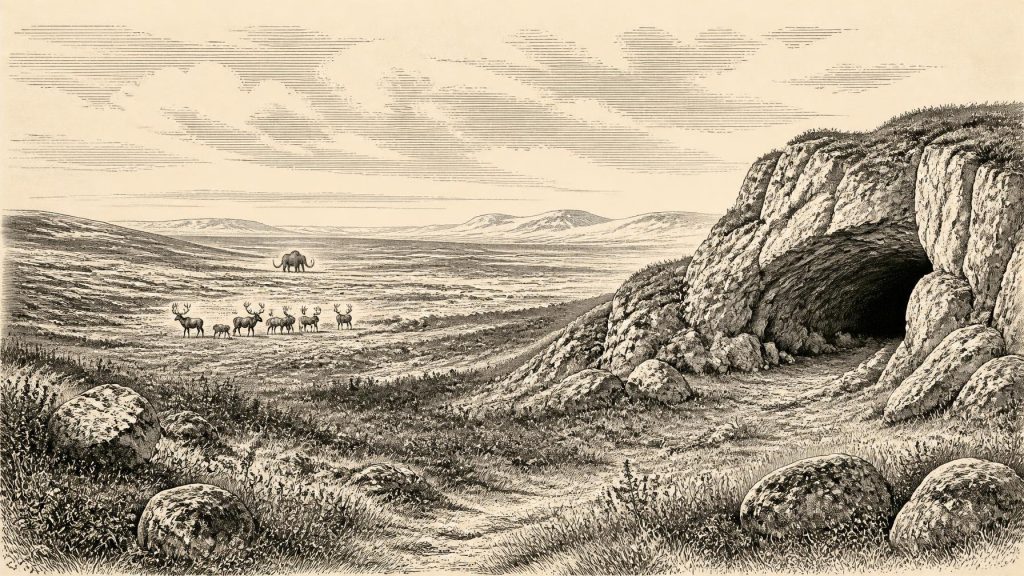
The Castlepook animals point to landscapes very unlike later wooded Ireland. Reindeer, Arctic fox and lemmings are strongly associated with cold, open conditions. Woolly mammoth and giant deer imply extensive grazing and browsing opportunities, while spotted hyaenas indicate a carnivore capable of using caves as dens and accumulating bone. Brown bears, wolves, hares and foxes add complexity rather than a simple label such as “frozen wilderness”. Conditions could vary sharply over time and place. Exposed grassland, herb-rich tundra, dwarf-shrub vegetation, wet ground and sheltered patches of more productive cover may all have existed within the wider glacial landscape.
Plant evidence from beneath glacial sediments in northern Ireland makes the same wider point. Organic deposits at sites including Aghnadarragh and Derryvree preserve pollen, seeds and other biological traces of cold-stage environments, but their chronological resolution is limited and their correlation with southern cave assemblages remains cautious. They show that Ireland was not uniformly lifeless between glacial advances. Freshwater pools, marshy margins and sparse tundra vegetation could support insects, small mammals and grazing animals during ice-free intervals. But they cannot establish that a particular wetland or plant community survived continuously until 30,459 BCE, still less that it was contemporary with every Castlepook find.
Sea level was far lower than today during the glacial period, remodelling coasts and exposing land now drowned beneath the Irish Sea and Atlantic shelf. The precise availability of routes between Ireland, Britain and continental Europe changed with ice volume, local topography and sea level. The presence of continental-style mammals establishes that dispersal occurred at some stages, but it does not reveal a permanent corridor at this exact date or a single direction of movement. Animal populations may have expanded, retreated or been locally lost as climate and habitat shifted. Ireland was a western edge of European range rather than an isolated ecological world.
The Human Question
Castlepook also raises a more difficult question: were people present? A reindeer femur from the cave has been reported as bearing a deep mark interpreted by zooarchaeologist Ruth Carden as made by a sharp stone implement during the processing of a fresh carcass. Public heritage material places the bone broadly at around 30,000 years ago, and the observation is potentially momentous. If the mark is anthropogenic and contemporary with the bone, it would be evidence that a person handled a reindeer in Ireland long before the securely documented terminal-Pleistocene human traces traditionally associated with the island.
Potential is not proof of a populated Ireland. The specimen comes from an old cave collection rather than a newly excavated occupation floor with a hearth, stone-tool assemblage, refitting animal bones and securely associated sediments. Caves are difficult archives: carnivores can drag in limbs; water can move bones and sediment; animals can die in fissures; and early excavation removed much contextual information that would now be indispensable. The date of the bone is not an annual date for the incision. No human skeletal remains, dwelling, burial, artwork or firmly dated Palaeolithic camp is known in Ireland for this period.
The most defensible interpretation is therefore modest. The marked femur may preserve a fleeting human action—perhaps cutting meat or detaching tissue from a reindeer carcass—rather than evidence for a settlement. It cannot identify the number, language, ancestry, route, seasonality or cultural tradition of any visitors. Nor can it demonstrate continuity between any such Upper Palaeolithic visitors and people who reached Ireland much later, after the ice sheets had retreated. Ongoing work at Castlepook, including new excavation, surveying, dating and environmental analysis, is valuable precisely because it may recover undisturbed contexts capable of testing these questions.
No Politics, but a Material World
There is no evidence from which to describe political affairs, warfare, diplomacy, formal religion or learning in Ireland at this date. There were no Irish states, written institutions or named peoples in the historical sense. If people did enter the island, they would have belonged to small, highly mobile hunter-gatherer groups operating within the larger Upper Palaeolithic world of north-west Europe. That is an inference from comparable continental settings, not a demonstrated description of a Castlepook community.
Likewise, trade cannot be responsibly reconstructed. A single possible butchered bone tells us about the processing of animal tissue, not exchange networks. It does not prove the ownership of reindeer herds, regular hunting territories, boats, long-distance commerce or a seasonal camp. The practical economy visible in the evidence is first an animal ecology: grazing herbivores sought vegetation; carnivores and scavengers followed prey or carrion; caves offered shelter, dens and traps for accumulating remains. If humans were present, the immediate opportunity suggested by the femur was animal food and raw material, but even that should be expressed as possibility rather than a documented livelihood.
An Archive Under Threat of Ice
The largest development relevant to this date was not a human event but environmental trajectory. The later advance of the British–Irish Ice Sheet would cover most, probably all, of Ireland and scour away vast quantities of earlier soil, sediment and archaeological evidence. Caves such as Castlepook survived as rare protected archives beneath or beside the ice. Their bones are consequently more than curiosities: they are fragments of an older Irish landscape almost obliterated by glaciation.
Thus 30,459 BCE should not be imagined as a year in which Irish history can be narrated scene by scene. It is a point within a long, unstable Late Pleistocene interval. The evidence supports an Ireland with cold open habitats, wetlands in favourable places and a diverse assemblage of Ice Age mammals, including reindeer, mammoth and spotted hyaena. It supports the possibility of a very early human encounter with that world at Castlepook. It does not yet support claims of permanent settlement, social organisation, political conflict, religion or trade. The proper history of this moment is the history of what endured: bones in limestone darkness, deposits beneath later ice, and scientific methods that continue to revise the island’s deepest past.
Primary Sources
- A Reconsideration of the Radiocarbon Dating of the Marine Isotope Stage 3 Fauna from Southern Ireland
- The Irish Quaternary Fauna Project
- New Insights on the Fauna of Ireland’s Younger Dryas and Early Holocene from Alice & Gwendoline Cave
- Growth and Retreat of the Last British–Irish Ice Sheet, 31,000 to 15,000 Years Ago: The BRITICE-CHRONO Reconstruction
- Pattern and Timing of Retreat of the Last British–Irish Ice Sheet
- Late Pleistocene Chronostratigraphy and Ice Sheet Limits, Southern Ireland
- The IntCal20 Northern Hemisphere Radiocarbon Age Calibration Curve (0–55 cal kBP)
- A 60,000 Year Greenland Stratigraphic Ice Core Chronology
- The Exploration of Castlepook Cave, County Cork
- Heritage Artefacts of County Cork
- 2022:564 – Castlepook Cave, Castlepook South, Cork
- Archaeology Research Excavation Grant 2022: Castlepook Caves Project Final Report
- County Cork Heritage Grant Scheme 2023: The Castlepook Cave Project
- Figure 6: The Subdivision of the Quaternary Period in Ireland
- Outreach and Education Resources
- Spotted Hyena Skull
- Ice Age Ireland: Cool Fossils!
- IntCal Radiocarbon Carbon Calibration Curves
- Ireland’s Palaeolithic Archaeology – Fleeting Footprints in a Frozen Land
- Our Ancient Landscapes: Hunter-Gatherers in Ireland