A Femur at Castlepook30460 BCE
At 30,460 BCE, Ireland cannot be reconstructed year by year, but evidence indicates intermittent ice-free environments during Marine Isotope Stage 3. Derryvree, County Fermanagh, preserves freshwater deposits between glacial tills, showing cold, treeless wetland with tundra plants, insects and shallow water before renewed ice advance. Castlepook Cave, County Cork, contains mixed Late Pleistocene animal remains, including mammoth and reindeer, accumulated over long periods and poorly stratified. A cut-marked reindeer femur may indicate Upper Palaeolithic butchery, but cannot demonstrate settlement or continuity. No political, social or economic history is recoverable. The period remains fragmentary environmental prehistory, awaiting improved dating and excavation.

Dateline
Modern calendar-year precision is not available for Ireland in 30,460 BCE. The number is useful only as a point on a much broader prehistoric timescale: roughly 32,410 calibrated years before AD 1950 (cal BP), within Marine Isotope Stage 3 of the Last Glacial period. No Irish written record, settlement sequence or archaeological layer can be assigned to that individual year. The responsible history of this moment is therefore one of dated ranges, surviving environmental archives and carefully limited inferences.
The strongest Irish evidence relevant to this date comes from two very different places. At Derryvree near Maguiresbridge in County Fermanagh, freshwater silts and organic deposits were trapped between two layers of glacial till. At Castlepook Cave, near Doneraile in north County Cork, old excavations recovered bones from a changing Ice Age animal community. Together they show that parts of Ireland were not simply a permanent sheet of ice before the Last Glacial Maximum. They do not, however, provide a year-by-year narrative, nor do they prove a settled human population.
Dating a Deep Past
Radiocarbon ages are measured against AD 1950, conventionally called “before present”, and must be calibrated because atmospheric radiocarbon has varied through time. The Derryvree freshwater series produced a conventional determination of 30,500 ± c.1,000 radiocarbon years BP. Calibration gives a broad and uneven probability range rather than a single historical date; published discussion places the deposit approximately within 36,900–31,700 cal BP. In BCE terms, that is broadly about 34,950–29,750 BCE. The requested year falls inside this long window, but no individual fossil, water level or climatic episode can safely be fixed to it.
This caution matters especially in a period of abrupt North Atlantic climatic change. Greenland ice cores record repeated swings between colder stadials and relatively milder interstadials during MIS 3. It is tempting to attach Derryvree to one numbered Greenland event. Yet the Irish deposits are too limited, and their older radiocarbon uncertainties too broad, for a secure one-to-one synchronisation. Derryvree is best described as a local record of an ice-free interval in a cold phase, not as proof that all Ireland shared one stable climate or landscape at 30,460 BCE.
Water Beneath Later Ice
Derryvree is unusually revealing because later glacial sediments sealed an older wetland. Road works in 1969 cut through a drumlin and exposed lower till, fine sands and freshwater silts, organic material, then upper till. The sequence gives a clear relative order. Ice deposited sediment first; at some later point the locality supported standing or slow-moving fresh water and biological communities; subsequently ice again advanced over, or expanded across, the district and deposited the upper till. The modern drumlin is not a surviving landscape from the date in question. It is a later glacial landform enclosing an older environmental archive.
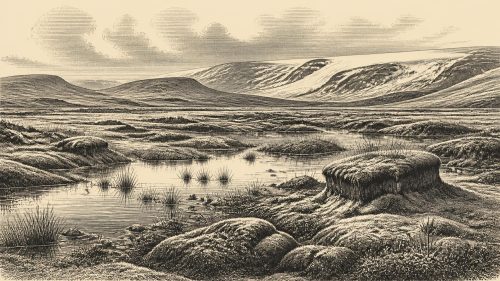
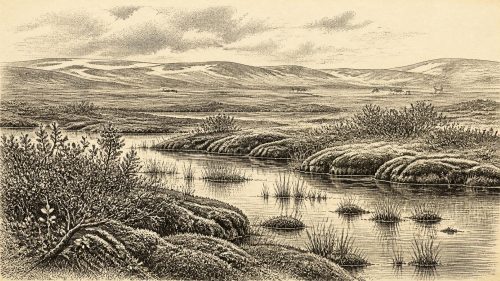
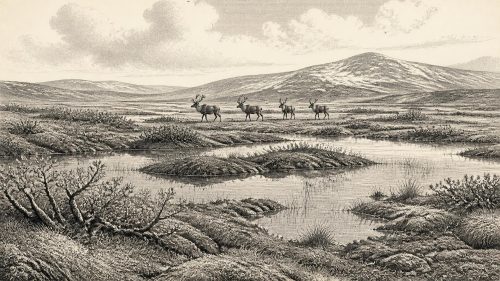
The fossils describe a severe but living setting. Poorly preserved pollen was chiefly herbaceous. More local plant remains, mosses and insects point towards open, treeless vegetation: grasses and sedges, low herbs, moss-rich wet ground and shallow pools. Reported plants include dwarf willow, mountain-avens, lesser clubmoss, bogbean and alternate water-milfoil. Bogbean and water-milfoil are particularly valuable evidence for freshwater and damp margins. Dwarf willow and mountain-avens fit exposed, cold conditions. In combination, these remains support an interpretation of periglacial tundra or muskeg-like wetland, with local patches of water, saturated sedgebanks and sparse open ground.
That interpretation should not be mistaken for a photograph of Fermanagh, still less of the whole island. A seed establishes that a plant grew nearby or was carried into the basin; insect and pollen assemblages widen the picture; sediments explain the setting. Reconstructing a short growing season, seasonal frost and a patchwork of poolside habitats is a reasoned synthesis from those clues. It is stronger than speculation, but remains different from direct observation. There is no evidence here for forest, farmland, permanent dwellings or a familiar modern bog.
Animals on the Atlantic Edge
Castlepook Cave supplies a complementary, though more difficult, record. Its collections contain bones attributed to woolly mammoth, reindeer, giant deer, brown bear, wolf, foxes, lemmings and spotted hyaena. Direct radiocarbon dates obtained through the Irish Quaternary Fauna Project showed that some animal remains belonged to the broad pre-Last Glacial Maximum interval, including mammoth and reindeer specimens with conventional ages in the mid-thirty-thousand range. They demonstrate that cold-adapted and open-country animals reached Ireland at intervals during the Late Pleistocene.
But a cave bone collection is not a single herd, season or food web frozen in time. Castlepook’s galleries accumulated material over many millennia. Carnivores could have dragged carcass parts into the cave; water, collapse and earlier digging could have moved deposits; antiquarian excavations did not preserve the stratigraphic information expected today. Some Castlepook specimens are demonstrably much younger than others. The responsible conclusion is that the cave records a succession of animal presences, not that mammoths, hyaenas, reindeer and every other recorded species necessarily stood together in Cork in 30,460 BCE.
Nevertheless, the combined Derryvree and Castlepook evidence changes the scale on which Ireland must be imagined. It was not an empty abstraction beyond Europe. During favourable intervals, open habitats, fresh water and mobile animal populations existed at the north-western edge of the continent. The sea was lower than today because much water was locked in global ice sheets, but the exact routes by which animals reached Ireland, and whether connections were intermittent, coastal or marine crossings, remain matters for palaeogeographical research rather than assumptions. No dependable evidence supports a named route or a permanent land bridge at this specific date.
The Castlepook Cut Mark
The most arresting human question is a reindeer femur from Castlepook. County Cork heritage publications date it broadly to about 31,000 BCE and report a deep incision interpreted by zooarchaeologist Ruth Carden as a cut made by a sharp stone tool while a fresh carcass was being processed. If that interpretation is sustained, it may be evidence that people handled a reindeer in Ireland during the Upper Palaeolithic, vastly earlier than the island’s formerly accepted human record.
Its importance demands restraint. The bone is evidence of an animal and, potentially, an act of butchery; it is not a village, a burial, a hearth, a tool kit or a named population. There is no securely associated Palaeolithic stone-tool assemblage, built shelter, occupation surface, human skeleton or rock art from Castlepook. Nor can the cut-marked femur prove that its maker hunted the animal, rather than scavenged it, or establish whether one visitor or a small party came to the island. The cave’s disturbed and long-lived deposits make the precise relation between bone, mark and landscape especially difficult to recover.
The later, better-established evidence provides a useful contrast. A butchered brown-bear patella from Alice and Gwendoline Cave in County Clare has two concordant calibrated ranges around 12,810–12,590 cal BP, or roughly 10,860–10,640 BCE. That is compelling evidence of people in terminal-Pleistocene Ireland, but it is almost twenty millennia later than the date considered here. It cannot fill the intervening gap or demonstrate continuity from any possible Castlepook visitors.
No Kingdoms, No Borders
Political affairs, diplomacy and organised conflict are beyond the evidence for 30,460 BCE. There were no Irish states, peoples with recoverable names, borders or institutions. It would be equally unjustified to invent a “tribe” from a single marked bone. If humans were present, the wider European comparison suggests small, mobile Upper Palaeolithic groups whose survival depended on knowledge of animals, weather, raw materials and seasonal movement. That is an inference from better documented continental contexts, not a fact established for Ireland.
Everyday life is similarly elusive. The possible processing of a reindeer implies only the practical value of meat, hide, sinew, fat or bone. It does not show what was eaten regularly, where people slept, how long they stayed, which tools they made or whether families travelled with them. There is no evidence for farming, exchange networks, seafaring trade, pottery, metalworking or settled economy. Nor is there Irish evidence from this date for formal religion, burial practice, visual art, language or learning in the sense later societies would recognise.
The principal development around this date was environmental, not political: a volatile Ice Age Ireland in which ice-free wetland could exist between glacial advances, supporting tundra plants and mobile fauna. Derryvree preserves the clearest local testimony to that possibility; Castlepook preserves the most provocative hint that people may have briefly entered that world. Future excavation, renewed dating and microscopic study of bone surfaces may alter the balance of evidence. For now, 30,460 BCE belongs not to an annual chronicle of Irish society, but to the deep and fragmentary prehistory from which Ireland’s later human story eventually emerged.
Primary Sources
- Palaeoecology
- Figure 6.— The subdivision of the Quaternary Period in Ireland
- Introduction to the Late Quaternary and Holocene of Northern Ireland
- Menyanthes trifoliata L.
- Irish Pleistocene biostratigraphy
- The Irish Quaternary Fauna Project
- 2022:564 – Castlepook Cave, Castlepook South, Cork
- Heritage Artefacts of County Cork
- The Archaeological Heritage of County Cork
- Irish Caves Database: Mammoth Cave
- First Evidence of a Late Upper Palaeolithic Human Presence in Ireland
- New Insights on the Fauna of Ireland’s Younger Dryas and Early Holocene from Alice & Gwendoline Cave
- The IntCal20 Northern Hemisphere Radiocarbon Age Calibration Curve (0–55 cal kBP)
- The IntCal20 Approach to Radiocarbon Calibration Curve Construction: A New Methodology Using Bayesian Splines and Errors-in-Variables
- A Stratigraphic Framework for Abrupt Climatic Changes During the Last Glacial Period Based on Three Synchronized Greenland Ice-Core Records
- The Tolsta Interstadial, Scotland: Correlation with D–O Cycles GI-8 to GI-5?
- Extent and Timing of the Last Glacial Maximum (LGM) in Britain and Ireland: A Review
- The Timing and Magnitude of the British–Irish Ice Sheet Between Marine Isotope Stages 5d and 2
- Last Glacial Maximum Cirque Glaciation in Ireland and Implications for Reconstructions of the Irish Ice Sheet
- Trimlines, Blockfields and the Vertical Extent of the Last Ice Sheet in Southern Ireland