
Year by Year
Explore Year by Year articles from the most modern historical year back to the oldest.
3,294 Articles Archived
Petty’s Survey
Archived: 14 October 2026
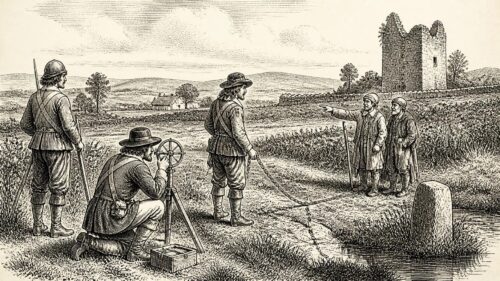
In 1655, Cromwellian rule in Ireland advanced from conquest to practical settlement through transplantation, social control, land measurement and changing leadership. Government orders extended deadlines for Catholic proprietors removed to Connacht and Clare, punished noncompliance, restricted Shannon crossings, and expelled Catholics from Dublin. Debate between Vincent Gookin and Richard Lawrence exposed disagreement over transplantation’s economic costs and security aims. Henry Cromwell’s arrival in July made him effective governor after Fleetwood’s departure, altering political balance. William Petty began the Down Survey, using former soldiers and local knowledge to map forfeited land for army arrears and adventurer claims, embedding dispossession in administration.
Connacht Deadline
Archived: 14 October 2026
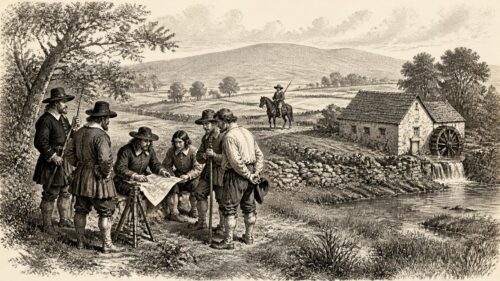
In 1654, the Commonwealth sought to consolidate Cromwellian conquest through transplantation, surveys and institutions. Catholics deemed liable to removal faced a 1 May deadline to move to Connacht or Clare, though enforcement proved uneven amid exemptions, shortages and local dependence on tenants. Courts of survey launched the Civil Survey, recording pre-war ownership, resources and boundaries to facilitate confiscation and redistribution. Charles Fleetwood, appointed Lord Deputy, pursued a hard settlement despite divisions among Protestants and intervention over exemptions. Ireland gained Westminster representation without an Irish parliament. In December, William Petty’s contract initiated preparations for the Down Survey, making dispossession administratively durable.

Cloughoughter Surrender
Archived: 14 October 2026
In 1653, the Commonwealth completed Ireland’s military conquest as Sir Phelim O’Neill was executed and Philip O’Reilly surrendered Cloughoughter Castle, the last formal Irish Catholic field-force stronghold. Catholic clergy faced expulsion, while Hugh O’Reilly’s death symbolised ecclesiastical disruption. Commonwealth plans shifted towards settlement: Connacht and Clare were designated for transplantation, and forfeited estates were prepared for soldiers and Merchant Adventurers through surveys and land allocation. These measures threatened Catholic proprietors and reshaped local society amid famine, disease, depopulation and insecurity. Cromwell’s Protectorate consolidated London-directed rule, inaugurating a Protestant military state whose post-war settlement rested on confiscation, displacement and administrative control.
Galway Surrender
Archived: 14 October 2026
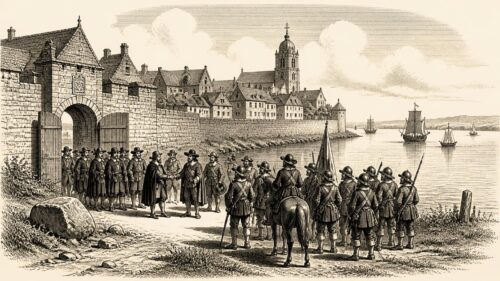
In 1652, Galway, the last major Confederate Atlantic port, surrendered to parliamentary forces after siege and blockade, ending its military significance but leaving Catholic inhabitants uncertain. Resistance persisted through irregular fighters, while agreements offered some soldiers foreign service. Charles Fleetwood’s appointment signalled army-backed civil rule. On 12 August, the Rump Parliament’s Act for the Settling of Ireland established punitive categories of guilt, enabling forfeiture, banishment and redistribution of land to soldiers and Adventurers, although later measures shaped transplantation. War, famine, disease and displacement devastated communities. Thus conquest evolved into a programme restructuring property, authority, religion and belonging under Commonwealth rule.
Limerick Siege
Archived: 14 October 2026
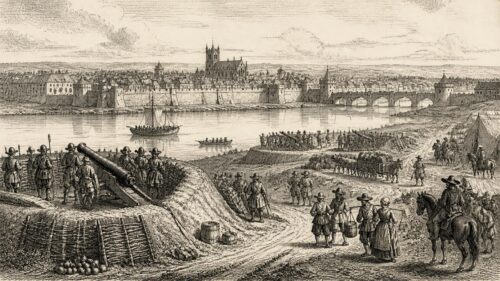
In 1651 Commonwealth forces tightened control of Ireland through campaigns in Munster and Connacht. Henry Ireton besieged Limerick, while Lord Broghill defeated Muskerry’s attempted relief army at Knocknaclashy, ending prospects of substantial support. Blockade, artillery, hunger and disease devastated Limerick’s inhabitants, provoking divisions between defenders, clergy and civilians seeking terms. The city surrendered on 27 October after internal betrayal opened key positions. Although many received quarter, leading military, civic and Catholic figures were excluded, imprisoned or executed. Ireton envisaged a more English, Protestant city. Meanwhile Galway came under blockade, becoming the remaining major centre of organised Catholic and royalist resistance.
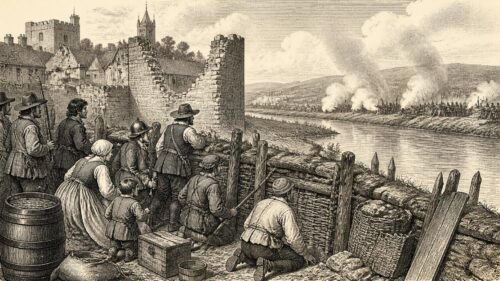
Clonmel Defence
Archived: 14 October 2026
In 1650, the Cromwellian conquest advanced despite continuing resistance in Connacht, Limerick and Ulster. Cromwell’s agreement with Protestant royalists weakened Ormond’s Catholic–royalist coalition. At Clonmel, Hugh Dubh O’Neill’s improvised inner defence repelled a costly assault, although shortages enabled the garrison’s escape and the town’s surrender. Broghill defeated a relief force at Macroom, while Scarrifholis destroyed the Ulster Catholic army and led to Heber MacMahon’s execution. After Cromwell departed, Henry Ireton captured plague-stricken Waterford and Duncannon, pressured Athlone and failed before Limerick. Clergy repudiated Ormond; garrisons, blockade, disease and resource seizures established groundwork for further conquest and settlement in Ireland thereafter.
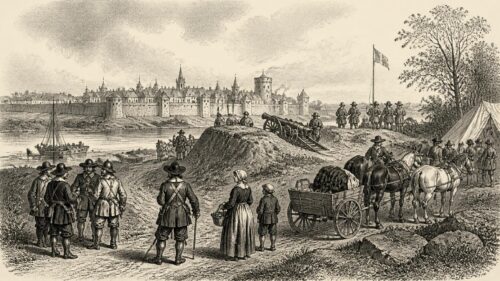
Cromwell’s Campaign
Archived: 14 October 2026
In 1649, the second Ormond peace united Confederate Catholics and royalists against the English Commonwealth, but exclusion of Owen Roe O’Neill exposed deep divisions. Ormond’s defeat by Michael Jones at Rathmines on 2 August secured Dublin for parliament, enabling Oliver Cromwell’s landing with the New Model Army and naval support. At Drogheda in September and Wexford in October, stormings produced exceptional killings, including civilians and clergy, and devastated resistance and trade. O’Neill’s death further weakened opposition. Cromwell failed to take Waterford before winter, but the year transformed the war, creating conditions for the later Cromwellian conquest and settlement in Ireland.

Inchiquin Truce
Archived: 15 October 2026
In 1648, the Catholic Confederation of Ireland fractured over the Dungarvan truce with Murrough O’Brien, Lord Inchiquin, newly aligned with Charles I. Exhaustion after 1647 defeats led moderates to seek a royalist coalition and negotiations with Ormond, despite Inchiquin’s destructive record. Papal nuncio Rinuccini condemned the truce, censuring supporters and joining Owen Roe O’Neill’s resistance. Rival Confederate armies campaigned without decisive battle, burdening civilians suffering requisition and scarcity. The Kilkenny assembly marginalised O’Neill, while Ormond’s return and Rome’s limited aid strengthened accommodation. O’Neill’s ceasefire with parliamentarian Michael Jones revealed division. Winter brought coalition, not peace, before the 1649 Ormond settlement.
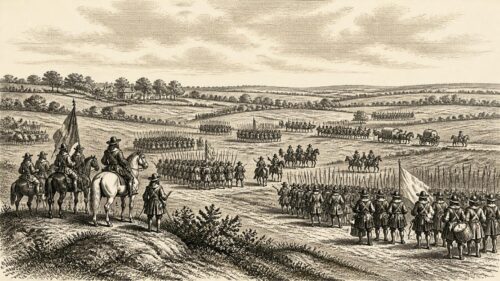
Confederate Collapse
Archived: 15 October 2026
In 1647, the Catholic Confederation’s position collapsed after political division, logistical weakness and military reverses. Parliament gained Dublin when Ormond transferred the city in June, providing a strategic base. Michael Jones destroyed Thomas Preston’s Leinster army at Dungan’s Hill in August, ending any prospect of taking Dublin. In Munster, Inchiquin’s forces devastated communities and stormed Cashel, killing defenders and civilians, plundering the religious complex and deepening Catholic fears. In November, Inchiquin defeated Taaffe’s army at Knocknanuss, killing Alasdair MacColla. Although Kilkenny and O’Neill’s Ulster army survived, these disasters encouraged royalist negotiation and transformed Confederate ambitions into a struggle for survival.
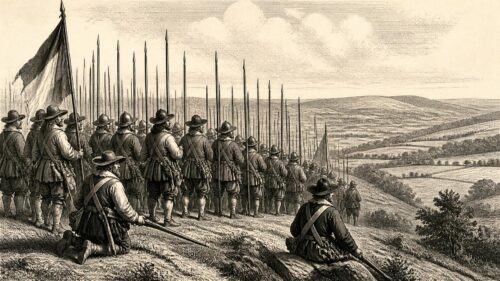
Ormond Peace
Archived: 15 October 2026
In 1646, the Catholic Confederation reached its military zenith but became divided over peace with Charles I. Owen Roe O’Neill’s victory over Scottish Covenanters at Benburb, Preston’s Connacht operations, and the capture of Bunratty strengthened hopes of securing Catholic religious and political guarantees. The First Ormond Peace, agreed secretly with the royalist lord lieutenant, offered insufficient protections and provoked clerical, military and popular resistance. Papal nuncio Giovanni Battista Rinuccini led opposition, overthrowing the agreement and remodelling Confederate government. A failed advance on Dublin exposed rivalries, weak supply and divided command. Kilkenny’s Catholic print culture also articulated suffering, rights and legitimacy.
Some records do not yet have a verified historical year and are awaiting chronological placement.