
Year by Year
Explore Year by Year articles from the most modern historical year back to the oldest.
3,292 Articles Archived
Presidential Succession
Archived: 8 October 2026
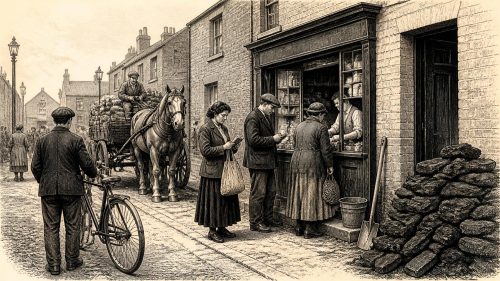
In 1945, Ireland emerged cautiously from wartime neutrality, retaining rationing, shortages and emergency powers despite Europe’s liberation. De Valera’s condolences on Hitler’s death provoked international condemnation, while VE Day renewed disputes over neutrality, partition and Allied relations. Censorship ended, but wartime administration unwound gradually. Seán T. Ó Ceallaigh became the second President after defeating Seán MacEoin, symbolising continuity and change. Legislation addressed drainage, tuberculosis and mental treatment, while supply functions returned to Industry and Commerce. Northern Ireland elections confirmed Unionist dominance, though Labour and nationalist representation exposed political divisions. Ireland entered peace facing economic constraint, institutional transition and diplomatic isolation.
Blacksod Forecast
Archived: 8 October 2026
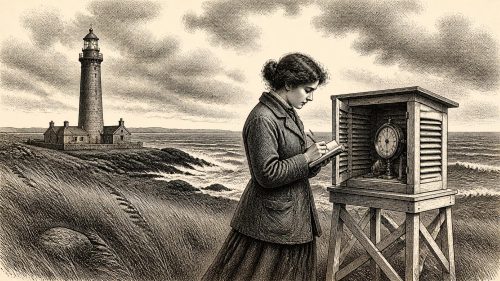
During 1944, neutral Ireland endured Emergency shortages, rationing and transport disruption while remaining strategically entangled in the war. At Blacksod Point, Maureen Flavin’s weather observations assisted Allied forecasting before the Normandy landings, illustrating neutrality’s limits. De Valera rejected Allied demands to expel Axis diplomats, defending sovereignty amid espionage concerns and partition. Fianna Fáil won a Dáil majority in May. Children’s allowances began in August, easing family pressures. December’s Transport Act prepared Córas Iompair Éireann, while the Abbey staged Joseph Tomelty’s Belfast-set play, The End House. The year combined democratic continuity, cautious social reform and preparations for postwar reconstruction across Ireland.

Kerlogue Rescue
Archived: 8 October 2026
In 1943, neutral Ireland faced the Second World War’s political, economic and human pressures. A wartime election left Éamon de Valera’s Fianna Fáil governing without a majority, while Labour advanced and Oliver Flanagan’s antisemitic maiden speech exposed prejudice. Emergency legislation, censorship and diplomacy defended neutrality amid Allied pressure and partition. War reached Donegal when a mine killed eighteen at Ballymanus, and U-607 sank the marked Irish Oak, though its crew survived. Rationing, compulsory tillage and fuel shortages burdened households and commerce. In December, the coaster Kerlogue rescued 168 German sailors in the Bay of Biscay, clearly demonstrating neutrality’s humanitarian responsibilities.

Irish Pine
Archived: 8 October 2026
In 1942, neutral Ireland endured the Emergency while Northern Ireland became an Allied base after American troops arrived in Belfast. De Valera’s government maintained neutrality, emergency controls and censorship, while creating the Central Bank and confronting extremist politics. Shortages of fuel, rubber, food and consumer goods reshaped work, travel and household life; labour migration to Britain remained significant. Irish merchant ships risked Atlantic attack while rescuing survivors, until the Irish Pine was torpedoed with all thirty-three crew lost. Cultural life persisted through Cavan Cathedral, Kavanagh’s The Great Hunger and folklore scholarship, alongside censorship disputes. Ireland faced constraint, danger and change.
North Strand
Archived: 8 October 2026
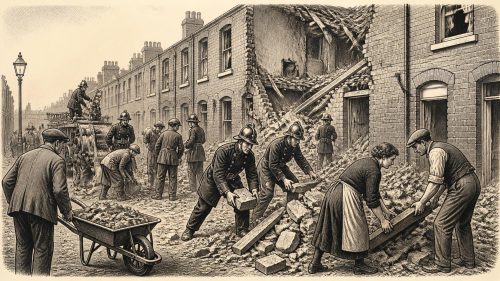
In 1941, neutral Éire faced the Second World War’s consequences despite preserving its Emergency policy. German raids devastated Belfast, a British industrial centre, killing hundreds and prompting fire brigades from Dublin and other southern towns to assist. On 31 May, German bombs killed twenty-eight people, injured over ninety and destroyed about 300 homes in Dublin’s North Strand. The attack demonstrated neutrality’s limits amid diplomatic tension over Northern Irish conscription and Churchill’s appeals for Irish participation. Shortages of food, fuel and imports led to rationing, expanded turf supplies and Irish Shipping’s creation. Maritime dangers and cross-border relief underscored Ireland’s wartime vulnerability.

Campile Bombing
Archived: 8 October 2026
In 1940, neutral Éire faced danger as German victories transformed its strategic position. De Valera defended neutrality, expanded emergency powers and rejected Britain’s unity proposal, judging it insecure and incompatible with sovereignty. The government suppressed IRA activity, while Seán Russell died during an abortive German-backed mission. On 26 August, German bombs killed three women at Campile creamery, Ireland’s first fatal Luftwaffe raid. Shortages prompted censorship, restrictions and compulsory tillage to strengthen food security. Northern Ireland mobilised for Britain, with Belfast industry expanding and John Miller Andrews succeeding Craigavon. The Bell appeared, while in December John Charles McQuaid became Dublin’s archbishop.

Magazine Fort
Archived: 9 October 2026
In 1939, Ireland faced both European war and republican militancy. The Government strengthened internal security through the Offences Against the State Act, while air-raid precautions reflected fears of attack. Following Germany’s invasion of Poland, constitutional amendments and the Emergency Powers Act enabled neutral Ireland to regulate security, supplies and communications. Dublin denied belligerents use of its territory and ports, despite British pressure, asserting sovereignty after the Treaty Ports’ return. Northern Ireland entered the war with Britain, underscoring partition’s consequences. Refugee appeals highlighted Nazi persecution. The December IRA raid on Dublin’s Magazine Fort demonstrated that armed challenges to State authority persisted.
Treaty Ports
Archived: 9 October 2026
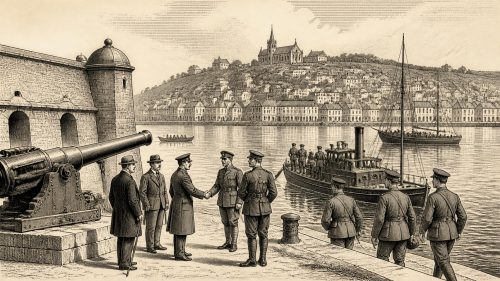
In 1938, the new Constitution acquired practical force as Ireland developed its institutions and position. Douglas Hyde, cultural revivalist and Church of Ireland scholar, became first President, symbolising an inclusive national identity, though disputes persisted. April agreements ended the Economic War: Ireland paid £10 million, Britain removed special duties, and the Treaty Ports at Cork Harbour, Berehaven and Lough Swilly returned to Irish control. Fianna Fáil then won an overall majority. Labour legislation addressed shop workers’ conditions, but poverty, emigration and agricultural dependence continued. Partition remained unchanged despite discussions with Britain and Northern Ireland, while port recovery strengthened future neutrality.
Irish Constitution
Archived: 9 October 2026
In 1937, Éamon de Valera’s government drafted, debated and submitted a Constitution to voters, replacing much of the Irish Free State’s imperial framework. Approved by the Dáil and endorsed in the 1 July plebiscite by 685,105 votes to 526,945, it came into force on 29 December, naming the State Éire/Ireland. It established the presidency, Taoiseach, reconstituted Seanad and Supreme Court, while asserting an all-island claim. Its Catholic-inflected provisions on religion and family prompted criticism. Fianna Fáil retained power without a majority. Amid poverty, emigration and dependence on Britain, legislation addressed housing and welfare, while Spain and insecurity shaped foreign policy.

Crown Removal
Archived: 9 October 2026
In 1936, the Irish Free State accelerated constitutional change under de Valera. Abolition of the Seanad created a unicameral Oireachtas, while Edward VIII’s abdication enabled removal of the Crown and governor-general from domestic government, retaining limited royal functions abroad. Economic War pressures, despite a coal-cattle agreement, sustained hardship and arguments over protectionism, while the census documented social conditions. The Spanish Civil War polarised opinion, although government maintained non-intervention. Catholic confidence appeared in Mullingar’s new cathedral; Peig and Ireland To-day reflected cultural life. Aer Lingus’s Iolar inaugurated Bristol flights. Partition endured, but 1936 anticipated the 1937 constitution and its future direction.
Some records do not yet have a verified historical year and are awaiting chronological placement.