Iolar and the Abdication1936 CE
In 1936, the Irish Free State accelerated constitutional change under de Valera. Abolition of the Seanad created a unicameral Oireachtas, while Edward VIII’s abdication enabled removal of the Crown and governor-general from domestic government, retaining limited royal functions abroad. Economic War pressures, despite a coal-cattle agreement, sustained hardship and arguments over protectionism, while the census documented social conditions. The Spanish Civil War polarised opinion, although government maintained non-intervention. Catholic confidence appeared in Mullingar’s new cathedral; Peig and Ireland To-day reflected cultural life. Aer Lingus’s Iolar inaugurated Bristol flights. Partition endured, but 1936 anticipated the 1937 constitution and its future direction.
Dateline
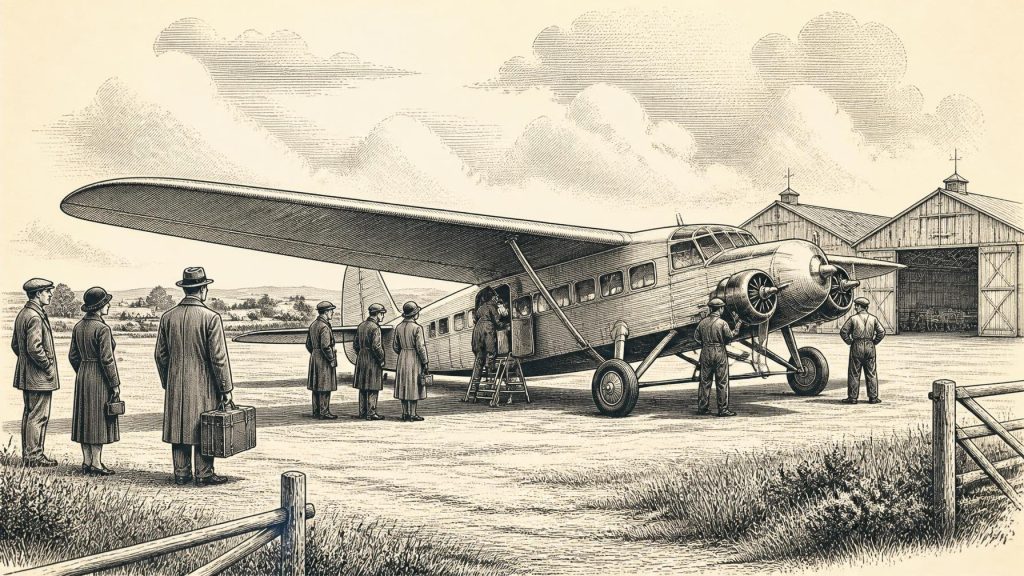
In 1936 the Irish Free State was not yet called Ireland in law, and it was not yet a republic. Its institutions still bore marks of the 1921 Treaty settlement: a constitution framed in 1922, a governor-general, and a formal relationship with the Crown. Yet the year brought a striking acceleration in constitutional change. It also supplied a vivid counterpoint to politics on paper: the little aircraft Iolar left Baldonnel for Bristol, making a new physical connection across the Irish Sea just as the State was redefining the political meaning of that connection.
A State Recasting Its Machinery
Éamon de Valera’s Fianna Fáil government remained in office, pursuing the long campaign to reduce the constitutional traces of British authority without provoking a rupture that might damage Irish interests abroad. This was delicate work. Britain remained the indispensable economic neighbour, the principal destination for much Irish produce, and the country to which many Irish people emigrated. Partition remained intact, while Northern Ireland continued under its own parliament at Stormont and within the United Kingdom. Constitutional assertion in Dublin could not by itself settle either question.
One major institutional change came in May, when the Free State Seanad disappeared. The upper chamber had repeatedly clashed with the Dáil, notably by delaying measures promoted by de Valera’s government. Its abolition was therefore both a practical victory for the administration and a contentious constitutional choice. Supporters treated the Seanad as an obstructive, insufficiently democratic remnant; critics warned that a single-chamber legislature weakened safeguards against hasty majorities. The State would operate without a second chamber until the new constitution created a different Seanad the following year. In 1936, however, the immediate fact was stark: legislation now passed through a unicameral Oireachtas.
The most dramatic constitutional moment arrived in December, prompted not by an Irish initiative but by the abdication of Edward VIII. Edward signed his instrument of abdication on 10 December. Within hours and days, Dublin moved rapidly. The Constitution (Amendment No. 27) Act received assent on 11 December, removing the king and governor-general from the Free State constitution and transferring or revising functions that had depended upon them. The Executive Authority (External Relations) Act followed on 12 December.
These measures did not simply proclaim a republic. Instead, they created a deliberately limited arrangement. In specified external matters—principally the appointment of diplomatic and consular representatives and the conclusion of international agreements—the king could still act on the authority of the Executive Council while the Free State remained associated with the Commonwealth. Internally, however, the Crown and governor-general were removed from the constitutional machinery. The result was a sophisticated, and purposely ambiguous, settlement: de Valera had used a British dynastic crisis to make the State more self-governing while postponing a final declaration about its ultimate constitutional destination.
Economy, Work and the Household
The constitutional drama unfolded against a hard economic background. The Anglo-Irish Economic War, begun in 1932 over disputed land-annuity payments, still shaped daily calculation on farms, in market towns and in government departments. Retaliatory duties and restrictions had damaged the cattle trade, on which many farmers and rural labourers depended. By 1936 a coal-cattle agreement had eased some pressures by improving the Irish cattle quota in Britain, but it did not end the wider dispute. Officials were still considering trade relations with Britain in December, and a comprehensive settlement would not come until 1938.
Fianna Fáil’s response combined protection, tariffs, state encouragement of domestic production and efforts to shift agriculture towards tillage, dairying and the home market. These policies offered some industrial opportunities, particularly in protected manufacturing, but they were no simple cure for rural insecurity or unemployment. A smallholder, an agricultural labourer and a cattle farmer could experience the same national policy very differently. The continuing argument over the Economic War reflected not merely party rivalry but conflicting ideas about what an independent Irish economy should look like: export-oriented and tied to Britain, or more diversified, sheltered and self-sufficient.
On 26 April the State took its third census. The exercise itself is a valuable snapshot of official concern in 1936. Household schedules recorded occupation, industry, housing, religion, Irish-language knowledge and unemployment. Those out of work were asked how many weeks of unemployment they had experienced in the preceding year. The eventual published tables show why the census mattered: they made it possible to compare crowded urban dwellings with rural homes, farms of different sizes, employment patterns and the condition of Irish-speaking districts. For contemporaries, filling in the form was a small domestic task; for the State, it was an attempt to see a dispersed, unequal and still largely rural population more clearly.
Spain Divides Irish Opinion
The outbreak of the Spanish Civil War in July brought European conflict into Irish political and religious life with unusual force. Many Catholics interpreted reports of anti-clerical violence in Republican-held territory as evidence that the Spanish Republic faced a communist assault on Christianity. The Irish Christian Front mobilised public feeling, while newspaper coverage, sermons and meetings made Spain an argument about religion, revolution and the future of Europe. De Valera’s government, however, resisted pressure to recognise General Francisco Franco’s insurgent regime. Its position was one of non-intervention and caution, shaped by an emerging commitment to keep Ireland out of other states’ wars.
Irish people nevertheless took sides. Eoin O’Duffy, former Garda commissioner and former Blueshirt leader, supported Franco’s Nationalists and recruited an Irish Brigade. The bulk of that force reached Spain in December 1936, though it would see its troubled service mainly in 1937. Smaller numbers of Irish left-wing volunteers also began travelling to support the Spanish Republic and the International Brigades. Their later story should not be projected backwards as though it were already complete in 1936. What can firmly be said of this year is that Spain polarised Irish opinion, tested the government’s restraint and offered activists on the right and left an international cause more intense than any available at home.
Church, Culture and Connection
Religion retained a conspicuous public presence. On 6 September the new Cathedral of Christ the King at Mullingar was formally opened and dedicated. Built on a monumental scale and designed in a basilican, Renaissance-inflected style, it could seat about 1,800 worshippers. At Pope Pius XI’s request it became the first cathedral in the world dedicated to Christ the King. Its opening represented more than a local building project: it displayed the confidence, resources and visibility of Roman Catholicism in the Free State during the interwar years.
Irish cultural life also registered the varied country that official rhetoric sometimes compressed into a single national ideal. Peig Sayers’s Peig, an autobiography rooted in the Blasket Islands and written in Irish, appeared in 1936. It carried the experiences and storytelling world of a west Kerry woman into print. In Dublin, the periodical Ireland To-day began publication in June under Jim O’Donovan, offering a forum for writers and commentators. Such developments sat beside the State’s continuing interest in Irish-language revival, revealed again in the census’s detailed attention to language knowledge and to conditions in Gaeltacht districts.
Modernity had its own emblem on 27 May. Aer Lingus’s first aircraft, the de Havilland Dragon Iolar—Irish for eagle—flew from Baldonnel to Bristol. The service was modest: a small machine, a short route, and operations from the Air Corps aerodrome rather than a purpose-built civil airport. Yet it mattered symbolically and commercially. Air travel promised faster movement for business, visitors and families separated by the Irish Sea. The route was extended to London later in the year, suggesting that national independence and practical connection with Britain were not opposites.
An Unfinished Settlement
For people in Northern Ireland, 1936 unfolded under a separate constitutional system, economic structure and political majority. The border was therefore not dissolved by Dublin’s December legislation, nor did the removal of the governor-general alter Stormont’s authority. Still, developments in the Free State mattered across the island. They sharpened the contrast between two jurisdictions and confirmed that de Valera’s government was seeking a constitutional identity distinct from Britain while avoiding an immediate clash over partition.
The year’s significance lies in that combination of limitation and momentum. The State had abolished its old upper chamber but had not yet built its replacement. It had expelled the monarch from domestic constitutional life but retained a narrow role for the Crown abroad. Rural households remained exposed to weak markets and trade conflict, while new industries and an airline hinted at different futures. Spain showed how quickly Irish religious and political passions could be connected to a wider European crisis. By the close of 1936, the Free State had not completed its transformation; it had, however, set much of the constitutional direction that the Ireland of 1937 would formalise.
Primary Sources
- Constitution (Amendment No. 27) Act, 1936
- Executive Authority (External Relations) Act, 1936
- Executive Authority (External Relations) Act, 1936, Schedule
- Executive Authority (External Relations) Act, 1936 – No. 58 of 1936
- Constitution (Amendment No. 27) Bill, 1936—Second Stage
- Seanad Debates Through the Decades
- Constitution (Amendment No. 24) Bill, 1935—Motion by Senator Douglas
- S.I. No. 96/1936 – The Statistics (Census of Population) Order, 1936
- Census 1936 Volume 1 – Population, Area and Valuation of each DED and each larger Unit of Area
- Census 1936 Volume 2 – Occupations
- Census 1936 Volume 4 – Housing
- Census 1936 Volume 6 – Industrial Status
- Census 1936 Volume 7 – Industries
- Census 1936 Volume 8 – Irish Language
- Aer Lingus Milestones
- Report No. 14 – Aer Lingus, Teoranta and Aerlínte Éireann, Teoranta
- Volume 4 – Documents on Irish Foreign Policy
- Conversation with de Valera
- British-Irish Trade Relations
- De Valera, Éamon (‘Dev’)
- O'Duffy, Eoin
- Ireland and the Spanish Civil War
- Cathedral of Christ the King, Bishop's Gate Street, Mullingar, County Westmeath
- Cathedral of Christ the King, Mullingar, Diocese of Meath
- Protection, Economic War and Structural Change: the 1930s in Ireland
- Economic War—Motion to Appoint Committee
- Peig .i. A Scéal Féin
- Spanish Civil War Veterans