British-Irish Ice Sheet Expansion31955 BCE
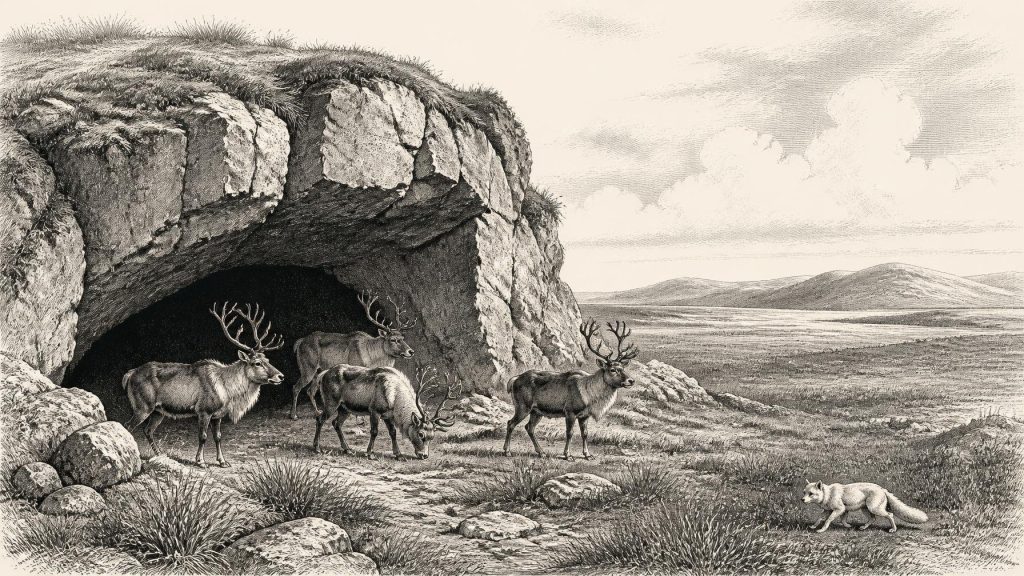
Around 31,955 BCE, Ireland was an unstable Late Pleistocene landscape approaching major glaciation, not a documented historical society. Castlepook Cave, County Cork, preserves important MIS 3 animal remains, including mammoth, reindeer, giant deer, predators and cold-adapted species. A reportedly stone-tool-marked reindeer femur, dated broadly around 33,000 years ago, suggests a possible fleeting human presence, but cannot establish settlement or a specific event. Disturbed deposits, uncertain dating and carnivore activity require caution. As the British–Irish Ice Sheet expanded, changing climates, sea levels and routes shaped animal movement. Future excavation, dating, taphonomic study and ancient-DNA research may clarify Ireland’s earliest human evidence.
Dateline
“31,955 BCE” is a modern calendar label, not a date that can be matched to a documented Irish event. There were no written records, named communities, rulers or calendars in Ireland at this depth of time, and archaeology cannot resolve activity to a particular year. In relation to the radiocarbon convention of “before present” (AD 1950), the label sits roughly 33,900 calendar years ago, within the Late Pleistocene and Marine Isotope Stage 3 (MIS 3), an unstable interval of the last Ice Age. The responsible history of this moment is therefore a history of dated bones, cave deposits, ice-sheet reconstructions and uncertainty—not a narrative of a particular hunt or settlement.
It is nonetheless an important horizon. Ireland’s evidence from before the Last Glacial Maximum is very slight, but Castlepook Cave near Doneraile in north County Cork preserves an exceptional collection of animal remains from this broader period. A reindeer femur from the collection has been interpreted as bearing a cut mark made by a sharp stone tool, and its reported age has been described as around 33,000 years ago. If that interpretation is sustained, it may represent a fleeting Upper Palaeolithic human presence in Ireland far earlier than the island’s formerly accepted archaeological record. It does not, however, establish a settlement, a resident population, or an event in 31,955 BCE itself.
A Date Range, Not a Year
Radiocarbon results are not calendar dates until they have been calibrated against changing atmospheric levels of carbon-14. At ages approaching 34,000 years, the resulting calibrated ranges can be broad and sometimes irregular. Moreover, a date obtained from an animal bone identifies when that animal died, not automatically when people handled it. The modern re-dating of faunal material from Castlepook has demonstrated exactly why caution is needed: improved pretreatment methods produced dates thousands of radiocarbon years older than several earlier results. Such revision is not a flaw in archaeology; it is a reminder that the evidence and its chronology are continually tested.
Castlepook’s original excavations, carried out mainly in the early twentieth century, recovered a very large bone assemblage but did not meet present-day standards of excavation, recording or stratigraphic sampling. Deposits had also been disturbed by natural processes and by earlier digging. A cave is not automatically a human camp. Carnivores can drag carcasses and loose bones into caves, water and sediment can move material between spaces, and modern researchers must distinguish traces of stone tools from animal teeth, trampling, breakage and other surface damage. Recent excavation and research projects at Castlepook seek securely recorded deposits, charcoal, stone artefacts, modified bone and other contextual evidence. Until such evidence is published and independently assessed, the possible human signal should be treated as promising but limited.
An Island of Ice-Age Fauna
The firmer evidence concerns animals. Research on Irish Quaternary fauna has shown that a range of mammals reached Ireland during MIS 3, broadly between at least 45,000 and 20,000 years ago. Castlepook has yielded remains attributed to woolly mammoth, reindeer, giant deer, brown bear, spotted hyaena, wolf, Arctic fox, mountain hare and small cold-adapted mammals including lemmings. The assemblage makes the cave one of the most valuable archives for understanding Irish environments before the full glaciation that followed.
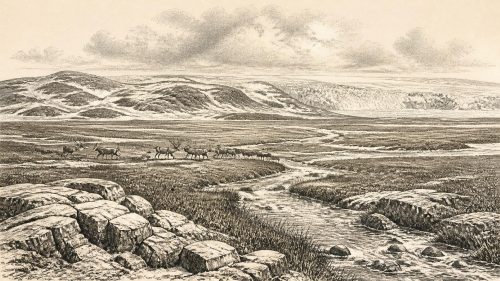
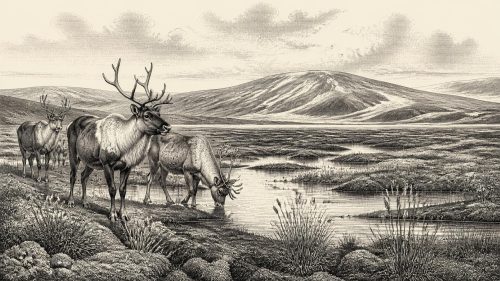
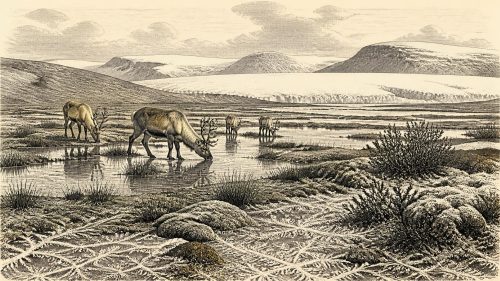
These animals should not be imagined as a neat, simultaneous cast standing together on an open plain in a single year. Individual specimens belong to differing episodes within a long climatic interval. Nor do their remains prove the exact vegetation around the cave at any one time. Taken together, however, they indicate that parts of southern Ireland could support a changing Pleistocene fauna during relatively favourable phases. Reindeer and lemmings point towards cold, open environments; mammoth and giant deer indicate substantial grazing landscapes; hyaenas, wolves and bears demonstrate a food web that included major predators and scavengers. The cave itself may have been used repeatedly by carnivores as a den or feeding place, helping to explain both the richness and the mixed nature of its bone record.
In this setting, the reported reindeer cut mark has importance precisely because it is so modest. It may indicate that a person or small group processed an animal somewhere in the Castlepook landscape, perhaps removing meat or disarticulating a limb. It cannot show whether the animal was hunted, found dead, scavenged from another predator, or butchered at the cave. It cannot identify the people, their language, sex, age, number, ancestry or destination. Stone tools, hearths, shelters, repeated activity surfaces and human remains have not been recovered from this period in Ireland. A single modified specimen is evidence for a possible action, not a complete society.
Climate, Ice and Changing Coasts
MIS 3 was marked across the North Atlantic region by rapid climatic oscillations. Ireland lay at Europe’s north-western edge, exposed to Atlantic weather systems and close to expanding ice masses in Britain and the Irish Sea basin. Ice-sheet reconstructions indicate that, around 31,000 years ago, the British–Irish Ice Sheet was still relatively small compared with its later maximum, with ice concentrated especially in Scotland and parts of Ireland. By about 30,000 years ago it expanded rapidly, and by roughly 27,000–26,000 calibrated years before present an extensive ice sheet covered Ireland and advanced across its surrounding continental shelf. The landscape around the nominal date was therefore not necessarily the fully ice-covered Ireland of the Last Glacial Maximum, but it was part of a region heading into profound glacial transformation.
Sea level was lower than today because vast quantities of water were stored in global ice sheets. The outlines of Ireland’s coasts and surrounding shelves were different, while local uplift and depression caused by ice loading complicate any simple reconstruction. Lower seas do not by themselves prove a dry route into Ireland at every time or place. The means by which animals—and any people—reached the island remain a central question. Recent sedimentary ancient-DNA research from Castlepook, currently reported as a preprint, strengthens the case that Irish megafauna formed part of wider Eurasian populations before the Last Glacial Maximum. That supports biological connectivity, but does not specify whether movement occurred over exposed ground, seasonal ice, short sea crossings or a combination of changing routes.
People at Europe’s Edge
Elsewhere in north-west Europe, people of the Middle Upper Palaeolithic made finely worked stone and bone tools, hunted and scavenged animals, used pigments and ornaments, and maintained social connections across considerable distances. Archaeologists often use cultural terms such as Aurignacian and Gravettian for parts of this wider European sequence. Those labels must not be transferred automatically to Ireland. No securely dated Irish lithic assemblage, dwelling, burial, artwork, ornament or hearth currently allows Castlepook activity to be assigned to one of those traditions.
Accordingly, there is no evidential basis for political affairs, diplomacy, warfare, territorial leadership, trade networks, religious rites, formal learning or artistic traditions in Ireland in this particular period. There is also no basis for describing farms, villages, boats or permanent houses. If people did visit the island around the time represented by the reindeer bone, they were almost certainly highly mobile hunter-gatherers living in small social groups, as was common across Upper Palaeolithic Europe. But that is a comparative inference, not a directly demonstrated fact about an Irish community. Their material possessions may have been portable and perishable, while later glaciation, erosion and rising seas have further reduced the chances of their survival.
What Can Be Said Responsibly
The most meaningful development around 31,955 BCE is environmental rather than political. Ireland was a changing Ice-Age territory where large mammals and predators occupied landscapes that would later be overridden or reshaped by the British–Irish Ice Sheet. In County Cork, Castlepook Cave accumulated a fragmentary record of that lost world. One reindeer bone, interpreted as stone-tool modified, raises the possibility that people also entered it. Its value lies not in licensing a detailed story of Ireland’s “first settlers”, but in directing research towards caves, former landscapes and submerged shelves where earlier evidence may remain.
For now, the historical verdict must remain deliberately restrained. Ireland at this time had demonstrable Pleistocene fauna, rapidly changing climate and geography, and a possible trace of human butchery. It has no securely documented settlement history. Future excavation, direct dating, taphonomic analysis and ancient-DNA work may sharpen that picture. Until then, the Ice Age bone record is both an extraordinary discovery and an invitation to distinguish what is known from what is merely possible.
Primary Sources
- A Reconsideration of the Radiocarbon Dating of the Marine Isotope Stage 3 Fauna from Southern Ireland
- The Irish Quaternary Fauna Project
- The Exploration of Castlepook Cave, County Cork, Being the Third Report from the Committee Appointed to Explore Irish Caves
- Heritage Artefacts of County Cork
- 2022:564 – Castlepook Cave, Castlepook South, Cork
- Archaeology Research Excavation Grant 2022
- Sedimentary Ancient DNA Reveals Late Pleistocene Faunal Connectivity Between Ireland and Eurasia
- Growth and Retreat of the Last British–Irish Ice Sheet, 31,000 to 15,000 Years Ago: The BRITICE-CHRONO Reconstruction
- Timing and Pace of Ice-Sheet Withdrawal Across the Marine–Terrestrial Transition West of Ireland During the Last Glaciation
- Maximum Extent and Dynamic Behaviour of the Last British–Irish Ice Sheet West of Ireland
- Sedimentology and Chronology of the Advance and Retreat of the Last British-Irish Ice Sheet on the Continental Shelf West of Ireland
- Dimensions and Chronology of the Last Ice Sheet in Western Ireland
- Spatio-Temporal Dynamics of Speleothem Growth and Glaciation in the British Isles
- The IntCal20 Northern Hemisphere Radiocarbon Age Calibration Curve (0–55 cal kBP)
- A Stratigraphic Framework for Abrupt Climatic Changes During the Last Glacial Period Based on Three Synchronized Greenland Ice-Core Records
- First Evidence of a Late Upper Palaeolithic Human Presence in Ireland
- New Insights on the Fauna of Ireland's Younger Dryas and Early Holocene from Alice & Gwendoline Cave
- The Mesolithic in Ireland: When Was It?
- Ireland: Submerged Prehistoric Sites and Landscapes
- Prehistoric Details