Castlepook’s Reindeer Bone31956 BCE
Around 31,956 BCE, Ireland lay within the variable cold conditions of Marine Isotope Stage 3, before the Last Glacial Maximum. Its landscapes included tundra-like open vegetation, periglacial environments and regionally uncertain ice cover, while lower seas did not guarantee human access. Castlepook Cave in County Cork preserves Ireland’s pre-maximum vertebrate assemblage, including mammoth, reindeer, giant deer, hyaena and predators. A possibly cut-marked reindeer bone, dated near 33,000 years ago, may indicate brief human activity, but remains unconfirmed and cannot establish settlement. No secure Palaeolithic habitation, tools, burials or art date to this period. Evidence instead depicts changing environments and fauna.
Dateline
Modern calendar precision cannot responsibly turn 31,956 BCE into an Irish annal. No community in prehistoric Ireland recorded such a year, and the surviving evidence cannot identify a particular season, generation, ruler or event. The number is best treated as a modern point within a very long span: roughly 33,900 years before 1950, during the later part of the last glacial cycle. Archaeologists and Quaternary scientists instead work with dated deposits, radiocarbon determinations, calibrated ranges where available, and changing environmental sequences. Around this point, Ireland belongs broadly to Marine Isotope Stage 3 and the Middle Midlandian or Devensian cold stage, before the fullest expansion of the Last Glacial Maximum.
A Country in a Changing Ice Age
Ireland at this time was not the familiar green, wooded island of later millennia. The climate was cold and highly variable, and the landscape was being shaped by frost, snow, meltwater, wind and advancing or retreating ice. Yet it would be misleading to picture every part of the island as continuously buried beneath a single unchanging ice sheet. The timing, extent and thickness of ice across Ireland before the Last Glacial Maximum remain subjects of active research. Geological reconstructions indicate that the major maximum of the British–Irish Ice Sheet came later, broadly between about 26,000 and 19,000 years ago, while evidence from some uplands suggests that areas of northern and central Ireland remained ice-free until at least around 34,000 years ago.
That does not amount to a map for 31,956 BCE. The available chronological controls have wide uncertainties, and conditions could differ greatly between uplands, lowlands, coasts and the Irish Sea basin. The responsible conclusion is regional and conditional: parts of Ireland were capable of supporting terrestrial life before the later ice-sheet maximum, while other places may have been glaciated, periglacial or rendered inaccessible by severe conditions. The country was in transition, not a stable environmental state.
Sea level was much lower than today because enormous volumes of water were held in continental ice sheets. The outlines of coasts and shallow seas were therefore different, but lower sea level alone does not prove a simple, dry land route into Ireland. Ice margins, marine channels, seasonal conditions and the shifting configuration of the British–Irish landmass all matter. For this period, there is no securely documented route by which people reached Ireland, and no basis for imagining routine crossings, permanent roads or regular contact networks.
Tundra, Grassland and Ice-Age Animals
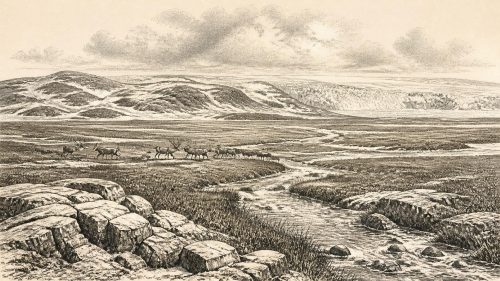
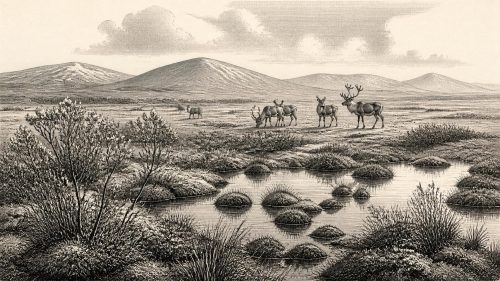
The clearest evidence for the Irish environment comes not from human settlements but from animal bones, sediments and fossil plant remains. At Derryvree in south Fermanagh, a freshwater deposit dated to about 30,500 radiocarbon years before present produced plant and animal evidence consistent with open tundra and a periglacial climate. Although it is later than the modern date label used here, it offers a valuable regional indication of the kinds of cold, open environments that could develop in Ireland during this part of the glacial cycle.
Vegetation was probably dominated in many exposed places by grasses, sedges, herbs, mosses and low shrubs rather than closed forest. The precise local mix depended on moisture, soil, shelter and temperature; pollen can also travel long distances, so individual grains do not automatically prove that a plant grew beside a sampled deposit. Nevertheless, the broad picture is one of a sparse, treeless or largely treeless landscape, with a short growing season and strong seasonal pressures on both plants and animals.
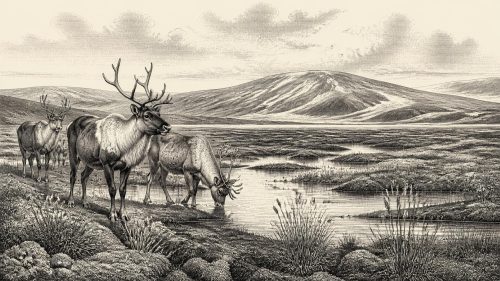
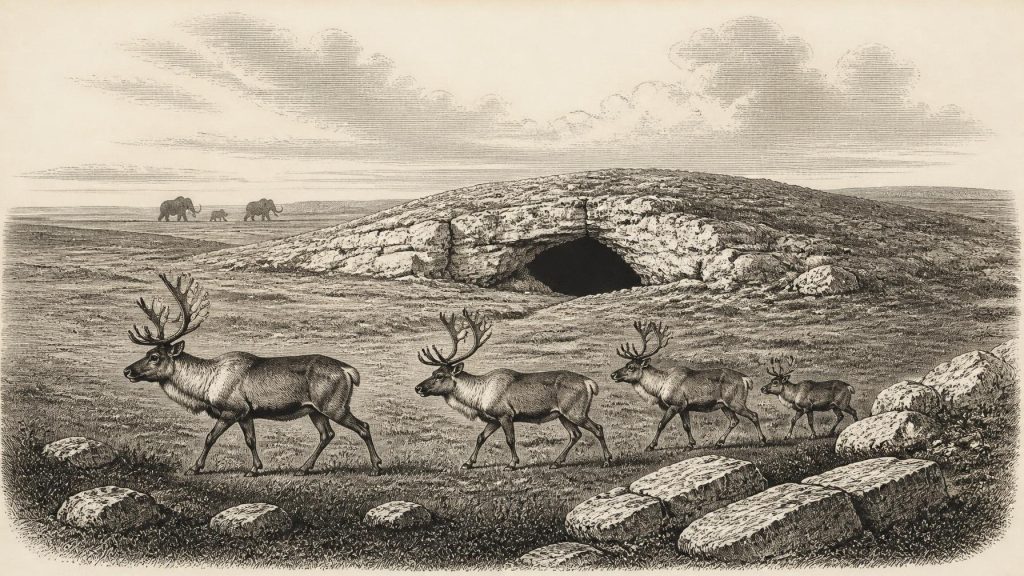
Castlepook Cave near Doneraile in north County Cork is central to this earlier Irish story. Its cave deposits and museum collections have yielded the richest known assemblage of pre-Last Glacial Maximum vertebrate remains from Ireland. Mammoth, reindeer, giant deer, brown bear, wolf, fox, Arctic fox, lemmings and spotted hyaena are among the animals represented. Their presence demonstrates that Ireland was not biologically empty during parts of the Ice Age. It also evokes a food web very different from that of historic Ireland: large grazing and browsing animals shared the landscape with scavengers and predators adapted to cold or open conditions.
However, a cave bone assemblage is not a census of the surrounding countryside. Carnivores carried prey into caves; scavenging, water movement, disturbance and early excavation methods mixed material from different episodes. Castlepook was used as a repository of bones across a long period, not as a sealed snapshot of one day or one year. Some individual specimens have produced dates ranging broadly from about 45,700 to 19,950 years before present. Older published radiocarbon determinations, including a mammoth bone dated to 33,400 ± 1,200 radiocarbon years before present, have also required reassessment as laboratory methods and pretreatment improved.
The Possibility of Human Visitors
The question of people in Ireland around this date remains more difficult than the question of animals. The National Museum of Ireland has long stressed that there is no clear, established body of Palaeolithic settlement evidence comparable to that known in Britain or continental Europe: no securely excavated habitation floor, hearth, stone-tool assemblage, human burial or cave art can presently be assigned to about 31,956 BCE in Ireland.
There is, nonetheless, an important developing lead from Castlepook. A reindeer bone from the older collections has been reported as dating to approximately 33,000 years ago and as bearing marks interpreted as possible cuts made by a sharp stone tool. If both the dating and anthropogenic interpretation are confirmed through full publication and contextual study, it would be striking evidence that humans processed an animal in Ireland before the Last Glacial Maximum. It would not, by itself, demonstrate a settled population. A butchered bone might represent a short hunting or scavenging visit by a small mobile party, and the original excavation history means that its precise relationship to surrounding deposits is difficult to reconstruct.
The distinction matters. Directly dated cut-marked bear bone from Alice and Gwendoline Cave, County Clare, gives stronger published evidence for a much later Upper Palaeolithic human presence, calibrated to 12,810–12,590 cal BP. That discovery established that people reached Ireland before the Mesolithic, but it cannot be projected backwards by more than twenty millennia to fill the gap at 31,956 BCE. The Castlepook material is potentially transformative precisely because the earlier evidence is so sparse, not because it has already settled the matter.
Society Beyond the Evidence
Nothing supports a year-specific account of political affairs, warfare, diplomacy, named leaders or territorial kingdoms. There were no states, towns, written records, monuments or known institutions in Ireland from which such claims could be drawn. Nor is there evidence for trade in the later sense of regular exchange between identified communities. If people did reach the island, they would have belonged to highly mobile Upper Palaeolithic hunter-gatherer worlds known elsewhere in north-west Europe, but Ireland has not produced the diagnostic artefact collections needed to assign a local group confidently to a named archaeological culture.
Everyday life can therefore be discussed only at the level of possibility. A party able to kill, acquire or process reindeer would have needed practical knowledge: reading animal movements, managing cold exposure, carrying cutting tools, sharing food and choosing shelter. Such capacities are reasonable inferences from Upper Palaeolithic lifeways elsewhere, but they are not directly evidenced as a complete social system in Ireland. The Castlepook cave itself should not be assumed to have been a human home. Its hyaena remains and accumulated animal bones underline its role as a dangerous carnivore-used place as well as a potential location of brief human activity.
Religion, language, music, visual art and formal learning lie beyond recovery for this particular Irish horizon. Humans elsewhere in Europe made ornaments, images and elaborate tools during the Upper Palaeolithic, but no equivalent material has been securely found in Ireland for this date. Silence in the record is not proof that thought, ritual or storytelling were absent; it is a limit on what archaeology can demonstrate. It is more accurate to say that Ireland’s evidence has not yet revealed them.
An Unfinished Earliest History
The greatest development relevant to 31,956 BCE was environmental rather than political: Ireland was part of a cold, changing north-west European world in which ice-sheet growth, exposed continental shelves, open vegetation and mobile animal populations continually altered opportunities for life. Castlepook Cave shows that mammoths, reindeer, hyaenas and other animals reached the island during the wider Middle to Late Pleistocene. The reported modified reindeer bone raises the serious possibility that people did too.
But the evidence does not support a confident story of an Irish population, a migration episode or a particular event in this numbered year. The most useful historical lesson is methodological. Ireland’s deep past is preserved unevenly: in cave sediments, old museum collections, radiocarbon samples, glacial landforms and microscopic traces of former environments. Renewed excavations at Castlepook and improved dating techniques may substantially refine the picture. For now, 31,956 BCE marks a threshold of possibility—an Ireland inhabited certainly by Ice-Age fauna, shaped by a deteriorating climate, and perhaps visited briefly by people whose presence has only begun to be detected.
Primary Sources
- Prehistoric Details
- Castlepook Cave: County Geological Site Report
- A Reconsideration of the Radiocarbon Dating of the Marine Isotope Stage 3 Fauna from Southern Ireland
- The Irish Quaternary Fauna Project
- Growth and Retreat of the Last British–Irish Ice Sheet, 31,000 to 15,000 Years Ago: The BRITICE-CHRONO Reconstruction
- Maximum Extent and Dynamic Behaviour of the Last British–Irish Ice Sheet West of Ireland
- Sedimentary and Foraminiferal Records of Late Quaternary Environmental Change West of Ireland and Implications for the Last British–Irish Ice Sheet
- Trimlines, Blockfields and the Vertical Extent of the Last Ice Sheet in Southern Ireland
- Palaeoecology
- The Quaternary Period in Ireland
- Quaternary Geology
- Late Midlandian, Pleistocene, Northern Ireland
- The Exploration of Castlepook Cave, County Cork, Being the Third Report from the Committee Appointed to Explore Irish Caves
- Holdings: The Exploration of Castlepook Cave, Co. Cork. With 3 Plates
- 2022:564 – Castlepook Cave, Castlepook South, Cork
- Archaeology Research Excavation Grant 2022: Castlepook Cave Final Report
- First Evidence of a Late Upper Palaeolithic Human Presence in Ireland
- New Insights on the Fauna of Ireland's Younger Dryas and Early Holocene from Alice and Gwendoline Cave
- First Evidence of a Late Upper Palaeolithic Human Presence in Ireland (Atlantic Technological University record)
- Pleistocene Vertebrates in the British Isles