Shandon Cave Fauna31980 BCE
Around 34,000 cal BP, during Marine Isotope Stage 3, Ireland was a climatically variable, partly exposed north-west European landscape before the Last Glacial Maximum. Lower sea levels altered coasts and possible access routes. Cave deposits at Shandon, Waterford, and Castlepook, Cork, preserve remains of mammoth, reindeer, horse, giant deer, bear, wolf and hyaena, indicating productive open habitats, though bones span different periods and disturbed contexts. Ice-sheet growth later transformed landscapes and fauna. No securely dated human occupation exists for this time; disputed cut-mark evidence warrants further investigation. Ireland is best understood as a changing Ice Age environment, not a society.

Dateline
“31,980 BCE” is a modern chronological label, not a date that prehistoric people in Ireland could have recognised or recorded. It cannot be matched to an event, ruler, settlement or individual. At this depth of time, archaeological and environmental dating works with ranges, margins of error and calibrated radiocarbon chronologies rather than a calendar year. The responsible frame is therefore around 34,000 calibrated years before present (cal BP), within the later part of Marine Isotope Stage 3, well before the Last Glacial Maximum. What can be described is an Irish landscape in climatic transition, the animals documented by cave deposits, and the unresolved question of whether people ever entered the island during this earlier Ice Age phase.
A Land Before Maximum Glaciation
Ireland lay at the north-western edge of Europe during the last glacial cycle. Around this notional year, the great British–Irish Ice Sheet had not yet reached its final maximum extent. Syntheses of the ice-sheet record place its major build-up after roughly 35,000–32,000 years ago, with maximum expansion later, broadly between 27,000 and 23,000 cal BP. This does not mean that Ireland was uniformly mild, open or free of ice at 31,980 BCE. Glaciers and ice caps could advance and retreat regionally; mountains, coasts and interior lowlands had very different conditions. The evidence instead warns against imagining either a wholly frozen island or a familiar green one.
In southern Ireland, stratified evidence indicates that parts of the coast remained free of the final ice-sheet advance until after about 24,200 cal BP. Cave faunas from the south and south-east also demonstrate that terrestrial animals could occupy parts of the island during Marine Isotope Stage 3. Together, these findings support an Ireland which included exposed ground, cold-water drainage systems, limestone caves and extensive open habitats during at least portions of this period. They do not supply a day-by-day weather record, nor do they permit a single line to be drawn around an “ice-free Ireland” for one year.
Global sea level was substantially lower than today because much water was locked in continental ice. The outlines of the Irish coast and the shallow seas around it were therefore different, with broader coastal plains in some areas. Connections and barriers between Ireland, Britain and continental Europe changed as sea level, ice margins and marine conditions changed. Animal arrivals prove that movement into Ireland occurred at some point during the broader glacial cycle, but they do not identify a simple, permanent land bridge or establish the route used by every species.
The Evidence in Irish Caves
The principal evidence for Ireland at this time is palaeontological: animal bones and teeth, usually recovered from caves, fissures and old sediment deposits. The most important sites for this early phase include Shandon Cave near Dungarvan in County Waterford and Castlepook Cave near Doneraile in County Cork. Their collections were first excavated in the nineteenth and early twentieth centuries, long before present-day standards for recording sediments, microscopic finds and stratigraphic relationships. They remain invaluable, but their limitations are central to their interpretation.
Shandon Cave produced remains attributed to brown bear, reindeer, horse, wolf and woolly mammoth. Radiocarbon programmes have placed elements of its fauna in Marine Isotope Stage 3, although individual specimens have different ages and should not automatically be treated as animals living together on a single occasion. Castlepook is especially significant for evidence of spotted hyaena, as well as remains of mammoth, giant deer, reindeer, brown bear and other cold-period animals. Improved pretreatment and redating have shown that some earlier radiocarbon determinations from Irish caves were too young. Reassessment has pushed aspects of the Castlepook fauna further back in time and suggests that some species disappeared locally before the Last Glacial Maximum, perhaps around 40,000 cal BP.
That distinction matters for 31,980 BCE. A bone date provides the age of an animal’s death within a statistical range; it is not a dated snapshot of an entire Irish ecosystem. Cave deposits may also have been accumulated by predators, water, roof collapse, later digging or the rearrangement of sediments. The most defensible conclusion is that Ice Age Ireland sustained a changing succession of large mammals and carnivores across the wider period, not that every species listed from a cave shared the same valley in the same season.
Open Country and Mobile Fauna
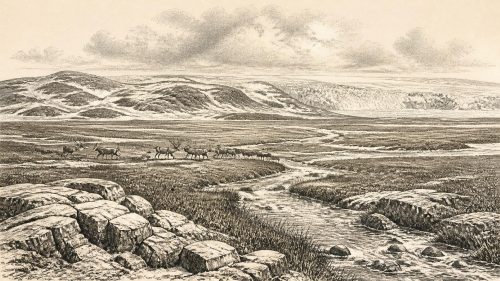
The faunal record nevertheless gives a vivid, if incomplete, impression of the environments available. Reindeer, wild horse and woolly mammoth are consistent with open, cold landscapes containing grasses, sedges, herbs and low shrubs rather than dense forest. Giant deer would have required productive forage, while brown bears, wolves and spotted hyaenas occupied very different places in the food web. Mountain hare, Arctic fox and lemmings recorded elsewhere in Irish Late Pleistocene contexts underline the capacity of climatic shifts to replace one animal community with another.
Such animals were not symbols of a timeless “Ice Age”; they were living populations responding to seasonality, food supply, snow cover, predation and changing access routes. Mammoth, horse and reindeer bones show that Ireland was not biologically empty. Hyaena evidence at Castlepook is particularly important because caves can be used as dens, places where scavenged or hunted carcasses accumulate, rather than merely shelters in which animals died naturally. A cave assemblage can thus preserve traces of relationships between predators and prey as well as a list of species.
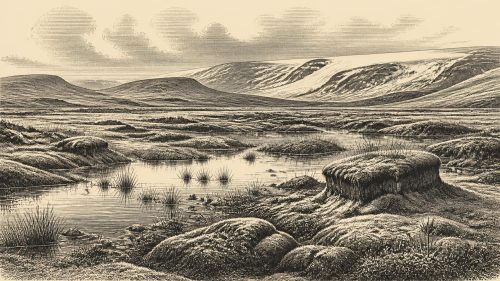
Vegetation cannot be reconstructed in fine detail for this exact point from the Irish record alone. Pollen, insects, animal diets, landforms and comparable north-west European sequences point to a cold, exposed and treeless or sparsely wooded mosaic in many areas. Local shelter, south-facing slopes, wetlands and river corridors could have differed markedly from uplands swept by wind and snow. It would be wrong to picture blanket forest, modern bogland or present-day coastlines. Equally, an entirely barren white wilderness would be misleading: the documented fauna required plant productivity, freshwater and seasonally usable ground.
People: A Genuine Uncertainty
No securely dated human settlement, hearth, stone-tool assemblage or human burial is presently known from Ireland for around 34,000 cal BP. There is therefore no responsible basis for describing an Irish clan, hunting camp, language, political territory or leader in 31,980 BCE. The Late Upper Palaeolithic butchered brown-bear patella from Alice and Gwendoline Cave, County Clare, is genuine and important evidence for later human activity: two independent radiocarbon measurements place it about 12,810–12,590 cal BP, during the Younger Dryas. It cannot be used to populate Ireland more than twenty millennia earlier.
There are, however, reasons why the question remains open. Researchers reassessing Castlepook’s old collections have identified bones with cut marks attributed to several phases of the last glacial cycle. The cave has been the focus of renewed excavation precisely because well-provenanced lithics, charcoal, modified bone or undisturbed sediments could test claims for an earlier Palaeolithic presence. At present, those investigations should be treated as a research programme, not as proof that people inhabited Ireland in 31,980 BCE.
This caution is strengthened by the nature of the evidence. A cut mark has to be separated from tooth damage, trampling, excavation damage and natural abrasion; the bone itself must be dated; and, ideally, it must come from a secure archaeological context alongside other evidence of human activity. A single modified specimen can demonstrate a brief visit or carcass-processing episode, but not a permanent population. The absence of recognised sites may reflect later glaciation, erosion, sea-level change and the difficulty of finding small camps, especially on now-submerged landscapes. Absence is not proof that nobody came, but it is not a licence to turn possibility into history.
No Politics, but a Human Ecological Frontier
Political affairs, diplomacy and organised warfare leave no evidence for Ireland at this date, and none should be invented. If small groups of Upper Palaeolithic people did reach the island during Marine Isotope Stage 3, their concerns would have been practical and immediate: safe passage, seasonal weather, fuel, freshwater, animal movements, shelter and the risks posed by large carnivores. Those are informed inferences from comparable European hunter-gatherer worlds, not direct observations of an Irish community.
Likewise, there is no Irish evidence from around 31,980 BCE for religion, formal learning, art, long-distance trade or enduring settlements. Cave use by hyaenas is not human ritual; animal bones are not a market; and a favourable crossing route is not evidence of regular exchange. Material culture cannot yet be assigned to this date in Ireland. The familiar social themes of later Irish prehistory—farming, monuments, metalworking, territorial lordship and maritime exchange—belong to immensely later worlds.
Yet this apparently silent period is historically significant. It establishes the environmental preconditions from which later Ireland emerged. Before the final glacial expansion reshaped the island, southern cave systems recorded a northern European fauna far richer in large mammals than that of historic Ireland. The advance and retreat of ice would later erase landscapes, alter coastlines and repeatedly restrict or open routes for plants, animals and people. Around 31,980 BCE, Ireland should be understood not as a nation awaiting its first history, but as a dynamic Ice Age peninsula or island-margin environment whose surviving bones, sediments and landforms still set the limits of what can honestly be said.
Primary Sources
- The Irish Quaternary Fauna Project
- A Reconsideration of the Radiocarbon Dating of the Marine Isotope Stage 3 Fauna from Southern Ireland
- First Evidence of a Late Upper Palaeolithic Human Presence in Ireland
- New Insights on the Fauna of Ireland's Younger Dryas and Early Holocene from Alice & Gwendoline Cave
- Revisiting Alice and Gwendoline Cave, Co. Clare: New Light on the 1902 Excavations
- Growth and Retreat of the Last British–Irish Ice Sheet, 31,000 to 15,000 Years Ago: the BRITICE-CHRONO Reconstruction
- Extent and Timing of the Last Glacial Maximum (LGM) in Britain and Ireland: A Review
- Response of the Irish Ice Sheet to Abrupt Climate Change During the Last Deglaciation
- Pattern and Timing of Retreat of the Last British-Irish Ice Sheet
- Maximum Extent and Dynamic Behaviour of the Last British–Irish Ice Sheet West of Ireland
- The Deglaciation of the Western Sector of the Irish Ice Sheet from the Inner Continental Shelf to its Terrestrial Margin
- Early Deglaciation of the British-Irish Ice Sheet on the Atlantic Shelf Northwest of Ireland Driven by Glacioisostatic Depression and High Relative Sea Level
- Timing and Pace of Ice-Sheet Withdrawal Across the Marine–Terrestrial Transition West of Ireland During the Last Glaciation
- Dimensions and Chronology of the Last Ice Sheet in Western Ireland
- Last Glacial Maximum Cirque Glaciation in Ireland and Implications for Reconstructions of the Irish Ice Sheet
- Radiocarbon Constraints on the Age of the Maximum Advance of the British–Irish Ice Sheet in the Celtic Sea
- Late Pleistocene Chronostratigraphy and Ice Sheet Limits, Southern Ireland
- Oscillating Retreat of the Last British-Irish Ice Sheet on the Continental Shelf Offshore Galway Bay, Western Ireland
- The Exploration of Castlepook Cave, County Cork
- The Exploration of the Caves of County Clare: Geology
- Archaeology Research Excavation Grant 2022: Castlepook Cave Final Report
- Reconstruction and 36Cl Based Geochronology of the Deglaciation of Central Ireland
- IntCal20 Northern Hemisphere Radiocarbon Age Calibration Curve (0–55 cal kBP)
- A 60,000 Year Greenland Stratigraphic Ice Core Chronology