Castlepook’s Last Open Ground30566 BCE
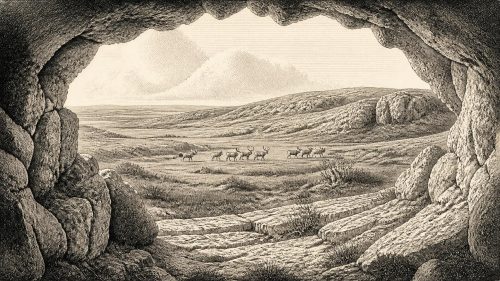
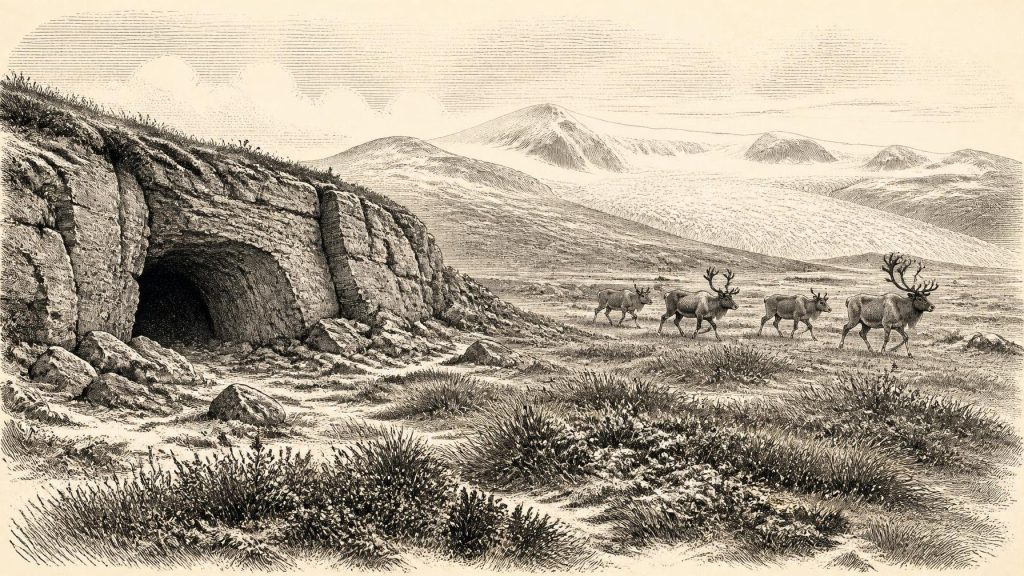
At approximately 30,566 BCE, Ireland was entering severe climatic deterioration preceding the Last Glacial Maximum, although neither its ice cover nor chronology can be defined precisely. Open tundra and steppe-tundra environments probably existed beyond shifting glaciers. Castlepook Cave in County Cork preserves Late Pleistocene animal remains, including mammoth, reindeer, giant deer, predators and small cold-adapted species, but these accumulated across different periods and do not describe one contemporary ecosystem. A possibly cut-marked reindeer bone suggests occasional human visitation around 33,000 years ago, yet permanent occupation is unproven. Later ice expansion transformed Ireland’s terrain, leaving fragmentary geological, fossil and archaeological evidence.
Dateline
The label 30,566 BCE gives a useful place in a modern chronological sequence, but it must not be mistaken for a date that prehistoric Ireland can match year for year. No written record, annual archaeological layer, or calendar-based event survives from this remote period. In conventional archaeological terms it falls roughly 32,500 years before AD 1950, within the Late Pleistocene and Marine Isotope Stage 3. Even that conversion should be treated cautiously: radiocarbon ages require calibration, different scientific chronologies use different ‘before present’ conventions, and the uncertainty around any individual Irish deposit is measured in centuries or millennia, not single years.
What can responsibly be said is that Ireland stood on the threshold of a profound environmental change. This was before the fullest Last Glacial Maximum ice cover, conventionally placed broadly between about 27,000 and 20,000 calibrated years before present, but during the long, unstable cooling in which the British–Irish Ice Sheet was growing. Around this point, the island’s human story is exceptionally faint. Its geological and animal records are more substantial, although they too must be read as scattered traces rather than as a complete picture.
A Landscape Entering the Great Freeze
The later Last Glacial Maximum left the dominant physical signature on Ireland: till, drumlins, erratic boulders, scoured rock, moraines and reshaped valleys. Yet these familiar landforms cannot be assigned simply to 30,566 BCE. Recent reconstructions show that the British–Irish Ice Sheet grew and reached local maxima at different times in different sectors, with advances and retreat beginning asynchronously between roughly 30,000 and 22,000 years ago. The configuration of ice over Ireland at about 32,500 calibrated years before present therefore remains less securely known than the configuration of the later maximum.
This matters because Ireland was not necessarily one uniform white expanse at every stage of the cold period. Ice margins moved; uplands, lowlands, western shelves and the Irish Sea basin responded differently; and local conditions were influenced by snowfall, sea level, ocean circulation and the changing shape of the ice itself. It is reasonable to see this date as belonging to the climatic deterioration that preceded the main maximum, but not to draw a precise line around an ice-free refuge or to specify which modern county was covered in a particular year.
In areas not buried beneath glacier ice, the environment was probably open and severe. The best analogies come from cold-stage tundra and steppe-tundra elsewhere in north-west Europe: low herbs, grasses, sedges, mosses and dwarf shrubs, with trees either absent or extremely restricted. Wind, frost action, sparse ground cover and short growing seasons would have governed the terrain. This was not the green, wooded island familiar today. Nor was it a timeless wilderness: every renewed ice advance could remove soils, divert drainage, destroy vegetation and make previous routes unusable.
Castlepook’s Uneven Animal Record
The most evocative Irish evidence for the broader period comes from Castlepook Cave near Doneraile in north County Cork. The cave system has produced Ireland’s richest known assemblage of earlier Late Pleistocene vertebrate remains. Finds include woolly mammoth, reindeer, giant deer, brown bear, wolf, Arctic fox, mountain hare, lemmings and spotted hyaena. Their presence demonstrates that, during favourable intervals before the later ice maximum, parts of Ireland could support a markedly richer cold-climate fauna than the island would possess after the Ice Age.
However, a cave bone assemblage is not a census of one season. Castlepook accumulated remains over a long span. Carnivores could carry prey or scavenged bones underground; animals might die in or near fissures; water and sediment could shift material; and early excavations removed much of the context that modern archaeologists would want to record. Direct dating has shown that individual bones belong to different episodes. A mammoth, a hyaena and a reindeer recovered from the same cave need not have encountered one another, and their remains do not prove that all these animals occupied the Doneraile landscape in 30,566 BCE.
Nonetheless, the faunal record is important evidence for regional possibility. Reindeer and lemmings point to open, cold habitats. Mammoth and giant deer indicate that large herbivores could reach Ireland when suitable forage and routes existed. Hyaenas and wolves show that predators were part of the ecological system. The cave thus preserves a fragmentary record of food webs, seasonal movement and animal dispersal across a changing north-west European world. It does not reveal stable herds, exact population sizes, or a continuous resident fauna.
The Human Question
Human presence is the most sensitive question for this date. A reindeer femur from Castlepook has been interpreted as bearing a cut mark made with a sharp stone tool, and it has been publicised as evidence for human activity in Ireland around 33,000 years ago. If that interpretation is upheld, it would show that people reached Ireland in the period before the Last Glacial Maximum. It would not demonstrate a village, a permanent population or an unbroken occupation of the island.
That distinction is essential. No securely associated hearth, stone-tool assemblage, dwelling floor, human burial or repeatedly occupied hunting camp of comparable age has yet been found in Ireland. The marked bone came from an old cave collection, not from a modern excavation revealing people, tools and food waste together in an intact layer. A cut mark can attest a particular action upon an animal; it cannot by itself identify the size, language, kinship system or political organisation of the people responsible. The date of that specimen also cannot be used to populate every century between its age and the later glacial maximum.
For 30,566 BCE, then, the responsible conclusion is deliberately modest. Occasional human visits to parts of pre-maximum-glaciation Ireland are plausible and may be indicated by the Castlepook specimen, but continued occupation remains unproven. The advancing ice sheet and the abrasive effects of later glaciation are likely to have destroyed or buried many open-air sites, so absence of evidence is not proof that nobody ever came. Equally, destruction cannot be used as evidence that a settled population existed. The archaeological record supports possibility, not certainty.
No Kingdoms, No Trade Network
There is no evidence from which to reconstruct political affairs, diplomacy, named communities or organised conflict in Ireland at this time. Terms such as tribe, chiefdom and territory would impose later social models on a record that does not warrant them. If people did enter the island, they were more likely to have moved in small, highly mobile groups whose survival depended on weather, animal movements, shelter and knowledge of dangerous ground. That is an interpretation based on Upper Palaeolithic lifeways elsewhere in Europe, not a directly documented Irish society.
For the same reason, religion, art, formal learning and language cannot be described specifically for Ireland in this year. Continental Upper Palaeolithic communities made sophisticated tools, ornaments and cave art, but no equivalent securely dated Irish evidence is presently available from this phase. It would be wrong to transfer the symbolic practices of France, Iberia or central Europe automatically to Cork. Ireland’s value in this wider story lies partly in the question of its accessibility: it was a western edge of the European landmass, affected by lowered sea levels but also by glacier ice, marine channels and rapidly changing coastlines.
There is likewise no demonstrated Irish economy or long-distance trade system. If a hunting party processed a reindeer at Castlepook or elsewhere, subsistence would have involved opportunistic use of animal resources rather than farming, herding or exchange in any historically recognisable sense. The later glacial landscape offered neither the settled fields nor the durable coastal communities often associated with prehistoric Ireland. It offered, instead, shifting opportunities at the margin of ice.
An Archive of Change
The wider significance of this period lies in what followed. During the following millennia, the Irish Ice Sheet expanded dramatically, joining the larger British–Irish ice complex and extending far beyond modern coasts in several directions. Ice thick enough to erode bedrock and rearrange sediment repeatedly transformed the surface. As it later withdrew, it created the physical framework of many Irish lowlands, lake basins and coastal landscapes. The terrain familiar to later Mesolithic settlers was therefore, in large measure, a post-glacial terrain.
At 30,566 BCE, Ireland was not yet the island of monuments, farms, saints or kingdoms. It was a changing cold-stage landscape whose evidence survives mainly in caves, sediments, fossils and glacial landforms. Castlepook offers a rare glimpse of its animal inhabitants and perhaps of a human encounter with them. But the clearest lesson is methodological: the farther back the record reaches, the more important it is to distinguish a dated bone from a dated society, a climatic phase from a calendar year, and a compelling possibility from a proven history.
Primary Sources
- Growth and Retreat of the Last British–Irish Ice Sheet, 31 000 to 15 000 Years Ago: The BRITICE-CHRONO Reconstruction
- The Timing and Magnitude of the British–Irish Ice Sheet Between Marine Isotope Stages 5d and 2: Implications for Glacio-Isostatic Adjustment, High Relative Sea Levels and ‘Giant Erratic’ Emplacement
- The Colonization of Ireland: A Human Ecology Perspective
- The Irish Quaternary Fauna Project
- A Reconsideration of the Radiocarbon Dating of the Marine Isotope Stage 3 Fauna from Southern Ireland
- Castlepook Cave
- Heritage Artefacts of County Cork
- 32564: Castlepook Cave, Castlepook, Doneraile, Cork
- Late Pleistocene Chronostratigraphy and Ice Sheet Limits, Southern Ireland
- Radiocarbon Constraints on the Age of the Maximum Advance of the British–Irish Ice Sheet in the Celtic Sea
- Maximum Extent and Dynamic Behaviour of the Last British–Irish Ice Sheet West of Ireland
- Timing and Pace of Ice-Sheet Withdrawal Across the Marine–Terrestrial Transition West of Ireland During the Last Glaciation
- The Deglaciation of the Western Sector of the Irish Ice Sheet from the Inner Continental Shelf to its Terrestrial Margin
- Dimensions and Chronology of the Last Ice Sheet in Western Ireland
- Trimlines, Blockfields and the Vertical Extent of the Last Ice Sheet in Southern Ireland
- Last Glacial Maximum Cirque Glaciation in Ireland and Implications for Reconstructions of the Irish Ice Sheet
- Dating Constraints on the Last British-Irish Ice Sheet: A Map and Database
- A Stratigraphic Framework for Abrupt Climatic Changes During the Last Glacial Period Based on Three Synchronized Greenland Ice-Core Records: Refining and Extending the INTIMATE Event Stratigraphy
- Warm Atlantic Surface Water Inflow to the Nordic Seas 34–10 Calibrated ka B.P.
- New Insights on the Fauna of Ireland's Younger Dryas and Early Holocene from Alice & Gwendoline Cave