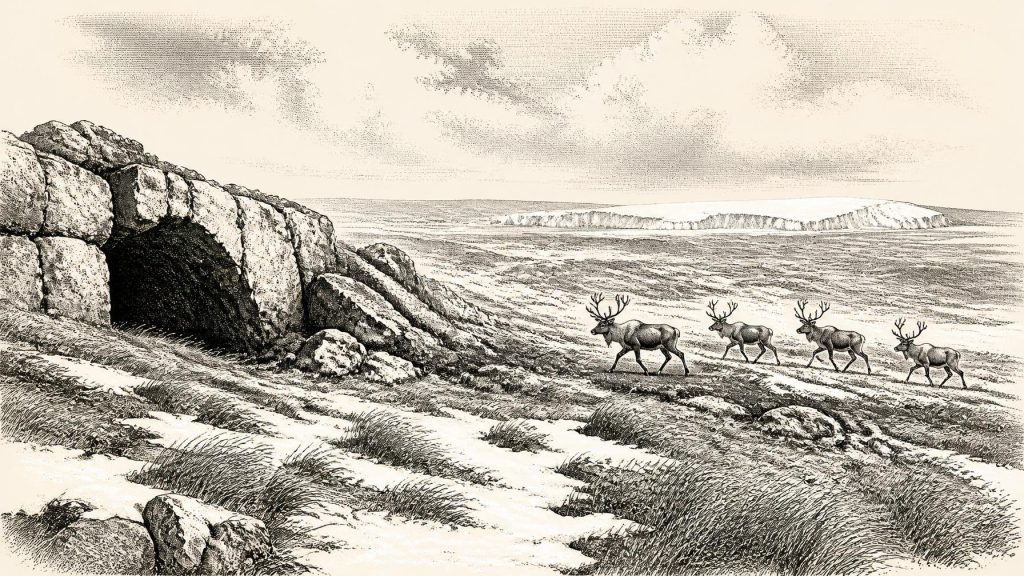
Reindeer Processing at Castlepook31979 BCE
Around 33,900 cal BP, rather than a precisely knowable year, Ireland experienced the cold, unstable later Marine Isotope Stage 3, before the Last Glacial Maximum. Ice and changing climates shaped landscapes, while later glaciation destroyed much evidence of earlier life. Cave finds record reindeer, hares, lemmings, Arctic foxes and larger mammals; dated red deer confirm habitable areas. Castlepook Cave yielded a reindeer femur, about 33,000 years old, with possible stone-tool cut marks, suggesting human carcass processing. However, no securely dated settlement, artefacts, skeletons or cultural affiliation exists. Any visitors were mobile foragers, but beliefs, society, routes and permanence remain unknown.
Dateline
The label 31,979 BCE gives a useful point on a modern timeline, but it does not identify a year that anyone in Pleistocene Ireland could have named, recorded or experienced as a discrete historical moment. Archaeology cannot resolve events in Ireland to a calendar year this far back. In radiocarbon practice, the nearest equivalent is roughly 33.9 thousand calendar years before present (cal BP, with “present” conventionally 1950), and even that is only an approximate conversion. The responsible subject is therefore Ireland during the later part of Marine Isotope Stage 3: a cold, unstable phase of the Late Pleistocene, before the fullest expansion of the last British–Irish Ice Sheet.
A Country in a Changing Ice Age
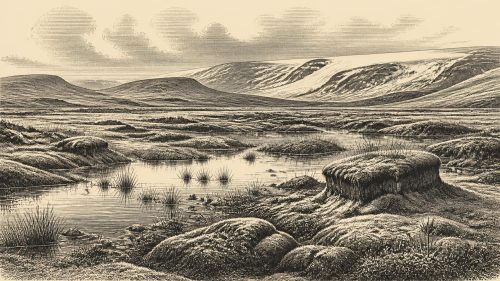
Ireland around this point was not the green, wooded island familiar from later prehistory. Nor should it simply be imagined as a single, unbroken white ice cap. The climate of the North Atlantic region changed sharply over millennia and sometimes more rapidly. Ice was growing and advancing in the wider British–Irish region, while the maximum extent of the last ice sheet came later, broadly between about 26,500 and 20,000 cal BP. Research on the continental shelf and on Irish landforms shows that the ice sheet eventually reached far beyond today’s coasts, in places to the shelf edge. At c. 33.9 ka cal BP, however, the precise extent, thickness and behaviour of ice in every Irish region remain matters of scientific reconstruction rather than direct observation.
That uncertainty is important. The later ice sheet eroded, redeposited and buried older ground surfaces, making the survival of campsites, hearths and footprints exceptionally unlikely. Much of what can be said about Ireland at this date comes instead from caves, animal bones, geological deposits, offshore sediment cores and the shapes ice left upon the land after it melted. These sources document a changing physical world more securely than they document human lives. They also represent different moments: a bone from one cave and a moraine on the continental shelf must not automatically be treated as evidence for the same season, generation or even millennium.
Cold Landscapes and Animal Traces
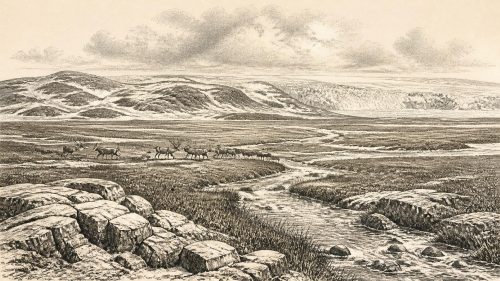
The best-supported picture is of a severe northern environment in which open habitats periodically had an important place. Pleistocene cave assemblages from Ireland include animals associated with cold, open country, among them reindeer, mountain hare, lemmings and Arctic fox, as well as larger mammals such as mammoth, horse, giant deer, red deer, wolf and brown bear. Castlepook Cave near Doneraile in County Cork is especially significant because nineteenth- and early twentieth-century excavations recovered a remarkably varied Ice Age fauna. Yet the list is not a census of one living landscape. Cave deposits can accumulate over very long intervals, and bones may be moved, disturbed or reworked before excavation. The presence of a species establishes that it reached Ireland at some stage; it does not prove that every listed animal shared the same valley at 31,979 BCE.
Direct dating brings a sharper, though still incomplete, chronology. Red-deer remains from caves in County Waterford have produced calibrated pre-Last Glacial Maximum ranges of about 32,930–31,280 cal BP and 30,297–29,594 cal BP. The earlier of these sits close enough to the date considered here to demonstrate that sizeable terrestrial mammals could occupy parts of Ireland during this broad interval. Such animals required food, shelter and routes through an exact landscape that is now largely lost. The evidence does not tell us their population sizes, migrations or the extent of vegetation with precision, but it cautions against depicting all of Ireland as permanently sterile or uniformly sealed beneath ice at this earlier stage.
The Question of Human Presence
The most arresting Irish evidence is a reindeer femur from Castlepook Cave reported to bear cut marks consistent with stone-tool butchery and dated to approximately 33,000 years ago. If the marks are correctly interpreted and the dated bone is closely connected with the modification, it indicates that people processed a reindeer in Ireland during the Late Pleistocene. It is a major challenge to the once-common belief that humans first reached Ireland only after the final retreat of the ice. It may illuminate the general era around 31,979 BCE, but it must not be converted into an invented event for that particular year. The reported date is not a calendar date, and it is not an occupation layer containing a house, hearth, tool kit or human burial.
Current research therefore treats the earliest occupation question as open. Excavations at Castlepook have sought intact deposits, lithics, charcoal and further modified bone, but no securely dated settlement of this age has yet been established. Ireland has no known human skeleton from c. 33.9 ka cal BP, no securely associated camp floor and no local sequence of stone tools from which a named archaeological culture can safely be assigned. It would be tempting to call any visitors “Aurignacian” or “Gravettian”, terms used for Upper Palaeolithic material traditions elsewhere in Europe. Without diagnostic Irish artefacts, that would be an interpretation about possible connections, not a fact about Ireland.
What Everyday Life May, and May Not, Reveal
If people did visit, the cut-marked reindeer bone suggests a very limited but concrete activity: the dismembering or stripping of an animal carcass with a sharp-edged implement. It does not by itself show whether the animal was hunted, scavenged, killed nearby or carried to the cave in pieces. Nor can one bone reveal the number, age or identity of the people involved. In comparable Upper Palaeolithic contexts beyond Ireland, small mobile groups used stone, bone, skin, fire and detailed environmental knowledge to obtain food in seasonal landscapes. That wider comparison makes short visits by capable foragers plausible; it cannot supply the missing Irish evidence for dwellings, clothing, kinship, diet beyond one episode, or a permanent population.
Accordingly, political affairs, warfare, diplomacy and formal leadership cannot be reconstructed for Ireland at this date. There is no evidence for communities large enough to identify as tribes, no fortifications, no territory boundaries and no exchange network represented by imported artefacts. The lower sea levels of the Ice Age changed the geography of the Irish Sea basin, but low sea level alone does not demonstrate an easy land route between Ireland and Britain. Ice, open water, unstable coastlines and seasonal conditions all mattered. Any human crossing would have been a difficult movement through a changing north-western European world, not evidence for routine travel or trade.
Culture Beyond Recovery
Nothing currently found in Ireland at or near 31,979 BCE allows archaeologists to identify religious rites, images, music, spoken languages or systems of teaching. Caves can seem inherently ceremonial to modern eyes, especially because spectacular cave art is known elsewhere in Ice Age Europe. That association is not proof that Castlepook or any Irish cave was a shrine, gallery or burial place. The scientific value of these sites lies first in their faunal deposits and their potential to preserve rare traces of human action. Absence of evidence is not proof that visitors had no beliefs, stories or skills; it means that the surviving record cannot responsibly describe them.
The enduring historical development at this date was environmental rather than political. Ireland was being shaped by the climatic deterioration that would culminate in the Last Glacial Maximum. Ice, meltwater and freezing ground would scour bedrock, transport boulders, reshape drainage and lay down sediments that still structure the Irish landscape. Later deglaciation would create new lakes, wetlands and coastlines, and only much later would sustained Mesolithic settlement become visible in the archaeological record. Around 31,979 BCE, Ireland stands at the edge of that long transformation: a cold and variable land with Ice Age animals, perhaps visited by people, but with its human history preserved only in the faintest and most carefully qualified of traces.
Primary Sources
- Growth and retreat of the last British–Irish Ice Sheet, 31 000 to 15 000 years ago: the BRITICE-CHRONO reconstruction
- Pattern and timing of retreat of the last British-Irish Ice Sheet
- Late Pleistocene chronostratigraphy and ice sheet limits, southern Ireland
- Stratigraphic and palaeo-geomorphological evidence for the glacial-deglacial history of the last British-Irish Ice Sheet in the north-western Irish Sea
- Maximum extent and dynamic behaviour of the last British–Irish Ice Sheet west of Ireland
- Early deglaciation of the British-Irish Ice Sheet on the Atlantic shelf northwest of Ireland driven by glacioisostatic depression and high relative sea level
- Modelling the Quaternary evolution of the Irish Sea and the land bridge between Britain and Ireland
- First evidence of a Late Upper Palaeolithic human presence in Ireland
- The Irish quaternary fauna project
- New insights on the fauna of Ireland's Younger Dryas and Early Holocene from Alice & Gwendoline Cave
- Red deer in Ireland: a palaeontological, archaeological and genetic study
- Could brown bears (Ursus arctos) have survived in Ireland during the Last Glacial Maximum?
- Archaeology Research Excavation Grant 2022: Final Report
- 2022:564 – CASTLEPOOK CAVE, Castlepook South, Cork
- Heritage Artefacts of County Cork
- Quaternary
- Late Midlandian, Pleistocene, Northern Ireland
- Outreach and Education Resources
- The Quaternary of the Irish Midlands
- Archaeological excavations at Killuragh Cave, Co. Limerick
- Irish Cave Exploration