Castlepook’s Cold Threshold30712 BCE
30,712 BCE is a modern label for an uncertain point in Ireland’s climatically unstable MIS 3, not a date tied to a recorded event. Ireland’s ice margins, sea levels and exposed lowlands changed, while later glaciation destroyed or disturbed much earlier evidence. Castlepook Cave, County Cork, preserves Ireland’s richest pre-Last Glacial Maximum vertebrate archive, including mammoth, reindeer, giant deer, lemmings, wolves and hyenas, indicating cold, open environments. Its mixed deposits cannot date all species to one moment. No evidence demonstrates settlement, politics or culture. A possibly tool-marked reindeer bone suggests fleeting human contact, but requires confirmation and cannot establish population.

Dateline
30,712 BCE is a modern numerical label, not a date that anybody in prehistoric Ireland could have recognised. It cannot be attached to a named season, generation, ruler or event. In simple arithmetic it falls about 32,661 years before the 1950 reference point used for radiocarbon dating, but that is not itself a calibrated radiocarbon age. At this depth in time, archaeological and environmental evidence is normally expressed as broad calibrated ranges, often with substantial uncertainty, and frequently dates an animal bone or sediment layer rather than a human action. The responsible question is therefore what can be said about Ireland around this point in the later Pleistocene, not what happened in one exact calendar year.
A Late Pleistocene Threshold
The period belongs to Marine Isotope Stage 3 (MIS 3), a long and climatically unstable part of the last Ice Age, conventionally spanning roughly 57,000–29,000 years ago. North Atlantic climate did not simply become steadily colder. Greenland ice-core records identify abrupt alternations between relatively milder interstadials and colder stadials; correlation between those distant records and Irish deposits is useful, but never exact. Around the numerical date represented here, Ireland stood close to a poorly resolved climatic and glacial transition. One broad synthesis describes the island as ice-free until about 32,000 calibrated years before present, while other research indicates that an Irish ice sheet had affected parts of the western margin before the Last Glacial Maximum. These statements are not necessarily contradictory: they reflect a fragmented record, changing regional ice margins and different meanings of “ice-free”.
The later Last Glacial Maximum, when the British–Irish Ice Sheet covered much or probably all of Ireland, lay ahead, broadly between about 26,000 and 19,000 calibrated years before present. It would profoundly scour, bury and rearrange older landscapes and deposits. That later glaciation is one reason why evidence from around 30,712 BCE is exceptionally scarce. It may have destroyed many open-air traces of earlier activity; it also means that surviving caves, protected fissures and buried sediments carry disproportionate importance. Yet scarcity cannot be converted into certainty. The absence of a camp, hearth or tool scatter is not proof that no person ever reached the island; it is proof that permanent or recurrent settlement has not been demonstrated.
Land, Water and Moving Ice
Sea level was far lower than today during the Ice Age. The Irish Sea basin and continental shelf therefore had a different geography, with expanses of presently submerged land exposed at various times. Such landscapes could facilitate animal movement between Britain and Ireland, though their coastlines, rivers, marshes and ice margins changed repeatedly. It is misleading to picture a simple, permanent “land bridge”. There were shifting lowlands, water barriers and, at times, glacial obstacles. The precise route by which particular mammals arrived in Ireland remains uncertain, and it cannot be assumed that every route passable to reindeer or hyena was equally feasible for people.
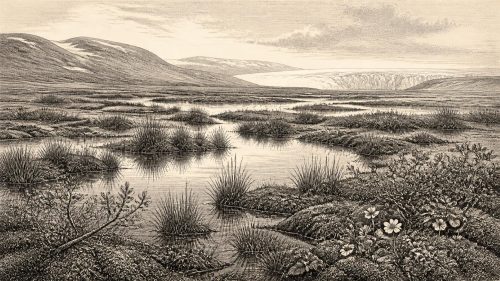
The evidence does nevertheless show that Ireland was not an inert block of ice throughout MIS 3. It was part of a wider north-west European ecological zone whose boundaries expanded and contracted with climate, sea level and ice. At around this date, local settings may have ranged from exposed, wind-swept ground to sheltered valleys, limestone caves, river margins and seasonal wetlands. General regional evidence supports cold, largely open habitats rather than continuous forest. But it does not permit a map of vegetation for every Irish county in 30,712 BCE. The familiar modern division between a green, wooded Ireland and a stormy Atlantic coast is an unsuitable guide to this much colder world.
Castlepook’s Animal Archive
The most important Irish evidence for this broad interval comes from Castlepook Cave, also known as Mammoth Cave or Doneraile Cave, near Doneraile in north County Cork. In the early twentieth century Richard J. Ussher and other investigators excavated its narrow limestone galleries, including places evocatively named Hyenahall and Elephant Hall. The work recovered a remarkable concentration of fossil remains, now largely associated with the National Museum of Ireland. Castlepook is Ireland’s richest known cave archive for vertebrates living before the Last Glacial Maximum.
The assemblage includes woolly mammoth, reindeer, giant deer, brown bear, wolf, foxes, mountain hare, Norwegian lemming, collared lemming and spotted hyena. Each animal is important evidence that suitable habitats and routes of colonisation existed at some point during the wider Ice Age interval. Reindeer and lemmings indicate cold open country; mammoth and giant deer evoke large herbivores using expansive feeding grounds; wolves and spotted hyenas show that sizeable predators were present too. The fauna makes Ireland’s Pleistocene environment appear far richer than the island’s later, historically familiar fauna.
That picture requires discipline. Castlepook is a cave repository, not a frozen snapshot of one afternoon on an Ice Age plain. Bones accumulated through more than one process and, apparently, over a long span. Hyenas may have brought carcass parts into the cave; water disturbed deposits; early excavation methods did not meet modern stratigraphic standards; and later radiocarbon work has shown that some older dates required revision. Directly dated bones from the cave and related Irish cave sites cover many millennia. Therefore, the faunal list does not show that every species was living together near Doneraile in 30,712 BCE. It establishes a changing MIS 3 animal world, within which the date belongs.
People: A Possibility, Not a Population
There is no securely excavated house floor, hearth, burial, stone-tool assemblage or settlement in Ireland that can be assigned to around 30,712 BCE. There is no basis for estimating a population, identifying a language, defining a community or describing a regular annual round. The National Museum of Ireland has long treated the Irish Palaeolithic record as lacking clear evidence of sustained human presence, while the better-supported evidence for a Late Upper Palaeolithic human visit comes much later, from cut marks on a brown-bear kneecap at Alice and Gwendoline Cave in County Clare, dated to approximately 12,810–12,590 calibrated years before present.
Castlepook has nevertheless reopened the question. A reindeer femur from the old collection has been publicised as bearing a deep mark interpreted by zooarchaeologist Ruth Carden as damage made by a sharp stone implement during butchery. Public accounts have associated the bone with roughly 33,000 years ago. If that interpretation and association are ultimately confirmed, it would indicate that people processed an animal in Ireland during MIS 3, dramatically earlier than the currently better-contextualised terminal-Pleistocene evidence.
For this particular year, however, the claim must remain carefully bounded. The specimen was not recovered from a newly excavated, sealed occupation surface alongside tools, charcoal and other unambiguous domestic debris. A single marked bone cannot establish that hunters lived at Castlepook, that they arrived every year, or that they formed a lasting Irish population. It may represent one brief visit, an episode of carcass processing elsewhere before the bone entered the cave, or a more complex history still awaiting microscopic, chronological and contextual testing. It is significant evidence under investigation, not a licence to invent a settled Palaeolithic Ireland.
No Polities, No Proven Trade
Accordingly, there are no political affairs to narrate for Ireland at this date. No chieftainship, territory, alliance, war, diplomacy or law can responsibly be inferred. Nor is there evidence for villages, farming, herds managed by people, pottery, metalworking or an exchange network. The economy visible in the record is an ecological one: wild animals moved through a changing landscape, predators fed upon herbivores, and caves trapped or received bone. If people did enter Ireland, they would have depended on mobile hunter-gatherer skills familiar elsewhere in Upper Palaeolithic Europe, but that broader comparison is interpretation rather than direct Irish evidence.
The same restraint applies to religion, culture and learning. Caves can later become places of art, burial, ritual or shelter, but Castlepook supplies no securely dated Palaeolithic cave art, grave, shrine or manufactured object from which beliefs can be reconstructed. Nor does it reveal songs, stories, kin groups or social rank. What it does preserve is an older kind of history: animal teeth, bones, cave sediments, marks on surfaces and the scientific records made from them. These materials show how much of Ireland’s early past survives as a difficult environmental archive rather than a conventional human chronicle.
What the Date Can Mean
A responsible portrait of Ireland around 30,712 BCE is therefore one of uncertainty at an environmental frontier. The island was within the climatic turbulence of MIS 3 and was moving towards the much more extensive glaciation of the Last Glacial Maximum. Parts of its landscape could sustain cold-adapted mammals and major predators. Castlepook Cave in Cork preserves compelling evidence of that wider world, but its mixed deposits cannot give a year-by-year census. A possible modified reindeer bone raises the prospect of very early human contact, yet does not demonstrate settlement.
The principal development is not a battle, dynasty or invention. It is the existence of a changing Irish Ice Age landscape in which mammoths, reindeer, giant deer and hyenas could occur, and in which the possibility of a fleeting human presence remains open but unproven. Future excavation of undisturbed cave deposits, improved radiocarbon pretreatment, microscopic study of bone modifications and environmental DNA may sharpen that picture. Until then, the evidence asks for precision about its limits as much as enthusiasm for its discoveries.
Primary Sources
- Castlepook Cave, County Geological Site Report
- The Exploration of Castlepook Cave, County Cork
- The Irish Quaternary Fauna Project
- A Reconsideration of the Radiocarbon Dating of the Marine Isotope Stage 3 Fauna from Southern Ireland
- The Colonization of Ireland: A Human Ecology Perspective
- First Evidence of a Late Upper Palaeolithic Human Presence in Ireland
- New Insights on the Fauna of Ireland's Younger Dryas and Early Holocene from Alice & Gwendoline Cave
- Prehistoric Details: Mell Flint Flake
- Spotted Hyena Skull
- Archaeological Heritage of County Cork
- Castlepook Cave, Co. Cork, Excavation Report 2022
- Archaeology Research Excavation Grant 2022: Castlepook Cave, Co. Cork
- Anthropogenic Changes to the Holocene Nitrogen Cycle in Ireland
- Radiocarbon Constraints on the History of the Western Irish Ice Sheet Prior to the Last Glacial Maximum
- Pattern and Timing of Retreat of the Last British-Irish Ice Sheet
- Maximum Extent and Dynamic Behaviour of the Last British-Irish Ice Sheet West of Ireland
- Timing and Pace of Ice-Sheet Withdrawal Across the Marine–Terrestrial Transition West of Ireland During the Last Glaciation
- Dimensions and Chronology of the Last Ice Sheet in Western Ireland
- A Stratigraphic Framework for Abrupt Climatic Changes During the Last Glacial Period Based on Three Synchronized Greenland Ice-Core Records
- Radiocarbon Constraints on the Age of the Maximum Advance of the British-Irish Ice Sheet in the Celtic Sea