Doneraile’s Hyena Corridor30186 BCE
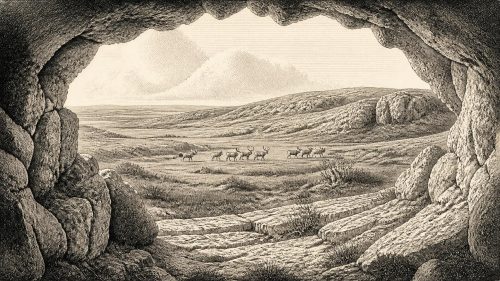
Around 30,186 BCE, Ireland experienced unstable Late Pleistocene conditions as ice expanded and sea levels fell. Castlepook Cave near Doneraile, County Cork, preserves major evidence: bones of mammoth, giant deer, reindeer, bear and spotted hyaena, accumulated across many millennia rather than one period. These animals indicate intermittent connections with north-west Europe and cold, open habitats, though not a single reconstructed ecosystem. Hyaena activity explains much bone damage and deposition. A marked reindeer femur may show human butchery, but remains unproven. No secure evidence exists for settlement, tools, houses, burials, farming, trade or political communities. Environmental change dominates this prehistoric horizon.
Dateline
30,186 BCE is a useful label in a modern chronological sequence, but it was not a year that anyone in Ireland could have named, counted or recorded. No Irish deposit can presently be tied to that single calendar year. At this depth of time, scientific dating produces probability ranges, and conversion between radiocarbon years, calibrated years before present and BCE notation introduces further uncertainty. The responsible frame is therefore a broad part of the Late Pleistocene, within Marine Isotope Stage 3 and the long approach to the Last Glacial Maximum, rather than an anniversary in an Irish annal.
The strongest evidence relevant to this horizon comes not from houses, tools or graves, but from caves, bones, sediments and ice-shaped landscapes. It reveals an Ireland subject to severe climatic change, occupied at least intermittently by large mammals and predators, and increasingly affected by the growth of the British–Irish Ice Sheet. It does not demonstrate a settled human population, political communities or a known Irish culture in 30,186 BCE.
A Date Without an Annal
A literal arithmetic conversion places 30,186 BCE roughly 32,136 years before AD 1950, the conventional reference point for radiocarbon dating. That should not be mistaken for a calibrated archaeological date. Carbon-14 concentrations in the atmosphere varied through time, so a radiocarbon measurement must be calibrated against independent records; the outcome is usually a range, not a point. Nor do Irish sites provide an unbroken annual sequence from which a particular season or generation can be isolated.
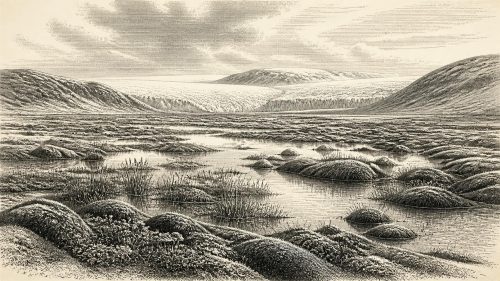
For this reason, conditions in Ireland are best discussed across several millennia around the nominal date. The later part of Marine Isotope Stage 3 was climatically unstable: colder phases and expanding ice alternated with more favourable intervals. The global Last Glacial Maximum is generally placed later, around 26,500–19,000 calibrated years before present, while maximum ice cover of Ireland and its continental shelf is often reconstructed around 27,000–23,000 calibrated years before present. The geography of ice growth before that maximum remains an active field of research, with regional differences and competing reconstructions. It would be wrong either to picture all Ireland as continuously buried beneath ice in 30,186 BCE or to imagine a stable, hospitable island.
Castlepook’s Long Bone Archive
The key Irish place is Castlepook Cave, also called Mammoth Cave or Doneraile Cave, near Doneraile in north County Cork. This limestone cave system is Ireland’s richest known archive of vertebrate remains from the period leading towards the Last Glacial Maximum. Excavations undertaken mainly between 1904 and 1918 recovered more than 2,000 bones, although methods of that era did not preserve the detailed stratigraphic information expected today. Water movement, carnivore activity and repeated disturbance within the cave further complicate the history of individual finds.
Direct radiocarbon dating of selected Castlepook bones demonstrates that the cave accumulated animal remains over a very long interval, rather than preserving one simultaneous community. Geological Survey Ireland places the dated span broadly between about 45,700 and 19,950 radiocarbon years before present. Revised measurements have pushed several southern Irish cave specimens substantially earlier than older determinations suggested. In calibrated terms, some Castlepook and nearby southern Irish faunal dates fall within broad ranges from roughly 40,000 to 30,000 calibrated years before present. Those ranges illuminate the world around the present nominal date, but they cannot make a particular mammoth, hyaena or reindeer an inhabitant of one specific year.
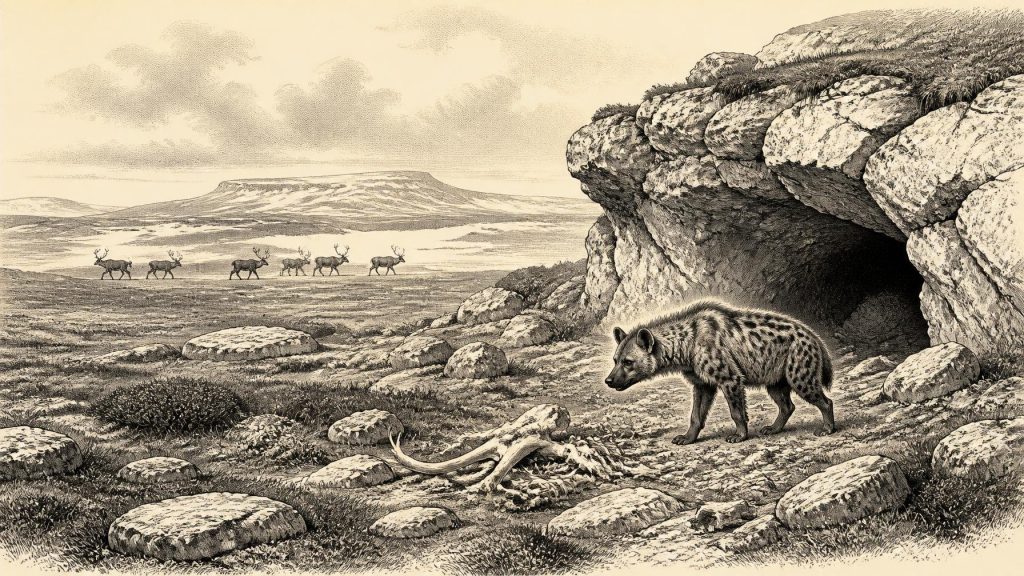
The documented fauna is remarkable. Castlepook has produced woolly mammoth, giant deer, reindeer, brown bear and spotted hyaena, alongside later records of wolf, Arctic fox, Norwegian lemming and collared lemming. These animals did not necessarily live together at the same time, and they should not be assembled into a single imagined herd crossing County Cork. Yet the assemblage securely establishes that, during different phases of the Late Pleistocene, Ireland formed part of a wider north-west European zone in which large herbivores and carnivores could reach its western edge.
Predators, Carcasses and Open Country
Spotted hyaena is particularly significant. Its presence makes Castlepook more than a collection point for animals that died naturally. Hyaenas use dens and carry portions of carcasses into sheltered places; tooth damage, bone fragmentation and the selection of skeletal parts can therefore result from carnivore behaviour rather than people. The cave’s bone deposits are evidence for an ecological relationship between predators, prey and shelter, but also a warning against treating every broken or marked bone as a human artefact.
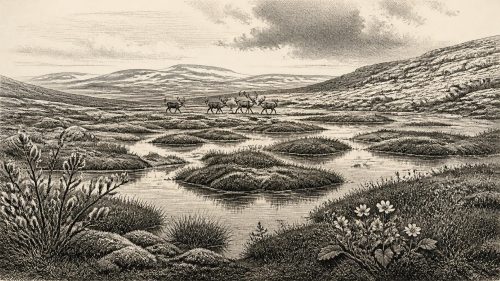
The animals suggest a cold, generally open landscape rather than the dense temperate woodland familiar in modern Ireland. Reindeer and lemmings are especially compatible with northern, treeless or sparsely vegetated conditions; mammoth and giant deer imply sufficient grazing and browsing resources to support large herbivores. However, the precise mixture of grassland, herb-rich tundra, scrub, exposed ground, wetlands and snow cover varied across place and time. The cave fauna provides firmer evidence for the presence of particular animals than for a complete map of Cork’s vegetation in any one century.
Climate and terrain shaped all movement. Lower global sea level altered coastlines, while glacial advance and retreat repeatedly remade routes through the British–Irish region. The animal record shows biological connection with wider Eurasian populations, not an economic system. Animals may have dispersed during favourable episodes by routes that are now submerged, eroded or buried beneath later glacial deposits. Their arrival does not itself reveal whether people used the same routes, how often they did so, or whether Ireland was ever connected by dry land.
The Reindeer Femur Question
The most provocative object from this wider period is a reindeer femur from Castlepook. Ruth Carden has argued that a deep linear modification on the bone is consistent with a sharp stone tool used on fresh bone, perhaps during the butchery of a carcass. Public discussion has associated the specimen with a radiocarbon age of around 33,000 years before present. If the mark is confirmed as a human cut mark and securely related to the bone’s age, it would indicate a human presence in Ireland far earlier than the previously accepted terminal-Pleistocene evidence.
That conclusion remains appropriately cautious. A radiocarbon result dates the animal bone, not automatically the action that caused a surface mark. Cave deposits can be mixed; carnivores, trampling, sediment movement and excavation history can alter bones; and the original context of many early finds is incomplete. A single modified bone cannot establish a camp, a season of occupation, a population size, a route of arrival or continuous settlement. The responsible formulation for the world of 30,186 BCE is therefore that human activity in Ireland is possible but unproven at this exact horizon, while Castlepook offers an important claim requiring continuing specialist scrutiny.
No Polities, No Proven Trade
There is no evidence from Ireland at this date for political authority, diplomacy, organised warfare, farming, herding, permanent villages, metalworking or trade. Nor is there an Irish object of this age that securely reveals language, ritual, teaching, art or formal religious practice. Upper Palaeolithic communities elsewhere in Europe made sophisticated stone technologies and symbolic works, but importing those achievements wholesale into Ireland would be analogy, not evidence.
If people did visit, they may have travelled in small mobile groups able to exploit large animals and difficult seasonal environments. That is a reasonable possibility drawn from the broader European Upper Palaeolithic, not an established account of Irish society. No hearth, dwelling floor, burial, indisputable stone-tool assemblage or human skeletal remain has yet been securely identified in Ireland for this period. Equally, absence of such evidence does not prove that no person ever reached the island: later glaciation, erosion, rising seas and the rarity of surviving deposits have severely narrowed the archaeological record.
An Island Being Remade
The major historical development was environmental, not political. Ireland lay within a changing northern Atlantic world in which ice sheets were enlarging, sea levels were falling and habitable spaces were shifting. During later maximum conditions, ice would override and scour extensive areas, burying or destroying much older evidence. Cave archives such as Castlepook are precious partly because they preserve fragments of life from before that fuller glacial transformation.
Thus the most defensible picture for around 30,186 BCE is neither an empty white wilderness nor a populated prehistoric nation. It is a changing, cold landscape at Europe’s north-western edge: large mammals moved through it in different episodes; hyaenas used Cork caves; ice and sea level were reorganising the region; and there may be a tantalising trace of human handling of a reindeer carcass. The difference between those levels of certainty is the essential history of this date.
Primary Sources
- Castlepook Cave: Cork County Geological Site Report
- A reconsideration of the radiocarbon dating of the Marine Isotope Stage 3 fauna from southern Ireland
- The colonization of Ireland: A human ecology perspective
- Ireland: Submerged Prehistoric Sites and Landscapes
- Timing and pace of ice-sheet withdrawal across the marine–terrestrial transition west of Ireland during the last glaciation
- Response of the Irish Ice Sheet to abrupt climate change during the last deglaciation
- Radiocarbon constraints on the age of the maximum advance of the British–Irish Ice Sheet in the Celtic Sea
- Trimlines, blockfields and the vertical extent of the last ice sheet in southern Ireland
- Dimensions and chronology of the last ice sheet in Western Ireland
- Deglaciation chronology of the Donegal Ice Centre, north-west Ireland
- Early deglaciation of the British-Irish Ice Sheet on the Atlantic shelf northwest of Ireland driven by glacioisostatic depression and high relative sea level
- The timing and magnitude of the British–Irish Ice Sheet between Marine Isotope Stages 5d and 2: implications for glacio-isostatic adjustment, high relative sea levels and ‘giant erratic’ emplacement
- Growth and decay of a marine terminating sector of the last British-Irish Ice Sheet: a geomorphological reconstruction
- Stratigraphic and palaeo-geomorphological evidence for the glacial-deglacial history of the last British-Irish Ice Sheet in the north-western Irish Sea
- The Quaternary of Ireland
- Field Guides
- Outreach and Education Resources
- Heritage Artefacts of County Cork
- The Mesolithic in Ireland: when was it?
- Mammoth Cave
- New insights on the fauna of Ireland’s Younger Dryas and Early Holocene from Alice & Gwendoline Cave
- Sedimentary ancient DNA reveals Late Pleistocene faunal connectivity between Ireland and Eurasia