Castlepook’s Hyena Galleries31922 BCE
About 33,900 calibrated years before present, Ireland experienced unstable MIS 3 conditions, with fluctuating ice, sea levels and open steppe-tundra habitats. Castlepook Cave, County Cork, preserves fauna including mammoth, reindeer, giant deer, hyaena, wolf and Arctic fox, although disturbed deposits and revised dates demand caution. Evidence indicates a cold-adapted animal community and carnivore activity, not a single contemporaneous landscape. A cut-marked reindeer femur plausibly suggests Upper Palaeolithic visitors butchered game, but cannot prove settlement. No associated tools, hearths or human remains exist. Later glaciation destroyed or buried evidence, leaving caves as fragile archives of possible early human presence in Ireland.

Dateline
The label 31,922 BCE gives a misleading impression of precision. No community in Ireland used a calendar, writing or named era at this depth of time, and archaeology cannot identify events within a single modern year. The responsible setting is therefore a broad one: roughly 33,900 calibrated years before present (where “present” is conventionally 1950), during the Late Pleistocene and Marine Isotope Stage 3. Dates from this age are usually expressed as radiocarbon determinations and calibrated ranges, often with uncertainties measured in centuries or millennia. What can be described is not an Irish ‘year’, but an interval in which climate, ice, animals and perhaps very occasional people shaped a precarious north-western edge of Europe.
An Island in an Unstable Ice Age
Ireland was then part of the long last glacial cycle, but it should not be pictured simply as an island sealed beneath permanent ice. Marine Isotope Stage 3, broadly c. 57,000–29,000 years ago, was climatically restless. Greenland ice-core records and North Atlantic sediments reveal abrupt warmer and colder swings. The British–Irish Ice Sheet was already an important presence, but its precise extent and behaviour around 34,000 calibrated years ago remain debated. Recent synthesis points to earlier growth, retreat and renewed advance before the Last Glacial Maximum, rather than one uncomplicated march towards a frozen peak.
The maximum expansion came later, broadly between c. 27,000 and 23,000 calibrated years before present. Around the notional year in question, parts of Ireland may have experienced open, cold landscapes during favourable phases, while other areas were influenced directly by expanding ice or by its severe climatic effects. The island’s familiar modern coast is no guide to this world. Global sea level was lower, local land levels were altered by the colossal weight of ice, and the Irish Sea region was a changing combination of shallow water, exposed ground, ice and sediment-filled basins. It is unsafe to imagine either an easy, continuous land route or a fixed sea crossing from Britain.
These changes matter because they governed which plants, animals and people could reach the island, and whether they could remain. The surviving evidence suggests that Ireland was not uniformly lifeless before the glacial maximum. Yet it does not prove that every region was habitable at the same time, or that conditions were stable enough to support a permanent human population. A cave fossil records that an animal, or material containing it, reached one place; it cannot by itself map a whole island.
The Evidence at Castlepook
The key Irish locality for this period is Castlepook Cave, also known as Mammoth Cave, near Doneraile in north County Cork. Its limestone passages produced a remarkable collection of animal remains during excavations in the early twentieth century. Later investigation and radiocarbon redating have made the cave central to understanding Irish fauna before the Last Glacial Maximum. The old excavations were undertaken long before modern standards of stratigraphic recording, however. The assemblage comes from a complex cave system affected by natural disturbance, and bones recovered from different passages or deposits cannot casually be treated as one simultaneous scene.
Even with that warning, the faunal evidence is striking. Castlepook has yielded remains attributed to woolly mammoth, reindeer, giant deer, brown bear, spotted hyaena, wolf, Arctic fox, stoat, mountain hare and lemmings. Some finds have uncertain ages or contexts, while earlier radiocarbon results have been revised as laboratory pretreatment improved. The 2020 redating programme showed that several Castlepook specimens were substantially older than their previous determinations suggested. It placed important parts of the fauna firmly within MIS 3 and indicated that spotted hyaena and giant deer may have disappeared locally before the later glacial maximum, around 40,000 calibrated years before present.
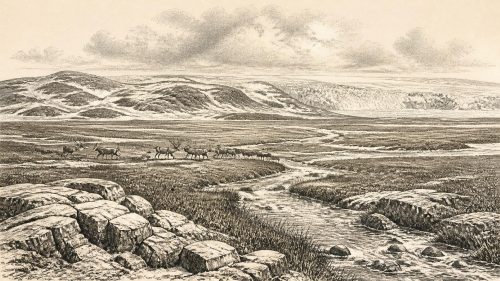
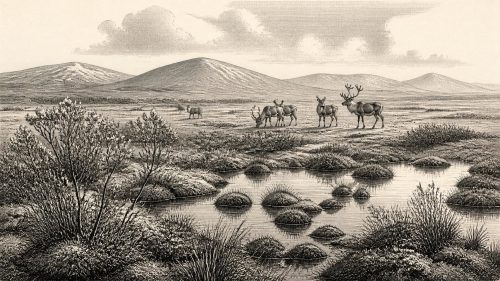
This is evidence for a cold-adapted animal community, not a painted panorama. Reindeer and lemmings point towards open habitats unlike the densely wooded Ireland of later millennia. Mammoth, giant deer and horse known from Irish Pleistocene contexts imply patches of productive grazing country. Predators and scavengers complicate the picture: hyaenas could accumulate bones in dens, while wolves, bears, carnivores, water movement and cave collapse could all alter an assemblage. Nevertheless, the combined record makes a landscape of open grassland, herb-rich steppe-tundra and sheltered valleys more plausible than a uniform wilderness of bare snow.
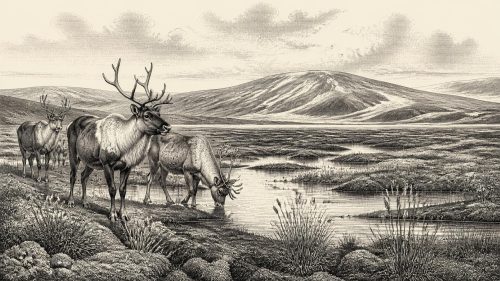
For the animals, seasonality would have been decisive. Plant growth, snow cover, access to grazing and the position of ice margins changed the value of particular valleys and uplands. A herd of reindeer may have passed through rather than lived year-round near Castlepook; a carnivore den tells of feeding and shelter rather than a settled ecosystem. It is possible to say that north Cork formed part of a wider Late Pleistocene ecological zone connected, at intervals, to Britain and continental Europe. It is not possible to calculate animal numbers, chart fixed migrations, or describe a particular hunting season in 31,922 BCE.
The Reindeer Bone Question
Castlepook has particular historical importance because a reindeer femur in the National Museum of Ireland collection has been reported as bearing a mark consistent with cutting by a sharp stone tool. County Cork heritage material dates the bone approximately to 31,000 BCE and presents the mark as evidence that Stone Age hunters butchered reindeer. If that interpretation is confirmed, it would represent a dramatic indication of human activity in Ireland far earlier than the island’s well-established post-glacial settlement record.
Its significance requires equally dramatic caution. A modified animal bone may demonstrate the processing of one carcass; it does not demonstrate a village, a resident population, or a continuous occupation. No securely associated Upper Palaeolithic stone-tool assemblage, hearth, habitation surface, burial, artwork or human skeletal remains has yet established a community in Ireland around 34,000 calibrated years ago. Castlepook’s nineteenth- and early twentieth-century recovery history also makes it difficult to tie every observation to an undisturbed deposit. Renewed fieldwork at the cave is valuable precisely because it may locate intact deposits and allow modern recording, dating and analysis.
The best conclusion is therefore conditional. The bone offers a plausible, officially recognised indication that people may have visited Ireland in this interval and butchered reindeer. It does not yet make permanent settlement certain. If people did arrive, they should not be called ‘Irish’ in an ethnic, linguistic or national sense. There is no evidence for a Gaelic language, ancestral continuity with later inhabitants, or any named group. They would have been Upper Palaeolithic hunter-gatherers operating at the far western margin of a larger European world.
People Without Polities
There were no Irish kings, tribes, provinces, laws, diplomatic missions or political institutions that can responsibly be assigned to this date. Nor does the evidence reveal warfare, alliances or territorial boundaries. The social scale most consistent with a possible hunting visit is a small, mobile party whose relationships were personal and kin-based, but even that is an inference from hunter-gatherer archaeology elsewhere rather than a fact demonstrated at Castlepook.
Upper Palaeolithic communities in other parts of Europe possessed sophisticated stone technologies, clothing, food-sharing practices, ornaments and forms of visual expression. Such evidence establishes that people of the wider period were capable of complex culture; it cannot fill the Irish record by assumption. No Irish object of this age demonstrates a particular tool-kit, dwelling design, clothing practice, artistic tradition or teaching system. If hunters processed a reindeer near Castlepook, the likely purpose was practical: meat, marrow, hide, sinew, bone and antler were valuable resources in a cold environment. But no tool from the event has been recovered, and no claim can be made about the exact method of the hunt.
There is likewise no direct Irish evidence for worship, burial custom, shrines, ceremony, music or formal learning at this time. Caves can appear inherently evocative to modern observers, but Castlepook’s importance here is geological and palaeontological. Its animal bones principally illuminate ecology and taphonomy: how carcasses were accumulated, moved and preserved. To convert the cave automatically into a sacred place would be to mistake possibility for evidence.
Economy at the Edge
If humans were present, subsistence rather than trade is the only defensible economic theme. Reindeer would have been an attractive target or scavenged resource, and an open landscape could support other large herbivores. A mobile group might have followed animals, adjusted journeys to weather and used temporary shelters. Yet ‘might’ is essential. Ireland has no securely dated camp of this age from which archaeologists can reconstruct meals, season of residence, group size or the division of labour.
Nor is there evidence for exchange between Ireland and neighbouring regions. Potential human movement does imply some connection beyond the island: people, animals and raw materials had routes into its changing landscape. But the form of that connection is unresolved. Lower sea levels did not necessarily erase marine barriers, while ice itself could obstruct travel as much as it connected terrain. The absence of a known flint assemblage is especially important, since sourceable stone could otherwise help identify routes and contacts.
A Record Made Fragile by Ice
The approaching glacial maximum helps explain why the evidence is so meagre. Later ice repeatedly eroded landscapes, transported sediment and removed or buried earlier surfaces. Sea-level change drowned other potential sites on the continental shelf. Caves such as Castlepook became disproportionately important archives because their sediments and fossil collections preserved traces that open-air places often lost. Even there, preservation was selective and excavation history imperfect.
Thus the principal development around 31,922 BCE was not a datable political event but an environmental threshold. Ireland lay within a fluctuating cold-stage world in which a distinctive large-mammal fauna survived in at least some areas, while the British–Irish Ice Sheet was becoming increasingly consequential. Castlepook’s hyaena galleries and reindeer bone suggest that this was not necessarily an empty island. They do not allow a fuller human history than the evidence can bear. The honest picture is compelling enough: a changing tundra-edge landscape, large animals moving through north Cork, caves used by carnivores, and the unresolved possibility that a small human party briefly entered Ireland long before settlement became archaeologically visible.
Primary Sources
- A reconsideration of the radiocarbon dating of the Marine Isotope Stage 3 fauna from southern Ireland
- The Irish Quaternary Fauna Project
- The exploration of Castlepook Cave, County Cork
- First evidence of a Late Upper Palaeolithic human presence in Ireland
- New insights on the fauna of Ireland's Younger Dryas and Early Holocene from Alice & Gwendoline Cave
- The colonization of Ireland: A human ecology perspective
- Growth and retreat of the last British–Irish Ice Sheet, 31,000 to 15,000 years ago: the BRITICE-CHRONO reconstruction
- The timing and magnitude of the British–Irish Ice Sheet between Marine Isotope Stages 5d and 2: implications for glacio-isostatic adjustment, high relative sea levels and ‘giant erratic’ emplacement
- Trimlines, blockfields and the vertical extent of the last ice sheet in southern Ireland
- Pattern and timing of retreat of the last British-Irish Ice Sheets
- Character of advance and retreat of the southwest sector of the British-Irish Ice Sheet during the last glaciation
- The problem of a late quaternary landbridge between Britain and Ireland
- The Island of Ireland: Drowning the Myth of an Irish Land-bridge?
- Ireland: Submerged Prehistoric Sites and Landscapes
- IntCal20 Northern Hemisphere radiocarbon age calibration curve (0–55 cal kBP)
- OxCal
- Heritage Artefacts of County Cork
- Archaeological Heritage of County Cork
- 2022:564 – Castlepook Cave, Castlepook South, Cork
- Castlepook Caves
- Guide to the National Museum of Ireland
- Ice Age Ireland: Cool Fossils!