Castlepook’s Reindeer Country31921 BCE
Around 34,000 calibrated years BP, Ireland experienced severe climatic change before the Last Glacial Maximum. Cold open grassland, steppe and tundra supported diverse mammals, documented chiefly at Castlepook Cave, County Cork. Its disturbed, long-lived deposits contain reindeer, bears, wolves, arctic foxes, mammoths, giant deer and Ireland’s only spotted-hyaena remains, but do not represent one moment. A reindeer bone possibly cut by tools suggests human contact around 33,000 years ago, yet lacks secure context. No hearths, tools, settlements or burials confirm permanent occupation. Expanding ice later erased landscapes and deposits, leaving Castlepook crucial evidence for pre-glacial environments but unresolved human history.

Dateline
Modern calendar notation gives the appearance of exactness that the evidence cannot sustain. No event can be assigned to “31,921 BCE”, no individual can be named, and no Irish community can be placed in that single notional year. The date falls roughly 33,870 years before the conventional 1950 reference point used by archaeologists for BP dating, but it is not itself a radiocarbon determination. The responsible approach is therefore to consider Ireland in the later part of Marine Isotope Stage 3, around 34,000 calibrated years BP, using date ranges rather than pretending to annual precision. This was a very remote phase of the Upper Palaeolithic world: long before farming, monuments, metalworking, writing, kingdoms or the continuous human settlement of Ireland.
A Landscape Before Full Glaciation
Ireland was entering a decisive climatic transformation. The Last Glacial Maximum, when the British–Irish Ice Sheet covered much of the island, lay ahead rather than behind: broadly, major ice expansion belongs to the period after about 34,000 years ago, with full glacial conditions developing later. Geological evidence from beneath tills in Fermanagh and from the west coast indicates that substantial areas of Ireland had been ice-free during the preceding millennia. That does not mean a mild or stable country. Temperatures fluctuated sharply, seasons were severe, and the growing ice sheet was beginning to reshape the wider region.
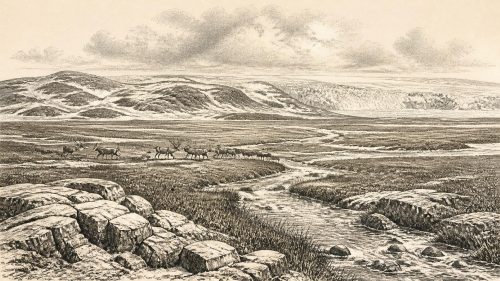
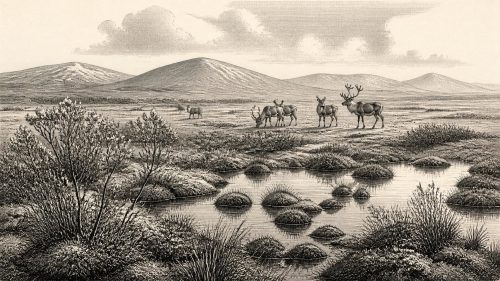
The Ireland of this period was not the green, wooded island familiar today. The best-supported reconstruction is of cold, largely open environments, with grassland, herb-rich steppe, tundra-like ground and patches of more sheltered vegetation varying with locality and climate. Rivers, exposed limestone, caves and rock shelters offered routes, cover and places where bones could accumulate; they do not, by themselves, demonstrate human residence. Much of the evidence has survived only because caves protected it from later erosion, while later excavation and disturbance have made interpretation difficult.
The Castlepook Archive
The most important Irish evidence close to this broad date comes from Castlepook Cave, also called Mammoth Cave or Doneraile Cave, near Doneraile in north County Cork. It is a limestone cave system whose antiquarian excavations, particularly those directed by Richard J. Ussher in the early twentieth century, recovered a remarkable concentration of Pleistocene animal remains. Only a small proportion of the huge original collection survives, and the methods of its recovery fall far short of modern excavation standards. Nevertheless, the surviving material, much of it curated in national collections, has made Castlepook Ireland’s richest known archive for vertebrate life before the Last Glacial Maximum.
Radiocarbon programmes have shown that Castlepook is not a single frozen moment. Its fauna spans a long interval, conventionally described as approximately 45,700 to 19,950 years BP, and parts of the cave were re-sorted by water, animals and earlier digging. A bone recovered beside another cannot automatically be treated as contemporary; nor can every species found in the cave be placed in 31,921 BCE. The site is valuable precisely because it reveals repeated use of a changing landscape over tens of millennia, but that longevity prevents it becoming a simple snapshot. Recent work has returned to the cave with survey, excavation and dating methods designed to locate undisturbed deposits and test older claims.
Animals in a Cold Mosaic
The Castlepook assemblage makes clear that Ireland supported a far richer large-mammal fauna before the ice sheet reached its greatest extent. Recorded remains include reindeer, brown bear, wolf, arctic fox, hare, lemming, giant deer, woolly mammoth and spotted hyaena. The latter is especially striking: Castlepook is the only Irish site known to have produced spotted-hyaena remains. Such animals belonged to food webs that included grazing and browsing herbivores, scavengers and formidable predators. Their presence is direct evidence that suitable habitats and prey existed at different points in the cave’s long record.
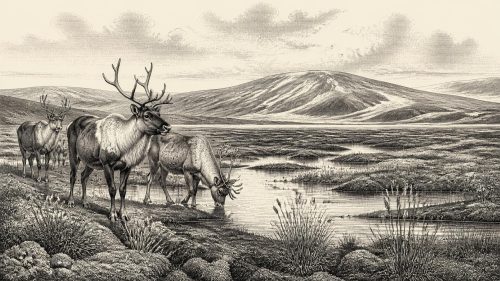
Reindeer are particularly appropriate to the period around this nominal year. A Castlepook reindeer specimen has been discussed as dating to about 33,000 years ago, close in broad terms to 31,921 BCE, while other dated Irish cave material confirms reindeer and brown bears in pre-maximum glacial environments. Yet chronology matters: an uncalibrated radiocarbon age, a calibrated calendar range and an informal phrase such as “33,000 years ago” are not interchangeable. Changes in laboratory pretreatment and calibration have prompted reassessment of several Irish Marine Isotope Stage 3 dates. The safest conclusion is that cold-adapted and open-country fauna reached Ireland during this phase, not that every famous Ice Age animal stood together at Castlepook in one year.
The Human Question
Human presence is possible but unproven at this depth of time. A reindeer bone from Castlepook has been reported as carrying marks consistent with cutting or chopping by a stone tool, and its proposed age has encouraged the suggestion that Upper Palaeolithic hunters reached Ireland around 33,000 years ago. If confirmed, it would move evidence of human activity on the island dramatically earlier. It would still show only an episode of animal processing, however: perhaps a brief visit by a mobile party, rather than a village, a permanent population or an ancestral nation.
The evidential threshold is high because the cave material lacks secure original context. There is no published, undisturbed Upper Palaeolithic hearth at Castlepook, no securely associated stone-tool assemblage, no dwelling floor, and no human burial from this period. Cork’s archaeological heritage assessment accordingly stresses the absence of unequivocal traces of human activity among the older Castlepook collection. The 2022 research excavation was important not because it settled the question, but because it sought the stratified deposits that could do so. Evidence of a butchered brown-bear patella at Alice and Gwendoline Cave, County Clare, is much firmer, but it dates vastly later, to about 12,810–12,590 calibrated BP. It cannot be used to populate Ireland nineteen millennia earlier.
For that reason, political affairs, warfare, diplomacy and institutions cannot responsibly be reconstructed for Ireland in 31,921 BCE. There is no evidence for chiefs, territories, tribal names, languages, sacred sites, alliances or conflicts. Nor is there evidence for agriculture, herding, crops, trade networks, boats, houses or settled communities. Absence of evidence is not proof that no person ever crossed the region, but it is decisive against invented narratives of an Irish Ice Age society. The island’s archaeological record supports animal movements and environmental change much more securely than human social history.
What Continental Comparisons Can—and Cannot—Do
Across north-west Europe, modern humans were established in the Upper Palaeolithic and developed sophisticated stone technologies, clothing, hunting practices, ornament traditions and artistic expression. Groups of this era were mobile and capable of exploiting seasonal resources in harsh climates. Such knowledge provides a context for the possibility of visitors to Ireland. It does not provide evidence that people at Castlepook made a particular tool type, wore particular garments, conducted rituals in the cave, or belonged to a named archaeological culture. Comparisons should explain the scale of what was possible, not fill Ireland’s evidential silence with borrowed continental detail.
Geography adds another caution. Lower global sea levels during the glacial period did not necessarily create an easy, dry walking route between Ireland and Britain. Research on the Irish Sea has challenged older, simple ideas of a lasting land bridge, while acknowledging that ice, water levels and coastlines changed repeatedly. Any human arrival near 34,000 calibrated BP would therefore have involved a route not yet demonstrated by direct archaeological evidence. It should not be casually imagined as a routine overland migration.
A Future Erased by Ice
The approaching glacial maximum gives the period its historical significance. As ice expanded after the interval represented by the older Castlepook fauna, it removed or buried landscapes on which animals—and any transient people—might have travelled. Later glaciers also eroded and redistributed deposits, helping to explain why the Irish Upper Palaeolithic record is so slight. This is a reason for caution, not a licence to assume a vanished population. Archaeology must distinguish between a plausible missing record and a demonstrated past.
Around the modern label 31,921 BCE, then, Ireland is best understood as a cold and changing land with a documented Pleistocene fauna and a tantalising but unresolved question of human contact. Castlepook Cave preserves the central clue: a deep archive of reindeer country, predators and large herbivores at the threshold of extensive glaciation. Its bones illuminate an Irish environment before later ice remade the island. They do not yet permit a year-by-year history of its people.
Primary Sources
- The Irish quaternary fauna project
- A reconsideration of the radiocarbon dating of the Marine Isotope Stage 3 fauna from southern Ireland
- Trimlines, blockfields and the vertical extent of the last ice sheet in southern Ireland
- Growth and retreat of the last British–Irish Ice Sheet, 31,000 to 15,000 years ago: the BRITICE‐CHRONO reconstruction
- Maximum extent and dynamic behaviour of the last British–Irish Ice Sheet west of Ireland
- First evidence of a Late Upper Palaeolithic human presence in Ireland
- New insights on the fauna of Ireland's Younger Dryas and Early Holocene from Alice & Gwendoline Cave
- The Archaeological Heritage of County Cork
- Castlepook Cave: County Geological Site Report
- Quaternary Site Descriptions
- 2022:564 – Castlepook Cave, Castlepook South, Cork
- Ancient hybridization and an Irish origin for the modern polar bear matriline
- The problem of a late quaternary landbridge between Britain and Ireland
- Deglaciation, Earth crustal behaviour and sea-level changes in the determination of insularity: A perspective from Ireland
- The Island of Ireland: Drowning the Myth of an Irish Land-Bridge?
- Biogeography of Ireland: Past, Present, and Future
- IAH Field Trip 2014
- Irish Caves Database: Mammoth Cave
- The extinction of the giant deer Megaloceros giganteus (Blumenbach): New radiocarbon evidence
- Investigating seasonal mobility in Irish giant deer Megaloceros giganteus (Blumenbach, 1799) through strontium isotope (87Sr/86Sr) analysis
- Anthropogenic changes to the Holocene nitrogen cycle in Ireland