
Doneraile Reindeer Country30139 BCE
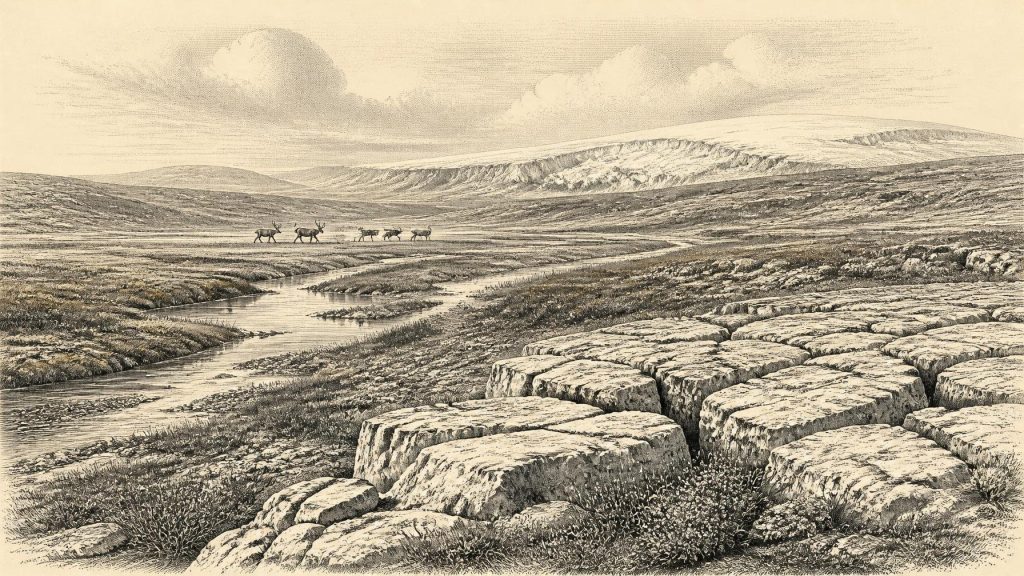
Around 30,139 BCE, Ireland was a climatically unstable Late Pleistocene landscape approaching extensive glaciation. Ice was advancing unevenly, while lower sea levels connected the island ecologically to wider north-west Europe. Castlepook Cave near Doneraile yielded reindeer, mammoth, giant deer, predators and cold-adapted smaller mammals, indicating open steppe-tundra habitats and complex food webs. A marked reindeer bone may indicate human butchery about 33,000 years ago, but poor excavation records and absent associated artefacts preclude claims of settlement. Any visitors were likely mobile foragers. Glaciation reshaped terrain and obscured earlier evidence, leaving uncertainty central to this period’s history and its interpretation today.
Dateline
“30,139 BCE” is a modern chronological label, not a date that anyone living in prehistoric Ireland could have known or recorded. It corresponds roughly to 32,000 years before AD 1950, but that conversion should not suggest calendar-year precision. For this depth of time, archaeologists and earth scientists work with calibrated ranges, radiocarbon determinations, luminescence dates, cave deposits, fossil assemblages and reconstructions of ancient ice. Those records rarely permit a statement about one particular year. They can, however, illuminate the changing world of Ireland around the opening stages of the final great expansion of the British–Irish Ice Sheet.
A Date on the Edge of Ice Growth
About 32,000 calibrated years ago, Ireland lay within the Late Pleistocene, during Marine Isotope Stage 3: a cold and climatically unstable part of the last glacial cycle. This was not yet the Last Glacial Maximum, conventionally placed at roughly 26,000–19,000 years ago, when ice covered virtually all of the island. Yet it was close to the transition into the large-scale ice growth that would remake Ireland’s terrain and erase or bury much older evidence.
The exact position of ice at this point remains debated. Some broad syntheses describe Ireland as becoming extensively glaciated after about 32,000 calibrated years ago. The BRITICE-CHRONO reconstruction, which integrates landforms, marine sediments, dating evidence and ice-sheet modelling, proposes that by around 31,000 years ago ice had advanced across northern and central Ireland, while separate ice caps occupied high ground in the south-west. Its reconstruction has Ireland almost entirely ice-covered by around 28,000 years ago. These are modelled time slices rather than a directly observed map of one day or year. They are especially useful for conveying direction and scale: ice was growing, joining up and increasingly controlling the country’s geography.
Other work points to still earlier glaciation during parts of the preceding cold stage. Optically stimulated luminescence dates from raised-beach deposits on the south coast, including the Courtmacsherry Formation, indicate complicated relations between sea level, crustal depression under ice and changing glacier margins during Marine Isotope Stages 4 and 3. Such evidence is important precisely because it prevents a simple story in which an entirely ice-free Ireland suddenly froze over. The island’s glaciers advanced and retreated across a long sequence of climatic shifts, while different regions could experience markedly different conditions.
An Uncertain Irish Landscape
For around 30,139 BCE, therefore, the most responsible picture is not of a settled island under a uniform white blanket, nor of a reliably open tundra from coast to coast. It is a landscape in transition. In some upland, northern and central areas, ice may already have been substantial or advancing. Elsewhere, especially where evidence is sparse, the precise balance between ice, bare ground, thin soils, seasonal snow, meltwater and cold-steppe vegetation cannot be fixed. Sea level was far lower than today because immense volumes of water were locked in continental ice sheets. Ireland was consequently part of a much broader north-west European land-and-sea landscape, though the exact routes across the Irish Sea basin changed with ice extent, exposed seabed and local water barriers.
The environment was harsh, but it was not lifeless. Fossil mammals from Ireland demonstrate that, during portions of the Late Pleistocene before the glacial maximum, the island supported a striking fauna. Castlepook Cave near Doneraile in north County Cork has produced remains of reindeer, woolly mammoth, giant deer, brown bear, wolf, spotted hyaena, mountain hare and lemmings. This is powerful evidence that Ireland was connected ecologically to the wider Pleistocene world of Britain and continental Europe. It does not prove that every species occupied the Blackwater valley simultaneously, or that each survived until the exact date represented by 30,139 BCE. Cave collections can combine material accumulated over many millennia, and animals, carnivores, water and excavation all affect how bones enter and remain in a deposit.
Nevertheless, the fauna allows a cautious environmental inference. Reindeer, lemmings and mountain hare are strongly associated with cold, open conditions; mammoth and giant deer point to productive grassland, herb-rich steppe or tundra mosaics rather than dense forest. Predators and scavengers such as hyaena and wolf imply food webs with large herbivores at their base. Limestone caves were likely used principally as dens, shelters and traps within animal territories, not as simple snapshots of an outdoor scene. The bones recovered inside them are evidence of ecological communities and processes, but cannot be treated as a census of one valley in one season.
Castlepook and the Human Question
The Castlepook material matters also because it has altered discussion of Ireland’s earliest possible human presence. A reindeer femur from the cave has been publicly identified as bearing a deep mark interpreted by zooarchaeologist Ruth Carden as damage made by a sharp stone tool during carcass processing. The specimen has been presented as approximately 33,000 years old, placing it broadly within the wider period under discussion. If that interpretation is sustained, it would indicate that Upper Palaeolithic people reached Ireland far earlier than the formerly accepted Late Glacial evidence.
But the distinction between possibility and certainty is essential. Castlepook was excavated largely in the early twentieth century, before modern standards of stratigraphic recording, sediment sampling and spatial analysis. Much of the cave assemblage is fragmentary, and its depositional history is complex. No securely associated stone-tool assemblage, hearth, dwelling floor, human burial or repeated occupation surface has yet been identified for a human group of this age in Ireland. A modification on one bone may be significant evidence for a brief visit or butchery episode; it is not evidence for a permanent population, a named people or a continuous settlement tradition.
Accordingly, there is no basis for describing political affairs, leaders, diplomacy, tribal territories or organised conflict in Ireland around this date. There is equally no direct evidence for a local religion, language, art tradition, formal learning, monuments or social hierarchy. These absences are not proof that fleeting visitors had no beliefs, skills or social bonds. They show that the Irish record has not preserved material that lets historians reconstruct such matters responsibly. The same restraint applies to culture: portable tools, ornaments, cave art and structured living spaces known elsewhere in Upper Palaeolithic Europe must not be projected automatically onto Ireland.
Mobility Rather Than Settlement
If people did enter Ireland in this phase, their economy would most plausibly have depended on mobility, hunting, scavenging and the skilled use of stone tools, as was common among Upper Palaeolithic communities elsewhere in north-west Europe. Reindeer would have offered meat, fat, hide, sinew, antler and bone; other large animals could have supplied similar resources. Yet this is a regional comparison, not direct evidence that a particular group hunted particular herds around Doneraile in 30,139 BCE. The Castlepook cave record does not currently demonstrate a camp, a hunting territory or a seasonal round.
Nor is there evidence of trade in the later prehistoric sense. Any people moving through the exposed western margins of Europe would have carried knowledge, tools and materials across wide distances, but no exchange network can be traced in Ireland for this date. The most meaningful connection was environmental. Lower sea levels and variable ice created a different geography, allowing animals—and potentially small groups of people—to move through landscapes now submerged or severed by sea. Those landscapes have since been drowned, glacially eroded or covered by later deposits, helping explain why the archaeological evidence is so scant.
“Settlement” should therefore be used with care. No houses, villages, field systems, graves or cultivated land belong to Ireland at this time. Farming lay tens of millennia in the future. There were no domestic crops, livestock or managed woodlands. If humans were present, they may have been occasional pioneers at the edge of their known world, travelling through a region whose ecological opportunities were rapidly narrowing as ice expanded. The stronger evidence concerns wild animals and climate, not a resident human community.
What This Period Left Behind
The major historical development around this date was environmental transformation. Ice did not merely make travel difficult: advancing glaciers quarried bedrock, moved vast quantities of sediment, diverted drainage and later left the tills, drumlins, eskers and meltwater channels that structure much of Ireland’s modern physical geography. Subsequent ice cover also destroyed, displaced or sealed many deposits that might once have recorded plants, animals and people. Ireland’s apparent archaeological silence is thus partly a product of preservation.
Later Irish history would unfold on ground profoundly shaped by this cold-stage inheritance. But around 30,139 BCE there was no Ireland of kingdoms, farms, monasteries or towns. There was an unstable Pleistocene borderland: a country of advancing ice, exposed rock, meltwater, open habitats and mobile fauna. Castlepook’s bones near Doneraile offer an unusually vivid, if imperfect, window onto that lost world. They support the existence of cold-adapted animal communities and raise a serious question about very early human visitation. They do not yet allow a year-by-year narrative of human society. That uncertainty is not a failure of history; it is the central fact of Ireland at this immense distance in time.
Primary Sources
- The colonization of Ireland: A human ecology perspective
- Growth and retreat of the last British–Irish Ice Sheet, 31,000 to 15,000 years ago: the BRITICE-CHRONO reconstruction
- The timing and magnitude of the British–Irish Ice Sheet between Marine Isotope Stages 5d and 2: implications for glacio-isostatic adjustment, high relative sea levels and ‘giant erratic’ emplacement
- Late Pleistocene chronostratigraphy and ice sheet limits, southern Ireland
- Radiocarbon constraints on the age of the maximum advance of the British–Irish Ice Sheet in the Celtic Sea
- Last Glacial Maximum cirque glaciation in Ireland and implications for reconstructions of the Irish Ice Sheet
- Pattern and timing of retreat of the last British-Irish Ice Sheet
- A Marine Isotope Stage 4 age for Pleistocene raised beach deposits near Fethard, southern Ireland
- Character of advance and retreat of the southwest sector of the British-Irish Ice Sheet during the last glaciation
- Ireland: Submerged Prehistoric Sites and Landscapes
- The Irish Quaternary Fauna Project
- Occurrence of mammalia relicts at site Castlepook Cave
- The exploration of Castlepook Cave, Co. Cork
- Heritage Artefacts of County Cork
- Prehistoric Details: Mell Flint Flake
- The Mesolithic in Ireland: when was it?
- New insights on the fauna of Ireland's Younger Dryas and Early Holocene from Alice & Gwendoline Cave
- First evidence of a Late Upper Palaeolithic human presence in Ireland
- Ireland Under The Ice
- Geology of Ireland
- BRITICE-CHRONO: Project Introduction
- Project findings provide essential insight into the last British–Irish ice sheet
- BRITICE-CHRONO: constraining the retreat of the last British-Irish Ice Sheet