Shandon Cave’s Bear Horizon31884 BCE
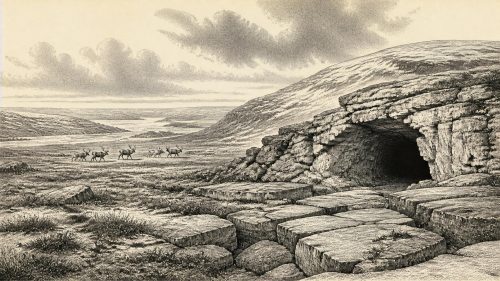
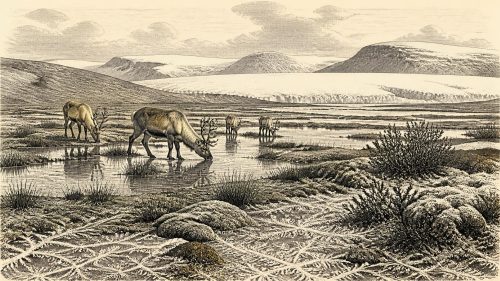
31,884 BCE is a modern, uncertain calendar conversion within Marine Isotope Stage 3, preceding the Last Glacial Maximum. Ireland experienced variable cold conditions, with shifting ice, periglacial terrain and habitable ice-free areas. Shandon Cave, County Waterford, contains a brown-bear bone whose calibrated range overlaps this period, demonstrating late-Pleistocene animal presence but not exact-year occupation. Cave finds from Shandon and Castlepook indicate intermittent access for mammals including reindeer, horse, mammoth, predators and bears across open, sparsely vegetated habitats. Possible cut marks on a Castlepook reindeer bone suggest, but cannot prove, a brief human visit. No evidence supports settlement or migration routes.

Dateline
31,884 BCE is not a date that can be isolated in the Irish archaeological record. It is a modern calendar conversion, roughly 33,834 years before AD 1950, rather than a year that any contemporary person could have named or recorded. For this deep period, radiocarbon measurements carry substantial uncertainty and must be calibrated; a single result commonly produces a range of possible calendar ages, not a pinpoint. The responsible subject is therefore Ireland in the later part of the Late Pleistocene, before the Last Glacial Maximum, rather than an invented event in one numbered year. The evidence is sparse, fragmented and concentrated in caves, sediments and the bones of animals rather than in settlements, graves, buildings or written testimony.
A Date Within a Longer Cold Age
At this point Ireland lay within Marine Isotope Stage 3, a long and climatically unstable interval of the last Ice Age. It was colder than the present, but it was not yet the moment when the last British–Irish Ice Sheet reached its fullest known extent. Major reconstructions place that maximum principally around 27,000–25,000 years before present in north-western sectors and about 25,000–23,000 years before present in the Irish Sea and Celtic Sea regions. Thus 31,884 BCE belongs to the preceding build-up: an age of pronounced cold shifts, expanding ice and exposed continental shelves, but not one in which a simple map can safely label all Ireland as either wholly frozen or wholly ice-free.
The older Irish terminology of the Midlandian glaciation remains useful as a broad label, but it can conceal important local variation. Ice sheets advanced and retreated over long spans; their margins, thickness and flow changed across the island and adjoining seas. Evidence from southern Ireland has revised older ideas that the last ice sheet stopped far to the north and east: research instead supports a more extensive Late Midlandian ice cover at its later maximum. That later conclusion must not be projected carelessly back onto 31,884 BCE. The safest picture is of a landscape approaching harsher glacial conditions, with ice, periglacial ground and habitable ice-free tracts varying by region and through time.
Shandon’s Dated Animal Evidence
The closest securely dated Irish evidence relevant to this calendar label comes from cave faunas. At Shandon Cave, County Waterford, a brown-bear bone produced an older radiocarbon determination of 32,430 ± 670 radiocarbon years before present, calibrated in published tabulations to approximately 37,146–33,635 calibrated years before present. Expressed as BCE, that broad range extends roughly from 35,196 to 31,685 BCE and therefore overlaps 31,884 BCE. This does not establish that a particular bear lived in that exact year. It does show that brown bear formed part of Ireland’s late-Pleistocene fauna during the interval in which this date falls.
Shandon is especially valuable because it reminds us that Ireland was not merely an empty expanse of ice in every phase of the last glacial cycle. The cave record, however, is not a census of a complete ecosystem. Animal remains may have entered caves through carnivore activity, water movement, collapse, natural deaths or human collection; nineteenth- and early twentieth-century excavations also removed much of the original stratigraphic context. Modern scholars consequently treat old cave collections as important but difficult archives, requiring direct redating and taphonomic reassessment rather than unquestioning repetition of inherited identifications. The material illuminates animal presence far more securely than it reconstructs a day-to-day landscape.
Animals, Open Ground and Seasonal Risk
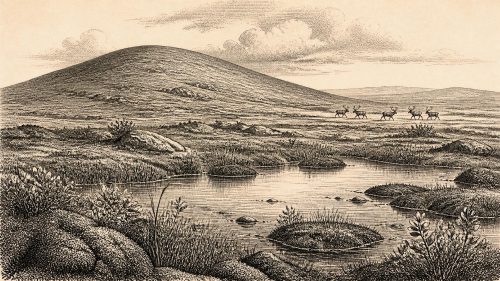
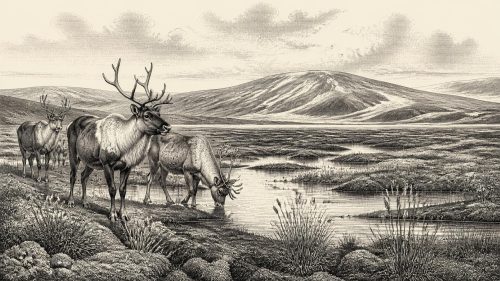
Other Irish cave assemblages demonstrate that sizeable mammals reached the island in the broad period between at least about 45,000 and 20,000 years ago. Castlepook Cave near Doneraile in north County Cork is the most famous of these deposits, yielding remains attributed to mammoth, reindeer, horse, brown bear, wolf and spotted hyaena, among other animals. Such a list should not be compressed into an imagined single herd grazing together in 31,884 BCE: individual bones have different ages, and the assemblage accumulated over a long period. Nevertheless, it supports the conclusion that episodes of open, cold-country habitat in Ireland could sustain, or at least be visited by, large herbivores and their predators.
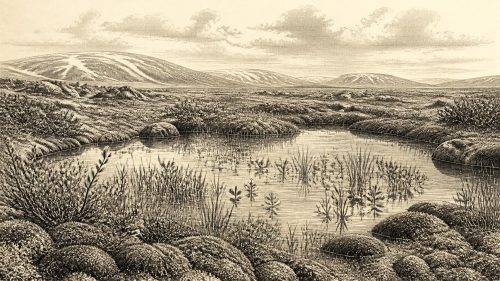
The likely vegetation was not the later familiar Ireland of broadleaf woodland, enclosed pasture and peat bog. In cold phases, exposed ground would have favoured low, sparse and locally variable plant cover: grasses, sedges, herbs, mosses and dwarf shrubs, with woodland greatly restricted or absent in the harshest districts. Older organic deposits at Derryvree, County Fermanagh, have been interpreted as recording a treeless muskeg environment in an earlier cold-phase framework. They do not date precisely to 31,884 BCE and must not be presented as a weather report for Shandon or Cork. They do, however, show why pollen, plant remains and insects are essential alongside animal bones when archaeologists attempt to understand Irish Ice Age environments.
For animals and any people moving through such country, seasonality would have been decisive. Winter forage, snow cover, wind exposure, frozen water and the shifting availability of shelter mattered more than later agricultural rhythms. Brown bears, reindeer and horses did not occupy identical ecological niches, while hyaenas and wolves could alter the survival prospects of carcasses and bone deposits. The presence of a species proves neither abundance nor a resident breeding population. It is better understood as evidence that a route into Ireland, and at least some suitable habitat, existed during particular windows of the Late Pleistocene.
The Human Question
There is no excavated house, hearth, stone-tool assemblage, human skeleton or cemetery from Ireland that can responsibly be assigned to 31,884 BCE. Accordingly, there is no basis for describing Irish political authority, diplomacy, tribes, warfare, religion, artistic traditions, formal learning, farming or trade in this year. Those are not missing chapters awaiting colourful reconstruction; they are subjects for which the evidence is presently absent. The National Museum of Ireland continues to state that no clear evidence has emerged for a Palaeolithic human presence in Ireland, a useful warning against converting possibility into certainty.
There is, however, a significant and unsettled clue from Castlepook. A reindeer femur from the cave has been interpreted as bearing a sharp stone-tool mark consistent with butchery, and a direct date on the bone falls broadly in the mid-to-late 30th millennium calibrated years before present. If the mark is human-made and contemporary with the animal’s death, it could indicate a brief Upper Palaeolithic visit to Ireland, perhaps to process a carcass. It would not demonstrate a village, a permanent population, a named people or continuous settlement. A bone’s radiocarbon age dates the animal, while identifying a surface mark as a human cut is a separate taphonomic judgement; the cave’s disturbed history makes that distinction especially important.
Island, Peninsula or Passage?
Lower global sea levels changed the outline of north-west Europe, exposing areas now beneath the Irish and Celtic Seas. Yet lowered water did not automatically make Ireland an uncomplicated walk from Britain or the Continent. Ice margins, meltwater, rivers, sea channels, coastal topography and the changing configuration of the British–Irish Ice Sheet all affected access. The archaeological evidence is too thin to identify a particular migration route around 31,884 BCE. What can be said is that the animal record indicates intermittent connectivity sufficient for large mammals, while the possible Castlepook butchery trace raises, but does not settle, the question of human movement across the same wider landscape.
The most important development around this notional year was therefore environmental rather than political: Ireland stood within a changing Ice Age world in which habitable ground and routes of access could be temporary. Shandon Cave’s bear and the wider cave fauna make that world tangible, while their limitations impose discipline. Ireland around 31,884 BCE may have supported mobile animals across cold open terrain and may conceivably have received short human incursions. It has not yet yielded evidence for a settled society. The historical task is to preserve that difference between what the bones demonstrate, what the landscapes suggest and what remains unknown.
Primary Sources
- The Irish Quaternary Fauna Project
- New Insights on the Fauna of Ireland's Younger Dryas and Early Holocene from Alice & Gwendoline Cave
- Prehistoric Details
- Archaeological Heritage of County Cork
- 32564: Castlepook Cave, Castlepook, Doneraile, Cork
- UCD School of Archaeology Research Day 2022
- Growth and Retreat of the Last British–Irish Ice Sheet, 31,000 to 15,000 Years Ago: the BRITICE-CHRONO Reconstruction
- Maximum Extent and Dynamic Behaviour of the Last British–Irish Ice Sheet West of Ireland
- Stratigraphic and Palaeo-Geomorphological Evidence for the Glacial-Deglacial History of the Last British-Irish Ice Sheet in the North-Western Irish Sea
- New Age Constraints for the Maximum Extent of the Last British-Irish Ice Sheet (NW Sector)
- Pattern and Timing of Retreat of the Last British-Irish Ice Sheet
- Trimlines, Blockfields and the Vertical Extent of the Last Ice Sheet in Southern Ireland
- Late Pleistocene Chronostratigraphy and Ice Sheet Limits, Southern Ireland
- The Deglaciation of the Western Sector of the Irish Ice Sheet from the Inner Continental Shelf to its Terrestrial Margin
- New Data for the Last Glacial Maximum in Great Britain and Ireland
- The IntCal20 Northern Hemisphere Radiocarbon Age Calibration Curve (0–55 cal kBP)
- Figure 6.— The Subdivision of the Quaternary Period in Ireland
- Soils of Co. Waterford
- Irish Cave Exploration
- Archaeological Excavations at Killuragh Cave, Co. Limerick