Doneraile’s Reindeer Incision31740 BCE
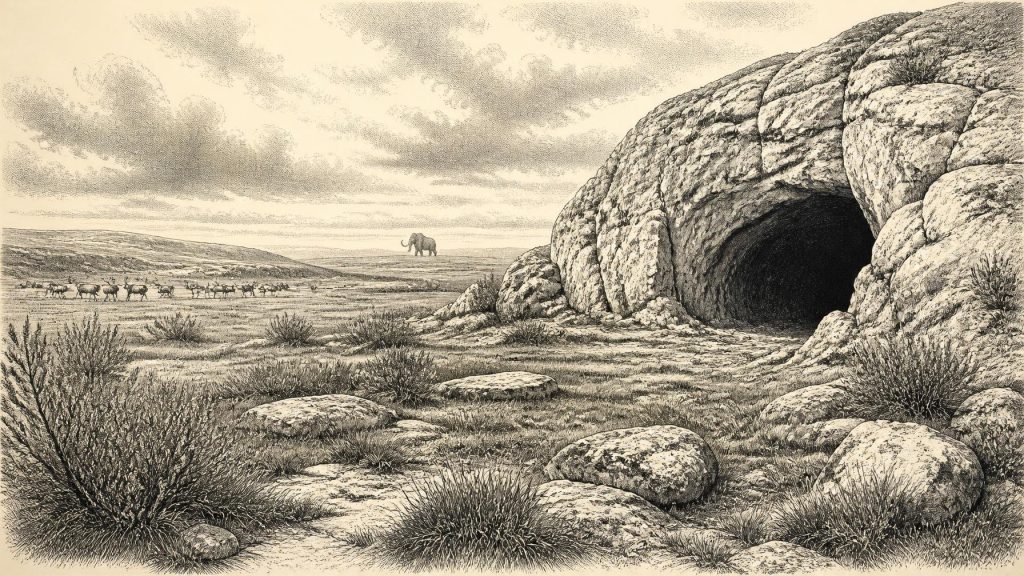
At approximately 31,740 BCE, Ireland lay within the fluctuating cold conditions of Marine Isotope Stage 3, before the last British–Irish Ice Sheet reached its greatest extent. Castlepook Cave near Doneraile preserves remains of mammoth, reindeer, giant deer, hyaena, lemmings and other fauna, indicating open, largely treeless habitats. An incised reindeer femur may record processing with a stone tool and therefore a Upper Palaeolithic human visit. However, old excavation context and absence of associated tools or settlement prevent certainty. The evidence neither proves permanent occupation nor later ancestry. Ice and seas obscured traces; later human activity is confirmed in County Clare.
Dateline
The label 31,740 BCE is a modern chronological convenience, not a date that anybody living in Ice Age Ireland could have known or marked. Archaeology cannot distinguish one particular year at such depth in time. In calendar arithmetic it falls roughly 33,700 years before AD 1950, the conventional reference point for “BP” (“before present”), but the evidence is dated in broad radiocarbon and calibrated ranges, not to a single season or generation. The responsible subject, therefore, is Ireland during the later part of Marine Isotope Stage 3, a highly variable interval within the last Ice Age.
There is no historical record, no named people, no political community and no securely dated dwelling from Ireland for this point in time. What survives is more fragmentary but still consequential: cave bones, cave sediments, traces of ancient vegetation, glacial landforms and the changing outline of the land itself. Together they show that the island’s deep past was not simply a blank prelude to later settlement. Parts of Ireland supported cold-climate animal communities before the fullest expansion of the last British–Irish Ice Sheet, and one object from north Cork raises the important, still unsettled possibility of very early human visits.
A Date Within Moving Ice
At about 33.7 thousand calendar years BP, Ireland lay in the Late Pleistocene and within Marine Isotope Stage 3, conventionally a span of roughly 57,000 to 29,000 years ago. This was not a single unchanging “Ice Age climate”. North Atlantic temperatures, sea ice, precipitation and glacier extent altered repeatedly across centuries and millennia. Any reconstruction of conditions in Ireland must therefore avoid picturing a uniform frozen island.
The greatest expansion of the last British–Irish Ice Sheet came later. Modern reconstructions show a rapidly growing and geographically uneven ice sheet between about 31,000 and 28,000 years BP, with much of Ireland eventually buried beneath ice during Marine Isotope Stage 2. Around the target date, the exact margin in every Irish region remains uncertain. It is more secure to say that southern cave evidence demonstrates that some land, at least at intervals before the main glacial maximum, was available to animals. Ice was an advancing and retreating regional force, not an on-off condition imposed identically across the whole island.
Sea level was substantially lower than today because water was held in continental ice sheets. The present coastline did not exist. Wider coastal plains and exposed shelves changed the relationship between Ireland, Britain and the continental landmass, though they did not automatically provide a simple, permanent walking route everywhere. Rivers ran across landscapes now drowned; shorelines shifted; and glacial advances could repeatedly obstruct or remake possible routes. For animals, and perhaps for people, access was an ecological and geographical opportunity that opened and closed rather than a permanent bridge.
Castlepook’s Cold-Climate Fauna
The most revealing Irish archive is Castlepook Cave, also known as Mammoth Cave, near Doneraile in north County Cork. Excavated principally in the early twentieth century, its complicated limestone passages yielded a notable collection of Pleistocene animal remains. Later dating and reassessment have been essential because the old excavations did not preserve the stratigraphic precision expected today, and cave deposits can be disturbed, mixed or redeposited.
Even with that caution, the faunal evidence is substantial. Castlepook has produced remains attributed to woolly mammoth, reindeer, giant deer, spotted hyaena, brown bear, wolf, fox, mountain hare and both Arctic and Norway lemmings. Not every species need have lived together at the same moment, and not every bone belongs to the same episode. Yet the assemblage establishes a cold-adapted, open-country world in southern Ireland during the Middle Devensian, another name often used for this part of the last glacial cycle.
Reindeer and lemmings point towards treeless or sparsely wooded landscapes with grass, herbs, sedges and low shrubs rather than the familiar wooded Ireland of later millennia. Mammoth and giant deer suggest grazing and browsing opportunities across open terrain. Carnivores, especially spotted hyaena, remind us that caves were not quiet shelters by default: they could be dens, scavenging places and traps in which animal remains accumulated through many different processes. The cave fauna provides evidence of an ecosystem, not a simple menu left by hunters.
Other Irish deposits help place this animal world in a wider environmental setting. Organic silts preserved beneath later glacial deposits at Derryvree and nearby sites in Fermanagh contain pollen, plant macrofossils and insect evidence associated with cold, largely treeless wetland conditions. These records belong to differing parts of the Pleistocene and cannot be assigned directly to 31,740 BCE. Their value is comparative: they show that Irish landscapes between glacial advances could include sedge-rich pools, mossy ground, shallow water and shrub tundra, habitats capable of sustaining specialised plants and animals.
The Single Incision
Castlepook’s importance to Irish human history rests especially on a reindeer femur. A deep mark on the bone has been interpreted by zooarchaeologist Ruth Carden as a fresh-bone cut or chop made by a sharp stone implement during carcass processing. Public heritage interpretation has associated the specimen with an age around 31,000 BCE; radiocarbon reassessment of the wider Castlepook fauna has also demonstrated that several animal remains are much older than early dating programmes had indicated.
This is potentially remarkable evidence, but “potentially” matters. A cut-marked bone is not the same as a settlement. No securely associated stone-tool assemblage, hearth, house floor, human skeleton, burial or repeated occupation surface of comparable age has yet been recovered in Ireland. The femur was also found in an old cave collection rather than in a recently excavated, sealed deposit. Its significance lies in the character of the incision and in the direct dating of the animal bone, while its limitation lies in context. Continued excavation, micromorphology, faunal analysis and improved dating are intended to test what survives in situ.
If the mark is confirmed as human-made and contemporary with the animal’s death, the most cautious interpretation is a brief Upper Palaeolithic presence, perhaps the butchery of a reindeer by a very small travelling party. It would not demonstrate a permanent population, an Irish cultural tradition or uninterrupted ancestry leading to later inhabitants. People could have arrived, used a carcass or cave vicinity briefly, and disappeared from an archaeological record later heavily damaged by ice, erosion, rising seas and antiquarian excavation.
Comparison with north-western Europe makes such a visit plausible but cannot prove it. Upper Palaeolithic groups elsewhere used stone tools, exploited large mammals and moved through severe but resource-bearing environments. Ireland’s evidence, however, must stand on its own. A practice documented in Britain or continental Europe cannot be transferred automatically across the Irish Sea. The Castlepook femur is valuable precisely because it may provide an Irish trace, while also showing how much remains unknown.
Life Beyond the Evidence
There is no basis for describing political affairs, diplomacy, warfare, tribal territories, chiefs, laws or alliances in Ireland at this date. There are no names, monuments, weapons caches or settlement distributions from which to infer them. Nor is there evidence for farming, herding, cereal cultivation, pottery, metalworking, formal trade routes or exchange institutions. These belong to much later chapters of Irish prehistory.
Religion, learning and artistic culture are equally beyond direct recovery here. Ireland has no securely dated cave art, engraved object, ceremonial structure or human burial from around 33,700 calendar years BP. It would be reasonable in a general human sense to suppose that people capable of travelling, hunting and sharing practical knowledge had social lives and systems of meaning; it would not be responsible to label those systems Irish religion, identify rituals, or connect them to later Gaelic traditions. Silence in the record is not proof that thought or culture were absent. It is proof that specific claims cannot yet be supported.
Everyday life can only be approached conditionally. A party responsible for processing a reindeer would have needed cooperation, cutting technology, knowledge of animal movement and ways to keep warm and mobile in an exposed climate. Reindeer could provide meat, fat, hide, sinew and bone, but none of those uses is securely demonstrated in Ireland by this one specimen. The strongest conclusion remains narrow: the bone may preserve a moment of animal processing, not a complete picture of domestic life.
An Island Before Settlement
The essential development around this modernly numbered year is environmental possibility under pressure. Southern Ireland could, during favourable intervals, sustain an open cold-climate fauna. Castlepook records that fauna with unusual richness, while its reindeer femur offers a disputed but serious challenge to the older assumption that humans first reached Ireland only after the last great ice retreat. Subsequent growth of the ice sheet would profoundly reduce the chances of survival for landscapes, camps and bone deposits alike.
Later, better-dated evidence confirms human activity at Alice and Gwendoline Cave in County Clare between about 12,810 and 12,590 calibrated BP, based on a butchered brown-bear patella. That much later result should not be conflated with Castlepook, but it demonstrates why cave collections and fresh fieldwork matter. Ireland’s earliest human story is not settled by a single dramatic claim. It is being rebuilt slowly from carefully dated material, with uncertainty stated openly. For 31,740 BCE, Doneraile’s marked reindeer bone remains the most evocative clue: slight, contested and historically important.
Primary Sources
- A Reconsideration of the Radiocarbon Dating of the Marine Isotope Stage 3 Fauna from Southern Ireland
- Growth and Retreat of the Last British–Irish Ice Sheet, 31,000 to 15,000 Years Ago: The BRITICE-CHRONO Reconstruction
- Maximum Extent and Dynamic Behaviour of the Last British–Irish Ice Sheet West of Ireland
- First Evidence of a Late Upper Palaeolithic Human Presence in Ireland
- New Insights on the Fauna of Ireland's Younger Dryas and Early Holocene from Alice & Gwendoline Cave
- The IntCal20 Northern Hemisphere Radiocarbon Age Calibration Curve (0–55 cal kBP)
- IntCal Publications
- The Irish Quaternary Fauna Project
- Occurrence of Mammalia Relicts at Site Castlepook Cave
- 2022:564 – Castlepook Cave, Castlepook South, Cork
- Archaeology Research Excavation Grant 2022: Castlepook Cave Final Report
- Heritage Artefacts of County Cork
- Ireland Through Geological Time
- Quaternary Geology of Ireland
- GeoConnect3d
- Origin of British and Irish Mammals: Disparate Post-Glacial Colonisation and Species Introductions
- Phylogeographic, Ancient DNA, Fossil and Morphometric Analyses Reveal Ancient and Modern Introductions of a Large Mammal: The Complex Case of Red Deer (Cervus elaphus) in Ireland
- Pattern and Timing of Retreat of the Last British–Irish Ice Sheet
- Pattern and Timing of Retreat of the Last British-Irish Ice Sheet
- Studies on the Early Settlement of Scotland and Ireland
- Pleistocene Vertebrates in the British Isles
- Figure 6.— The Subdivision of the Quaternary Period in Ireland