Reindeer Beyond Doneraile31778 BCE
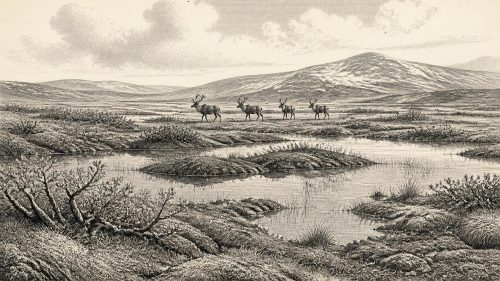
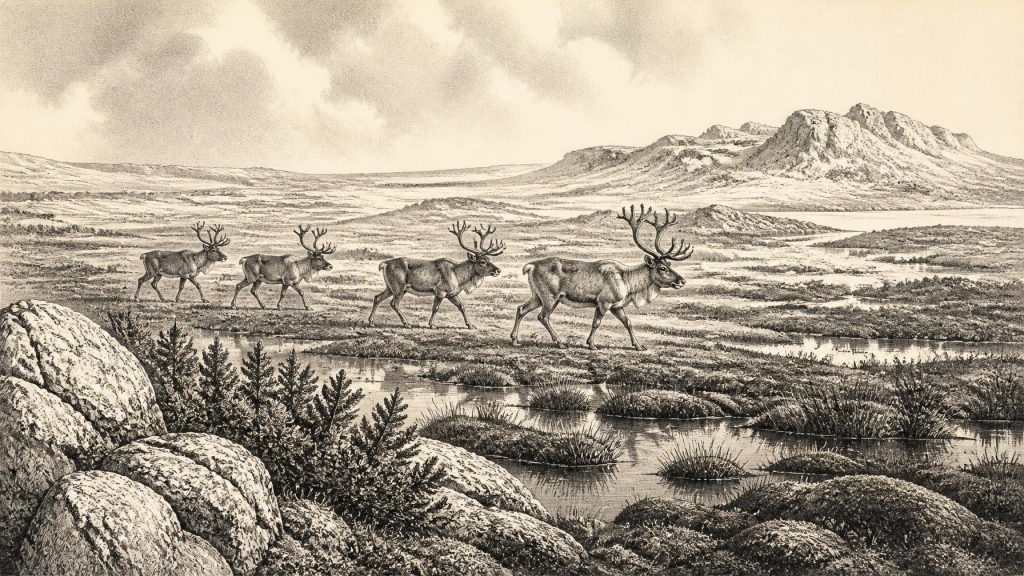
Around 31,778 BCE, Ireland lay within the climatically unstable later Marine Isotope Stage 3, before the Last Glacial Maximum. Lower seas altered coastlines and potential routes. Evidence from Derryvree indicates ice-free areas could support wet, treeless tundra vegetation during milder intervals. Castlepook Cave near Doneraile preserves a disturbed but important Ice Age fauna, including mammoth, giant deer, reindeer, hyaena and bear. A reindeer femur reportedly bears a stone-tool butchery mark and may represent Ireland’s earliest human evidence. However, its poor context and uncertain interpretation preclude claims for permanent settlement, communities, routes or institutions. It therefore documents only tentative human presence.
Dateline
The label 31,778 BCE is a modern plotting device, not a date that anybody in prehistoric Ireland could have known, recorded or attached to an event. It corresponds approximately to 33,700 years before the conventional radiocarbon “present” of 1950, but that conversion must not imply calendar-year precision. For this depth of time, archaeologists work with calibrated ranges, stratigraphic relationships and broad climatic stages. Ireland at this horizon belongs to the later part of Marine Isotope Stage 3 (MIS 3), a long and highly variable cold phase of the last Ice Age. The responsible subject is therefore not an invented annual occurrence, but the changing landscape, animals and exceptionally slight possible evidence of people in Ireland around 34,000–33,000 calibrated years ago.
A Cold Stage, Not a Single Winter
This was well before the Last Glacial Maximum, the period when the British–Irish Ice Sheet reached its greatest overall extent. A widely used chronological model places the main build-up of that ice sheet after roughly 35,000–32,000 years ago, with its maximum much later, broadly 27,000–21,000 years ago. Yet the approach to maximum glaciation was neither smooth nor simultaneous around every Irish coast and upland. Ice masses advanced and retreated, climates swung abruptly, and the extent of ice-free ground remains a research question in several regions. It is unsafe, therefore, to imagine all Ireland as either a continuous white ice cap or an unbroken habitable plain at 31,778 BCE.
Even the word “Ireland” needs qualification. Lower global sea levels exposed far more of the continental shelf than survives above water today, altering shorelines and possible routes between the Irish landmass, Britain and north-western Europe. But no simple map can demonstrate a dependable route in one named year. Coasts, ice margins, rivers and seasonal terrain changed over long spans; any human movement would have depended on conditions then prevailing, not on the familiar geography of a modern island.
The wider setting was one of repeated climatic instability. Evidence from Crag Cave in south-west Ireland shows that stalagmites formed episodically through MIS 3. Because calcite growth in this shallow cave required liquid water and conditions generally above freezing, these deposits provide independent evidence for milder intervals amid the cold stage. They do not prove that every part of Ireland was mild at the same time, nor do they identify a particular season in 31,778 BCE. They do, however, caution against treating Ice Age Ireland as climatically uniform or permanently frozen.
Wet Tundra at Derryvree
The clearest Irish environmental archive relevant to this broad period lies far from Cork, at Derryvree near Maguiresbridge in County Fermanagh. Roadworks there exposed freshwater silts and fine sands trapped between two tills: in effect, a living interval preserved between episodes of glaciation. The organic deposits produced a radiocarbon determination of 30,500 years BP, with a large uncertainty; later calibration places the deposit broadly around 37,000–34,800 calibrated years BP. That range is older than the nominal year in this article, but it is close enough in the same cold-stage world to illuminate the kind of terrain that could occur during this unstable era.
The Derryvree evidence is emphatically not evidence for forest. Pollen, plant remains and insects indicate open, treeless vegetation: grasses, sedges, herbs, mosses and low shrubs, including juniper, around freshwater pools and waterlogged ground. The older literature described it as tundra or muskeg, meaning a wet, moss-rich landscape with open water and abundant decaying plant matter. Winters were severe and frost action important, but the deposits also show that shallow water, insects and vegetation persisted during productive seasons. This was a hard landscape, not a lifeless one.
Such evidence supports a careful reconstruction of everyday ecology rather than a picturesque certainty. In summer, sedge beds, stream edges and damp hollows could have concentrated forage for herbivores and prey for carnivores. In winter, snow, frozen soils, exposure and limited daylight would have constrained movement. The precise appearance of north Cork in 31,778 BCE cannot be lifted wholesale from Fermanagh, hundreds of kilometres away and represented by an older deposit. Nevertheless, Derryvree demonstrates that Ireland could contain ice-free, periglacial wetland environments during the broader Middle Midlandian cold phase.
Castlepook’s Animal Archive
The most important southern Irish archive is Castlepook Cave, near Doneraile in County Cork. Formed in Carboniferous limestone, its narrow galleries and chambers accumulated more than 2,000 animal bones during a long stretch of the later Ice Age. The cave was not a neatly sealed time capsule: water disturbance, carnivore activity and early excavations complicate the original relationships between specimens. Nonetheless, it is Ireland’s richest known vertebrate site for the period leading up to the Last Glacial Maximum. Individual bones from its collections have produced dates ranging from roughly 45,700 to 19,950 radiocarbon years BP.
The animal list evokes an Ireland very different from the later wooded island. Castlepook has yielded woolly mammoth, giant deer (Megaloceros giganteus), reindeer, brown bear and spotted hyaena, with wolf, Arctic fox, mountain hare and lemmings also represented in relevant cold-stage material. These finds establish that large grazing and browsing mammals, predators and scavengers reached Ireland during parts of the Ice Age. They do not show that every species lived together at precisely the same moment, in one herd or beneath one cave roof. Nor should the traditional phrase “Irish elk” mislead: giant deer was a widespread Eurasian animal, not a species unique to Ireland.
A cave is especially difficult evidence to translate into a landscape scene. Carnivores may drag in limbs and skulls; animals can die in fissures; water can move bones; and excavators working a century ago did not have modern recording methods. Castlepook’s hyaena remains make a carnivore-den function particularly plausible for some deposits. A reindeer femur in a cave consequently does not demonstrate that reindeer were killed there, still less that people camped there. The cave preserves a valuable faunal archive, but its contents must be interpreted bone by bone and layer by layer.
The Marked Reindeer Bone
One specimen has made the period around this article’s nominal date unusually important. A reindeer femur from Castlepook has been reported by County Cork heritage material as bearing a deep mark interpreted by zooarchaeologist Ruth Carden as having been made with a sharp stone tool during butchery. The same publication dates the bone broadly to about 31,000 BCE; public accounts commonly describe it as about 33,000 years old. If the mark is correctly identified as a human cut or chop, and if its relationship to the bone is secure, it may be Ireland’s earliest known evidence of human activity by many millennia.
That “if” is indispensable. The bone derives from an old cave collection, rather than a modern excavation of an intact occupation floor. No securely associated hearth, stone-tool assemblage, dwelling, human burial or repeated living surface of this age has been published from Castlepook. The radiocarbon age dates the animal’s death, not automatically the making of the mark, the place of carcass processing or the duration of a possible human visit. Re-dating work has also demonstrated that some earlier Irish cave dates were substantially too young because of limitations in past bone-treatment methods. This is precisely why a potentially transformative find requires continuing taphonomic and archaeological scrutiny.
The strongest responsible conclusion is modest but significant: people may have reached and processed an animal in Ireland during MIS 3, perhaps as mobile Upper Palaeolithic hunters moving through a wider north-west European world. The evidence does not establish a permanent population, a named community, a migration route, or continuous occupation of the island. It cannot tell us how many people were present, whether they arrived once or repeatedly, or whether they survived locally through the worsening climate that followed.
No Kingdoms, No Recorded Wars
There were no known Irish kingdoms, chiefs, tribal names, laws, diplomatic agreements or political institutions at this horizon. There is likewise no evidence for organised warfare. Predation and competition for food or shelter were realities of Ice Age ecology, but a hyaena bone, a mammoth remain or a potentially cut-marked reindeer femur cannot be inflated into a story of raiding parties, territorial states or alliances. Political history begins here only with an honest acknowledgement that it cannot yet be recovered.
Religion, culture and learning demand the same restraint. Upper Palaeolithic people elsewhere in Europe made sophisticated stone and bone tools, ornaments, images and ritual objects. That wider comparison makes it reasonable to suppose that any people who entered Ireland possessed skills, social knowledge and symbolic lives. It does not licence the attribution of a particular art style, language, ceremony or belief to Ireland. No Irish cave art, figurine, engraved object, sanctuary or burial has been securely dated to around 31,778 BCE.
Nor is there evidence for an Irish economy in the later historical sense: no farming, livestock, fields, metalwork, markets or trade networks can be demonstrated. If the Castlepook mark proves human butchery, reindeer could have offered meat, fat, hide, sinew, marrow and bone. That is an inference from the animal and from known hunter-gatherer practices, not a documented Irish economic system. The same caution applies to settlement: a brief hunting visit, a seasonal passage or an isolated episode are possible; a village is not.
What This Date Can Bear
Around the modern date called 31,778 BCE, Ireland was part of a colder, more open and less geographically familiar north-west European world. Glacial advance was becoming increasingly consequential, while ice-free wetlands and grass-herb tundra existed at least in some intervals and regions. Mammoths, reindeer, giant deer, hyaenas and other animals are securely part of the country’s broader MIS 3 record. The possibility that people also briefly entered this landscape rests largely on one remarkable but contextually difficult reindeer bone from Castlepook.
That uncertainty is not a deficiency to be filled with fiction. It is the historical fact of the period. Every recalibrated date, re-examined bone and undisturbed cave deposit has the potential to alter the picture. For now, the evidence permits an Ireland of cold wetlands, shifting ice margins and mobile Ice Age animals; it permits a carefully qualified possibility of Palaeolithic hunters near Doneraile; and it requires silence about the events, leaders and institutions that later historical writing normally expects.
Primary Sources
- A reconsideration of the radiocarbon dating of the Marine Isotope Stage 3 fauna from southern Ireland
- The Irish Quaternary Fauna Project
- Castlepook Cave, County Geological Site Report
- Heritage Artefacts of County Cork
- Spotted Hyena Skull
- The timing and magnitude of the British–Irish Ice Sheet between Marine Isotope Stages 5d and 2: implications for glacio-isostatic adjustment, high relative sea levels and ‘giant erratic’ emplacement
- Extent and timing of the Last Glacial Maximum (LGM) in Britain and Ireland: a review
- Growth and retreat of the last British–Irish Ice Sheet, 31,000 to 15,000 years ago: the BRITICE-CHRONO reconstruction
- Stratigraphic and palaeo-geomorphological evidence for the glacial-deglacial history of the last British-Irish Ice Sheet in the north-western Irish Sea
- Using novel methods to track British and Irish Ice Sheet dynamics since the Late Pleistocene, along the west Porcupine Bank, NE Atlantic
- A Middle Midlandian Freshwater Series at Derryvree, Maguiresbridge, County Fermanagh, Northern Ireland
- Early Midlandian–Middle Midlandian, Pleistocene, Northern Ireland
- Figure 6.— The subdivision of the Quaternary Period in Ireland
- Irish Pleistocene biostratigraphy
- Episodic speleothem deposition tracks the terrestrial impact of millennial-scale last glacial climate variability in SW Ireland
- Episodic speleothem deposition tracks the terrestrial impact of millennial-scale last glacial climate variability in SW Ireland
- The IntCal20 Northern Hemisphere Radiocarbon Age Calibration Curve (0–55 cal kBP)
- New insights on the fauna of Ireland's Younger Dryas and Early Holocene from Alice & Gwendoline Cave
- Trimlines, blockfields and the vertical extent of the last ice sheet in southern Ireland
- Dimensions and chronology of the last ice sheet in western Ireland