
Crag Cave’s Thawing Calcite31756 BCE
Around 31,756 BCE, Ireland formed an unstable Ice Age frontier during Marine Isotope Stage 3, rather than a precisely datable historical setting. Derryvree sediments in Fermanagh record wet, largely treeless tundra between glacial advances. Castlepook Cave in Cork contains mixed remains of mammoth, reindeer, giant deer and predators, demonstrating a cold-climate fauna over millennia. A marked reindeer bone may indicate brief human butchery, but proves neither settlement nor sustained occupation. Crag Cave calcite shows intermittent thaws, linked to North Atlantic climate shifts. As conditions deteriorated, advancing ice later reshaped landscapes and destroyed, buried or disturbed much earlier evidence of prehistory.
Dateline
31,756 BCE is best treated not as a date at which an Irish event can be assigned, but as a modern calendar marker for a far broader prehistoric interval. It falls roughly 33,700 years before AD 1950, the conventional ‘present’ used in radiocarbon reporting. No evidence permits calendar-year precision for Ireland at this depth of time, and there is no named community, ruler, battle, settlement or ceremony to place in this particular year. What can responsibly be described is Ireland during the later part of Marine Isotope Stage 3 (MIS 3), within the Upper Palaeolithic world of north-west Europe: a climatically unstable Ice Age landscape, intermittently capable of supporting animals and perhaps occasional people, but moving towards much more extensive glaciation.
Dating a Moving Landscape
The distinction between calendar years and archaeological dates is especially important here. Radiocarbon determinations are reported in years before present (BP), where ‘present’ means AD 1950, but atmospheric radiocarbon levels changed through time. A radiocarbon age must therefore be calibrated against an internationally maintained curve, and at c. 30,000–35,000 radiocarbon years BP the resulting calendar ranges may be broad and sometimes irregular. A numbered BCE year can be useful for arranging an annual archive, but it must not suggest the false precision of a diary entry.
Irish evidence relevant to this horizon comes chiefly from deposits rather than conventional archaeological sites: cave bone assemblages in southern Ireland, freshwater sediments buried beneath later glacial deposits in Fermanagh, and mineral deposits in caves. These sources do not all date to one moment. They record episodes spread across millennia, and some were disturbed by water, animals, excavation or later geological processes. Their value lies in combination. They demonstrate that parts of Ireland supported a cold-climate fauna before the Last Glacial Maximum, while also showing how incomplete the surviving record is.
In Irish Quaternary terminology, this phase has often been associated with the Middle Midlandian and the Derryvree Cold Phase. Such regional labels are useful shorthand, but they should not be mistaken for neatly bounded historical periods. The growth of the last Irish Ice Sheet was uneven, as were local temperatures, vegetation and the availability of ice-free ground. Later ice also eroded or buried much of the evidence needed to reconstruct the preceding landscape.
Open Ground at Derryvree
The clearest environmental window is Derryvree near Maguiresbridge, County Fermanagh. Roadworks in 1969 exposed silts and fine sands lying between two substantial tills in a drumlin. The deposits produced a radiocarbon determination of 30,500 years BP, with a sizeable uncertainty, and contained plant and animal remains. The crucial evidence is geological: a freshwater environment existed between episodes of glaciation, and its sediments were subsequently sealed beneath later ice-laid material.
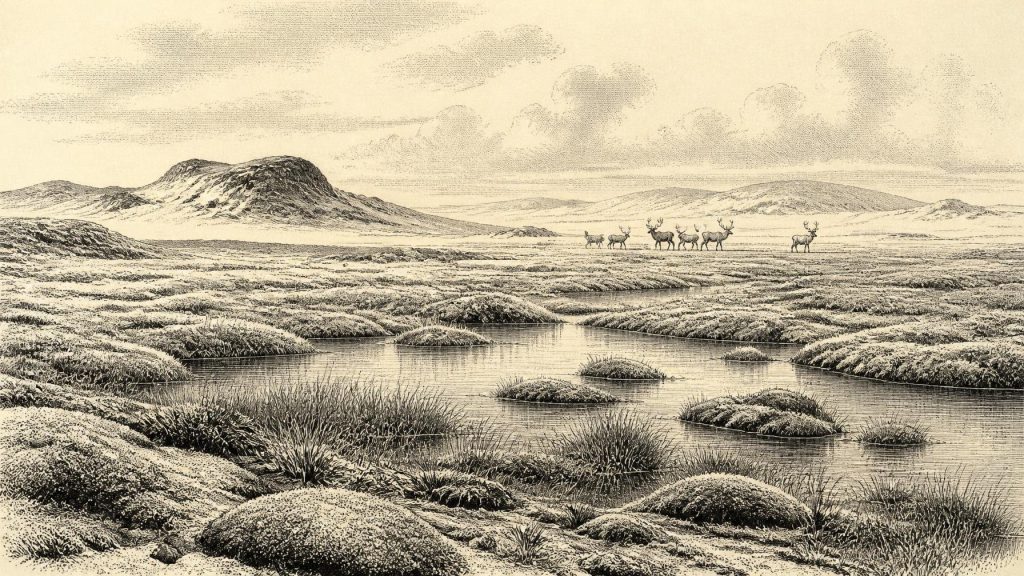
The fossil assemblage indicates open tundra vegetation and a periglacial climate. Mosses, sedges and other herbaceous plants speak of wet ground, pools and a short growing season rather than the familiar oak-and-hazel woodland of later prehistoric Ireland. Some pollen was poorly preserved, and a handful of tree pollen grains cannot establish local forest; they may have travelled far or been redeposited. The responsible reconstruction is therefore a largely treeless mosaic of damp hollows, sparse dry-ground vegetation and frost-affected terrain. It was not a uniform frozen desert. Water, plants and animals persisted, but in a landscape highly exposed to seasonal cold and climatic fluctuation.
Derryvree offers no evidence for a settlement. There are no houses, hearths, tools, graves or food refuse attributable to people. It instead preserves the conditions that would have shaped any human visit: difficult movement over wet and frozen ground, limited shelter, seasonal resources and an environment in which mobility mattered more than permanent residence.
Castlepook’s Faunal Record
At Castlepook Cave near Doneraile in north County Cork, formerly known as Mammoth Cave, antiquarian and twentieth-century excavations recovered a striking collection of Pleistocene bones. Species represented in the wider assemblage include woolly mammoth, reindeer, giant deer, brown bear, spotted hyaena, wolf, Arctic fox, hare and lemmings. Not every animal lived there together. Modern radiocarbon work has shown that bones from different chambers and deposits accumulated across a long span, while water action and earlier digging mixed material in places.
That complication is not a reason to discard the cave. It is precisely why the site is informative when read cautiously. Accelerator mass spectrometry dating has placed several Castlepook animals in the broad MIS 3 interval. A reindeer metacarpal, for example, returned 35,200 ± 950 radiocarbon years BP in the earlier Irish Quaternary Fauna Project, while mammoth, brown bear and giant-deer remains produced other pre-Last Glacial Maximum ages. Subsequent redating has revised some legacy results substantially older, underlining how advances in bone pretreatment can change the chronology of an old collection.
The cave assemblage establishes the presence of a substantial cold-stage animal community in southern Ireland, not a tidy snapshot of a single ecosystem. Reindeer and giant deer imply grazing and browsing opportunities over open country; mammoth points to access by very large herbivores; hyaena, wolf and bear indicate predators and scavengers. Caves were not necessarily places where those animals died naturally. Carnivores could drag prey remains into dens, animals could fall into openings, and moving water could redistribute bones. Castlepook is thus a record of animal movement, death and bone accumulation, rather than a prehistoric menagerie preserved in life position.
A Marked Reindeer Bone
Castlepook also raises Ireland’s most difficult human question for this period. A reindeer femur from the old collection has been interpreted by zooarchaeologist Ruth Carden as bearing a cut or chop mark made by a sharp stone tool during carcass processing. A modern radiocarbon assessment placed the bone at approximately 33,000 years old in popular reporting, and the discovery has rightly prompted renewed interest in the possibility that Upper Palaeolithic people reached Ireland far earlier than once thought.
Yet the limits of the claim are as important as its potential significance. The bone did not come from a newly excavated, sealed occupation floor. No associated lithic toolkit, hearth, dwelling, burial, art object or repeated domestic deposit has securely demonstrated an inhabited camp at Castlepook. Nor can one marked bone identify the number, language, origin, route or social organisation of any visitors. If the mark is anthropogenic and contemporary with the animal’s death, it supports an episode of human carcass processing. It does not prove continuous occupation, a settled population or an Irish ‘society’ in the later historical sense.
The most plausible interpretation remains deliberately modest: mobile hunter-gatherers may have entered this north-western European landscape during a relatively favourable interval, exploiting large game and moving on. Such groups elsewhere in Upper Palaeolithic Europe relied on stone tools, detailed knowledge of animal behaviour and flexible social networks. Those broader comparisons help explain what a brief visit to Ireland could have involved, but they cannot fill the Irish evidential gap with invented campsites or customs.
No Polities, No Trade Network
There were no demonstrable political affairs, diplomacy, institutions or territorial states in Ireland at this date. There is likewise no evidence for agriculture, herding, pottery, metalworking, formal religion, monuments or long-distance trade conducted from Ireland. These absences are not merely missing chapters: they reflect the scale and character of the evidence. Any people present would have lived by hunting, gathering and opportunistic use of seasonal resources, but the Irish record cannot presently reconstruct their food-sharing rules, beliefs, kinship or learning traditions.
Sea level was markedly lower globally during the Ice Age, and the geography of the Irish Sea region differed greatly from today. Nevertheless, it is unsafe to imagine a simple, permanent dry land bridge connecting Ireland to Britain or continental Europe. Ice margins, changing coastlines, marine channels and local crustal movements created shifting conditions. The animal record shows that faunal dispersal into Ireland was possible before the ice maximum; it does not by itself specify the route or prove that people crossed by the same means.
Brief Thaws, Approaching Ice
Crag Cave in County Kerry supplies a different kind of evidence. Uranium-thorium dates on broken and reworked calcite formations show that speleothems grew episodically during the last glacial period. Because calcite deposition in this shallow cave required liquid water filtering through the ground, these growth phases point to intervals when mean annual conditions rose above freezing. The record aligns broadly with abrupt Greenland interstadials, demonstrating that south-west Ireland responded sharply to wider North Atlantic climate shifts.
That does not mean 31,756 BCE was mild. It means that the Ice Age was volatile. Shorter ameliorations could permit soil activity, vegetation growth and animal expansion, only for colder phases to curtail them. Ireland was approaching the long advance to the Last Glacial Maximum, when the British–Irish Ice Sheet covered all or almost all of the island’s low ground. The landscape familiar today—its bogs, drumlins, valleys and coastline—would be profoundly reshaped by that later ice.
What the Evidence Allows
Around this nominal year, then, Ireland was not yet a documented human homeland but an Ice Age frontier. Derryvree preserves wet, open tundra beneath a future drumlin. Castlepook preserves the remains of a varied mammal community and a possible, still context-poor trace of human butchery. Crag Cave preserves calcite testimony to climatic breathing space. Together they support a history of environmental opportunity and constraint: animals entered and survived during suitable phases; people may have made brief incursions; advancing ice would later remove, rearrange and conceal much of their evidence. That uncertainty is not a failure of the record. It is the central historical fact of Ireland at such depth in time.
Primary Sources
- Middle Midlandian Freshwater Series at Derryvree, Maguiresbridge, County Fermanagh, Northern Ireland
- A Reconsideration of the Radiocarbon Dating of the Marine Isotope Stage 3 Fauna from Southern Ireland
- The Irish Quaternary Fauna Project
- Episodic Speleothem Deposition Tracks the Terrestrial Impact of Millennial-Scale Last Glacial Climate Variability in SW Ireland
- The Last Irish Ice Sheet: Extent and Chronology
- Extent and Deglacial Chronology of the Last British–Irish Ice Sheet: Implications of Exposure Dating Using Cosmogenic Isotopes
- Growth and Retreat of the Last British–Irish Ice Sheet, 31,000 to 15,000 Years Ago: the BRITICE-CHRONO Reconstruction
- The IntCal20 Northern Hemisphere Radiocarbon Age Calibration Curve (0–55 cal kBP)
- The Greenland Ice Core Chronology 2005, 15–42 ka. Part 1: Constructing the Time Scale
- The Greenland Ice Core Chronology 2005, 15–42 ka. Part 2: Comparison to Other Records
- Irish Pleistocene Biostratigraphy
- Palaeoecology
- Figure 6.— The Subdivision of the Quaternary Period in Ireland
- Geology of Ireland
- Quaternary
- Spotted Hyena Skull
- Heritage Artefacts of County Cork
- Sedimentary Ancient DNA Reveals Late Pleistocene Faunal Connectivity Between Ireland and Eurasia
- Continuity of Brown Bear Maternal Lineages in Northern England Through the Last-Glacial Period
- Modes of Global Climate Variability During Marine Isotope Stage 3 (60–26 ka)
- Timing, Pace and Controls on Ice Sheet Retreat: An Introduction to the BRITICE-CHRONO Transect Reconstructions of the British–Irish Ice Sheet
- Ice-Core Data Used for the Construction of the Greenland Ice-Core Chronology 2005 and 2021 (GICC05 and GICC21)