

Awbeg Valley Bone Trail31527 BCE
About 31,527 BCE, Ireland lay within the climatically unstable later Marine Isotope Stage 3, not a precisely datable historical year. Organic silts at Derryvree, County Fermanagh, indicate locally habitable, treeless tundra wetlands between glacial advances. Castlepook Cave in County Cork preserves remains of reindeer, mammoth, bears, hyaenas, wolves, Arctic foxes and other cold-adapted fauna, although its mixed bone deposits require caution. A marked reindeer femur may record stone-tool butchery and thus an exceptionally early human visit, but lacks corroborating tools or occupation evidence. Later ice expansion obscured landscapes. Ireland was intermittently environmentally viable, while any contemporary human presence remains unproven.
Dateline
Modern calendar-year precision is not available for Ireland in 31,527 BCE. The numbered year is a retrospective convenience, not a recoverable moment in an archive of written records, settlements or annual deposits. In radiocarbon terms it lies roughly 33,500 years before AD 1950, but radiocarbon results must be calibrated and carry substantial uncertainty at this depth of time. The responsible subject is therefore not an event in a particular year, but Ireland during the later part of Marine Isotope Stage 3 (MIS 3), a volatile phase of the Late Pleistocene before the Last Glacial Maximum.
For this approximate point in time, the best evidence comes from two very different archives. At Derryvree near Maguiresbridge, County Fermanagh, water-laid organic silts sealed between glacial tills preserve a local environmental interval. In north Cork, Castlepook Cave, also called Mammoth Cave, near Doneraile in the Awbeg Valley, holds a remarkable collection of animal remains. Neither archive supplies a diary of 31,527 BCE. Together, however, they show that parts of Ireland could support cold-adapted life before the later expansion of the British–Irish Ice Sheet, and they frame an important but unresolved question about the earliest human presence on the island.
A Date Within Broad Ranges
The principal Fermanagh date is a conventional radiocarbon measurement of about 30,500 ± 1,170 radiocarbon years BP from organic material at Derryvree. Calibration places it broadly in the range c. 36,900–31,700 calibrated years BP, or approximately 34,950–29,750 BCE. The requested year falls inside that broad range, but it cannot be pinned to a particular season, generation or bed within the deposit. This distinction matters. A calibrated range tells us when the accumulation is likely to belong; it does not turn a prehistoric sediment into an annual chronicle.
The wider climatic setting was one of abrupt instability. MIS 3 included relatively milder interstadial episodes as well as severe stadials. Ice cover, vegetation, animal movement and coastlines changed over long and sometimes rapid timescales. The great Late Glacial ice advance that later transformed much of Ireland was still ahead, although ice was already a decisive force in the wider region. Recent reconstructions and cave-mineral records both stress that Irish ice margins were dynamic rather than simple, fixed lines. It would be misleading to imagine either an entirely ice-free Ireland or an island buried uniformly beneath ice in this particular notional year.
Freshwater Under a Drumlin
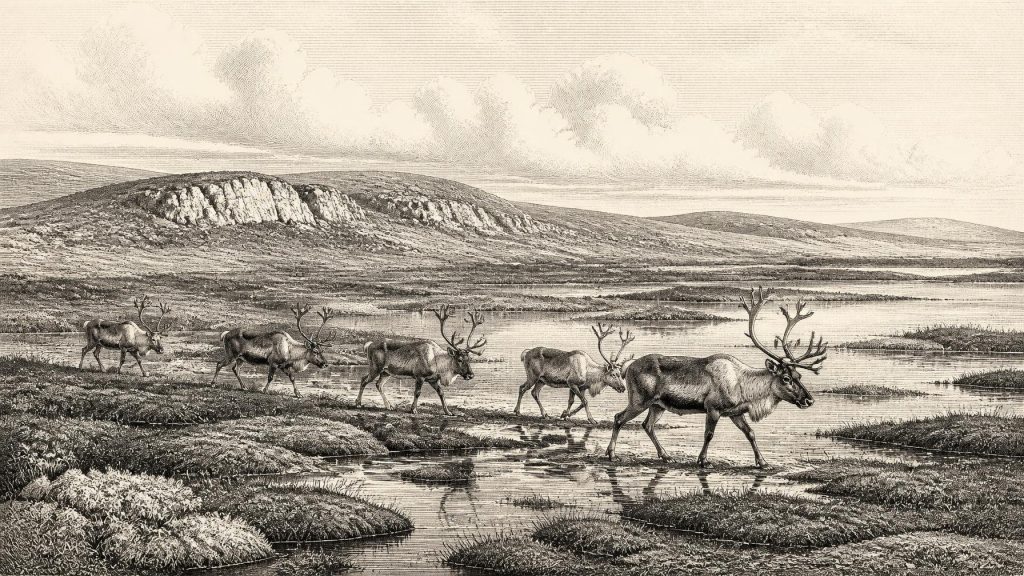
Derryvree is especially valuable because it preserves organic sediment between two tills: deposits left by separate phases of glacier ice. The sequence records an earlier glacial episode, a non-glacial interval in which water and organic matter accumulated, and a later advance that sealed the evidence. Pollen, plant remains and related environmental indicators point to an open, treeless landscape with wet ground, pools and marshy vegetation. Sedges, mosses and cold-tolerant plants were better suited to this setting than woodland.
This was not an Irish landscape of green fields, hedgerows or dense forest. It was a periglacial and tundra-like mosaic, locally damp rather than uniformly dry, shaped by low temperatures, seasonality and sparse cover. In a protected basin, freshwater vegetation could flourish even while surrounding terrain remained exposed and severe. The Derryvree evidence is local, and it must remain local: it cannot prove the exact appearance of County Cork, the western seaboard or every upland at the same time. Yet it firmly demonstrates that later MIS 3 Ireland contained habitable environmental pockets between episodes of ice cover.
Such wetlands mattered beyond their botanical interest. They retained pollen, seeds and small organic traces that rarely survive elsewhere. They also would have concentrated water, edible plants in season, insects and grazing opportunities around their margins. For large animals, a patchwork of open grass- and sedge-rich ground, scrub and wet places could provide routes through a changing landscape. For people, if people were present, the same places would have been important landmarks and resources. That final inference is ecological rather than archaeological: no camp has been found at Derryvree.
Castlepook’s Animal World
The strongest Irish evidence for the broader fauna comes from Castlepook Cave. Excavations conducted mainly in the early twentieth century recovered an extraordinary assemblage that includes reindeer, woolly mammoth, brown bear, spotted hyaena, wolf, Arctic fox, hare and lemming, alongside other remains. The National Museum of Ireland regards Castlepook as the country’s most important site for mammal remains from the last cold stage. Its assemblage shows that Ireland was not ecologically empty during parts of the Late Pleistocene.
These animals should not be imagined as all living together in one neatly dated herd, nor as a complete inventory of a single year. Cave deposits are mixed archives. Carnivores drag prey and scavenged limbs into dens; animals may die near fissures; water can move bones; sediment can be disturbed; and antiquarian excavations removed much context that modern archaeologists would preserve. Direct dating has also shown that some older determinations from Irish cave collections need reassessment under improved preparation methods. Castlepook is exceptionally informative, but its information requires taphonomic caution.
Even so, the pattern is compelling. Reindeer indicate cold open country and potentially seasonal movement through the region. Lemmings and Arctic fox reinforce the picture of harsh conditions. Mammoth, giant deer and horse remains from Irish Pleistocene contexts suggest that, at different times and places, extensive open habitats could sustain large herbivores. Spotted hyaenas and wolves indicate powerful carnivores capable of exploiting carcasses and concentrating bones in caves. A cave full of bones therefore tells more reliably of animal ecology, carnivore behaviour and preservation than of a human settlement beside its entrance.
The Reindeer Femur Question
One Castlepook object gives this era its unusual importance for Irish human history: a reindeer femur bearing a deep linear mark. Zooarchaeologist Ruth Carden has interpreted the modification as consistent with cutting or chopping by a sharp stone tool while the bone was fresh. Public heritage material has presented the specimen as dating to around 31,000 BCE; the relevant scientific discussion places it within the pre-Last Glacial Maximum fauna and has prompted renewed investigation of the cave.
If the mark is confirmed as human-made and contemporary with the animal’s death, it would be momentous: evidence that Upper Palaeolithic people handled a reindeer in Ireland tens of millennia before the formerly accepted late-glacial evidence for people on the island. It could represent a brief hunting or scavenging episode in the Awbeg Valley, with a carcass processed outside the cave and a limb later carried in by hyaenas or other carnivores. That is a plausible interpretation, not an established narrative.
The limits are essential. The bone derives from an old cave collection, not from a modern excavation of an intact occupation floor. No securely associated stone tools, hearth, dwelling, human remains, artwork or food-waste assemblage of comparable age has yet been recovered at Castlepook. A radiocarbon date concerns the animal’s death, not automatically the moment, location or agent of any marking. Nor can one modified bone demonstrate a resident population, a permanent settlement or continuous occupation. At present it is best described as a potentially crucial trace of human butchery, awaiting corroboration from fresh excavation, microscopic analysis and securely stratified finds.
Society Beyond Recovery
There is no evidence from Ireland around this date for political institutions, named leaders, territorial states, diplomacy, formal warfare or organised religion. There are no graves, shrines, houses, tools or ornaments from which to reconstruct kinship, language, ceremony, learning or social rank. It would be wrong to fill that silence with generic images of ‘tribes’ or to project later Irish traditions backwards into the Palaeolithic.
Should the Castlepook femur eventually prove humanly modified, the least that could be inferred is a short-lived presence by people equipped with sharp stone technology and knowledgeable enough to obtain or process a large ungulate in a cold, unfamiliar landscape. Survival in such conditions would have required practical expertise: maintaining clothing and fire, sharing food, reading animal movements and travelling through a broader world beyond Ireland. These are reasonable inferences from Upper Palaeolithic lifeways in north-west Europe, but they remain contextual comparison, not direct evidence for a particular Irish community.
Accordingly, there is no securely demonstrable Irish economy or trade system for 31,527 BCE. Any exchange networks, boats, crossings or seasonal circuits are unknown. The fauna proves that animals reached Ireland during favourable windows in the Late Pleistocene, but it does not settle precisely how people, if present, crossed the changing sea channels and exposed coastal shelves. Lower sea levels altered the geography profoundly, yet Ireland’s relationship with Britain and continental Europe must not be reduced to an assumed permanent land bridge.
Before the Great Advance
The most important development around this notional date was environmental possibility. Ireland was part of a changing north-west European world in which cold-stage mammals could enter, wetlands could form between glacial episodes, and perhaps people briefly ventured to its western edge. Later ice expansion would erode, bury and rearrange many older deposits, helping explain why the evidence is so sparse and discontinuous.
For that reason, 31,527 BCE is not a year of known rulers or recorded battles. It is a point within a wide prehistoric interval illuminated by silts beneath a Fermanagh drumlin and bones in a Cork cave. Derryvree supplies the clearest picture of a cold freshwater landscape; Castlepook supplies the richest evidence of its animal life and the tantalising possibility of human action. The proper historical conclusion is both modest and significant: parts of Ireland were environmentally active and intermittently habitable long before later prehistoric settlement, but the story of any people who may have passed through remains almost entirely unrecovered.
Primary Sources
- A reconsideration of the radiocarbon dating of the Marine Isotope Stage 3 fauna from southern Ireland
- The Irish Quaternary Fauna Project
- New insights on the fauna of Ireland's Younger Dryas and Early Holocene from Alice & Gwendoline Cave
- Trimlines, blockfields and the vertical extent of the last ice sheet in southern Ireland
- Spatio-temporal dynamics of speleothem growth and glaciation in the British Isles
- Spatio-temporal dynamics of speleothem growth and glaciation in the British Isles: discussion paper
- Spotted Hyena Skull
- Heritage Artefacts of County Cork
- 2022:564 – Castlepook Cave, Castlepook South, Cork
- Archaeology Research Excavation Grant 2022: Final Report
- On the Cave of Castlepook, near Doneraile, Co. Cork
- Castlepook Caves
- Irish Pleistocene Biostratigraphy
- The Quaternary of Northern Ireland
- Irish Quaternary Association: Outreach and Education Resources
- Irish Quaternary Association
- Pleistocene vertebrates in the British Isles
- Pleistocene Rodents of the British Isles
- Continuity of brown bear maternal lineages in northern England through the Last-glacial period
- The Late Quaternary history of east-central Ireland
- British–Irish Ice Sheet maps and GIS data of the last ice sheet, 31 to 15 ka
- IntCal20 Northern Hemisphere Radiocarbon Age Calibration Curve (0–55 cal kBP)