Castlepook Toolmarked Femur30276 BCE
Around 30,276 BCE, Ireland lay within the fluctuating cold conditions of later Marine Isotope Stage 3, before the Last Glacial Maximum. Lower sea levels altered coasts but did not guarantee permanent land connections. At Derryvree, Fermanagh, organic deposits between glacial tills preserve treeless wetlands with sedges, mosses and Arctic-alpine plants, showing intermittent habitable environments. Castlepook Cave, Cork, contains remains of mammoth, reindeer, giant deer, predators and other cold-adapted animals, accumulated over time. A cut-marked reindeer femur may indicate human carcass processing about 33,000 years ago, but cannot prove settlement. Later ice disturbed or buried evidence, leaving an incomplete environmental record.
Dateline
The label 30,276 BCE gives a useful point of reference, but it must not be mistaken for a recoverable year in Ireland’s past. No Irish community recorded a calendar at this depth of time, and neither archaeology nor climate science can isolate events to a particular modern year. Counting from the conventional radiocarbon baseline of 1950, it falls about 32,226 years before present. The responsible historical setting is therefore a broad one: later Marine Isotope Stage 3 (MIS 3), within the Midlandian, or last, glacial cycle. Evidence is sparse, discontinuous and often disturbed by later ice. It can illuminate an Ice Age Ireland around this time, but not a named event, ruler, battle or settlement.
A Changing Ice-Age Island
Ireland then formed part of north-western Europe’s repeatedly changing cold-stage world. Sea level was lower than today because immense quantities of water were stored in northern ice sheets, and the outlines of coasts and shallow seas differed greatly from those now familiar. Yet lower seas did not mean that one simple, permanent land bridge joined Ireland to Britain or continental Europe. The Irish Sea basin, changing ice margins, exposed shelves and sea channels created different possibilities at different times. How animals, and perhaps people, reached Ireland remains a question to be investigated through geology, palaeogeography and the distribution of fossils rather than presumed from a modern map.
The climate of MIS 3 was not a single unbroken freeze. Greenland ice-core records show abrupt fluctuations on the scale of centuries and millennia, while Irish evidence shows that local environments could alter sharply as ice advanced, retreated or reworked older deposits. Around the thirty-third millennium BCE, the island was moving towards the much more extensive glaciation of the Last Glacial Maximum, whose main British–Irish ice-sheet phase came later. That wider trajectory is clear; the exact configuration of ice, tundra, water and bare ground in every Irish district in 30,276 BCE is not.
Derryvree’s Buried Wetland
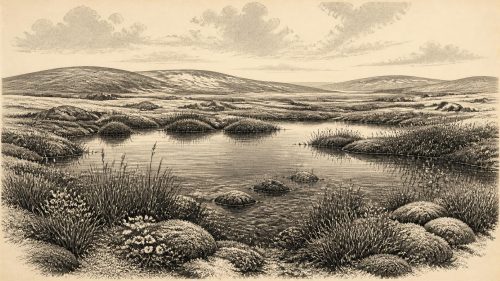
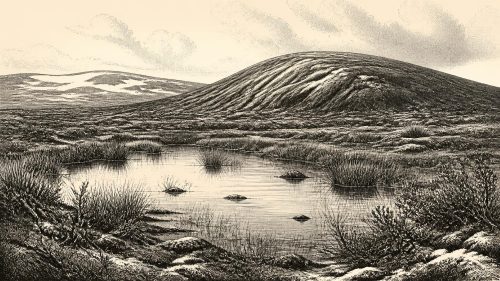
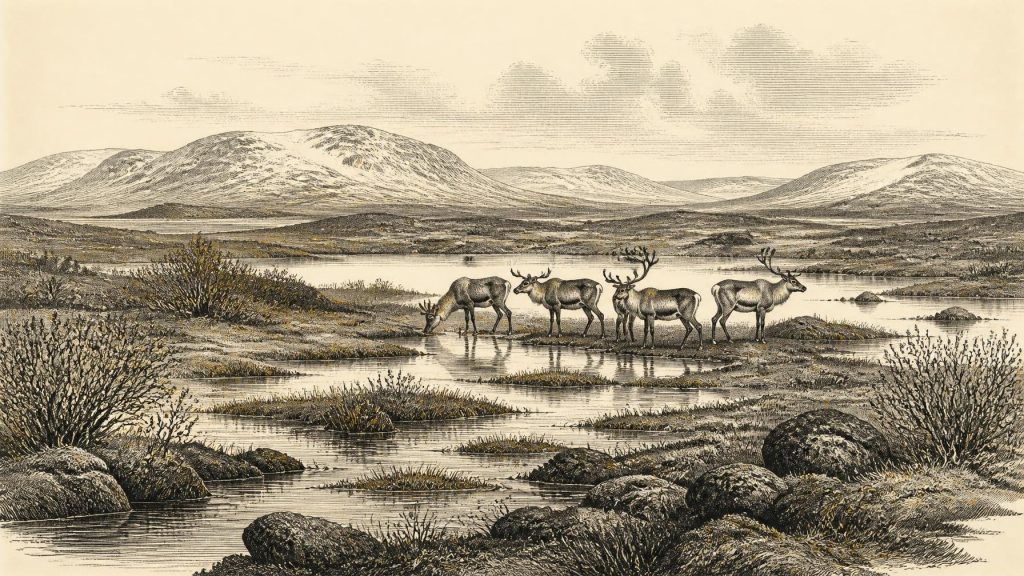
The most informative environmental evidence close to this notional date comes from Derryvree near Maguiresbridge, County Fermanagh. There, roadworks exposed organic silts and fine sands lying between two bodies of glacial till. The deposits are important precisely because they preserve a landscape from between episodes of ice cover. Plant macrofossils and associated remains indicate freshwater pools, wet ground and a treeless cold-climate vegetation, rather than the forested island of later millennia.
A conventional radiocarbon determination from the Derryvree organic material was 30,500 radiocarbon years BP, with a large uncertainty of +1,170/−1,030 years. Radiocarbon years are not calendar years: atmospheric carbon levels varied through time, so the result must be calibrated. Published discussion places the deposit broadly in the later part of MIS 3, approximately 36,900–31,700 calibrated years BP. The point represented by 30,276 BCE—about 32,226 years BP—can therefore be discussed as lying near the younger end of this wide chronological window. It cannot be identified as the date on which the wetland formed, froze, thawed, or was overridden by ice.
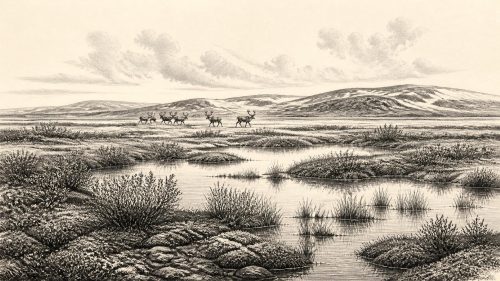
Derryvree’s fossils suggest a cold, open mosaic. Sedges, mosses and Arctic-alpine plants, including dwarf willow, mountain avens, bogbean and water-milfoil, point to wet margins and shallow freshwater rather than uniform barren tundra. This was a landscape with a short productive season: plants could flower, aquatic habitats could support life, and animals could graze or browse where food was available. But it was also exposed to severe winters, frost action and unstable drainage. The later till overlying the deposit is a decisive reminder that any hospitable interval was vulnerable to renewed glaciation.
Animals, Caves and Caution
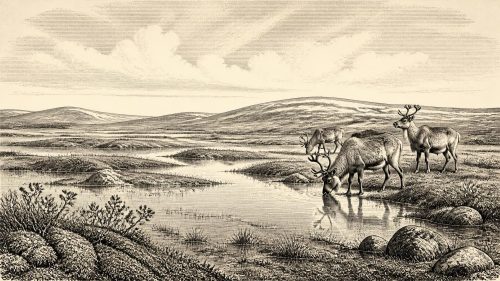
In southern Ireland, Castlepook Cave near Doneraile, County Cork, offers a different kind of archive. Excavations in the early twentieth century, and subsequent reassessment of museum collections, recovered bones of animals associated with the Late Pleistocene. These include woolly mammoth, reindeer, giant deer, brown bear, wolf, Arctic fox, lemmings and spotted hyaena. Taken together with material from other Irish caves, they show that Ireland was periodically reached by cold-adapted mammals during the last glacial cycle.
The cave must not be read as a photograph of one living community. Its deposits accumulated over a long span; carnivores dragged in bones, natural deaths occurred, water moved material, earlier excavators disturbed sediments, and some specimens have been redated with improved methods. Recent work on Castlepook has shown that some older radiocarbon determinations substantially underestimated the age of bones. The strongest conclusion is not that mammoths, hyaenas, giant deer and reindeer all stood together outside the cave in a single season, but that a succession of Ice Age faunas used or reached southern Ireland during MIS 3.
For everyday ecology, however, the combined evidence is powerful. Reindeer and lemmings indicate cold conditions; mammoth and large deer imply enough vegetation to support sizeable herbivores; wolves and hyaenas signal predation and scavenging. A cave could have served as a carnivore den or a trap in the landscape as readily as a refuge. Its bone assemblage therefore preserves food webs and animal movements more securely than it reveals human life. There is no evidence of farming, domesticated stock, permanent houses, fields, pottery or metalworking. All belonged to futures separated from this period by many thousands of years.
The Reindeer Femur
Castlepook is especially significant because a reindeer femur from the cave has been reported as bearing a deep incision consistent with cutting by a sharp stone tool. The bone has been presented as roughly 33,000 years old, placing it close to the period in question. If the mark is confirmed as humanly made, it would be the earliest known indication that people handled animal carcasses in Ireland, far earlier than the securely established post-glacial settlement record.
That conditional language matters. A modified bone is evidence of an act, not proof of a resident population. The date belongs to the animal bone, not to a precisely measured moment of butchery. No securely associated hearth, stone-tool assemblage, occupation floor, shelter, burial or repeated concentration of butchered animals has yet been demonstrated at Castlepook for this age. Modern excavations have sought surviving undisturbed deposits partly because such context is essential. The reindeer femur makes an early human visit plausible enough to merit serious research; it does not permit a reconstruction of a settled Palaeolithic Ireland.
People Without a Political History
If people did reach Ireland around this broad interval, they would have been mobile hunter-gatherers operating at a very small scale, not members of an identifiable Irish polity. They may have followed game, scavenged carcasses, surveyed seasonal routes, or made a brief crossing from a wider north-west European range. Such possibilities are interpretations based on the ecology of the available fauna and on Upper Palaeolithic lifeways elsewhere; they are not direct observations from an Irish camp. There are no grounds for naming a people, language or territory, and no evidence for chiefs, diplomacy, warfare, tribute or formal political institutions.
The same restraint applies to religion, culture and learning. People in Upper Palaeolithic Europe possessed complex social worlds, technologies and symbolic practices, but Ireland has yielded no securely dated art, ornament, ceremonial site, grave or dwelling from around 30,276 BCE. It would be misleading to transfer the cave paintings, burials or regional identities of mainland Europe directly to Ireland. Nor can trade be demonstrated. At most, animal dispersal and the possible humanly modified bone show that Ireland was not necessarily isolated from wider ecological and human networks.
What This Date Can Mean
The Ireland of this period was thus neither an empty abstraction nor a landscape that can be narrated like a later kingdom. It was an environmentally dynamic part of the Late Pleistocene: in some places ice and glacial sediments dominated; in others, as the Derryvree record shows, cold freshwater wetlands briefly supported distinctive plant communities. Large mammals moved through suitable territories, while caves such as Castlepook retained fragments of their histories. A possible reindeer butchery mark opens the prospect of very early human presence, but remains an exceptional and carefully qualified clue.
The most important development around 30,276 BCE was not political or dynastic. It was the unstable relationship between climate, ice, water, vegetation and movement. Later glaciation erased or buried much of the evidence that might have settled larger questions. What survives requires a history written from silts, pollen and plant remains, bones, cave sediments, radiocarbon measurements and landforms. That record establishes an Ice Age Ireland capable, at intervals, of sustaining life; it does not yet furnish a year-by-year human story.
Primary Sources
- A Middle Midlandian Freshwater Series at Derryvree, Maguiresbridge, County Fermanagh, Northern Ireland
- Pleistocene Glaciations in Ireland
- A Reconsideration of the Radiocarbon Dating of the Marine Isotope Stage 3 Fauna from Southern Ireland
- The Irish Quaternary Fauna Project
- Phylogeographic, Ancient DNA, Fossil and Morphometric Analyses Reveal Ancient and Modern Introductions of a Large Mammal: the Complex Case of Red Deer (Cervus elaphus) in Ireland
- Growth and Retreat of the Last British–Irish Ice Sheet, 31,000 to 15,000 Years Ago: the BRITICE-CHRONO Reconstruction
- The Timing and Magnitude of the British–Irish Ice Sheet Between Marine Isotope Stages 5d and 2: Implications for Glacio-Isostatic Adjustment, High Relative Sea Levels and ‘Giant Erratic’ Emplacement
- Radiocarbon Constraints on the Age of the Maximum Advance of the British–Irish Ice Sheet in the Celtic Sea
- A Critical Review and Re-Investigation of the Pleistocene Deposits of the North Coast of Northern Ireland
- BRITICE Glacial Mapping Project
- BRITICE-CHRONO: Aims
- Project Findings Provide Essential Insight into the Last British–Irish Ice Sheet
- 2022:564 – Castlepook Cave, Castlepook South, Cork
- Archaeology Research Excavation Grant 2022: Final Report
- The Archaeological Heritage of County Cork: A Guide
- Ireland’s Palaeolithic Archaeology – Fleeting Footprints in a Frozen Land
- NOAA/WDS Paleoclimatology – North GRIP – MIS3 CH4, d15N, and Temperature Data
- Chapter 9: Ocean, Cryosphere and Sea Level Change
- The Colonization of Ireland: A Human Ecology Perspective
- Investigating Seasonal Mobility in Irish Giant Deer Megaloceros giganteus (Blumenbach, 1799) Through Strontium Isotope (87Sr/86Sr) Analysis
- Occurrence of Mammalia Relicts at Site Castlepook Cave
- New Insights on the Fauna of Ireland’s Younger Dryas and Early Holocene from Alice & Gwendoline Cave