
Derryvree Beneath Two Tills31526 BCE
31,526 BCE is an imprecise modern label for a Late Glacial interval in Marine Isotope Stage 3. At Derryvree, County Fermanagh, freshwater sediments between two tills, dated broadly to 36,900–31,700 calibrated BP, preserve evidence of cold, treeless tundra wetlands during an ice-free episode. Comparable Castlepook Cave remains in County Cork indicate diverse fauna, including mammoth, reindeer and predators. A marked reindeer bone may suggest brief Upper Palaeolithic human activity, but does not prove settlement. No polities, culture, trade or permanent occupation can be identified. Lower sea levels altered routes, while later ice-sheet expansion buried or destroyed much evidence across Ireland.
Dateline
31,526 BCE is a modern chronological label, not a year that can be recovered from the Irish archaeological record. No community in Ireland recorded time in a calendar that can be translated to this particular year, and neither radiocarbon dating nor glacial sediments can identify an event to annual precision so far back. In calendar terms, the label falls roughly 33,475 years before AD 1950, the conventional “present” used in calibrated radiocarbon chronologies. The responsible historical setting is therefore a broad interval in the later part of Marine Isotope Stage 3, within the Last Glacial period but before the fullest expansion of the British–Irish Ice Sheet.
The most informative Irish evidence close to this notional date lies not in a village, grave or tool scatter, but beneath a drumlin at Derryvree, near Maguiresbridge in County Fermanagh. There, roadworks in 1969 exposed freshwater silts, fine sands and organic layers trapped between two tills: deposits left directly by separate episodes of glacial ice. The organic material produced a conventional radiocarbon determination of 30,500 +1,170/−1,030 BP. Later calibration places the deposit broadly within about 36,900–31,700 calibrated years BP, or approximately 34,950–29,750 BCE. That is a substantial range, but it encompasses 31,526 BCE and gives Ireland an unusually rare environmental archive for this deep past.
An Interval Between Ice Advances
Derryvree shows that at some point between two glacial episodes, part of south Fermanagh was not under moving ice. Instead, a body of still or slow-moving fresh water and adjacent wet ground accumulated mud, sand and plant remains. The layers were later sealed beneath another till, preserving a small window that would otherwise have been vulnerable to erosion. This sequence is important because later ice repeatedly stripped, mixed and buried older surfaces across Ireland. It also explains why the evidence is so uneven: a landscape may once have contained campsites, animal trails and river margins, while almost none can now be expected to survive in their original form.
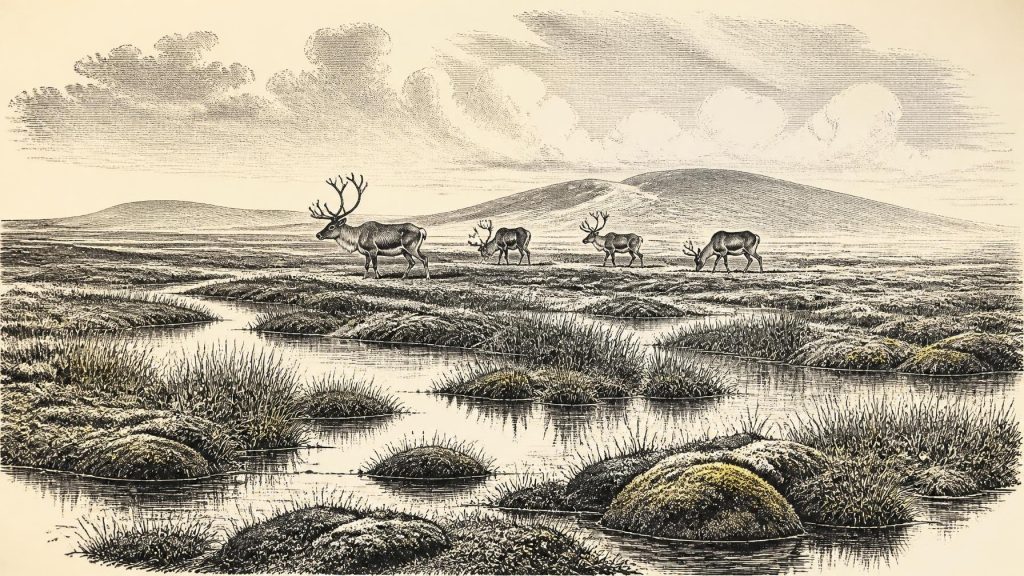
The Derryvree fossils indicate a cold, open and treeless setting. Mosses, sedges and the remains of other plants point to wet tundra or muskeg-like ground, with pools and saturated hollows rather than forest. Pollen was poorly preserved, so it cannot provide a complete vegetation map; nevertheless, the combined botanical and insect evidence supports a periglacial climate with a strongly northern character. This was not an empty ice sheet, but neither was it the green, wooded Ireland familiar today. The region was a mosaic of wet ground, sparse herbaceous vegetation, exposed mineral soil and seasonal water.
That conclusion should be kept at the scale of the evidence. Derryvree documents conditions at one Fermanagh locality over an interval of deposition, not the weather on a particular day or the appearance of every Irish region. Yet it is consistent with wider evidence that the climate of Marine Isotope Stage 3 changed abruptly between relatively milder interstadials and colder stadials. Around the requested date, Ireland stood within a North Atlantic world of climatic instability, in which the extent of ice, the course of rivers, the availability of grazing and the viability of travel could alter over generations or less.
Animals in an Open Country
County Cork’s cave deposits provide the clearest evidence for the larger animals that could inhabit Ireland during broadly comparable parts of this period. Castlepook Cave, near Doneraile, has yielded remains attributed to woolly mammoth, giant deer, reindeer, brown bear, wolf, Arctic fox, mountain hare and spotted hyaena, among others. Modern redating of selected bones has materially altered older chronologies: some Castlepook fauna proved thousands of radiocarbon years older than previous determinations suggested. The result is a stronger case for a varied Marine Isotope Stage 3 fauna in southern Ireland, although individual species did not necessarily live there simultaneously or occupy every district.
This fauna evokes an open, productive but demanding landscape. Reindeer and mammoth are often associated with broad grass-forb tundra and steppe-like environments; hyaenas, wolves and bears remind us that carcasses were contested resources. Cave bone assemblages, however, are not simple lists of animals seen in a single landscape. Carnivores may have carried bones in, water can move sediments, and early excavators did not record deposits to modern standards. Castlepook is therefore firm evidence that Ice Age animal remains survived in Irish caves, but a more limited guide to the precise ecological relationships of any one year.
The Human Question at Castlepook
A reindeer femur from the Castlepook collection has made this horizon especially significant. The bone has been reported as about 33,000 years old and bears a deep mark interpreted as damage made with a sharp stone tool while a carcass was fresh. If that assessment is upheld, it is evidence that a person or people handled a reindeer in Ireland during the Upper Palaeolithic, vastly earlier than the long-established record of post-glacial hunter-gatherers. In relation to 31,526 BCE, it makes a human visit plausible rather than impossible.
But plausibility is not proof of settlement. The dated bone is an animal bone; its age does not establish the precise moment at which the mark was made. Nor has Castlepook produced a securely associated hearth, dwelling floor, lithic assemblage, burial, food store or repeated occupation sequence of this age. The material also comes from cave investigations begun in the early twentieth century, before present-day standards of stratigraphic recording. Recent work at the cave has sought surviving Pleistocene deposits, but its reported results underline the difficulty of recovering intact contexts after earlier excavation and natural disturbance. The careful conclusion is that Castlepook may record brief human activity, not an established population.
For that reason, no responsible account can name an Irish people, assign a language, or attach a continental archaeological culture such as the Aurignacian or Gravettian to Ireland in 31,526 BCE. If people reached the island or its then-larger exposed coastal margins, they were probably highly mobile hunter-gatherers operating in small groups. Such groups elsewhere in north-west Europe had sophisticated knowledge of animal behaviour, stone raw materials, hides, fire and seasonal terrain. That wider comparison may help readers imagine the skills required, but it is interpretation, not direct evidence from Ireland.
No Polities, No Proven Diplomacy
Political affairs, diplomacy and organised warfare are wholly beyond the Irish evidence at this date. There are no chiefs, territories, treaties, monuments or fortified places to identify. Even the existence of a resident human community remains unproven. A possible butchery mark could indicate one short episode: perhaps the processing of a carcass by a travelling party, perhaps activity near a cave used by animals, or another explanation still to be tested. It cannot reveal social rank, gender roles, kinship, conflict or belief.
The same restraint applies to religion, culture and learning. There is no known Irish cave art, portable art, ritual deposit, musical instrument or symbolic object securely attributable to this period. The absence of such evidence is not evidence that people lacked stories, beliefs or artistic practices; it chiefly reflects the thinness and damaged condition of the record. What can be said is that knowledge of terrain and animals would have mattered intensely in a cold, changeable environment. Reading snow, water, tracks, vegetation and the behaviour of herds was potentially a matter of survival, but it cannot be documented as a specifically Irish tradition.
Routes, Coasts and Vanished Ground
Economy and trade likewise cannot be demonstrated. There is no evidence for farming, permanent settlement, exchange networks or local manufacture in Ireland at this horizon. A hypothetical visiting group would have depended on wild resources: meat, marrow, fat, hide, sinew, bone, fuel and perhaps freshwater fish or birds where conditions allowed. Yet this is a model of hunter-gatherer subsistence, not an excavated Irish household. Nothing presently supports claims for regular commerce across the Irish Sea or for a population continuously occupying the island.
Geography complicates every question. Sea level was markedly lower than today during the growth of global ice sheets, exposing areas now submerged around Ireland and Britain. Modelling indicates relative sea levels in the British–Irish region could have stood roughly 50–100 metres below present around 31,000 years BP, although shorelines were shaped also by local ice loading and crustal movement. Lower seas did not automatically create an easy land bridge to Ireland. Any crossing, whether by exposed coastal terrain, sea ice, short water passages or watercraft, remains uncertain for this particular period. Potential entry routes have largely vanished beneath the modern sea.
The greatest development relevant to Ireland around 31,526 BCE was therefore environmental rather than political: an unstable cold-world landscape, locally capable of sustaining tundra wetlands and large mammals, was moving towards a more extensive phase of glaciation. By roughly 27,000–23,000 calibrated years BP, the British–Irish Ice Sheet covered Ireland and its continental shelf at its maximum extent. That later advance transformed the land and erased much of the older surface record. Derryvree’s silts and the contested Castlepook reindeer femur consequently carry disproportionate importance. They do not yield a conventional annual history, but they preserve the narrow evidence from which Ireland’s possible human and certainly Ice Age past must be reconstructed.
Primary Sources
- A Middle Midlandian Freshwater Series at Derryvree, Maguiresbridge, County Fermanagh, Northern Ireland
- Early Midlandian–Middle Midlandian, Pleistocene, Northern Ireland
- Palaeoecology
- The Subdivision of the Quaternary Period in Ireland
- Growth and Retreat of the Last British–Irish Ice Sheet, 31,000 to 15,000 Years Ago: The BRITICE-CHRONO Reconstruction
- BRITICE-CHRONO Maps and GIS Data of the Last British-Irish Ice Sheet 31 to 15 ka
- Britain and Ireland: Glacial Landforms from the Last Glacial Maximum
- A Reconsideration of the Radiocarbon Dating of the Marine Isotope Stage 3 Fauna from Southern Ireland
- The Irish Quaternary Fauna Project
- Occurrence of Mammalia Relicts at Site Castlepook Cave
- 2022:564 – Castlepook Cave, Castlepook South, Cork
- Heritage Artefacts of County Cork
- Archaeological Heritage of County Cork
- The IntCal20 Northern Hemisphere Radiocarbon Age Calibration Curve (0–55 cal kBP)
- The IntCal20 Northern Hemisphere Radiocarbon Age Calibration Curve (0–55 cal kBP)
- Ireland: Submerged Prehistoric Sites and Landscapes
- Stratigraphic and Palaeo-Geomorphological Evidence for the Glacial-Deglacial History of the Last British-Irish Ice Sheet in the North-Western Irish Sea
- Maximum Extent and Readvance Dynamics of the Irish Sea Ice Stream and Irish Sea Glacier Since the Last Glacial Maximum
- Advance and Retreat of the Marine-Terminating Irish Sea Ice Stream into the Celtic Sea During the Last Glacial: Timing and Maximum Extent
- Dimensions and Chronology of the Last Ice Sheet in Western Ireland
- New Insights on the Fauna of Ireland's Younger Dryas and Early Holocene from Alice & Gwendoline Cave
- First Evidence of a Late Upper Palaeolithic Human Presence in Ireland
- The Mesolithic in Ireland: When Was It?