Moss-Rich Mud at Derryvree31568 BCE
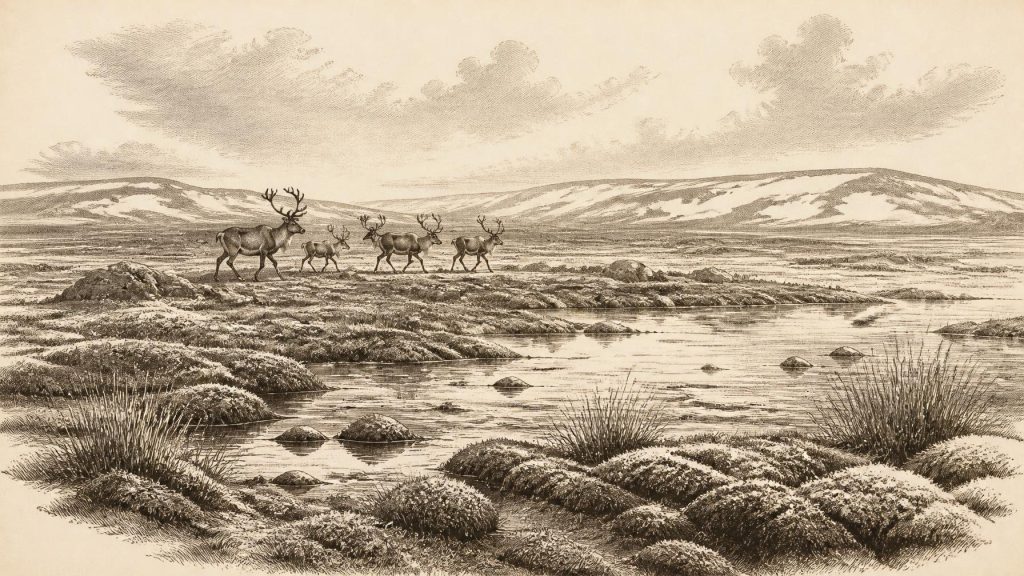
About 31,568 BCE, Ireland lay within the unstable Late Pleistocene, although evidence permits only broad chronological ranges. At Derryvree, Fermanagh, moss-rich freshwater deposits beneath later till record treeless, cold periglacial terrain, with sedges, shallow water and open vegetation. Southern caves, notably Castlepook, preserve Marine Isotope Stage 3 fauna including mammoth, giant deer, reindeer, hyaena and Arctic species, indicating intermittent connections beyond Ireland. Changing sea levels and ice margins shaped access routes. A cut-marked reindeer bone may indicate brief human activity, but no secure settlement evidence exists. Subsequent ice expansion likely destroyed earlier archaeology, leaving an environmental rather than social history.
Dateline
The label 31,568 BCE is a modern way of placing a point far beyond any Irish calendar, written record or recoverable annual chronology. In archaeological convention it falls roughly 33,500 years before AD 1950, within the Late Pleistocene and Marine Isotope Stage 3, a long, climatically unstable part of the last Ice Age. It would be misleading to claim knowledge of an event in this particular year. The responsible evidence consists of wide calibrated ranges, cave-bone collections, buried sediments, pollen, plant remains, insects and the landforms left by ice. Together they illuminate an Irish landscape in transition; they do not provide a year-by-year history of a population.
An Interval, Not a Date
The closest useful Irish chronological anchor is at Derryvree, near Maguiresbridge in County Fermanagh. Road works exposed a remarkable succession beneath a drumlin: a lower glacial till, then freshwater silts, sands and organic mud, and finally a further till deposited by later glacier ice. The middle deposits accumulated during a period when the locality was not under active ice, before being sealed and preserved by renewed glaciation. A conventional radiocarbon determination, BIRM-166, of 30,500 ± 1,100 radiocarbon years BP has been associated with the moss-rich mud. Under modern calibration, its broad possible calendar range has been expressed at approximately 36,900–31,700 cal BP. That range embraces the notional date considered here, but it is a window spanning millennia, not a timestamp for a single season, let alone a single year.
The terminology itself requires care. Older Irish Quaternary schemes called this part of the record the Derryvree Cold Phase, while broader international discussion uses Marine Isotope Stage 3. Neither label means that every part of Ireland shared one identical climate, or that the island was either wholly ice-covered or wholly ice-free. Ice margins, meltwater routes, vegetation and animal ranges changed repeatedly. Recent reconstructions of the British–Irish Ice Sheet show that its last major expansion was an extended, uneven process, with different sectors advancing and later retreating at different times. Around 33,500 cal BP, Ireland was approaching the interval in which that ice sheet grew dramatically, but the evidence does not support a single, island-wide map for 31,568 BCE.
Wet Tundra Beneath Later Ice
Derryvree offers the clearest local environmental picture. Its organic beds contained freshwater mosses and sedges, while pollen and insect evidence indicate cold conditions and an open landscape of northern character. This was not the familiar green, wooded Ireland of recent millennia. Trees were absent or extremely sparse around the site. The ground is best envisaged as a varied periglacial mosaic: wet mossy hollows, sedgy margins, shallow freshwater, stream-fed deposits, frost-affected soils and exposed herb-rich ground. Seasonal contrasts were probably severe. Summer growth in sheltered, damp places could be productive, yet winter cold and wind would have imposed powerful limits on vegetation and animals.
The evidence should not be made more picturesque than it is. Plant macrofossils and pollen do not reconstruct every hill, nor can an insect assemblage tell us the weather on a particular day. They do, however, establish that freshwater habitats persisted locally and that treeless vegetation survived between glacial episodes. Derryvree is especially valuable precisely because later ice commonly eroded, rearranged or buried the earlier record. Its mud is a small surviving archive from a landscape whose open-air surfaces were subsequently scoured by glaciers, cut by meltwater and overlain by younger deposits.
Animals at the Atlantic Edge
Southern Irish caves add another kind of evidence. Castlepook Cave, near Doneraile in north County Cork, traditionally called Mammoth Cave, has produced Ireland’s most important collection of Late Pleistocene vertebrate remains. Reassessment and improved radiocarbon dating have shown that some of its fauna is substantially older than earlier determinations suggested, placing animals including giant deer and spotted hyaena in Marine Isotope Stage 3, before the Last Glacial Maximum. The cave’s wider assemblage includes woolly mammoth, reindeer, brown bear, wolf, Arctic fox, lemmings and other species, though not all specimens belong to precisely the same time or sedimentary event.
This distinction matters. A cave bone collection is not a census of animals alive together in 31,568 BCE. Carnivores can carry prey into caves; water, collapse and earlier excavation practices can mix deposits; and old collections may lack the precise stratigraphic records expected today. Nonetheless, the combined faunal evidence demonstrates that cold-adapted and open-country mammals reached Ireland during parts of this era. Mammoths and giant deer suggest extensive grazing landscapes, while reindeer, lemmings and Arctic fox fit a colder setting. Spotted hyaena, wolf and bear remind us that herbivores moved through a landscape structured also by predators, scavengers and sheltered den sites.
A 2026 sedimentary ancient-DNA study from Castlepook, currently available as a preprint rather than a completed peer-reviewed article, reinforces the broader point of faunal connection. It detected genetic traces of numerous ancient taxa in cave sediments and linked Irish cave hyaenas and mammoths with wider Late Pleistocene Eurasian populations. It is promising evidence for connectivity at Europe’s north-western edge, but its provisional publication status should be acknowledged. It does not demonstrate a continuous corridor, a single migration route or an exact date for the arrival of any animal.
Routes Across a Changing Seascape
Low global sea levels exposed much more of the continental shelf around north-west Europe than is visible today. Ireland’s coastline was therefore markedly different, and movements between Britain, Ireland and the continent were geographically easier at some points than in the modern seascape. Yet ‘land bridge’ is too simple a phrase if it implies a broad, permanent dry road. The depth and shape of the Irish Sea basin, regional ice cover, fluctuating sea level and the location of ice margins all affected possible passages. Scholarly reconstructions differ in detail and warn against treating Ireland as automatically joined to Britain throughout the Ice Age.
For animals, intermittent access may have been enough. A landscape of shelf plains, frozen ground, ice-fringed water and shifting valleys could open or close routes over centuries and millennia. The animal record supports recurrent connections to populations beyond Ireland, not permanent isolation. For people, however, the geographical possibility of access is not proof of occupation. No known house, hearth, working floor, securely stratified stone-tool assemblage, burial, art panel or cemetery can be assigned to this Irish interval. No sustained settlement has been demonstrated.
The Castlepook Bone Question
The most consequential possible human clue is a reindeer femur from Castlepook. It has been reported as roughly 33,000 years old and bears a deep incision interpreted by zooarchaeologist Ruth Carden as a mark made on fresh bone with a sharp stone implement during carcass processing. If that interpretation and association are ultimately confirmed, the specimen would indicate that people handled a reindeer in Ireland in the Upper Palaeolithic, far earlier than the long-established evidence for terminal-Pleistocene and Mesolithic occupation.
Its importance is matched by its limitations. One modified bone cannot identify a group’s language, ancestry, travel route, numbers, season of arrival or length of stay. It cannot establish that hunters lived in the cave, rather than visiting briefly or processing an animal elsewhere. Nor does it amount to evidence for an Irish population in the ordinary sense. Renewed work at Castlepook, including a 2022 research excavation, is intended to improve the contextual record. Until securely dated deposits yield associated tools, hearths or occupation surfaces, the most defensible wording is that there may have been brief human activity in Ireland during this broad period.
No Polities, No Monuments
The absence of evidence here is historically meaningful. There is no basis for describing political authority, diplomacy, organised warfare, farming, formal trade, named communities, religious institutions or learned traditions in Ireland around this notional date. There were no known fields, livestock herds, villages, tombs or monuments. If people did enter the island, their material traces have either not survived, remain undiscovered or are too ambiguous to identify securely. The ice sheet’s later expansion is a major reason why: it could erase campsites and redistribute artefacts beyond recognition.
Nor should silence be confused with proof that nobody ever came. Archaeology records survival as much as original activity. Caves and sediment traps preserve exceptional fragments; exposed ground rarely does. The comparison with later Irish prehistory makes the gulf clear. Thousands of years afterwards, changing climate, sea level and ecology allowed more enduring human settlement, leaving recognisable stone artefacts, habitation sites and eventually monuments. Nothing comparable exists for 31,568 BCE.
An Environmental Irish Past
Ireland at this point is therefore best understood as an environmental, rather than a political, historical horizon. The Derryvree deposits provide rare direct evidence of treeless, freshwater-fed cold-stage ground in Fermanagh. Castlepook and other caves show that a remarkable assemblage of mammals reached southern Ireland during Marine Isotope Stage 3. Glacial geology shows that the island’s terrain was entering a phase of profound alteration as the British–Irish Ice Sheet expanded. Possible human butchery at Castlepook is intriguing and potentially transformative, but remains much too slight to carry a narrative of society.
The enduring significance of this remote date lies in that restraint. Around 31,568 BCE, the future island was not an empty abstraction, but a changing assemblage of wet tundra, open ground, caves, animals, rivers and advancing ice. Its surviving evidence is fragmentary, calibrated in broad ranges and often debated. Read carefully, it tells an important story: Ireland’s human history was preceded by a deep Ice Age history in which climate, geography and animal movement repeatedly remade the possibilities of life.
Primary Sources
- A Middle Midlandian Fresh-Water Series at Derryvree, Maguiresbridge, County Fermanagh, Northern Ireland
- A Reconsideration of the Radiocarbon Dating of the Marine Isotope Stage 3 Fauna from Southern Ireland
- The Irish Quaternary Fauna Project
- Figure 6.— The Subdivision of the Quaternary Period in Ireland
- Trimlines, Blockfields and the Vertical Extent of the Last Ice Sheet in Southern Ireland
- Growth and Retreat of the Last British–Irish Ice Sheet, 31,000 to 15,000 Years Ago: The BRITICE-CHRONO Reconstruction
- Exploring Controls of the Early and Stepped Deglaciation on the Western Margin of the British–Irish Ice Sheet
- The Geology of Ireland: Cenozoic—Tertiary and Quaternary
- Dimensions and Chronology of the Last Ice Sheet in Western Ireland
- The Deglaciation of the Western Sector of the Irish Ice Sheet From the Inner Continental Shelf to Its Terrestrial Margin
- Timing and Pace of Ice-Sheet Withdrawal Across the Marine–Terrestrial Transition West of Ireland During the Last Glaciation
- The Island of Ireland: Drowning the Myth of an Irish Land-Bridge?
- The Problem of a Late Quaternary Landbridge Between Britain and Ireland
- The IntCal20 Northern Hemisphere Radiocarbon Age Calibration Curve (0–55 kcal BP)
- Sedimentary Ancient DNA Reveals Late Pleistocene Faunal Connectivity Between Ireland and Eurasia
- 2022:564 – Castlepook Cave, Castlepook South, Cork
- First Evidence of a Late Upper Palaeolithic Human Presence in Ireland
- New Insights on the Fauna of Ireland's Younger Dryas and Early Holocene from Alice & Gwendoline Cave
- Quaternary
- Outreach and Education Resources