BIRM-166’s Frostwater Flora31360 BCE
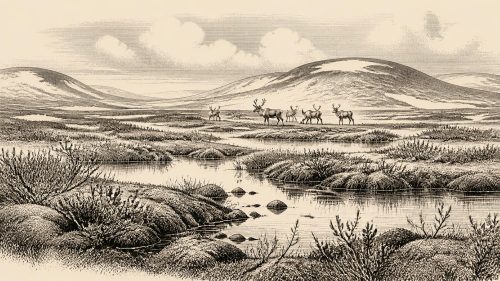
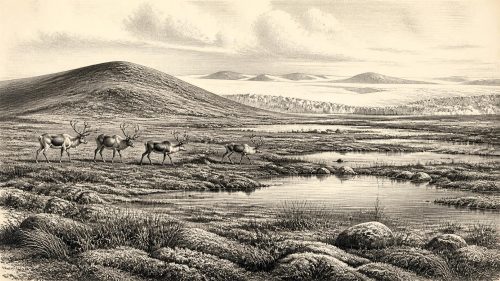
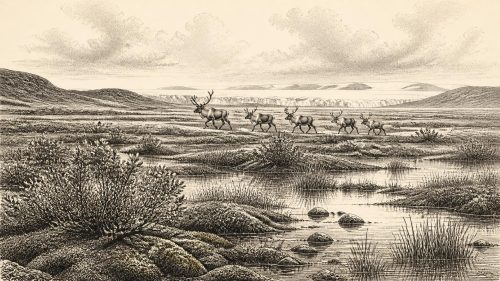
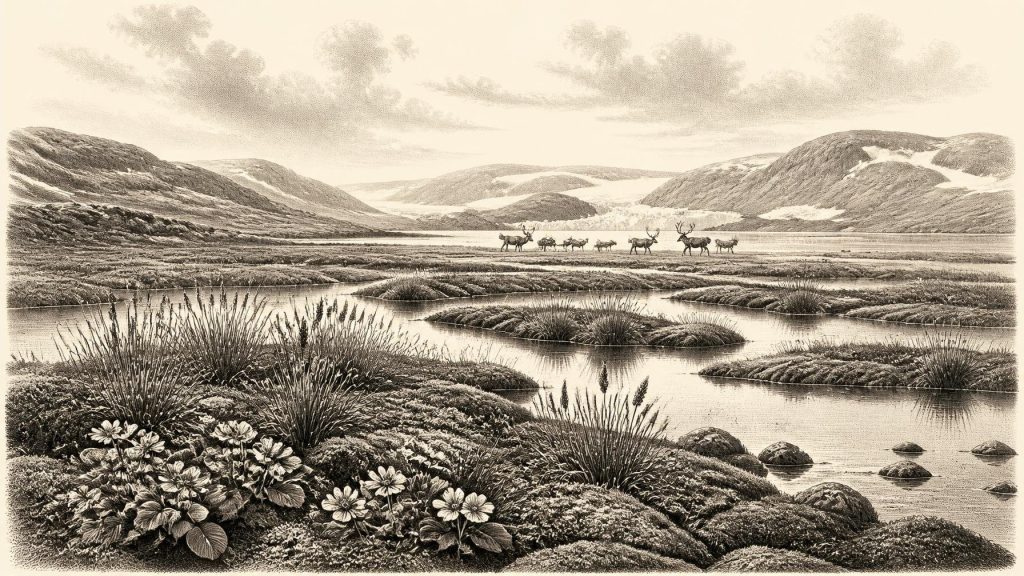
31,360 BCE is a modern label within unstable Marine Isotope Stage 3, rather than a precisely identifiable Irish year. At Derryvree, County Fermanagh, freshwater sediments between glacial tills record a locally ice-free, treeless tundra wetland, dated broadly to this period. Macrofossils, mosses and insects indicate cold-adapted herbs, sedges, pools and damp ground. Ireland’s ice cover and exposed sea routes varied regionally. Castlepook Cave, County Cork, preserves MIS 3 remains of mammoth, reindeer, giant deer, bear and hyaena. A possibly stone-cut reindeer femur may indicate transient human butchery, but no contemporary settlement, tools or other secure evidence confirms human occupation there.
Dateline
The label “31,360 BCE” is a modern chronological convenience, not a year visible in Ireland’s prehistoric record. Nobody in Ice Age Ireland counted time in calendar years, and neither radiocarbon dating nor glacial stratigraphy can identify an event in a particular twelve-month interval this far back. The responsible approach is to place the date within wider calibrated ranges. Around 33,310 years before 1950, it falls within Marine Isotope Stage 3, a long, unstable part of the last glacial cycle. Ireland was a cold, changing north-western frontier of Europe: in places a landscape of ice, elsewhere a land of open ground, wetlands, rivers and animal herds.
The best direct environmental evidence close to this notional date comes not from a settlement but from a road cutting at Derryvree, near Maguiresbridge in County Fermanagh. There, work in 1969 revealed fine sands, silts and organic layers sealed between two tills: sediments left by separate glacier advances. The material between them accumulated during an interval when ice was absent locally. Its radiocarbon determination, BIRM-166, was 30,500 radiocarbon years before present, with a wide error margin. Calibration has placed it broadly at about 36,900–31,700 calibrated years before present, while more recent modelling centres it around 33,500 ± 1,200 calendar years before present. These are overlapping chronological estimates, not a precise timestamp; nevertheless, they make Derryvree the most valuable Irish window on conditions around 31,360 BCE.
A Wetland Between Ice Advances
Derryvree corrects the simple image of an Ireland wholly smothered by permanent ice. The lower and upper tills establish that glaciers reached this part of Fermanagh at different times. The intervening freshwater deposits establish something equally important: for a substantial interval, the district contained unfrozen ground and water. Sediment could settle in quiet pools or sluggish channels; plants rooted or grew at the margins; insects lived and died there; organic matter accumulated. Later ice buried this small archive, protecting it while also making clear that the open landscape was not secure or permanent.
The biological evidence points to treeless tundra and periglacial wetland rather than woodland. Pollen was poorly preserved, so it cannot offer a complete map of the vegetation. Plant macrofossils, mosses and fossil insects are therefore especially significant. Together they indicate a low, open cover of herbs, sedges, grasses, mosses and cold-adapted plants, with shallow water and damp organic ground. Finds associated with species such as mountain avens, Arctic willow, bogbean and water-milfoil show that different microhabitats existed within the wider cold landscape: exposed mineral ground, wet margins and freshwater pools. The older term “muskeg” usefully conveys this mosaic of waterlogged, mossy and sedge-rich terrain.
This was harsh country, but it was not lifeless. Seasonal thaw allowed liquid water and a short growing season; vegetation supported invertebrates, and the landscape formed part of a food web capable of sustaining larger animals. Repeated freezing and thawing disturbed soils and exposed sediment. Winds crossing open ground would have been keen, especially in winter. There is no basis for projecting modern Irish weather, trees or coastlines into this world. The familiar green, wooded island lay far in the future.
An Uneven Irish Ice Sheet
The wider geography is necessarily more complicated than a single line between “ice-covered” and “ice-free” Ireland. Research on the Irish Ice Sheet shows an ice mass that expanded in stages and behaved differently in separate sectors. Derryvree demonstrates local ice-free conditions in north-central Ireland during part of later MIS 3, but it does not prove that every county was open at the same moment. Marine and glacial evidence from western and southern Ireland shows that ice margins could fluctuate dramatically during the long run-up to the Last Glacial Maximum, conventionally dated in this region to roughly 26,000–19,000 years ago.
At 31,360 BCE, therefore, Ireland should be envisaged as a region in transition, with changing connections between uplands, basins, coastlines and the adjacent lands now divided by sea. Lower global sea levels exposed much of the Irish Sea basin, though routes across it were not necessarily easy, dry or continuously available. Glacial meltwater, marsh, river channels, ice margins and seasonal conditions could all impede movement. An animal or person reaching Ireland did not necessarily cross a simple grassy land bridge. The exact configuration of ice and water at any given point remains an active subject of geological reconstruction.
Castlepook’s Animal World
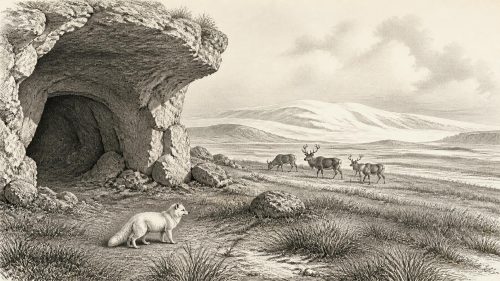
Evidence from Castlepook Cave, near Doneraile in north County Cork, offers a different kind of insight. The cave was excavated in the early twentieth century and produced a remarkable collection of Pleistocene animal remains, including woolly mammoth, giant deer, reindeer, brown bear and spotted hyaena. Improved radiocarbon methods have shown that several Castlepook specimens are substantially older than the dates first obtained in the 1990s, placing important parts of the fauna in MIS 3. The cave does not represent a single episode: bones accumulated over long periods and were affected by carnivores, natural processes and early excavation methods. It is a time-depth archive, not a snapshot.
Even so, the fauna establishes that large mammals moved through parts of Ireland during this cold stage. Reindeer were especially well suited to open, cold environments; giant deer, horse and mammoth are also represented in the broader Irish late-Pleistocene record. Predators and scavengers mattered as much as herbivores. Hyaenas could drag bones into caves, while bears used caves in other ways. Castlepook was therefore not simply a hunting camp or a human refuge. It was part of a wider animal landscape in which caves could become dens, traps, shelters or repositories of bone.
A reindeer femur from Castlepook has special relevance to this date because it has been reported as bearing a deep mark interpreted by zooarchaeologist Ruth Carden as stone-tool damage made during carcass processing. County Cork heritage interpretation places the specimen broadly at about 31,000 BCE, close to the requested horizon. If the mark is correctly identified as human-made and contemporary with the animal’s death, it is potentially Ireland’s earliest evidence of people handling an animal. It may record butchery by a small party of Upper Palaeolithic hunter-gatherers.
That conclusion must remain carefully bounded. The bone was recovered from an old cave collection, rather than from a modern, sealed excavation containing an associated hearth, stone tools, occupation surface or dwelling. A direct date gives the age of the bone, not the exact moment the surface mark was made. Nor can one modified bone identify the size, origin, language, cultural tradition or duration of any human visit. It is evidence of a possible action, not proof of a settled population. The securely documented human presence represented by butchered bear bone at Alice and Gwendoline Cave in County Clare belongs much later, around 12,800–12,600 calibrated years before present.
People, If They Came
If people did reach Ireland around this broad MIS 3 interval, the Castlepook evidence suggests mobility rather than established settlement. In comparable parts of Upper Palaeolithic Europe, small hunter-gatherer groups possessed stone-working skills and detailed knowledge of animal behaviour, seasonal movement, fire, clothing and shelter. Such comparisons can illuminate what might have been possible; they cannot fill Ireland’s archaeological silence with borrowed detail. Ireland has yielded no securely dated camp, lithic assemblage, house floor, burial, artwork or food store from around 31,360 BCE.
For the same reason, political history cannot be written here. There are no known leaders, territories, tribes, alliances, diplomatic contacts or battles. Conflict is imaginable wherever people, carnivores and scarce resources met, but no Irish evidence demonstrates warfare. Equally, there is no evidence for farming, herds, pottery, metallurgy, formal trade routes or permanent villages. A possible reindeer-processing episode would imply practical knowledge of meat, hide, sinew, marrow and bone, but the specific use of this animal cannot be recovered from its femur alone.
Religion, language, music, visual art and teaching are also beyond direct recovery in Ireland at this date. People elsewhere in Upper Palaeolithic Europe certainly had rich social and cultural lives, yet it would be irresponsible to assign cave art, ritual, myth or ceremonial practice to Ireland without local evidence. The most meaningful “learning” visible here is ecological: the knowledge, held by any visiting hunters, that would have been needed to navigate a cold landscape and make use of animal resources. That is an inference from human survival in comparable environments, not a documented Irish tradition.
What This Year Can Mean
In an annual series, 31,360 BCE should not be treated as the date of a named event. It marks a point inside a broad span when Ireland’s environmental history is better documented than its human history. Derryvree preserves proof of a locally ice-free, freshwater tundra landscape between glacial advances. Castlepook preserves evidence for a diverse cold-stage fauna, and perhaps a humanly modified reindeer bone of approximately this age. Together they show a country neither timelessly frozen nor recognisably modern: a precarious, regionally varied Ice Age environment in which animal movement is certain, glacier change is certain, and human presence remains a serious but limited archaeological possibility.
Primary Sources
- A Middle Midlandian Freshwater Series at Derryvree, Maguiresbridge, County Fermanagh, Northern Ireland
- Palaeoecology
- The Subdivision of the Quaternary Period in Ireland
- A Reconsideration of the Radiocarbon Dating of the Marine Isotope Stage 3 Fauna from Southern Ireland
- The Irish Quaternary Fauna Project
- Trimlines, Blockfields and the Vertical Extent of the Last Ice Sheet in Southern Ireland
- Radiocarbon Constraints on the History of the Western Irish Ice Sheet Prior to the Last Glacial Maximum
- Last Glacial Maximum Cirque Glaciation in Ireland and Implications for Reconstructions of the Irish Ice Sheet
- Stratigraphic and Palaeo-Geomorphological Evidence for the Glacial-Deglacial History of the Last British-Irish Ice Sheet in the North-Western Irish Sea
- Growth, Dynamics and Deglaciation of the Last British-Irish Ice Sheet: The Deep-Sea Ice-Rafted Detritus Record
- New Insights on the Fauna of Ireland’s Younger Dryas and Early Holocene from Alice & Gwendoline Cave
- First Evidence of a Late Upper Palaeolithic Human Presence in Ireland
- First Evidence of a Late Upper Palaeolithic Human Presence in Ireland
- Heritage Artefacts of County Cork
- The Exploration of Castlepook Cave, County Cork
- Radiocarbon Constraints on Readvances of the British Irish Ice Sheet in the Northern Irish Sea Basin During the Last Deglaciation
- Glacial Geomorphology in the Wicklow Mountains, Ireland
- Investigating Seasonal Mobility in Irish Giant Deer Megaloceros giganteus Through Strontium Isotope Analysis
- The Mesolithic in Ireland: When Was It?
- The IntCal20 Northern Hemisphere Radiocarbon Age Calibration Curve (0–55 cal kBP)