Castlepook’s Palaeolithic Prospect31252 BCE
Around 31,252 BCE, Ireland lay within the variable cold conditions of Marine Isotope Stage 3, without recorded peoples, settlements or institutions. Cave fauna at Castlepook, County Cork, including reindeer, mammoth and hyaena, indicates diverse cold-stage habitats. A reindeer femur bears an incision interpreted as a possible stone-tool cut, suggesting a brief Upper Palaeolithic human visit, but not permanent occupation. Poor early excavation records and absent associated tools require caution. Fermanagh wetland sediments and Kerry speleothems show fluctuating climates before expanding ice sheets. Secure evidence of human presence comes far later, while sustained settlement began in the Mesolithic after 8000 BCE.
Dateline
The label 31,252 BCE is a modern chronological convenience, not a date that can be matched to an Irish annal, ruler, settlement or individual life. No calendar-year precision is available for Ireland at this depth of time. Counting backwards from AD 1950, the label lies roughly 33,200 years before present, but the relevant archaeological and environmental evidence is dated in broad radiocarbon and calibrated ranges, often with uncertainties of centuries or more. The responsible subject is therefore Ireland during the later part of Marine Isotope Stage 3 (MIS 3), within the Midlandian cold stage, rather than an event in one exact year.
A Country Before Records
Ireland at this time had no known written language, political institutions, named communities or recoverable oral traditions. There is no evidence for kingship, diplomacy, warfare between organised polities, law, monuments, formal religion, farming, trade centres or permanent villages. It would be misleading to manufacture equivalents simply because a year-by-year format usually expects them. What survives instead is a scattered environmental record: cave bones, buried organic sediments, pollen, insects, plant remains, landforms and cave mineral deposits. These sources reveal changing habitats and animals far more clearly than they reveal human lives.
The island’s position also matters. Sea level was much lower than today because vast quantities of water were held in northern ice sheets. Ireland was not necessarily as isolated as it would later become, although coastlines, channels and land connections changed repeatedly as ice and sea level changed. The precise configuration around 33,200 years ago remains difficult to reconstruct locally. A lower sea level might have shortened crossings between Ireland and Britain, but it does not prove that people regularly travelled them, still less that an established population lived on the island.
Castlepook Cave and One Marked Bone
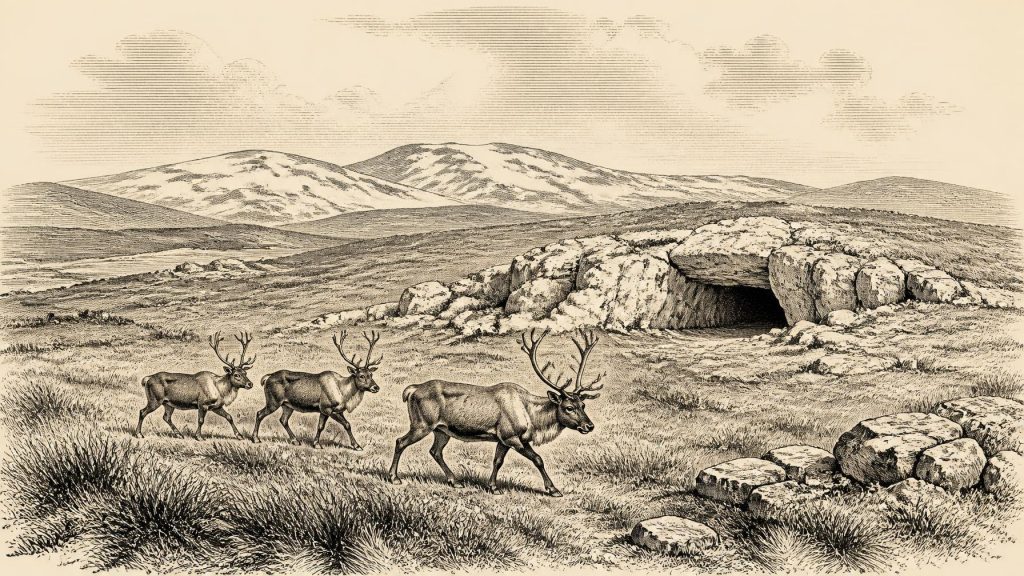
The most arresting evidence relevant to this approximate date comes from Castlepook Cave, also known as Mammoth Cave, near Doneraile in north County Cork. The cave produced an important collection of Late Pleistocene animal remains, accumulated over a long period and investigated principally in the early twentieth century. Its fauna includes such cold-stage animals as reindeer, giant deer, brown bear, wolf, fox, lemmings, spotted hyaena and woolly mammoth. These bones show that southern Ireland could, at intervals during MIS 3, support or receive a strikingly varied northern European fauna.
One reindeer femur from the Castlepook collection is particularly significant. County Cork heritage material, drawing on the assessment of zoologist Ruth Carden, identifies a deep surface incision as a cut made by a sharp stone tool while fresh tissue was being removed. The object is broadly placed at about 31,000 BCE. If the mark is correctly interpreted and belongs to the animal’s original death-age, it is possible evidence that a person processed a reindeer in Ireland during the Upper Palaeolithic.
That conclusion must be kept separate from the evidence itself. The femur and its incision are real objects; the human origin of the mark is an expert interpretation. A humanly made cut would demonstrate contact between people and one carcass, not necessarily a successful hunt. The animal could have been scavenged, butchered elsewhere and its remains later carried to the cave by carnivores, water or other natural processes. Castlepook has not yielded a securely associated stone-tool assemblage, hearth, shelter floor, human burial or repeated sequence of occupation from this period. Nor can the bone date a particular season, day or year.
The cave archive requires additional caution because antiquarian excavations pre-dated modern standards of stratigraphic recording, sieving and geoarchaeological sampling. Bone collections may combine material introduced at different times and by different agencies. Later accelerator radiocarbon work has shown that some earlier dates from Irish caves underestimated the true ages of bones by thousands of radiocarbon years. Castlepook is therefore invaluable, but it is not a sealed hunting camp. Its greatest importance lies in raising a difficult and productive question: whether brief Upper Palaeolithic visits to Ireland occurred long before the later, better-established record of settlement.
Reindeer Country
The Castlepook fauna does not describe a single living community frozen in time. Each species, specimen and deposit has its own history. Yet together they make it reasonable to picture parts of Ireland in MIS 3 as open, cold and strongly seasonal. Reindeer are especially suggestive of extensive grazing country. In other parts of Late Pleistocene Europe, reindeer were important prey for mobile hunter-gatherers, providing meat, marrow, hides, sinew, antler and bone. None of those uses can be demonstrated for the specific Castlepook animal beyond the reported incision, but they explain why reindeer would have been a valuable resource for any visiting people.
Large herbivores would have occupied a landscape shared with formidable scavengers and predators. Spotted hyaenas, wolves and foxes could transport, gnaw and scatter bones; caves may have served as dens or places where remains accumulated rather than as human homes. Mammoth and giant deer point to the ecological breadth of the wider cold-stage environment, but they should not be imagined standing together at the cave mouth in one scene. Their dated remains span long intervals, and animal ranges shifted as climates fluctuated.
There is no sound basis for describing an Irish economy in the usual historical sense. No crop cultivation, livestock keeping, metallurgy, pottery, markets or exchange network is known from this era. If humans did reach Ireland, their livelihood would have depended upon mobility, practical stone technology, knowledge of animals and weather, and the capacity to use a short-lived opportunity in a demanding landscape. Any connections with Britain or continental Europe remain hypothetical in the absence of tools, camps or identifiable imported materials.
Wetlands Beneath Later Ice
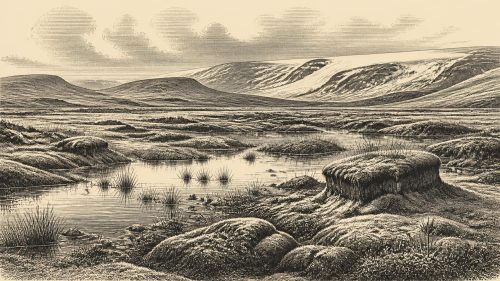
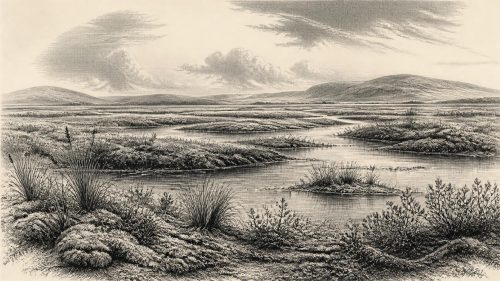
Evidence from the north adds environmental depth. At Derryvree and nearby sites in County Fermanagh, organic sediments survive between glacial deposits. They have yielded remains including mosses, sedges, bogbean, dwarf shrubs and insects. Their exact correlations and dates have been debated, but they are generally used to illuminate cold phases of MIS 3. Rather than presenting a uniform desert of ice, these buried deposits indicate episodes when freshwater pools, marshy ground and tundra-like vegetation existed within a landscape later overridden or bordered by glacier ice.
The Derryvree evidence is best read as a regional environmental archive, not as a diary of conditions in north Cork or proof that every part of Ireland was simultaneously ice-free. It nevertheless establishes an important point. The advance towards the Last Glacial Maximum was neither simple nor instantaneous. Ice margins fluctuated, and non-glacial habitats could exist during intervening periods. The later maximum expansion of the British-Irish Ice Sheet is generally placed around 27,000–21,000 years before present, while its build-up began after roughly 35,000–32,000 years before present. Ireland around this article’s notional date was therefore approaching a major reorganisation of its climate and landscapes, not yet living in the final full-glacial world.
Crag Cave in County Kerry provides another kind of climatic evidence. Speleothems, the calcite deposits formed by dripping water in caves, grew only when liquid water could penetrate the ground and cave conditions permitted mineral deposition. Uranium-series dating of such formations offers an independent way to study environmental change. It does not supply a weather report for 31,252 BCE, but it reinforces the wider conclusion that the Irish climate of this period was variable rather than permanently static.
People: Possibility, Not Population
The possible Castlepook cut mark must be judged against the very sparse Irish Palaeolithic record. The later cut-marked brown-bear patella from Alice and Gwendoline Cave in County Clare is directly dated by two determinations to about 12,810–12,590 and 12,810–12,685 calibrated years before present. That find is widely treated as the earliest secure published evidence for human presence in Ireland. Its reliability does not disprove an earlier Castlepook visit; rather, it defines the difference between a well-dated later indication and a much earlier, more provisional claim from a complex cave collection.
Substantial evidence for enduring post-glacial settlement appears only much later, in the Mesolithic, conventionally from about 8000 BCE. There is no demonstrated continuity between any people who might have visited MIS 3 Ireland and those Mesolithic communities. Later glaciation would have eroded, buried and rearranged much of the earlier landscape, including possible coastal sites now submerged or destroyed. This helps explain the archaeological silence, but it cannot be used as licence to fill the silence with imagined camps, clans or migrations.
For society, culture and belief, restraint is essential. No Irish artwork, ornament, ritual deposit, grave or dwelling can presently be assigned to around 31,252 BCE. Upper Palaeolithic people elsewhere in Europe possessed sophisticated technologies, social relationships and symbolic traditions, but Irish evidence does not allow those practices to be transferred automatically across the sea. At most, the Castlepook femur raises the possibility that people capable of using a sharp lithic edge briefly entered or operated within this northern Atlantic landscape.
An Ice-Age Threshold
The historical importance of this point lies not in a named event but in the scale of the question it poses. Around the early thirty-second millennium BCE, Ireland was a climatically unstable, seasonally severe and ecologically changing place. Its caves preserve the remains of animals adapted to open cold environments; Fermanagh sediments preserve wetland vegetation and insects between glacial episodes; and a reindeer bone from Castlepook may retain a human-made trace. The evidence supports an Ireland capable of sustaining cold-stage fauna and perhaps receiving small human parties. It does not support a settled nation, a political history or a continuous Palaeolithic population.
That is a slender record, but not an empty one. The marked femur, cave fauna and buried wetlands make this a crucial threshold in Irish deep history: a period in which the island’s potential human past is visible only briefly, before advancing ice and the passage of millennia obscure almost everything else.
Primary Sources
- A Reconsideration of the Radiocarbon Dating of the Marine Isotope Stage 3 Fauna from Southern Ireland
- Heritage Artefacts of County Cork
- The Irish Quaternary Fauna Project
- Figure 6.— The Subdivision of the Quaternary Period in Ireland
- The Mesolithic in Ireland: When Was It?
- Extent and Timing of the Last Glacial Maximum (LGM) in Britain and Ireland: A Review
- Pattern and Timing of Retreat of the Last British-Irish Ice Sheet
- The Last Irish Ice Sheet: Extent and Chronology
- Late Pleistocene Chronostratigraphy and Ice Sheet Limits, Southern Ireland
- Response of the Irish Ice Sheet to Abrupt Climate Change During the Last Deglaciation
- Last Glacial Maximum Cirque Glaciation in Ireland and Implications for Reconstructions of the Irish Ice Sheet
- Trimlines, Blockfields and the Vertical Extent of the Last Ice Sheet in Southern Ireland
- Maximum Extent and Dynamic Behaviour of the Last British-Irish Ice Sheet West of Ireland
- Radiocarbon Constraints on the Age of the Maximum Advance of the British-Irish Ice Sheet in the Celtic Sea
- Dating Constraints on the Last British-Irish Ice Sheet: A Map and Database
- Mammoth and Musk Ox ESR-Dated to the Early Midlandian at Aghnadarragh, County Antrim, Northern Ireland, and the Age of the Fermanagh Stadial
- The IntCal20 Northern Hemisphere Radiocarbon Age Calibration Curve (0–55 cal kBP)
- First Evidence of a Late Upper Palaeolithic Human Presence in Ireland
- New Insights on the Fauna of Ireland’s Younger Dryas and Early Holocene from Alice & Gwendoline Cave
- Dimensions and Chronology of the Last Ice Sheet in Western Ireland
- The Late Quaternary History of East-Central Ireland
- Landscapes and Environments of the Last Glacial-Interglacial Transition: A Time of Amazingly Rapid Change in Ireland