
Fermanagh Between the Tills31679 BCE
Around 31,679 BCE, Ireland lay within a cold, unstable Late Pleistocene interval, rather than a precisely datable historical year. Evidence from Derryvree, County Fermanagh, shows freshwater sediments, tundra-like vegetation and insects preserved between glacial tills, demonstrating local ice-free conditions before later ice advance. Castlepook Cave, County Cork, contains remains of mammoth, reindeer, bears, wolves, foxes and hyenas, indicating changing open-country fauna. A cut-marked reindeer bone may suggest human activity around 33,000 years ago, but remains inconclusive. No secure evidence establishes permanent Palaeolithic settlement, political societies, farming, language or culture. Ireland’s record is geological, ecological and fragmentary in character and scope.
Dateline
The label 31,679 BCE is a modern chronological convenience, not a year that can be recovered from Irish evidence with calendar-like precision. It corresponds approximately to 33,628 calibrated years before present (cal BP, with “present” conventionally fixed at AD 1950). At this depth of time, radiocarbon measurements must be calibrated and normally produce ranges rather than a single date. The responsible subject is therefore not an event in one Irish year, but the Late Pleistocene world broadly surrounding it: a cold, unstable interval within Marine Isotope Stage 3, before the fullest expansion of the last British–Irish Ice Sheet.
Ireland then had no recorded names, rulers, peoples, frontiers or calendar. Nor can archaeology identify a polity, a diplomatic relationship, a battle, a religion or a language. What can be investigated is more fundamental: whether parts of the island were ice-free, what plants and animals occupied them, how caves and sediments accumulated, and whether the faintest traces point to human visitors. The evidence is fragmentary, often recovered long ago, and frequently disturbed by water, frost, scavengers and later glaciation. Its value lies precisely in the way it sets limits on what can honestly be said.
An Interval, Not an Anniversary
The date belongs to the later part of the last Ice Age, but it should not be imagined as the familiar image of an island uniformly buried beneath ice. The maximum extent of the last Irish ice sheet came later. Research on the British–Irish Ice Sheet places its broad maximum on the Irish shelf and mainland chiefly between roughly 27,000 and 23,000 cal BP, although ice advance was asynchronous in different regions. Around 33,600 cal BP, glaciers and ice caps were important and growing features of the north-west European world, yet Ireland’s environmental history was locally varied.
This distinction matters. A layer of till records an advancing or overriding glacier; an organic bed between tills can preserve a period when a particular place supported water, vegetation and animal life. It does not mean that the whole island enjoyed the same conditions at the same moment. Nor can a date from one bone or peat layer turn into a national weather report. The Irish record is instead a mosaic of surviving windows, separated by large areas where later ice erosion removed or scrambled evidence.
The modern dating language is itself a safeguard. “Radiocarbon years before present” are not identical to calendar years because atmospheric carbon-14 levels have changed through time. The IntCal20 calibration curve allows researchers to translate measurements into probability ranges, but uncertainty remains, especially this far back. Thus 31,679 BCE should be read as a point within a millennial-scale horizon, not as a dated episode in which an identifiable Irish community did something memorable.
Derryvree’s Buried Wetland
The clearest Irish environmental evidence relevant to this broad horizon comes from Derryvree near Maguiresbridge, County Fermanagh. There, freshwater organic sediments and silts were found sandwiched between an older lower till and a later upper till inside a drumlin sequence. The placement is crucial: it demonstrates that, between phases of glaciation, this locality possessed a non-glacial freshwater environment capable of preserving plant and animal remains before subsequent ice sealed it beneath glacial sediment.
The Derryvree deposit has traditionally been assigned to the Middle Midlandian, the Irish term for part of the last cold stage, and has a reported radiocarbon determination of about 30,500 radiocarbon years BP. That is not a precise equivalent of 31,679 BCE, and the relationship between old radiocarbon dates, calibration and regional ice advances must be handled carefully. Nevertheless, its flora, insect evidence and stratigraphic setting illuminate the kind of Irish landscape that existed during the wider middle part of the last glaciation.
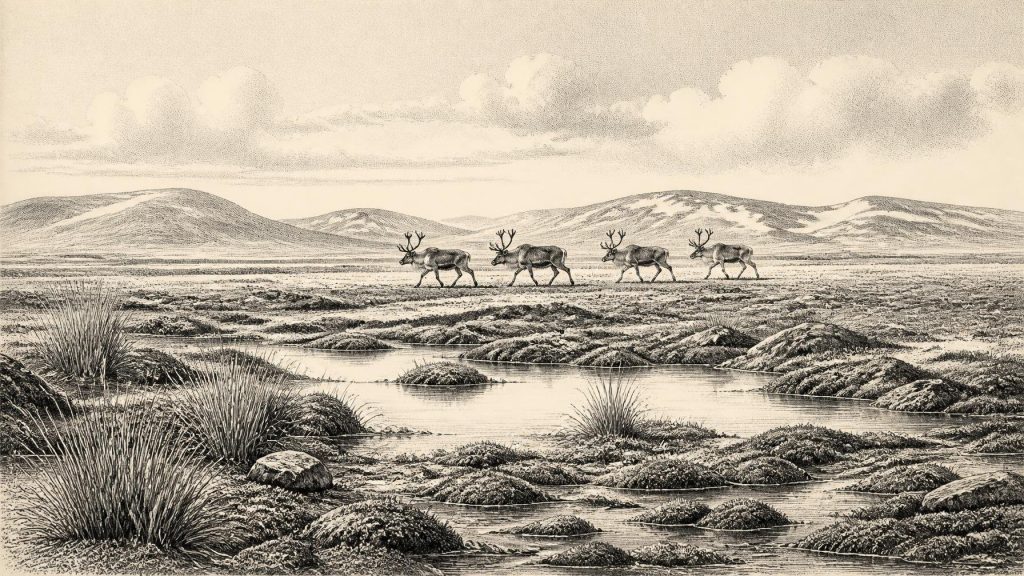
It was an open, cold and largely treeless environment, not a landscape of oak woods, hedged fields or familiar bog pasture. Mosses, sedges and aquatic plants indicate wet ground, pools and sluggish freshwater. Fossil evidence has been associated with plants such as bogbean, water-milfoil, lesser clubmoss and Irish saxifrage, species or relatives of species adapted to open, moist and often cold conditions. Insect remains likewise point towards a northern, periglacial climate. The term muskeg has sometimes been used as a useful modern comparison: waterlogged, mossy and sedge-rich ground, broken by shallow water, in a short-growing-season climate.
That comparison is an interpretation, not a literal reconstruction. Derryvree does not supply a complete view of every season, nor an exact map of local vegetation. It does show, however, that parts of Ireland could sustain freshwater habitats and tundra-like plant communities in the broad era before later ice became dominant. The later upper till both ended the local record and helped preserve it: a reminder that ice destroyed much evidence while also sealing a few exceptional archives.
Animals of the Cork Caves
For large mammals, Castlepook Cave near Doneraile in north County Cork is indispensable. Antiquarian excavations there, published in 1918, produced an extraordinary but difficult cave assemblage. Subsequent work on the Irish Quaternary Fauna Project showed that a wide range of mammals reached Ireland at various points between at least about 45,000 and 20,000 years ago. Castlepook is especially associated with remains of woolly mammoth, reindeer, brown bear, wolf, fox and spotted or cave hyena.
This is strong evidence that Ireland was not biologically empty throughout the last cold stage. Reindeer and other grazing animals could occupy open country when conditions and routes permitted; large carnivores followed prey or used caves as refuges and dens. Mammoth remains indicate that animals of the wider north-west European cold-steppe fauna reached the island at some stage. Hyena material is especially important because hyenas can accumulate bones in dens, carry in prey parts, gnaw and digest bone, and mix remains gathered at different times.
Consequently, Castlepook’s faunal list must not be treated as a single herd and predator group observed together in 31,679 BCE. Individual specimens carry different dates, and cave deposits can be palimpsests created over many millennia. Water movement, roof collapse, carnivore activity and early excavation methods further complicate original associations. The cave offers persuasive evidence for a changing Ice Age animal world in Ireland, but not a precise census of north Cork in one season.
The cave also corrects a modern misconception embedded in the phrase “Irish elk”. The giant deer later famous from Irish fossil finds was not the defining evidence for this particular interval. The better-supported picture around the broader Middle Midlandian is of open habitats capable of supporting mobile cold-climate fauna, with reindeer, mammoth and carnivores among the animals documented at different times in the cave record. Their movements depended on changing ice margins, vegetation, weather and access across the surrounding shelf and seaways.
The Human Question
One Castlepook reindeer femur has been presented in recent public reporting as bearing a deep fresh-bone incision consistent with cutting or chopping by a sharp stone implement, and as dating to roughly 33,000 years ago. If the mark is accepted as anthropogenic and contemporary with the animal’s death, it would be potentially momentous: evidence that people handled a reindeer carcass in Ireland far earlier than the island’s long-established post-glacial archaeological record.
That possibility should neither be dismissed nor overstated. The femur derives from an old cave collection rather than a modern excavation of an intact occupation floor. A radiocarbon result dates the animal bone, not automatically the act that produced a mark, the identity of the marker, the place where the animal died, or the duration of a human visit. No securely associated Upper Palaeolithic stone-tool assemblage, hearth, dwelling, burial, art panel or settlement surface has yet been published from Castlepook for this age. The National Museum of Ireland accordingly continues to state that clear evidence for Palaeolithic human presence in Ireland has not emerged.
The most careful conclusion is that a brief human incursion is possible, and the marked reindeer bone may prove to be a significant clue. It does not demonstrate a permanent population, a continuous occupation from the Palaeolithic to later Ireland, or membership of a named archaeological culture. Nor does it permit claims about kinship, leadership, ritual, trade networks or warfare. If people did reach the island, comparison with Upper Palaeolithic groups elsewhere in north-west Europe suggests highly mobile hunter-gatherers using perishable equipment and stone-edged tools; that is a reasoned comparison, not direct evidence of an Irish camp.
What Cannot Yet Be Written
There were no Irish states, kingships or diplomatic systems that archaeology can identify at this date. There is no evidence for organised conflict, territorial government, farming, herding, pottery production, metalwork, formal trade, literacy or monuments. There is equally no evidence from which to reconstruct religious observance, stories, music, teaching or language. The absence of such evidence does not prove that any possible visitors had no beliefs or social relationships. It means only that the surviving Irish record cannot describe them responsibly.
Economically, the securely evidenced activity is ecological rather than human: freshwater plants grew, large herbivores found usable open ground, and carnivores exploited animal carcasses and caves. If the Castlepook incision is verified, it would add one narrow human action—processing a reindeer carcass—to that picture. It would not establish regular hunting grounds or exchange routes. Even access to Ireland remains a question requiring caution, because sea level, ice margins and coastlines changed substantially, while potential coastal evidence has often been submerged, eroded or buried.
For 31,679 BCE, then, Irish history survives not as a chronicle but as an argument from sediments, bones and geological sequences. Fermanagh preserves the image of cold freshwater ground between advancing ice sheets; north Cork preserves animal remains from a wider Pleistocene world and a provocative, unresolved possible human trace. Together they reveal an Ireland that was environmentally alive, climatically precarious and archaeologically elusive—an island whose later glacial transformation would conceal much of the evidence needed to tell a fuller human story.
Primary Sources
- Early Midlandian–Middle Midlandian, Pleistocene, Northern Ireland
- A Middle Midlandian Freshwater Series at Derryvree, Maguiresbridge, County Fermanagh, Northern Ireland
- Figure 6.— The Subdivision of the Quaternary Period in Ireland
- References and Recommended Reading
- The Irish Quaternary Fauna Project
- The Exploration of Castlepook Cave, Co. Cork. With 3 Plates.
- Spotted Hyena Skull
- Castlepook Cave (Mammoth Cave)
- Pleistocene Vertebrates in the British Isles
- Late Pleistocene Chronostratigraphy and Ice Sheet Limits, Southern Ireland
- Dimensions and Chronology of the Last Ice Sheet in Western Ireland
- Growth and Retreat of the Last British–Irish Ice Sheet, 31,000 to 15,000 Years Ago: the BRITICE-CHRONO Reconstruction
- Timing and Pace of Ice-Sheet Withdrawal Across the Marine–Terrestrial Transition West of Ireland During the Last Glaciation
- The Deglaciation of the Western Sector of the Irish Ice Sheet From the Inner Continental Shelf to its Terrestrial Margin
- New Data for the Last Glacial Maximum in Great Britain and Ireland
- Ireland: Submerged Prehistoric Sites and Landscapes
- The IntCal20 Northern Hemisphere Radiocarbon Age Calibration Curve (0–55 cal kBP)
- Prehistoric Details
- Stone Age
- First Evidence of a Late Upper Palaeolithic Human Presence in Ireland
- First Evidence of a Late Upper Palaeolithic Human Presence in Ireland
- The Mesolithic in Ireland: When Was It?
- Introduction to the Glacial Sand and Gravel Landscapes of Northern Ireland
- The Geological Heritage of County Leitrim