

Bogbean Below the Drumlin31509 BCE
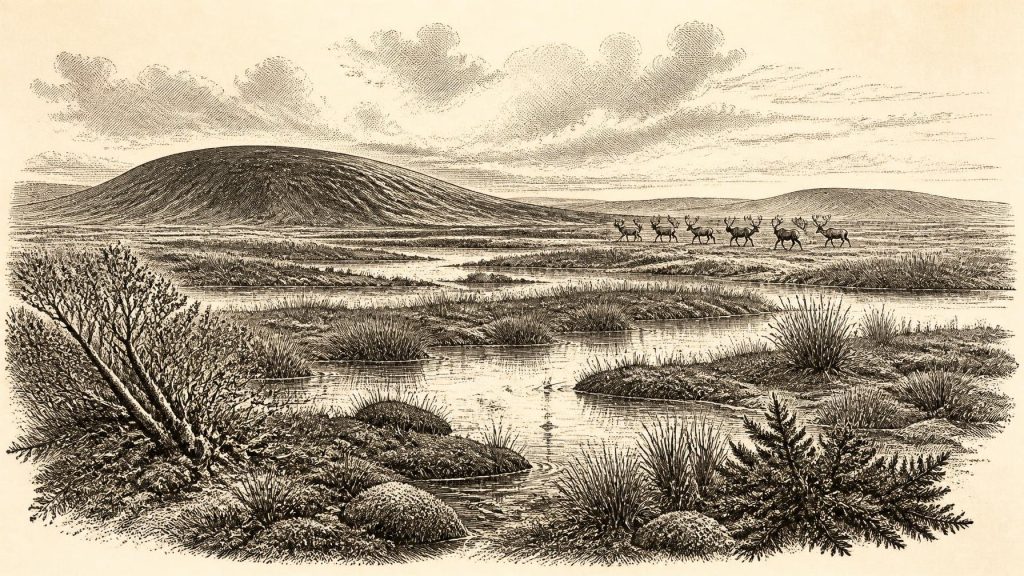
About 31,509 BCE is an archaeological horizon, not a recorded Irish date. At Derryvree, County Fermanagh, organic silts beneath glacial till, broadly dated to 36,900–31,700 calibrated BP, preserve an ice-free periglacial wetland of sedges, grasses, mosses, juniper, dwarf willow and bogbean. Castlepook Cave, County Cork, documents a diverse Marine Isotope Stage 3 fauna, including reindeer, mammoth, giant deer, predators and lemmings. A possible stone-tool mark on a reindeer bone may indicate exceptionally early human butchery, but proves neither settlement nor sustained occupation. Subsequent ice-sheet expansion transformed habitats, while changing seas and terrain complicated animal and potential human movement across Ireland.
Dateline
Modern calendar precision cannot responsibly be applied to Ireland in 31,509 BCE. The number is a useful point of orientation, not the date of a recorded event: no written record, settlement sequence or securely dated human activity allows historians to describe a particular Irish year so far back. In conventional conversion it sits roughly 33,458 calendar years before AD 1950, the reference point used in radiocarbon reporting. The responsible approach is therefore to examine the broader archaeological and environmental window around it: the later part of Marine Isotope Stage 3, within the long last glacial cycle.
A Date Within a Range
The closest important Irish environmental record is at Derryvree, near Maguiresbridge in County Fermanagh. Roadworks through a drumlin exposed freshwater silts and fine sands trapped between two distinct layers of glacial till. Their organic material produced the conventional radiocarbon determination BIRM-166: 30,500 radiocarbon years BP, with a substantial uncertainty range. Radiocarbon years are not calendar years. Because atmospheric carbon-14 has varied over time, such measurements must be calibrated against independently dated records; calibration also produces ranges rather than a single pinpoint date.
Published discussion places the Derryvree evidence broadly within approximately 36,900–31,700 calibrated years BP, or roughly 34,950–29,750 BCE. That wide interval encompasses 31,509 BCE, but it does not show what happened in that numbered year. Nor should the deposit be mistaken for an annual layer. It represents sediment accumulating over time in a cold landscape, later overridden or sealed by ice. Its importance is precisely that it preserves a rare interval when north-central Ireland was not beneath the ice that would subsequently reshape so much of the island.
A Tundra Wetland in Fermanagh
Derryvree was neither a familiar green Ireland nor simply an empty white wilderness. Plant remains, pollen, insects and other small fossils indicate an open, treeless tundra or muskeg environment. Sedges and grasses were important components, accompanied by herbs, mosses and low woody plants such as juniper and dwarf willow. A seed of bogbean, a plant associated with wet ground and shallow freshwater, is especially evocative: even in a severe climate, pools and saturated hollows supported particular aquatic and marsh vegetation.
The word muskeg is useful because it conveys a waterlogged mosaic rather than a uniform plain. Fine sediments accumulated in pools; plant matter gathered in wet ground; mossy surfaces and sedge-rich margins lay beside more exposed terrain. Insect evidence reinforces the picture of cold, open country and local standing water. The climate was periglacial: cold enough for frost processes and probably permafrost in places, but not one in which every part of the landscape was permanently covered by glacier ice.
Such evidence establishes environment, not an exact temperature or a fixed season. Scholars can infer harsh winters, short growing seasons and sparse tree cover, but cannot reconstruct the weather on a particular day in 31,509 BCE. Nor does the presence of bogbean mean that the whole island was wetland. It demonstrates instead that a suitable freshwater niche existed at Derryvree within a wider cold-stage setting. Ireland at this time contained sharply varying local environments, shaped by relief, drainage, exposure, ice margins and changing North Atlantic climate.
Animals in the Southern Caves
County Cork provides a complementary, though different, body of evidence. Castlepook Cave near Doneraile, also known as Mammoth Cave, has yielded an exceptional collection of Late Pleistocene animal remains. Reassessment and improved radiocarbon dating have shown that some of its fauna belongs to Marine Isotope Stage 3, before the Last Glacial Maximum. The assemblage includes reindeer, woolly mammoth, giant deer, brown bear, wolf, Arctic fox, mountain hare, collared lemming and spotted hyaena.
This is not a census of a single moment. The cave was investigated mainly in antiquarian excavations, its deposits were disturbed in places, and fossils need not all be contemporary. A cave can also collect bones through carnivore activity, natural deaths, water movement and later disturbance. Nevertheless, the faunal record shows that, during parts of this broader period, Ireland could sustain a striking cold-adapted animal community. Reindeer and lemmings point towards open, northern conditions; mammoths and giant deer indicate extensive grazing or mixed feeding opportunities; wolves and hyaenas reveal a predator and scavenger guild able to exploit large carcasses.
There was no political map behind this ecology. No chiefdom, border, alliance or war can be identified from the Irish evidence of this age. The meaningful territories were ecological ones: a wet hollow at Derryvree, limestone cave systems in north Cork, open feeding grounds, river corridors, and routes by which animals could move into or out of the island as sea level, ice and terrain changed. The later growth of the British–Irish Ice Sheet would disrupt these habitats dramatically.
The Human Question
The most tantalising evidence relevant to this era is a reindeer femur from Castlepook. A deep mark on the bone has been interpreted as having been made by a stone tool during the processing of a fresh carcass. The specimen has been publicly presented as about 33,000 years old, broadly around 31,000 BCE. If the interpretation of the mark is confirmed, it would be the earliest known sign of human activity in Ireland by a very large margin.
That conclusion remains deliberately narrow. A date on bone establishes the age of the animal’s death, while identifying a cut mark is a separate taphonomic judgement about what made the mark and when. Most importantly, Castlepook has not yet produced a securely associated stone-tool assemblage, hearth, floor surface, dwelling, human burial or stratified camp of the same age. One possible butchery mark cannot demonstrate permanent settlement, continuous occupation, a population size, a language, ancestry or a migration route.
If people did visit Ireland around this interval, their presence may have been brief, mobile and difficult to detect. They could have belonged to small Upper Palaeolithic hunting groups moving through the north-western European world, taking advantage of seasonal opportunities and large animals. That is an interpretation based on wider European archaeology, not something directly documented in Ireland. A reindeer could have offered meat, fat, hide, sinew, bone and antler, but the single specimen does not reveal which resources were taken or how a group organised its work.
Life Without a Visible Settlement
Accordingly, everyday life must be described mostly through limits rather than colourful invention. There is no Irish evidence from around 31,509 BCE for houses, clothing, boats, cooking methods, kinship rules, ritual places, music, images, formal learning or exchange networks. There is no basis for assigning people a tribal name or calling them the ancestors of later Irish communities. The Irish language, Gaelic society, farming, metalworking and monumental religion all belong to immensely later chapters of the island’s past.
Yet absence of evidence does not mean that nothing happened. It reflects the fragility of traces left by highly mobile people in a landscape repeatedly altered by glacial erosion, sediment movement, rising seas and later human activity. Organic camps, light shelters, hearths and small scatters of stone tools are much less likely to survive or be found than bones in a cave or organic silts sealed beneath a drumlin. The distinction matters: archaeology can explain why the record is thin without turning possibility into fact.
Ice, Water and Disconnection
At this point in the glacial cycle, Ireland was approaching a major environmental transformation rather than experiencing a stable age. Studies of the British–Irish Ice Sheet show expansion and reorganisation through the period leading to the global Last Glacial Maximum, conventionally placed about 26,500–19,000 years ago. The Derryvree deposit is therefore evidence for an earlier ice-free or lightly glaciated window, not proof that Ireland remained hospitable throughout the succeeding millennia.
Lower sea levels altered coastlines and connections, but they did not create a simple, permanent land bridge that can be assumed for every movement. Routes between Ireland, Britain and continental Europe depended on changing ice, sea, rivers, exposed shelves and local topography. Faunal arrivals prove that movement occurred at some stages; they do not identify a single route, nor do they establish human travel on the same path. The island’s position at Europe’s Atlantic edge made its animal and possible human populations especially vulnerable to climatic deterioration.
An Archive, Not an Anniversary
Ireland around 31,509 BCE is best understood as a scientific horizon rather than an anniversary. Beneath a Fermanagh drumlin, bogbean and sedges record cold freshwater ground. In north Cork caves, bones preserve evidence of an Ice Age fauna far richer than the modern island’s wild mammals. A marked reindeer bone raises the profound possibility of an early human encounter with that world, but does not yet provide a settlement story. The period’s central historical fact is not a named event: it is the precarious coexistence of tundra wetlands, large mammals, carnivores, possible visitors and advancing ice at the far western edge of Europe.
Primary Sources
- A Middle Midlandian Freshwater Series at Derryvree, Maguiresbridge, County Fermanagh, Northern Ireland
- A reconsideration of the radiocarbon dating of the Marine Isotope Stage 3 fauna from southern Ireland
- The Irish Quaternary Fauna Project
- The IntCal20 Northern Hemisphere Radiocarbon Age Calibration Curve (0–55 cal kBP)
- Growth and retreat of the last British–Irish Ice Sheet, 31,000 to 15,000 years ago: the BRITICE-CHRONO reconstruction
- Exploring the retreat of the last British-Irish Ice Sheet across the North Channel, Irish Sea Basin and Celtic Sea
- Timing and pace of ice-sheet withdrawal across the marine–terrestrial transition west of Ireland during the last glaciation
- Dimensions and chronology of the last ice sheet in Western Ireland
- Vertical dimensions and age of the Wicklow Mountains ice dome, Eastern Ireland, and implications for the extent of the last Irish Ice Sheet
- Figure 6.— The subdivision of the Quaternary Period in Ireland
- Section 1: The Quaternary of Fermanagh
- Landscapes and environments of the last glacial-interglacial transition: a time of amazingly rapid change in Ireland
- BSBI: Menyanthes trifoliata
- Heritage Artefacts of County Cork
- The Mesolithic in Ireland: when was it?
- Ireland’s Palaeolithic Archaeology – Fleeting Footprints in a Frozen Land
- Mammoth Cave
- Occurrence of mammalia relicts at site Castlepook Cave
- Could brown bears (Ursus arctos) have survived in Ireland during the Last Glacial Maximum?
- New insights on the fauna of Ireland's Younger Dryas and Early Holocene from Alice & Gwendoline Cave
- Pleistocene vertebrates in the British Isles
- The nature of MIS 3 stadial–interstadial transitions in Europe: New insights from model–data comparisons
- UCD School of Archaeology Research Day 2022